1

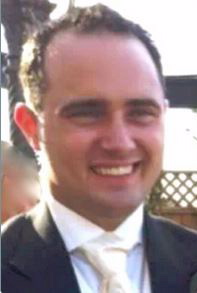
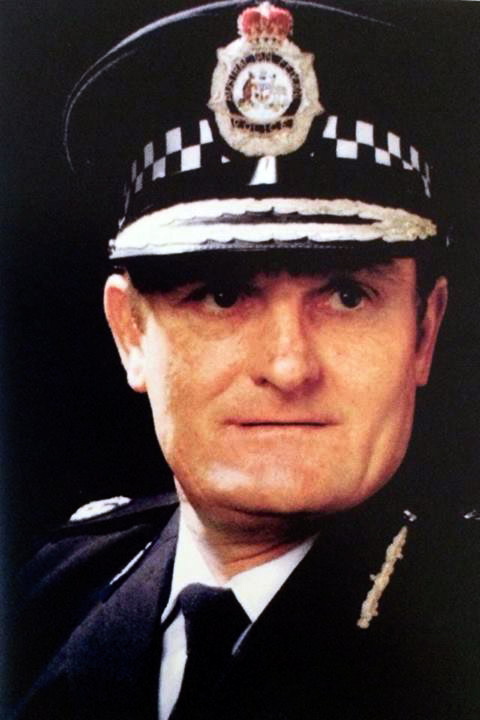
Adam DUNNING

Adam DUNNING

Australian Protective Services Officer ( A.P.S. )

Australian Federal Police, 29 March 2003 – 22 December 2004

RAAF Reservist, 1995 –

Regd. # ?

Rank:  PSO1 (Protective Services Officer )

Stations:  Solomon Islands, 4 October 2004 – 22 December 2004

Service:  From  29 March 2003  to  22 December 2004 = 1+ year Service

[blockquote]

Unit:  RAMSI

Regiment:  ?

Enlisted:  ?

Service #  ?

Rank:  ?

Embarkation:  ?

Next of kin:  ?

Religion:  ?

Single / Married:  ?

Returned to Australia:  ?

[/blockquote]

Awards:  Meritorious Unit Citation for work in East Timor.

Commendation for efforts in disarming a male carrying a replica pistol in Honiara Court.

Born:  ?

Died on:  Wednesday  22 December 2004

Cause:  Shot – Murdered

whilst deployed on official duties at Honiara, Solomon Islands

Age: 26

Funeral date:  Thursday  30 December 2004

Funeral location:  ANZAC Memorial Chapel,

Royal Military College, Duntroon, ACT

Buried at:  Cremated

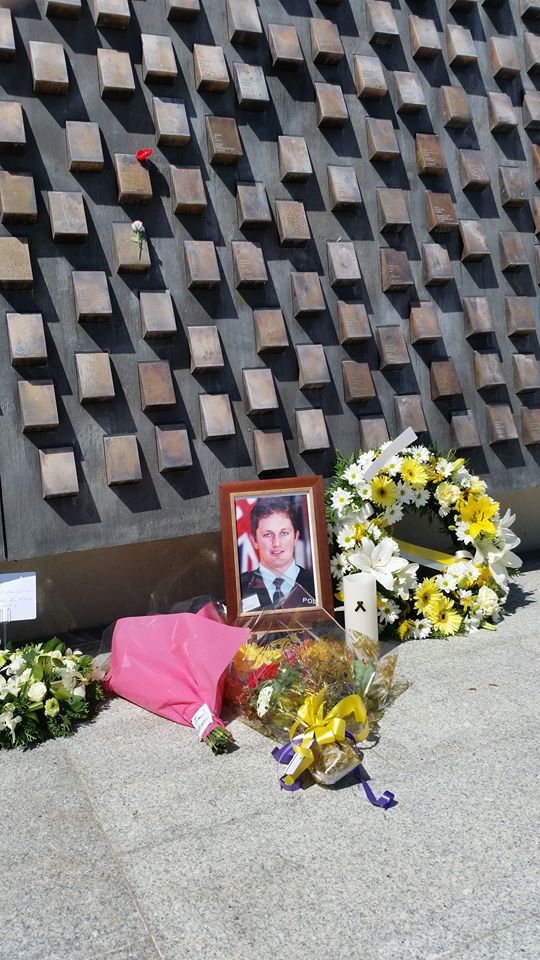
Memorial:  The main street of a new AFP training village in Canberra was named Adam Dunning Drive in his memory.
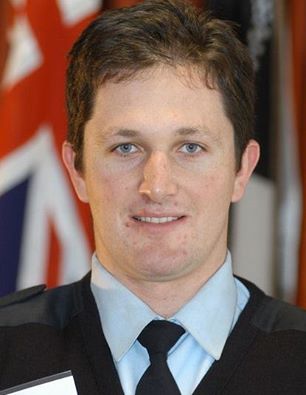
Adam DUNNING
Adam DUNNING

Adam IS mentioned on the Police Wall of Remembrance


Tears for the fallen as Adam comes home

By Craig Skehan and Aban Contractor
December 24, 2004
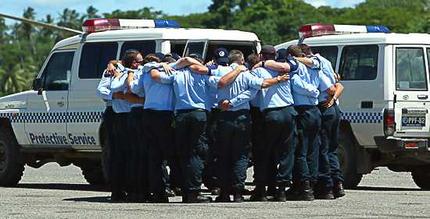
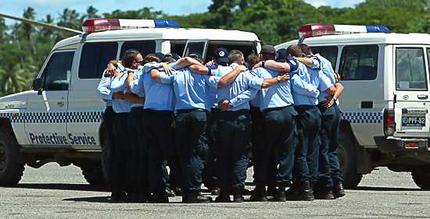
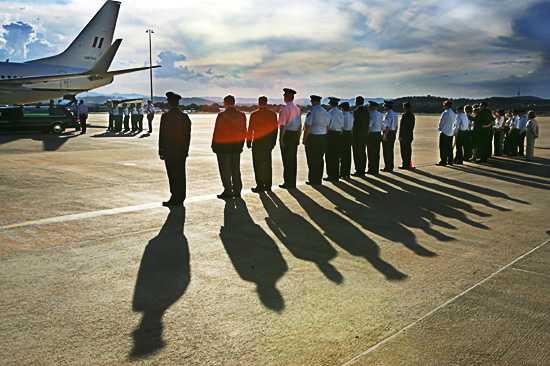
AFP officers farewell their mate Adam Dunning after loading his coffin into a RAAF jet at Honiara Domestic Airport.
AFP officers farewell their mate Adam Dunning after loading his coffin into a RAAF jet at Honiara Domestic Airport. Photo: Andy Zakeli


They had slow-marched their comrade’s casket to the plane that would take him home.

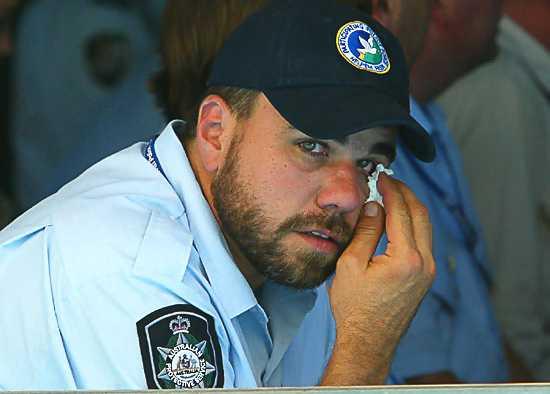
Their backs were straight, but the emotions were too much: tears tumbled down the cheeks of the Australian Federal Police pallbearers as they did Adam Dunning this last honour.

Then, once his body was stowed in the hold of the RAAF jet on the tarmac in Honiara, his mates made a last gesture of solidarity with the colleague they were farewelling forever – forming a circle, heads bowed, arms locked around each other’s shoulders.

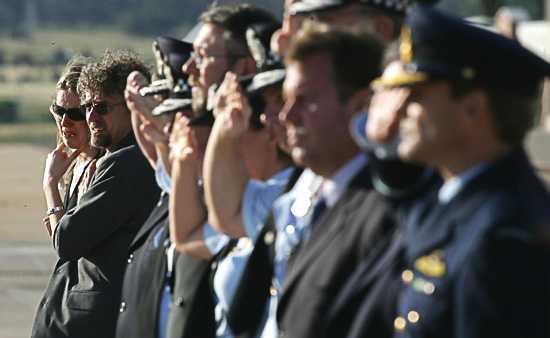
Adam Dunning, the 26-year-old AFP protective service officer who was killed by a sniper in the early hours of Wednesday morning, was accompanied home by the Minister for Justice, Chris Ellison, and the Opposition’s home affairs spokesman, Robert McClelland, but at Fairbairn air base in Canberra, where the RAAF 737 touched down just before 6pm, it was Mr Dunning’s family and friends – his parents, Michael and Christine, his sisters, Sarah and Emma, and his girlfriend, Elise Wiscombe – who formed the guard of honour.

Standing in two straight lines, they faced the plane.

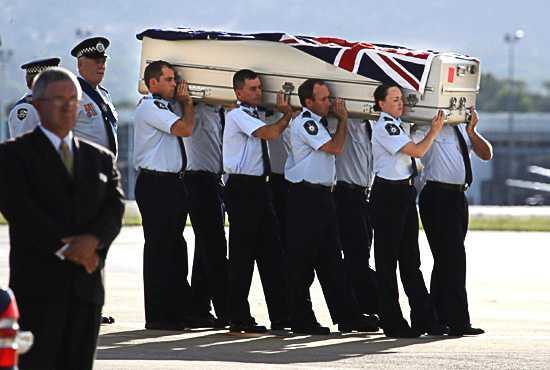
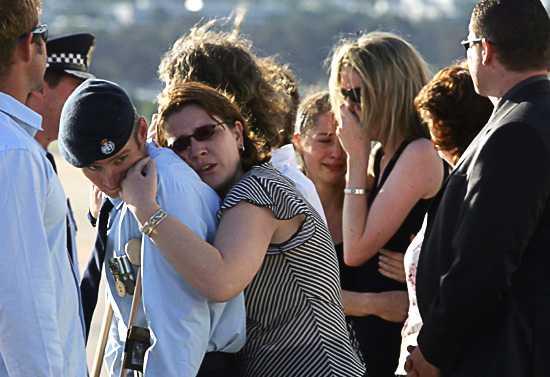
With the Australian Federal Police Commissioner, Mick Keelty, standing watch nearby, Mr Dunning’s parents held their heads high, and his sisters and Ms Wiscombe quietly sobbed as eight AFP pallbearers bore his flag-draped casket from the plane. His parents held hands and seemed to stand even straighter as their only son was placed in the hearse that would take him to the mortuary.

In the Solomons, police are questioning a taxi driver about several suspects in the murder. A Solomon Islands police source told the Herald that the taxi – seen near the murder scene with several passengers before the shooting – had been seized.

On a narrow, potholed road on the outskirts of the Solomons capital, Honiara, locals offered heartfelt apologies for the shooting.

“I am so very sorry,” said one young man. “He came here to help us.”

By the roadside at Zion Junction, investigating officers had cut the long grass to help search for clues to the identity of the person who, in darkness shortly after 3am on Wednesday, shot Mr Dunning while he was on patrol in a Toyota Land Cruiser.

Zion Junction does not have a particularly dangerous reputation. Rather, locals said, other settlements further along the same ridge were known for trouble, ranging from extortion to payback shootings.

Moffat Suiga, a community elder who was awakened by the shots that killed Mr Dunning, said he and others were at a loss to explain the murder.

A middle-aged businessman said the overwhelming majority of Solomon Islanders wanted to see those responsible put in jail. He said it would be a good thing if the Australian-led intervention force remained for the next 40 years.

At a commemoration service earlier in Honiara, Mr Keelty said Mr Dunning had “died for peace”.

The Solomon Islands Prime Minister, Sir Allan Kemakeza, said the young man had been helping the country overcome ethnic strife and crime. “We will not forget him,” he said.

A police funeral will be held for Mr Dunning on a day to be announced.

http://www.smh.com.au/news/World/Tears-for-the-fallen-as-Adam-comes-home/2004/12/23/1103391900411.html


adam-dunning-funeral


Offenders:  John Hen OME, 31 & James TATAU, 29


Location of Murder: 


Peacekeeper killed
ADG’s funeral brings Air Force and police together

By FLGOFF Fiona Peacock

The funeral of LAC Adam Dunning, a member of the PAF and Air Force Active Reserve.

The funeral of LAC Adam Dunning, a member of the PAF and Air Force Active Reserve.

LAC Adam Dunning.

LAC Adam Dunning.

LEADING Aircraftman Adam Dunning, an ADG with No. 28 (City of Canberra) Squadron and former member of No. 2 Air Field Defence Squadron, was killed in December last year while on operational duty with the Australian Federal Police as part of the Regional Assistance Mission to the Solomon Islands (RAMSI).

In the early hours of December 22, LAC Dunning and an Australian Protective Service colleague were on a routine vehicle patrol in Honiara, protecting the Prime Minister’s and Governor General’s residences.

A concealed gunman shot at the vehicle, fatally wounding LAC Dunning, who was 26.

He deployed to the Solomons in October and, after only six weeks there, was awarded a commendation for disarming a man in front of the Magistrates Court.

At LAC Dunning’s funeral, members of 28SQN played a part in recognising his Air Force service. The squadron’s honorary air commodore, Air Commodore Justice Terence Higgins, represented 28SQN among the official party of Service chiefs.

Members of the Air Field Defence Wing provided the firing party and the guard of honour for receiving VIPs. The RAAF Ensign was carried by Pilot Officer Shane McGaughey and was escorted by Flight Sergeant John Forth.

Two close friends of LAC Dunning, Leading Aircraftmen Tim Gresham and David Pauli, were members of the bearer party. The President of 28SQN Association, Steve Williams, represented former 28SQN members. 28SQN members joined AFP personnel to form a guard of honour.

AFP Commissioner Mick Keelty praised No. 34 Squadron for the way it handled bringing LAC Dunning’s body back to Australia.

http://www.defence.gov.au/news/raafnews/editions/4701/topstories/story03.htm


http://www.abc.net.au/news/2004-12-22/afp-officer-adam-dunning-was-murdered-while-on/606888


Family, friends, colleagues farewell peacekeeper

By Misha Schubert
Political correspondent
Canberra
December 31, 2004

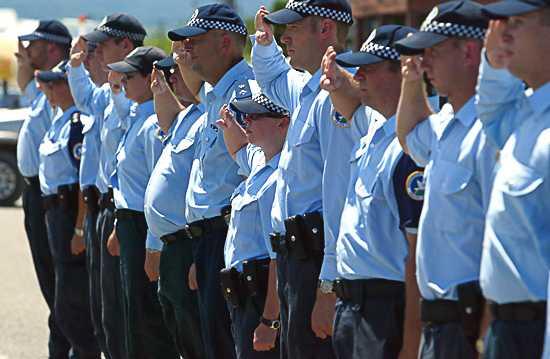
They stood side by side. Two long lines of blue uniforms facing each other along the tree-lined road. Like a slow Mexican wave, each snapped to attention and saluted as the body of one of their own passed by.

Adam Dunning, murdered by a sniper while on patrol in the Solomons early last week, had begun the last leg of his journey home.

Earlier, these men and women of the Australian Federal Police and the Royal Australian Air Force had wept openly as Mr Dunning was farewelled with full police and military honours in the Duntroon chapel. “He was a great man,” said his federal police mate Pat Castle.

The nation’s military chiefs turned out to pay tribute, as did Prime Minister John Howard, Governor-General Michael Jeffery and senior cabinet ministers.

But this ritual belonged to those who knew and loved Adam Dunning.

His mother, Christine, read from a tribute that she and her husband, Mike, had written to their son in February. They had praised his courage, sensitivity and mettle.

His partner, Elise, who had brought red roses for the man she had loved, said he was her greatest friend. “He was my strength, my inspiration, my love.”

Peacekeeper Beau Tennant, who was with Mr Dunning the night before he died, broke down as he recalled his friend’s generosity.

“Before he left me, his last words were: ‘Are you right for money mate?’ That was the kind of bloke he was,” he said.

Federal Police Commissioner Mick Keelty said Mr Dunning would live on in the memories of grateful Solomon Islanders.

“Adam Dunning died for peace and law and order. His work and his death will always be remembered by his colleagues,” he told mourners.

The federal police hope to build a memorial to Mr Dunning at their new training centre for overseas police peacekeepers.

Mr Dunning also served with RAAF in Timor before joining the AFP.

Police believe his murder and another attack on police on October 21 were carried out by three former members of the Malaitan Eagle Force militia.

They have charged two men – John Ome and Philip Kwaimani – over the attacks and are hunting James Tatau, who Mr Keelty said was present at both events and had access to a cache of weapons.

Police believe the trio were working on their own, with no sign of any broader uprising against the peacekeeping effort.

It fell to Emma, who had adored her older brother, to claim his service medals and caps from the flag-shrouded coffin and hand them to her grieving parents.

As his police mates carried Mr Dunning’s coffin from the chapel into the sunlight, drummers and bagpipers ushered him on his way. A police motorcade led the cortege through Canberra’s streets to a private service and cremation.

http://www.theage.com.au/news/National/Family-friends-colleagues-farewell-peacekeeper/2004/12/30/1104344927723.html


Body of sniper victim arrives in Canberra

December 23, 2004 – 7:54PM


A plane carrying the body of murdered Australian peacekeeper Adam Dunning has landed in his home town of Canberra.

The 26-year-old Australian Protective Services officer was shot twice in the back by a sniper while serving as part of a peacekeeping mission in the Solomon Islands yesterday morning.

Members of Mr Dunning’s family, and his colleagues were on hand to formally receive his body.

Australian Federal Police Commissioner Mick Keelty returned from the Solomon Islands about half an hour before the plane bearing Officer Dunning’s body landed.

He was among those waiting for Justice Minister Chris Ellison and Labor’s homeland security spokesman Robert McClelland, who accompanied the body on the flight back to Canberra.

Commissioner Keelty, Senator Ellison, Mr McClelland and AFP officers formed a guard of honour before the coffin was removed from the plane.

Family members, including Officer Dunning’s parents Mike and Christine, and girlfriend Elise Wiscombe, stood arm in arm watching proceedings.

A guard of honour, carrying Officer Dunning’s hat, led the flag-draped coffin to the hearse.

Eight pall bearers stood tall under the weight, as Officer Dunning’s police colleagues watched on.

A cavalcade of AFP motorcycles is waiting to lead the hearse to Canberra’s mortuary.

A full police funeral will be held for Officer Dunning on a day to be announced.

Officer Dunning’s parents took the time to thank those who attended the short ceremony before the hearse headed for Kingston mortuary under police escort.

Senator Ellison later said the Solomons people were behind RAMSI and Australia’s efforts to bring law and order to the country.

He said some adjustments might be made to the conduct of night patrols but any final decision would depend on recommendations from the AFP.

He denied the Government had too quickly reduced the AFP’s military support in the Solomons.

“We’ve made fantastic progress in the Solomons and we never underestimated the danger that our people faced,” he told ABC television

http://www.smh.com.au/news/World/Body-of-sniper-victim-arrives-in-Canberra/2004/12/23/1103391888916.html


More troops sent in as peacekeeper slain

By Craig Skehan and Cynthia Banham
December 23, 2004

Australia is rushing 100 extra troops to the Solomon Islands in defiant reaction to the sniper murder of Adam Dunning, the nation’s first peacekeeper to be killed by hostile fire.

The murder highlights the perils of the new interventionist role in the Pacific islands, but the Prime Minister, John Howard, vowed the mission to the Solomons would go on “undeterred, unrestrained, unaffected by what’s happened”.

“We won’t be cowed by this,” the Foreign Minister, Alexander Downer, added.

Mr Dunning, a 26-year-old Australian Protective Service officer from Canberra who had dodged bullets while serving in East Timor, was shot twice in the back while on a patrol in a four-wheel drives Toyota Land Cruiser in the capital, Honiara, at 3.10am on Wednesday. The bullets were among six shots fired rapidly from a high-powered military rifle.

“It looks as though the person who fired it had training in the use of such firearms,” a Solomon Islands official said.

Members of former ethnic militias – who had formed gangs and reduced the country to anarchy – are now being questioned. Australian investigators say the involvement of former Solomon Islands police officers, or an individual officer, cannot be ruled out.

At his Canberra home, Mr Dunning’s father, Michael, was distraught as he spoke of his son’s honourable death.

“It is sad as he cared for the [Solomons] people so much and was doing something really good on their behalf,” Mr Dunning told the Herald. “He always has been a decent person, tough and soft-hearted at the same time. He was totally honourable and very stubborn – nobody could make him do anything that he did not think was right. He was a credit to us.”

Adam Dunning had been planning a future with his 22-year-old girlfriend, Elise Wiscombe, on his return home next month. “I’m very, very proud of what he’s done over there,” she said. “He’s one of the greatest people I’ve ever met.”

Mr Dunning was part of the regional intervention force which has been seeking to stem ethnic and criminal violence in the Solomons since July last year.

A rapid-response, 100-member infantry company from the First Royal Australian Regiment was to leave Townsville on Thursday for the Solomons, just a day after the murder. The Defence Minister, Robert Hill, said: “This is to send a clear message to the thugs … that we will not tolerate the murder of our police officers.”

A meeting of departmental secretaries in Canberra recommended extra forces to support the 160 defence force personnel already there. Those troops are backing the 147 Australian Federal Police members who are serving in the Regional Assistance Mission to the Solomon Islands (RAMSI) – about 95 of them from the Australian Protective Service, which comes under the federal police. The Justice Minister, Chris Ellison, and the Federal Police Commissioner, Mick Keelty, flew to Honiara on Wednesday night. Australian forensic experts also flew in.

Mr Keelty said: “Over 4000 arrests have been made and over 3700 weapons have been seized [since the intervention began]. Clearly this indicates that there are some in the community in the Solomon Islands who are not happy about RAMSI’s presence.”

He said the hot tropical climate – and the large number of weapons already recovered – were among the reasons body armour had not been used for regular patrols. However, this is now under review.

Mr Keelty called Mr Dunning “a brave and courageous young Australian” and said his killing emphasised “the danger that our people face”.

The Solomons Prime Minister, Sir Allan Kemakeza, described the killing as barbaric and cowardly.

Mr Dunning’s partner on patrol, who had been driving, tried to resuscitate him.

The murder scene, on the outskirts of Honiara, was close to two settlements which are known to be frequented by former ethnic militiaman who formed criminal gangs.

The Australian police contingent has been at the forefront of efforts to clean up local police and officers have been charged with offences from corruption to assault and robbery. A number of local politicians are either under investigation or already facing various charges.

Mr Keelty said the ammunition used indicated the murder weapon was an SLR or possibly an AK-47. This was consistent with some of the weapons used before the arrival of the intervention force. The looting of many SLRs and other military-style weapons from Solomons police armouries had fuelled the five years of unrest that prompted the intervention of the Australian-led force.

There was a major riot at the Central Prison in Honiara this year, when inmates threw rocks at Australian personnel and painted anti-Australian slogans. Two months ago, an intervention force vehicle patrol was fired on.

http://www.smh.com.au/news/World/More-troops-sent-in-as-peacekeeper-slain/2004/12/22/1103391841939.html


Protective Service Officers were deployed along with other Australian law enforcement officers in the Solomon Islands as part of RAMSI. The peacekeeping force suffered their first casualty on 22 December 2004 when PSO1 Adam Dunning was shot and killed while deployed on official duties in the Solomon Islands. Two former members of a local militia were charged but acquitted of Dunning’s murder.[5] Officer Dunning was buried with full police honours.

The main street of a new AFP training village in Canberra was named Adam Dunning Drive in his memory.[6] The $2.8 million training facility at Mount Majura just outside Canberra, has been designed to replicate situations in regional countries to which personnel might be assigned.

https://en.wikipedia.org/wiki/Australian_Protective_Service


Dunning remembered in training complex

June 23, 2005 – 4:04PM

The main street of a new training village for Australian Federal Police and other personnel being sent overseas has been named after murdered peacekeeper Adam Dunning.

The $2.8 million training facility at Majura, just outside Canberra, has been designed to replicate situations in regional countries to which personnel might be assigned.

Prime Minister John Howard officially opened the facility on Thursday in the presence of police chiefs from across the country as well as from several regional nations.

Australian Protective Service officer Mr Dunning, 26, was fatally shot twice in the back while on night patrol in the Solomon Islands capital of Honiara in December.

He was serving as part of the Regional Assistance Mission to the Solomons.

His parents attended the opening of the village, through the centre of which runs a road now named Adam Dunning Drive.

“The loss of Adam Dunning signified that this is very dangerous work,” Justice Minister Senator Chris Ellison said.

 “That was the ultimate sacrifice paid in the course of his duties.”

Mr Howard said the new facility reflected the new security reality for Australia and its region.

“Events of the last five years have totally transformed both the demands and the expectations of the Australian community on the Australian Federal Police,” he told the gathering.

“In that five-year period we have seen the threatening arrival of international terrorism.

“We’ve (also) seen the emergence of an ongoing need on the part of this country, in cooperation with our friends in the Pacific region, to involve ourselves in the restoration of conditions of law and order and cooperation with police services and governments of those countries.”

The training village, to be used by a range of emergency services personnel as well as police, recreates the environment that police experience when on overseas missions.

Designed to reflect the streetscape of a small overseas township, it enables true-to-life scenario training which helps to prepare police for unknown and sometimes dangerous challenges.

It includes 18 buildings and structures including a corner store, a town hall, a police station, a school, a pub, a marketplace and even a cemetery, reflecting the fact that police are sometimes required to perform exhumations in the course of their work.

The spokesman said 124 personnel had already trained at the complex which was completed in March.
http://www.theage.com.au/news/National/Dunning-remembered-in-training-complex/2005/06/23/1119321840325.html


Gregory Joseph JENSEN

Gregory Joseph JENSEN

New South Wales Police Force

Redfern Police Academy – Class 203

( 1st Class at the new Goulburn Police Academy )

Regd. # 21470

Rank:  Commenced Training at Redfern Police Academy on Monday 7 May 1984

Probationary Constable – appointed 20 July 1984

Constable – appointed 20 July 1985

Constable 1st Class – appointed ?

Detective- appointed ? ? 1991

Senior Constable – appointed ? ? ?


Stations:  Regional Crime Squad, Nth West ( Parramatta ), ?


ServiceFrom:  7 May 1984   to  To? ? ?


Awards:  No Find on Australian Honours system


Born:  Thursday 25 July 1963

Died? ? ?

Cause:  Stomach Cancer – H.O.D.


Funeral date?

Funeral location?


Grave site location?


FURTHER INFORMATION IS NEEDED ABOUT THIS MEMBER


GREG IS Mentioned on the Police Memorial Wall, Sydney Police Centre, Surry Hills as of October 2022


25 October 2022

This afternoon, in a quiet and deeply-felt ceremony at the Sydney Police Centre, another thirteen names were added, and the memories of another thirteen dedicated NSW Police Force employees were honoured, at the NSW Police Force Service Memorial:
Detective Senior Constable Vaughan Anthony Hau
Detective Senior Constable Gregory Joseph Jensen
Senior Sergeant John Kelly
Senior Constable David John Koen (Ret’d)
Constable Joseph Lees
Senior Constable Matthew Joseph Rees
Senior Constable Caroline Roberts


http://www.smh.com.au/news/national/holding-judgement/2007/06/08/1181089328815.html?page=fullpage

June 9, 2007

It took up 451 hearing days, heard from 902 public witnesses and cost an estimated $64 million. Malcolm Brown reports on the Wood royal commission, 10 years on.


It began on June 15, 1995, when an unnamed Annandale detective jumped to his death from the seventh floor of a building, apparently through fear of the Wood royal commission. The detective’s suicide was followed by those of Ray Jenkins, a dog trainer (July 10), and Inspector Robert Tait, the acting patrol commander at Narrabri ( March 29, 1996 ). Nineteen days later a former Wollongong alderman, Brian Tobin, gassed himself.

On May 8 the same year, Peter Foretic gassed himself the day after giving evidence about paedophilia. On September 23, Detective Senior Constable Wayne Johnson shot himself and his estranged wife after being adversely named in the royal commission. On November 4, David Yeldham, a retired judge about to face the royal commission on questions of sexual impropriety, killed himself. A month later Danny Caines, a plumber and police confidant, committed suicide at Forster, on the North Coast.

Altogether, 12 people enmeshed in the Wood royal commission took their own lives. Scores of others were so profoundly affected by proceedings that their supporters and families believe it shortened their lives. A former detective, Greg Jensen, suffered a recurrence of the stomach cancer that ultimately ended his life, while another former detective, Ray McDougall, who faced the threat that commission investigators might expose his extramarital affair if he did not co-operate, succumbed to motor neurone disease.

There is no doubt that the Royal Commission into the NSW Police Service, headed by the Supreme Court judge James Wood, purged the force of a rollcall of rotters. A total of 284 police officers were adversely named, 46 briefs of evidence were sent to the Director of Public Prosecutions and by 2001 nine officers had pleaded guilty to corruption offences and three not guilty. Seven police officers received jail sentences, including the former Gosford drug squad chief Wayne Eade and a former chief of detectives, Graham “Chook” Fowler.

Several high-profile police ended their careers in disgrace, including Ray Donaldson, an assistant commissioner, whose contract was not renewed, and Bob Lysaught, the commissioner’s chief of staff, whose contract was torn up. Charges against 14 officers were dismissed because of irregularities in search warrants and their execution.

That left the question of what to do with police who were on the nose but who could not be brought to account by normal means. The solution was the creation of section 181B of the Police Service Act, under which the police commissioner could dismiss an officer on the basis of what had come out of the royal commission. Section 181D allowed the police commissioner to serve an officer with a notice indicating that he “does not have confidence in the police officer’s suitability to continue as a police officer”. The officer could show cause as to why he should be retained, and if dismissed could appeal to the Industrial Relations Tribunal.

In the wake of the two legislative changes, 380 officers were targeted for dismissal or internal investigation. By March 1998, 19 police officers had been dismissed under section 181B and three under 181D. Another had been dismissed under a separate provision of the act, 14 had resigned, four had been medically discharged and 15 had been given performance warning notices. Others were under consideration, and as the Police Integrity Commission – a legacy of the royal commission which became a permanent watchdog – has demonstrated, even officers who had been corrupt many years before were not necessarily in the clear.The former independent MP John Hatton, who was instrumental in setting up the royal commission, said he thought the Police Integrity Commission was the royal commission’s “greatest achievement”. The Child Protection Enforcement Agency, which launched a purge of sex offenders, is another positive legacy of the royal commission.But 10 years on, was the exercise worth it?To some there were considerable benefits. Some appalling malpractice – known as “process” or “noble cause” corruption – prompted Wood to wonder at one point about the quality of a lot of police evidence he had accepted over the years.Despite this, many officers still believe the royal commission was too puritanical. They claim the investigators, not able to grapple with the really big issues, jumped on anything they could: “They had to have runs on the board,” says Michael McGann, who as a policeman in 1984 participated in the so-called Kareela Cat Burglar case, in which police used mace on an uncooperative thief and sex offender. To some critics this treatment did no serious harm and only required a word of caution. But under the spotlight of the royal commission 12 years later, it ended the careers of high-flying police such as John Garvey, Brian Harding and Steve York. A decade later, Harding works in corporate security but insists that the real sting was that the investigators had fabricated evidence. When that finally came out, he says, the group received a confidential settlement, but it did little to redress the feelings of outrage.

Another former policeman, Dr Michael Kennedy, says the commission was a political response to the police commissioner, Tony Lauer, bringing about the downfall of the then police minister, Ted Pickering.

The attorney-general, ministry and judiciary took little responsibility for the state of the force, Kennedy says, while the responsibility of the police rank-and-file grew to “the size of a Pacific driftnet”. “I don’t think the royal commission contributed anything to the reform process except to provide a template for double standards,” he says.

Chook Fowler put $200 into his pocket from Louis Bayeh. Chook was a lazy, good-for-nothing drunk. But he was put into the same category as Ray Williams and HIH.”McGann says that against the string of petty corrupt activities uncovered, “you have to look at what the government did and did not do with gambling and vice, over the decades. There have been direct links to Parliament for 50 or 60 years. That is hypocrisy.”The critics’ view is that the royal commission has left a demoralised police force, tarnished and rudderless, with limited operational effectiveness and the problem of corruption unsolved. Seven police officers have taken their lives since 2001, including two this year.”It highlights the fact that the structure no longer takes in the needs of the NSW police force,” says Mike Gallacher, the Opposition police spokesman, and a former internal affairs police officer. Gallacher believes, as does the NSW Police Commissioner, Ken Moroney, that the tentacles of corruption no longer spread to embrace entire squads or larger units. But it does not prevent low-level incidents of corruption and there are continuing nests of corruption.In its most recent report, the Police Integrity Commission said it had undertaken 21 major investigations in 2005-06. These dealt with extortion, theft, unauthorised disclosure of confidential government information and perverting the course of justice, police brutality and the handling of $250,000 stolen from automatic teller machines. The then police integrity commissioner, Terry Griffin, said there had been 51 investigations in the 12 months, compared with 44 in 2004-05, and the 1141 written complaints represented a 15 per cent increase. Moroney says all these reports are disappointing, but one of the significant statistics was the number of police who were reporting on other police. “You go back a decade and the number of informants who were police was 5 to 10 per cent,” he says. “In the Ombudsman’s last report, that figure was 49 per cent.”The mechanism for dealing with internal complaints has been expedited: “I have not been afraid to use a section 181D notice,” Moroney says.He believes there is a different mentality in the force. A video of the royal commission had been shown at a recent reunion dinner of the old criminal investigation branch. “It is part of our history. But the interesting thing is that when Chookie came onto the screen, everyone booed. That was a signal to the Fowlers and the Eades that those found to have acted corruptly would not be accepted.”
However, Moroney accepts that corruption is not a thing of the past. “In the contemporary period, there are huge monies to be made from the illicit drug environment. You are talking in some cases of millions of dollars. It is the greatest menace in society today. And the greatest menace to officers is drug money. That is why rotation of officers out of specialist squads on a regular basis is important.”Taking over as commissioner five years ago, he had brought a low-key “Uncle Ken” influence, sorely needed, and had had to balance the principles of police accountability against the public demand for law and order, and the task has been awkward.A senior counsel told the Herald this week that the focus on integrity, scrutiny of professional standards and attacks by defence lawyers meant that talented police prepared to do the dirty work were deterred. “In the old days the best and the brightest went into plain-clothes,” he said. “But when the police perceive that when they have to go the extra yard [to get convictions], they are crucified – ‘Why should I go to plain-clothes when I can just get some uniform job with a 12-hour shift, and a second job?”‘Clive Small, a former assistant commissioner who set up crime agencies and established the child protection unit, says that after so many detectives were disgraced in the royal commission, the police force sought to take the spotlight off detectives and put more of the onus of responsibility for crime control onto local area commands. Crime agencies had a continual battle to keep up to strength. Regionalising responsibility for crime control reflected a lack of understanding. “A lot of crime spreads through the metropolitan area, across the state and across the nation,” he says.Kennedy, now a university lecturer, says the “business model” approach is incompatible with good police work. “We cannot expect police to behave like they are in the private sector, where competence is measured in terms of productivity,” he says.Kennedy attended the recent CIB reunion dinner and sat at a table with former drug squad detectives who remained friends of Wayne Eade. He takes issue with Moroney‘s claim that people at the dinner made catcalls when Fowler came on screen. “No one supported Chook,” he says. “But the animosity of the crowd was directed straight at Justice Wood and his commission.”Clive Small, who was also at the dinner, says: “I think it is really a matter of interpretation who they were booing. There were things the royal commission did not take care about. There was a lot of collateral damage. And the implementation [of its recommendations] has been pretty ordinary.”

CRUSADER WHO MADE THE CALL

JOHN HATTON well remembers the audience on May 11, 1994, when he made his speech calling for a royal commission into the NSW Police Service. MPs were listening, of course, but it was a gallery above him, packed with the “top brass of the police force – the commissioner himself, the deputy commissioner, superintendents – they were an intimidating force on the Parliament”.

“They thought they could stare down the Labor Party support for my motion,” Hatton, now retired, says. “It was probably the best indicator of the way in which the police force thought they could control the agenda.”

Hatton won the day, putting paid to a claim by then police commissioner, Tony Lauer, that “systemic corruption” was “a figment of the political imagination”. Hearings started on November 24, 1994, and Justice James Wood delivered his final report on August 26, 1997.

Ten years later, Hatton believes he was vindicated. He says Wood was “the right man” to head the commission and the recruitment of interstate police was crucial, along with the decision to use phone taps and surveillance.

The 11 volumes of material Hatton gave the royal commission had been accumulated over 14 years, he says, from the time he had first spoken up. He had received information on illegal gambling, drug trafficking and police involvement with the mafia.

There had been earlier moves to address police corruption, including inquiries by the Independent Commission Against Corruption, but these had only scratched the surface. “I can remember on one occasion I reported a death threat which had to do with the McKay murder in Griffith and 48 hours later the bloke who had given the information was threatened by a shotgun at his door in Queensland,” Hatton says.

The royal commission came into being because Hatton and other independent MPs held the balance of power in Parliament. The Labor Party may have had high public motives, but also saw a chance to attack the Fahey government. Labor stipulated that an inquiry into police protection of paedophiles, previously in the hands of the ICAC, become part of the royal commission.

The process of gathering information was helped greatly by Trevor Haken, a detective who became an informer and covert investigator as part of a deal to avoid being prosecuted himself.

Hatton says Haken‘s entry was “out of the blue”. Though useful, in the long term it had had a detrimental effect on the fight against corruption. Living in fear and watching his back, Haken had provided “the greatest disincentive for someone coming forward to finger corruption in the system”.

Malcolm Brown


Evan Barry HEINJUS

Evan Barry HEINJUS

New South Wales Police Force

Regd. # 25954

Academy Class 237 ? or 238 ?

Senior Constable

Stations:  Wagga Wagga G.D’s & HWP in 1995, Tarcutta HWP ( paper transfer only ),

Batemans Bay HWP, Bodalla LUK & Jugiong LUK & HWP

Awards:  No Find on Australian Honours system

Service:  From ?  –  To 4 March 2007

Born:  1968

Illnessviral Myocarditis, this illness led to major organ failure.

Hospitalised ( St Vincent’s )  11 September 2006

Heart bypass:  3 March 2007

Died:  Sunday  4 March 2007 @ 6.15am

39 old

Funeral:  9 March 2007 at

Wagga Wagga St Johns Anglican Church ( Full Police Funeral )

Evan was Cremated and remains with the family

Memorial: NSW Police force Service Memorial Wall, Sydney Police Centre, Surry Hills, F31 ( left wall )

 Evan Barry HEINJUS - NSWPF - Died 4 March 2007

Evan contracted an illness – viral myocarditis, this illness led to major organ failure. Evan was airlifted to to Sydney St Vincent’s hospital on 11/9/2006, and was placed in a coma for several weeks until a special total heart bypass machine was bought from England.

This Machine kept Evan alive and awake until a donor heart became available.

This machine bought many months of family time that the family will be forever grateful for.

The transplant surgery was a success on the 3/3/2007 but the effects of the prolonged use of blood thinners was unable to be reversed and Evan passed away 6.15am on 4/3/2007.

Evan is survived by his wife Helen, children Hannah, Olivia and Theo Heinjus.

Evan was a much adored country cop, he always said his mouth was his best weapon and he could talk people around with his manner. Evan loved his work as a NSW Police Officer and received many Superintendent and Commissioners commendation’s and awards.


May you forever Rest In Peace Evan.


The Commissioner’s Police Remembrance Day Scholarship

On the 29th day of each September, police officers, fellow officers, wives, husbands, parents, partners, and children gather at sites across the state to remember those police officers who have lost their lives in the course of serving their community.
A commemoration is held at the NSW Police Force Wall of Remembrance in the Domain, Sydney which includes a service and prayers for those fallen officers.

As the dignitaries laid wreaths they were accompanied by some of our young Legatees. We’d like to thank Theo, Olivia and Hannah Heinjus and Brendon Speechley who laid wreaths in honour of their lost parents and all fallen officers.

Each year at the Remembrance Day Ceremony, the Commissioner’s Scholarship is presented to a young Legatee to assist with furthering their education. Congratulations to Theo Heinjus, 11, who was the 2011 recipient of this $5,000
scholarship.

Theo was only six years old when his father, Senior Constable Evan Heinjus, died from complications after a heart transplant, aged 38.

Theo received the award from NSW Police Commissioner Andrew Scipione. “Theo is a popular and enthusiastic boy, who has exhibited a great deal of courage in dealing with the grief of his father’s death,” Commissioner Scipione said.

“He has enormous potential to reach his dreams and I hope this scholarship will assist him to reach his potential.”

The $5000 scholarship will be put into a trust fund for Theo and will be managed by NSW Police Legacy.

“I am immensely proud that he has been able to achieve this award, it will certainly make a difference to his schooling in the upcoming years,” Theo’s mother Helen Foley said.


Legatee, Olivia Heinjus aged 12 records her experience of the 2011 October Camp
below.

This year we went to the Gold Coast, staying for the week at the Christian Youth Camp (CYC). I was in a room with Maddie, Jasmine, Margaret, Eleano and the new girls, Catlin & Katie.

On the first day we went to Dreamworld and I’m sure everyone loved it. I personally had a thrilling time because I went on the CLAW.  Lara and Amy dragged me on to it!

On Monday we did stand up paddle boarding and surfing. The weather wasn’t great and some of us were being blown away by the wind but standing up paddle boarding was so much fun!

On Tuesday we did canoeing and tubing and it was great. While we were tubing Iveta and James did a switch and swapped sides and Callum and Mitch tried to flip it.

On Wednesday we went to Wet ‘n Wild and had lots of fun on all the rides. On Thursday we went to the movies at this giant shopping centre and after our movie we went shopping.

Friday was goodbye. When we landed Theo and I were back in our mothers arms. We had a great time and can’t wait to go on our next camp.

http://www.policelegacynsw.org.au/PDF/Annual_Review_2011.pdf


Evan is NOT mentioned on the Police Wall of Remembrance

Evan is NOT mentioned on the Retired Police Association Vale list

Evan IS mentioned on the NSW Police Memorial Wall , Sydney Police Centre, Surry Hills, F31 ( left wall )


Location of Church Service 


Peter James McGRATH

Peter James McGRATH

New South Wales Police Force

Member of Police Academy Class  227

Regd. #  23807

Rank: Probationary Constable – appointed 26 June 1987

Constable – appointed 26 June 1988

Detective Senior Constable – Death

Stations:  Petersham ( 1987 ) – 11 Division, Annandale Police Station

ServiceFrom Pre June 1987  to 15 June 1995 = 8+ years Service

Awards? Nil

Born:  11 April 1963

Died on:  15 June 1995

Cause:  Suicide – jumped from 7th floor

Event location:  Camperdown, NSW

Age:  32

Funeral date?

Funeral location:

Buried at: Cremated at Rookwood


Peter James McGRATH


At 4.15pm on 15 June, 1995 the senior constable fell to his death from a building in Glebe. He was off duty and on sick leave at the time. It was later determined that he was suffering from work related Post Traumatic Stress Disorder, depression and anxiety as a result of his policing experiences.


The senior constable was born in 1963 and joined the New South Wales Police Force on 26 June, 1987.


This member IS mentioned on the National Police Memorial Wall.


Death Of Detective Constable Peter McGrath

Legislative Council by date

24 October 1996

About this Item
Speakers Gallacher The Hon Michael
Business Adjournment, Condolence

DEATH OF DETECTIVE CONSTABLE PETER McGRATH
The Hon. M. J. GALLACHER [4.49]: I bring to the attention of all honourable members yet another example of bureaucracy gone wrong. On 17 August 1992 Detective Constable Peter McGrath attended the scene of an armed robbery in progress at the Associazione Polysportiva Italo-Australiana club, the APIA club. Offenders were present and were armed. They had taken eight hostages and were in the process of collecting $60,000 from the armed robbery when the police arrived. It was a classic stand-off situation, with the offenders and police pointing loaded firearms at each other. The cool head of this officer and his partner resulted in both offenders eventually giving up. On 26 November 1992 Detective McGrath together with another officer whilst off duty were viciously attacked by approximately 12 males, resulting in serious injury to Detective McGrath’s companion and grave psychological illness to himself.

During the course of Detective McGrath’s duty he attended a domestic situation in which a mother and her de facto partner had placed a baby into a bath of boiling water before picking the skin off the baby and putting it to bed. The baby died a few months afterwards. Detective McGrath had to attend the post mortem. At the time of the trial of the offenders the detective’s wife had given birth to a son. In May 1993, as a result of the assault in November 1992, Detective McGrath began to show signs of depression, which were accepted by the Police Service as illness related to the course of his duty. His doctor supplied information to the Police Service regarding his illness and it was accepted that he had been hurt on duty.

By June 1995 Detective McGrath’s psychological condition had deteriorated. He believed that he was being followed by personnel from the Royal Commission into the New South Wales Police Service. He believed that he was going to be set up by police in relation to a crime. On 15 June 1995 he went to work at Annandale with the purpose of resigning. Detective McGrath’s supervisor realised that he was suffering from depression, talked him out of handing in his resignation and sent him home on annual leave. Later that afternoon Detective McGrath told his wife that he was going to resign. He left his home but instead of attending the police station he went to a high-rise block of flats in Camperdown and jumped to his death.

Contrary to rumours, Detective McGrath was not the subject of any royal commission inquiry, and I am in possession of correspondence to that effect from Mr Michael Finnane, QC, who represents the Police Service at the royal commission. Detective McGrath’s integrity is not in question. The Police Service and the people of New South Wales can ill afford to lose police of the calibre of Detective McGrath. I resigned from the Police Service and within three weeks received my superannuation payment. Detective McGrath died on 15 June 1995 but his wife did not receive his superannuation payment until August 199614 months after his death. On 26 June 1996 she received a letter from the Police Service telling her that his death was not as a result of his police work.

Detective McGrath has left a wife and two children, Kata aged four and David who is now two. His wife must go it alone without any support from the Police Service. I have written to the Commissioner of Police in regard to the appalling treatment that this woman has received and I look forward to hearing from him that the decision made earlier this year will be reversed. On 19 September 1996 Mrs McGrath personally filed an application for determination with the Compensation Court of New South Wales to challenge the decision of the Police Service so that she might be entitled to a pension. She has to pay for those proceedings herself. The money that Mrs McGrath is using is money from the family, money that would be better used for the children.

I do not believe that this case has been accorded the credit to which it is certainly entitled. The Commissioner of Police must immediately reinvestigate this matter to ensure that Mrs McGrath is treated justly. It is important that all wives and husbands and all children whose fathers and mothers work for the Police Service know that if they are unfortunate enough to lose their loved ones they will be protected. Psychological illness does not disbar an officer from consideration for compensation from the Police Service. I firmly believe that this matter is one that deserves just consideration and I hope that the Commissioner of Police accords it such consideration expeditiously.

Motion agreed to.

House adjourned at 4.53 p.m. until Tuesday, 29 October 1996, at 2.30 p.m.

http://www.parliament.nsw.gov.au/prod/parlment/hansart.nsf/V3Key/LC19961024053


http://www.smh.com.au/news/national/holding-judgement/2007/06/08/1181089328815.html?page=fullpage

June 9, 2007

It took up 451 hearing days, heard from 902 public witnesses and cost an estimated $64 million. Malcolm Brown reports on the Wood royal commission, 10 years on.


It began on June 15, 1995, when an unnamed Annandale detective jumped to his death from the seventh floor of a building, apparently through fear of the Wood royal commission. The detective’s suicide was followed by those of Ray Jenkins, a dog trainer (July 10), and Inspector Robert Tait, the acting patrol commander at Narrabri ( March 29, 1996 ). Nineteen days later a former Wollongong alderman, Brian Tobin, gassed himself.

On May 8 the same year, Peter Foretic gassed himself the day after giving evidence about pedophilia. On September 23, Detective Senior Constable Wayne Johnson shot himself and his estranged wife after being adversely named in the royal commission. On November 4, David Yeldham, a retired judge about to face the royal commission on questions of sexual impropriety, killed himself. A month later Danny Caines, a plumber and police confidant, committed suicide at Forster, on the North Coast.

Altogether, 12 people enmeshed in the Wood royal commission took their own lives. Scores of others were so profoundly affected by proceedings that their supporters and families believe it shortened their lives. A former detective, Greg Jensen, suffered a recurrence of the stomach cancer that ultimately ended his life, while another former detective, Ray McDougall, who faced the threat that commission investigators might expose his extramarital affair if he did not co-operate, succumbed to motor neurone disease.

There is no doubt that the Royal Commission into the NSW Police Service, headed by the Supreme Court judge James Wood, purged the force of a rollcall of rotters. A total of 284 police officers were adversely named, 46 briefs of evidence were sent to the Director of Public Prosecutions and by 2001 nine officers had pleaded guilty to corruption offences and three not guilty. Seven police officers received jail sentences, including the former Gosford drug squad chief Wayne Eade and a former chief of detectives, Graham “Chook” Fowler.

Several high-profile police ended their careers in disgrace, including Ray Donaldson, an assistant commissioner, whose contract was not renewed, and Bob Lysaught, the commissioner’s chief of staff, whose contract was torn up. Charges against 14 officers were dismissed because of irregularities in search warrants and their execution.

That left the question of what to do with police who were on the nose but who could not be brought to account by normal means. The solution was the creation of section 181B of the Police Service Act, under which the police commissioner could dismiss an officer on the basis of what had come out of the royal commission. Section 181D allowed the police commissioner to serve an officer with a notice indicating that he “does not have confidence in the police officer’s suitability to continue as a police officer”. The officer could show cause as to why he should be retained, and if dismissed could appeal to the Industrial Relations Tribunal.

In the wake of the two legislative changes, 380 officers were targeted for dismissal or internal investigation. By March 1998, 19 police officers had been dismissed under section 181B and three under 181D. Another had been dismissed under a separate provision of the act, 14 had resigned, four had been medically discharged and 15 had been given performance warning notices. Others were under consideration, and as the Police Integrity Commission – a legacy of the royal commission which became a permanent watchdog – has demonstrated, even officers who had been corrupt many years before were not necessarily in the clear.The former independent MP John Hatton, who was instrumental in setting up the royal commission, said he thought the Police Integrity Commission was the royal commission’s “greatest achievement”. The Child Protection Enforcement Agency, which launched a purge of sex offenders, is another positive legacy of the royal commission.But 10 years on, was the exercise worth it?To some there were considerable benefits. Some appalling malpractice – known as “process” or “noble cause” corruption – prompted Wood to wonder at one point about the quality of a lot of police evidence he had accepted over the years.Despite this, many officers still believe the royal commission was too puritanical. They claim the investigators, not able to grapple with the really big issues, jumped on anything they could: “They had to have runs on the board,” says Michael McGann, who as a policeman in 1984 participated in the so-called Kareela Cat Burglar case, in which police used mace on an unco-operative thief and sex offender. To some critics this treatment did no serious harm and only required a word of caution. But under the spotlight of the royal commission 12 years later, it ended the careers of high-flying police such as John Garvey, Brian Harding and Steve York.A decade later, Harding works in corporate security but insists that the real sting was that the investigators had fabricated evidence. When that finally came out, he says, the group received a confidential settlement, but it did little to redress the feelings of outrage.

Another former policeman, Dr Michael Kennedy, says the commission was a political response to the police commissioner, Tony Lauer, bringing about the downfall of the then police minister, Ted Pickering.

The attorney-general, ministry and judiciary took little responsibility for the state of the force, Kennedy says, while the responsibility of the police rank-and-file grew to “the size of a Pacific driftnet”. “I don’t think the royal commission contributed anything to the reform process except to provide a template for double standards,” he says.

Chook Fowler put $200 into his pocket from Louis Bayeh. Chook was a lazy, good-for-nothing drunk. But he was put into the same category as Ray Williams and HIH.”McGann says that against the string of petty corrupt activities uncovered, “you have to look at what the government did and did not do with gambling and vice, over the decades. There have been direct links to Parliament for 50 or 60 years. That is hypocrisy.”The critics’ view is that the royal commission has left a demoralised police force, tarnished and rudderless, with limited operational effectiveness and the problem of corruption unsolved. Seven police officers have taken their lives since 2001, including two this year.”It highlights the fact that the structure no longer takes in the needs of the NSW police force,” says Mike Gallacher, the Opposition police spokesman, and a former internal affairs police officer.Gallacher believes, as does the NSW Police Commissioner, Ken Moroney, that the tentacles of corruption no longer spread to embrace entire squads or larger units. But it does not prevent low-level incidents of corruption and there are continuing nests of corruption.In its most recent report, the Police Integrity Commission said it had undertaken 21 major investigations in 2005-06. These dealt with extortion, theft, unauthorised disclosure of confidential government information and perverting the course of justice, police brutality and the handling of $250,000 stolen from automatic teller machines. The then police integrity commissioner, Terry Griffin, said there had been 51 investigations in the 12 months, compared with 44 in 2004-05, and the 1141 written complaints represented a 15 per cent increase.Moroney says all these reports are disappointing, but one of the significant statistics was the number of police who were reporting on other police. “You go back a decade and the number of informants who were police was 5 to 10 per cent,” he says. “In the Ombudsman’s last report, that figure was 49 per cent.”The mechanism for dealing with internal complaints has been expedited: “I have not been afraid to use a section 181D notice,” Moroney says.He believes there is a different mentality in the force. A video of the royal commission had been shown at a recent reunion dinner of the old criminal investigation branch. “It is part of our history. But the interesting thing is that when Chookie came onto the screen, everyone booed. That was a signal to the Fowlers and the Eades that those found to have acted corruptly would not be accepted.”
However, Moroney accepts that corruption is not a thing of the past. “In the contemporary period, there are huge monies to be made from the illicit drug environment. You are talking in some cases of millions of dollars. It is the greatest menace in society today. And the greatest menace to officers is drug money. That is why rotation of officers out of specialist squads on a regular basis is important.”Taking over as commissioner five years ago, he had brought a low-key “Uncle Ken” influence, sorely needed, and had had to balance the principles of police accountability against the public demand for law and order, and the task has been awkward.A senior counsel told the Herald this week that the focus on integrity, scrutiny of professional standards and attacks by defence lawyers meant that talented police prepared to do the dirty work were deterred. “In the old days the best and the brightest went into plain-clothes,” he said. “But when the police perceive that when they have to go the extra yard [to get convictions], they are crucified – ‘Why should I go to plain-clothes when I can just get some uniform job with a 12-hour shift, and a second job?”‘Clive Small, a former assistant commissioner who set up crime agencies and established the child protection unit, says that after so many detectives were disgraced in the royal commission, the police force sought to take the spotlight off detectives and put more of the onus of responsibility for crime control onto local area commands. Crime agencies had a continual battle to keep up to strength. Regionalising responsibility for crime control reflected a lack of understanding. “A lot of crime spreads through the metropolitan area, across the state and across the nation,” he says.Kennedy, now a university lecturer, says the “business model” approach is incompatible with good police work. “We cannot expect police to behave like they are in the private sector, where competence is measured in terms of productivity,” he says.Kennedy attended the recent CIB reunion dinner and sat at a table with former drug squad detectives who remained friends of Wayne Eade. He takes issue with Moroney‘s claim that people at the dinner made catcalls when Fowler came on screen. “No one supported Chook,” he says. “But the animosity of the crowd was directed straight at Justice Wood and his commission.”Clive Small, who was also at the dinner, says: “I think it is really a matter of interpretation who they were booing. There were things the royal commission did not take care about. There was a lot of collateral damage. And the implementation [of its recommendations] has been pretty ordinary.”

CRUSADER WHO MADE THE CALL

JOHN HATTON well remembers the audience on May 11, 1994, when he made his speech calling for a royal commission into the NSW Police Service. MPs were listening, of course, but it was a gallery above him, packed with the “top brass of the police force – the commissioner himself, the deputy commissioner, superintendents – they were an intimidating force on the Parliament”.

“They thought they could stare down the Labor Party support for my motion,” Hatton, now retired, says. “It was probably the best indicator of the way in which the police force thought they could control the agenda.”

Hatton won the day, putting paid to a claim by then police commissioner, Tony Lauer, that “systemic corruption” was “a figment of the political imagination”. Hearings started on November 24, 1994, and Justice James Wood delivered his final report on August 26, 1997.

Ten years later, Hatton believes he was vindicated. He says Wood was “the right man” to head the commission and the recruitment of interstate police was crucial, along with the decision to use phone taps and surveillance.

The 11 volumes of material Hatton gave the royal commission had been accumulated over 14 years, he says, from the time he had first spoken up. He had received information on illegal gambling, drug trafficking and police involvement with the mafia.

There had been earlier moves to address police corruption, including inquiries by the Independent Commission Against Corruption, but these had only scratched the surface. “I can remember on one occasion I reported a death threat which had to do with the McKay murder in Griffith and 48 hours later the bloke who had given the information was threatened by a shotgun at his door in Queensland,” Hatton says.

The royal commission came into being because Hatton and other independent MPs held the balance of power in Parliament. The Labor Party may have had high public motives, but also saw a chance to attack the Fahey government. Labor stipulated that an inquiry into police protection of pedophiles, previously in the hands of the ICAC, become part of the royal commission.

The process of gathering information was helped greatly by Trevor Haken, a detective who became an informer and covert investigator as part of a deal to avoid being prosecuted himself.

Hatton says Haken‘s entry was “out of the blue”. Though useful, in the long term it had had a detrimental effect on the fight against corruption. Living in fear and watching his back, Haken had provided “the greatest disincentive for someone coming forward to finger corruption in the system”.

Malcolm Brown


Scott Andrew NICHOLSON

Scott Andrew NICHOLSON

New South Wales Police Force – Resigned

Regd. #  20237

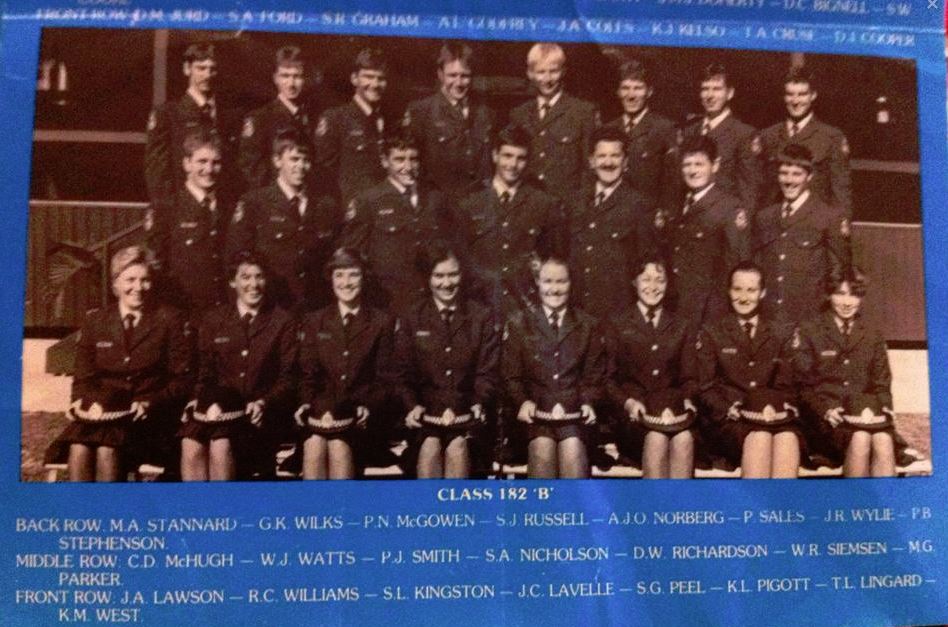
Redfern Police Academy Class 182 B

Rank: Probationary Constable – appointed 28 May 1982

Constable 1st Class – appointed 28 May 1987

Detectives Training Course 28/ 20 May – 28 June 1991

Senior Constable – level 9 upon Resignation

“possibly” Acting Detective Sergeant – Resigned

After resignation ( due to PTSD ) Scott was a Ranger with Liverpool Council until his death

Stations:  Campbelltown ( 1980’s ), Camden,

Bulga, Fraud Squad, Child Mistreatment Unit

Service:  From ? February 1982 to ? ? 1996 = 13 years Service

Awards:  No find on It’s An Honour

Illness: – PTSD – Suicide – carbon monoxide gassing in vehicle

Born:  4 April 1959

Died:  14 November 1996

Age:  37 old

Funeral:  Leppington Lawn Cemetery

Funeral date? ? ?

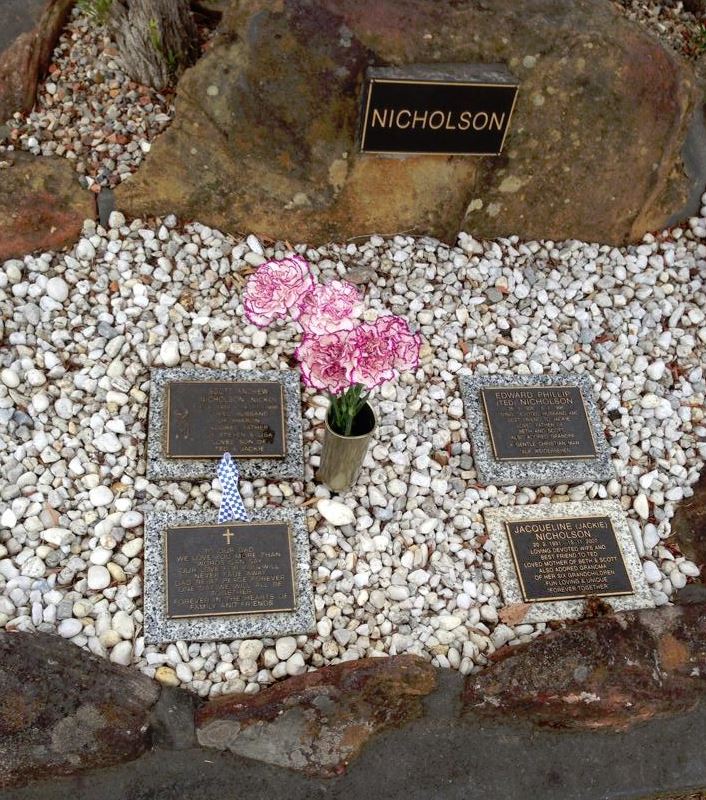
Buried at:  Cremated & Resting in the Fountain Garden, Nicholson plot,

Location: Beside Cafe Pagona Area

Section: Gazebo 3 bed 3

Lot:

Lat/Lng: -33.95538, 150.83279


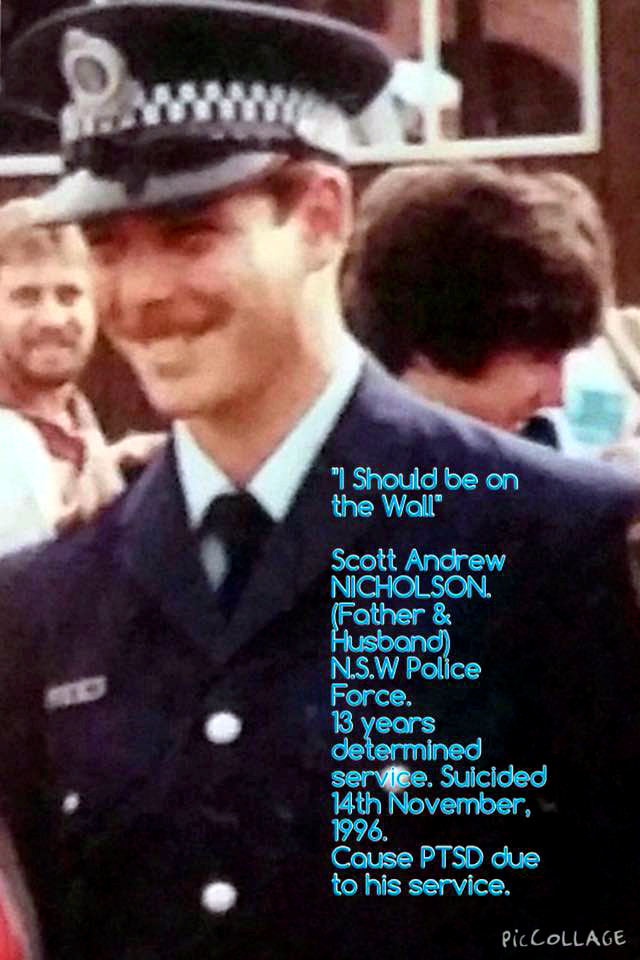
"I should be on the Wall." I was once a Policeman, I served you for years, I saw so much pain, It reduced me to tears. I saved many lives, Did the best I could do, I served with distinction, All to protect you. Year after year, Without self regard, I lived for the job, No matter how hard. The toll it was taking, Eventually broke through, My brain now was broken, I did not know what to do. I keep telling myself, It will get better in time, Just keep pushing yourself, All will be fine. But it did not get better, It only got worse, The trauma I suffered, Became my own curse. It brought to an end, The job that I live, I can't do this anymore, No more I could give. The pain did not stop, In fact it just grew, The demons took over, I did not know what to do. I was empty inside, Lost and in pain, I tried to fight on, But I could no longer remain. The trauma had won, I saw no other way, So I took my own life, On a cool summer day. It was because of Policing, You all know it's true, It destroyed who I was, From the things I went through. The trauma of death, Seen hundreds of times, The witnessing of evil, The wickedest of crimes. Yet now I'm forgotten, By the job I died for, Even though I gave my all, After everything I saw. If I had died on duty, Answering the same call, You would all see my name, My name on the wall. I was still on duty, I just could not let go, I was still a Policeman, My brain made it so..... Written 12.2.15.
“I should be on the Wall.”
I was once a Policeman,
I served you for years,
I saw so much pain,
It reduced me to tears.
I saved many lives,
Did the best I could do,
I served with distinction,
All to protect you.
Year after year,
Without self regard,
I lived for the job,
No matter how hard.
The toll it was taking,
Eventually broke through,
My brain now was broken,
I did not know what to do.
I keep telling myself,
It will get better in time,
Just keep pushing yourself,
All will be fine.
But it did not get better,
It only got worse,
The trauma I suffered,
Became my own curse.
It brought to an end,
The job that I live,
I can’t do this anymore,
No more I could give.
The pain did not stop,
In fact it just grew,
The demons took over,
I did not know what to do.
I was empty inside,
Lost and in pain,
I tried to fight on,
But I could no longer remain.
The trauma had won,
I saw no other way,
So I took my own life,
On a cool summer day.
It was because of Policing,
You all know it’s true,
It destroyed who I was,
From the things I went through.
The trauma of death,
Seen hundreds of times,
The witnessing of evil,
The wickedest of crimes.
Yet now I’m forgotten,
By the job I died for,
Even though I gave my all,
After everything I saw.
If I had died on duty,
Answering the same call,
You would all see my name,
My name on the wall.
I was still on duty,
I just could not let go,
I was still a Policeman,
My brain made it so…..
Written 12.2.15.


Scott Andrew NICHOLSON


Scott Andrew NICHOLSON - Class photo taken at Redfern Police Academy. Class 182 'B'
Scott Andrew NICHOLSON – Class photo taken at Redfern Police Academy. Class 182 ‘B’


Scott Andrew NICHOLSON - Memorial
Scott Andrew NICHOLSON – Memorial

[alert_red]Scott is NOT mentioned on the Police Wall of Remembrance[/alert_red]  * BUT SHOULD BE

SCOTT ( as of 2017 ) IS mentioned on the NSW Police Wall of Remembrance

 SCOTT ( as of March 2019 ) IS NOT mentioned on the NATIONAL Police Wall of Remembrance – Canberra * BUT SHOULD BE


* Stemming from the continued work of the wives & parents of four Fallen NSW Police to Suicide – those four names will now be included in the newly refurbished NSW Police Wall of Remembrance, Sydney, as of 2017

Congratulations to those family members who fought the fight to right this wrong.

*

Commissioner Scipione has telephoned each of us today to advise that our loved ones names are being added to the replacement NSW Police Force Wall of Remembrance, to be unveiled in the next few weeks.

We would like to thank everyone who has offered support over a long and difficult journey and truly hope this sets a precedent for all police departments, not only in Australia but the global policing community.

It is so very important to remember that policing can and often does have a detrimental effect on those who serve.

We believe that the inclusion of suicide deaths, stemming from a work related psychological injury, is the most compassionate way of showing that the police hierarchy truly cares.

The following names will be added:

Detective Sergeant Ashley Bryant

Sergeant Tom Galvin

Senior Constable Scott Nicholson

Constable Morgan Hill

#OneWallForAll


Scott was a member of the New South Wales Police Force for 13 years and, suffering from the effects of PTSD ( Post Traumatic Stress Disorder ) took his own life on the 14 November 1996 by gassing himself in a car and leaving behind two children, aged 6 & 9 ( at the time ) and a wife.

Scott worked at various stations such as Campbelltown in the 1980’s, Camden and the One Man station at Bulga before leaving the Police Force and gaining employment as a Ranger with Liverpool Council.


Dimmy Nicholson Hi, my late husbands name is Scott Andrew Nicholson reg number 20237 who died by gassing himself on 14th November 1996 shortly after he resigned from the job when he could no longer cope with his PTSD, worked at Campbelltown police, Camden, one Man Bulga Police Station, Fraud Squad both in uniform & D’s, Child Mistreatment & others. Hope that’s enough info & thank you for all u do
Wife = Sharon
Dimmy Nicholson

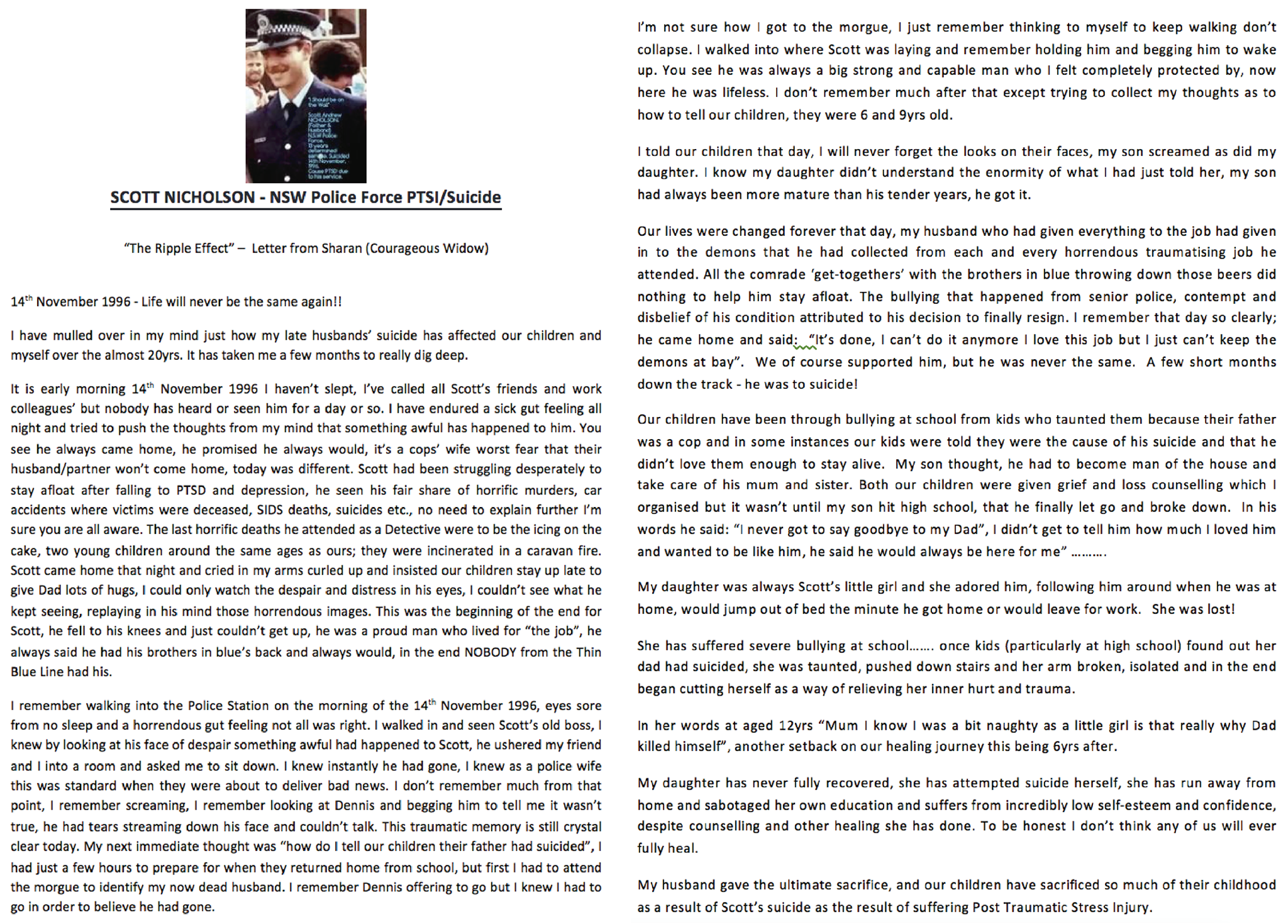
Scott Nicholson - NSW Police Force PTSI / Suicide

PLEASE EVERYONE I ASK THAT YOU TAKE THE TIME OUT OF YOUR LIVES TO READ MY STORY. I’M LISA NICHOLSON AND MY FATHER WAS SCOTT NICHOLSON.

PLEASE JUST READ LIKE AND SHARE!!!!!!!!


[blockquote]Hi my name’s Lisa Nicholson and my father is Scott Nicholson. They say we are one big police family and we look after our own yet they don’t even care to see the damage there doing. My dad suicided when I was just 6 years old he was my world my life my everything. The day he died my world fell apart and the older I got the harder it hit me. I suffered and battled countless years of depression, I was raped and beat as a child and teenager and I had the balls to follow this through with court. But, tragically, all of this led to many suicide attempts.

Thankfully my dad had my back though I actually believed the world was so awful and painful that I belonged with my dad. I had a very hard time seeing other officers thinking that’s my dad he is as good a officer as you, yet why is he not remembered!??

He was so proud to be an officer and truly lived through his work right to the end! The end that the line of work he did helped drive him too!!! He worked his ass off to get the respect and acknowledgement that he gained and I’ve always been so proud to say that my daddy was a police officer!! Yet here these ass wipes are claiming that everything my father worked for his whole life everything he believed in and followed isn’t recognised. They claim that we’re one big family and in truth it has felt like that thanks to police legacy but then there’s the fact that I’ve got to, every single day, deal with the emotional grief that I will never see my daddy again and then there’s the fact that the man I love so much and am so proud to say he was an officer will never meet my daughter and my daughter will never meet her grandfather and that, in itself, has me pretty low but on top of all that these guys wanna destroy me; even more, give me no choice and take whatever is left in me to fight to have my daddy’s name on the police Remembrance wall; a wall that all our fallen officers are on, all except the ones who took things into there own hands. We’re one big family yet not only has their line of work taken my father and my daughters grandfather but they wanna take everything that I’ve left because they won’t respect what they’d say “one of our own” my dad deserves that respect and so do so many others and again they say we’re one big family but can they even see that their own choices, actions are killing us even more!!!!

I know I’m not the only one but I can only speak on behalf of myself. I wanna know why?? my daddy, the man that the only image I can recall is of him in his uniform, the man who tragically lost his life, the man who they claim death is not tragic enough to be remembered. Why??? I wanna know why?? my dad’s dead the same as officers who’ve died in the line of duty. Dead not coming back; he died from the pain and suffering from his job and they die in the line of duty but they’re telling me my dad’s death isn’t good enough or tragic enough.

No wonder half the population have lost faith in these guys. I will continue to support and stand tall and for as long as I can with everyone else and I won’t ever stop speaking out.

Your secret is no longer!

He will be remembered.

Thank you for reading my story. Please like and share this around. The more this gets around the more I hope will get in their face and finally remember all our lost men and women.

[/blockquote]

Thank you for sharing such a deeply personal and heart wrenching story of your journey Lisa! This is so courageous of you. The impact that your father’s death had on you and your family is something that the Police force haven’t been around to witness, acknowledge or support and sadly have contributed to your grief in doing so!
Glad to have you on this journey with us Lisa! Xx
Like · Reply · 3 · 2 hrs
  • Sharona Sione Tylern Orlando Aweee hunni so heartbreaking thinking of you sweetie. X x x
    Like · Reply · 2 · 1 hr
  • Lisa Nicholson No thank you for allowing me to share this!!! It is such a raw painful subject but I’ve had enough of holding it in and I can only hope that others have the courage to do the same. Will be on this journey till the end!!!!
    Like · Reply · 1 · 1 hr
    Resting place of Scott


    When Sharan’s happy-go-lucky husband became a monster

    By CYDONEE MARDON

    Sharan Nicholson-Rogers has a plea for the minister: "Don't let any more families lose their husband, wife or parent by not making changes that you know will make a difference.'' Picture: CHRISTOPHER CHAN
    Sharan Nicholson-Rogers has a plea for the minister: “Don’t let any more families lose their husband, wife or parent by not making changes that you know will make a difference.” Picture: CHRISTOPHER CHAN

    Sharan Nicholson-Rogers watched her husband change from a happy-go-lucky police officer into an unpredictable man prone to violent and emotional outbursts.

    The gentle bloke she loved grabbed hold of her one day and shoved his gun down her throat, telling her he couldn’t live any more because of what he was doing to their family.

    Eighteen months later, Detective Sergeant Scott Andrew Nicholson took his own life.

    That was 19 years ago.

    Today Mrs Nicholson-Rogers is as determined as she was the day her husband died to bring about change.

    [blockquote]” There is complete contempt for anyone who falls. They will kick you to the kerb. “[/blockquote]

    She is calling for the establishment of a centre of excellence – a place where police officers can go for respite, support and treatment from mental health professionals.

    “I know guys in the job right now who are crippled with PTSD [post-traumatic stress disorder],” Mrs Nicholson-Rogers said.

    “They’re still working, doing their best to stay in the job, but they need help.

    “So many have gone through poor management and there is complete contempt for anyone who falls. They will kick you to the kerb.

    “[Sufferers] need a place where they can go, feel safe, be honest about the fact they need help to cope and a place where they can get the best available support from experts in the field.”

    Mrs Nicholson-Rogers sought help for her husband when she saw the signs he was losing control.

    “He became this monster, he couldn’t help it, everything triggered him,” Mrs Nicholson-Rogers recalls.

    “I’d find him curled up in the foetal position, crying and crying.

    “One night we had a bunch of friends over, we cooked lamb on the Weber and I brought it in for him to cut up and he just lost it. He started smashing the kitchen up and screaming.”

    Later he revealed the charred lamb reminded him of two children he’d seen burnt to death in a caravan.

    Detective Sergeant Scott Andrew Nicholson with his family.
    Detective Sergeant Scott Andrew Nicholson with his family.

    “The kids were the same ages as ours,” Mrs Nicholson-Rogers said.

    She urged her husband to talk to his boss about his emotional well-being and asked him to contact police welfare.

    “He said to me ‘Are you serious? They’ll say go to the pub and have a drink, get over it’.

    “He didn’t drink much then but he soon learnt to so he wouldn’t be labelled a ‘sheila’.

    “They get this sick sense of humour, that’s the way they get through it. Down at the pub or the bowlo for a debrief then the wives are left to pick up the mess at the end.”

    Mrs Nicholson-Rogers and her two children have been to hell and back since her husband’s 1996 suicide.

    It was only through counselling that Mrs Nicholson-Rogers, a health promotions officer with NSW Health, realised the true impact on her children.

    “The day Scott had the gun down my throat, my seven-year-old son witnessed that. I didn’t know at the time. It’s impacted on them terribly. As they got older they realised the enormity of what had happened. It’s been a really rough road for us.”

    Scott spent 13 years in the job, with stints in Camden, Campbelltown and a one-man station in the country.

    He died aged 37.

    Mrs Nicholson-Rogers reached out for help when things got really bad.

    “I contacted police welfare the day after he went off his head about the barbecue, I told them he wasn’t well. He had his gun taken off him [temporarily]. They suggested maybe he should stay home, play housewife more, take more holidays, go for walks at night, debrief with his mates, that’s it.

    “He was suffering PTSD and he was told the best thing he could do is exercise.”

    Then one night Detective Sergeant Nicholson came home and told his wife he had resigned. Six months later he was dead.

    “We had been asking for help for a while, through his bosses. I tried senior management,” she said.

    “At one point when he got violent with me I said I’d had enough and I would have him charged if something didn’t change.

    “They said ‘Please don’t because we will have to take his gun off him’. I told them he needed help, he was a loose cannon, he will hurt someone.”

    Mrs Nicholson-Rogers said suggestions he and other struggling officers were simply not right for the job was a cop-out.

    “I hear the same thing today, young guys now being told maybe they’re not right for the job, maybe they should get out. Well no-one is right for a job where day in, day out, they deal with trauma. Layer on layer it consumes them and no-one can take that without the proper support.”

    Mrs Nicholson-Rogers with her children.
    Mrs Nicholson-Rogers with her children.

    Mrs Nicholson-Rogers, a nurse familiar with the trauma of frontline emergency, is one of several police wives willing to work with government and police officials to create the centre of excellence.

    “We can give a family perspective to help them set up a place where police can go in the short term and stay if they need to and feel safe, where they are not going to feel compromised or spied on by insurance companies.

    “We need change. The attitude of senior management has got to change.

    “Right now, if you say you’ve got a problem, you’re not coping, the bosses think ‘Oh great there’s another one off sick. That means a man down, overtime, it’s the cost.”

    Mrs Nicholson-Rogers and a group of police wives believe they have a solution and are urging NSW Police Minister Stuart Ayres to work with them.

    "We need change. The attitude of senior management has got to change.''
    “We need change. The attitude of senior management has got to change.”

    “We need change. The attitude of senior management has got to change.”

    “I’m one of the lucky ones who have healed to a degree and married again to a man who totally supports my fight for change,” she said.

    “I would like to see him meet with us, it’s not about us canning him, it’s about working together collectively with all our experience as families, to pick our brains on what they can do to make a change. Hiding from it is not the answer.

    “They can’t keep turning their back. There are more and more suicides and experienced cops are dropping out. They are losing an experienced workforce that can be real value.”

    Mrs Nicholson-Rogers has a plea for the minister: “Don’t let any more families lose their husband, wife or parent by not making changes that you know will make a difference.

    “Just take a minute or two of your time to listen to my children if you can’t talk to me, see the pain and grief in their eyes and I assure you it will change your mind and you will work to make positive changes.”

    The NSW Police Minister was contacted by the Mercury but so far has not responded.

    The NSW Police Force has provided details of the programs and initiatives already in place for preventing PTSD and supporting its officers.


    For help and counselling: Lifeline 131114; Suicide Call Back Service 1300 65946 

    [divider_dotted]


  • Please keep running these stories, there needs to be a ground swell of public contempt for this culture within the policing system. Only that way will there be some light at the end of the tunnel for these men and women, and their families, who are having their lives ruined whilst serving and protecting the public.

    So proud of you sharon !!! Step by step change is coming !!!
    We cant change the past but we can change the future and prevent other families feeling the same pain . Much love to you and the girls so proud ox

    Not everyone is mentally able to absorb the rigours of the Military or Emergency services.
    I note that the Police “spokesman” has declared that they have in place procedures to help if PTSD becomes a factor.
    Having some knowledge of this issue Why are the recruits not adequately assessed during training rather than waiting for the nightmare to begin?
    It may not catch all , but may help some before their life is destroyed.
    The military at least have programs to assess their recruits and place them in areas of higher or lower degrees of capability to absorb stress. it cannot be that difficult.
    I thank God my daughter changed her decision and followed nursing.

    Im not sure that you can 100% assess how a person will handle situations. I see myself as pretty resilient but that may all change if i saw the aftermath of a bunch of children stabbed to death.
    I guess u just never know.

    You are a strong woman Sharon for campaigning for this and no doubt keeping the wounds raw for you. It is horrible that your husband was not given the support he needed, and I’m sure there are many others suffering in silence like a ticking time bomb.

    There used to be government run places people could go but they had a few issues that the media beat up and politicians could see a few bucks in selling off the real estate to themselves so……………………………………………………………………thank the dumb Aussie people.

    http://www.illawarramercury.com.au/story/2807747/when-sharans-happy-go-lucky-husband-became-a-monster/?cs=4401


Scott Andrew NICHOLSON - Detectives Course # 28/1991
Scott Andrew NICHOLSON – Detectives Course # 28/1991 – Memorial Port


13 January 2015

She said that they develop a “Sick Sense Of Humour” her husband put a gun in her mouth in front of her children, he took his own life some time after. She said they turn into monsters , and they lose track of reality and develop this “sick sense of humour” Black humour I know cops call it.. but those of us with a sense of balance and compassion, would call it “sick”.. Because it is “sick” Its as sick as the criminals they chase and lock up for doing “sick’ things, they themselves have a “sick” way after a while.. And it gets worse not better over time ..

“Sharan Nicholson-Rogers watched her husband change from a happy-go-lucky police officer into an unpredictable man prone to violent and emotional outbursts.

The gentle bloke she loved grabbed hold of her one day and shoved his gun down her throat, telling her he couldn’t live any more because of what he was doing to their family.

Eighteen months later, Detective Sergeant Scott Andrew Nicholson took his own life.

That was 19 years ago.

Today Mrs Nicholson-Rogers is as determined as she was the day her husband died to bring about change.

“There is complete contempt for anyone who falls. They will kick you to the kerb.”

She is calling for the establishment of a centre of excellence – a place where police officers can go for respite, support and treatment from mental health professionals.

“I know guys in the job right now who are crippled with PTSD [post-traumatic stress disorder],” Mrs Nicholson-Rogers said.

“They’re still working, doing their best to stay in the job, but they need help.

“So many have gone through poor management and there is complete contempt for anyone who falls. They will kick you to the kerb.

Mrs Nicholson-Rogers sought help for her husband when she saw the signs he was losing control.

“He became this monster, he couldn’t help it, everything triggered him,” Mrs Nicholson-Rogers recalls.

“I’d find him curled up in the foetal position, crying and crying.
She urged her husband to talk to his boss about his emotional well-being and asked him to contact police welfare.

“He said to me ‘Are you serious? They’ll say go to the pub and have a drink, get over it’.

“He didn’t drink much then but he soon learnt to so he wouldn’t be labelled a ‘sheila’.

“They get this sick sense of humour, that’s the way they get through it. Down at the pub or the bowlo for a debrief then the wives are left to pick up the mess at the end.”

Mrs Nicholson-Rogers and her two children have been to hell and back since her husband’s 1996 suicide.

It was only through counselling that Mrs Nicholson-Rogers, a health promotions officer with NSW Health, realised the true impact on her children.

“The day Scott had the gun down my throat, my seven-year-old son witnessed that. I didn’t know at the time. It’s impacted on them terribly. As they got older they realised the enormity of what had happened. It’s been a really rough road for us.”

Scott spent 13 years in the job, with stints in Camden, Campbelltown and a one-man station in the country.

He died aged 37.

Mrs Nicholson-Rogers reached out for help when things got really bad.

“I contacted police welfare the day after he went off his head about the barbecue, I told them he wasn’t well. He had his gun taken off him [temporarily]. They suggested maybe he should stay home, play housewife more, take more holidays, go for walks at night, debrief with his mates, that’s it.

“He was suffering PTSD and he was told the best thing he could do is exercise.”

Then one night Detective Sergeant Nicholson came home and told his wife he had resigned. Six months later he was dead.

“We had been asking for help for a while, through his bosses. I tried senior management,” she said.

“At one point when he got violent with me I said I’d had enough and I would have him charged if something didn’t change.

“They said ‘Please don’t because we will have to take his gun off him’. I told them he needed help, he was a loose cannon, he will hurt someone.”

Mrs Nicholson-Rogers said suggestions he and other struggling officers were simply not right for the job was a cop-out.

“I hear the same thing today, young guys now being told maybe they’re not right for the job, maybe they should get out. Well no-one is right for a job where day in, day out, they deal with trauma. Layer on layer it consumes them and no-one can take that without the proper support.”


Tom Rigby PTSD is a terrible burden for anyone to wear, unfortunately though societies answer is exactly as written in the article ” Go to the pub and have a drink!”


Alan Hardy If you carnt handle the heat get out of the kitchen


Stephen Evelyn Wall Just wondering Alan what job do you do??
These ppl do a wonderful job but doing that job they see and experience terrible things we can’t imagine. All the training in the world doesn’t prepare you for what they have to face.


N.S.W Police Watch You need to do some more research Evelyn, many are not doing a wonderful job at all and then many above them cover for it..


N.S.W Police Watch http://books.google.com.au/…/Enemies_of_the_State.html…

Tim Priest is a former police detective who was on the front line in the war against crime and drugs in…
books.google.com.au


Alan Hardy You are right Evelyn wall ,but if you can not handle your job ,what ever that job is quit and get another job. It’s a job not your life


Alan Medhurst Revell Well, well, well…. Looky ere…


N.S.W Police Watch Have edited Jeff, apologies for that.

For more read on below

http://www.illawarramercury.com.au/…/when-sharans-happy-go…/


William Norman St. John MAULE

William Norman St. John MAULE

New South Wales Police Force

Regd. #  ‘Q’  3939

NSWPF – ‘Q‘ represents those Police joining between 1862 ( commencement of NSWPF ) – 23 February 1915 ( Commencement of NSWPF current numbering system )

Rank:  Mounted Constable

ServiceFrom 6 June 1881  to 8 December 1881   = 6 months Service

Stations: Goulburn ( only six weeks )

Born:  23 October 1853 in England

Died:  Thursday  8 December 1881

Age: 28 old

Cause:  Accident – Thrown from horse – On Duty

Funeral:  Saturday  10 December 1881

Buried: at St Saviour’s Cemetery,

Cemetery St, Goulburn ( opposite the gaol )

GPS of grave:    -34.74095,   149.74291

The Pointer on the below map is the exact point of the grave

NSW Deaths Registration # 4783/1881


On Thursday 8 December 1881, the Mounted Constable who had only been stationed at Goulburn for about six weeks after leaving the Police Depot ( Redfern Police Academy ), was riding his Police Mount with Mounted Constable Pritzler to Mummel ( an area nth west of Goulburn ) to fetch a person suspected to be of unsound mind.

Maule was riding ahead and Pritzler was behind, when Maule‘s horse shied and plunged forward over a log, causing Maule   ( an inexperienced rider ) to lose one of his stirrups.  The horse jumped a second log and Maule lost his second stirrup iron and was unseated and fell with his head violently against a tree.

Maule, unconscious and bleeding from the nose, was later loaded into a buggy, with the assistance of the messenger and the prisoner, and taken into Goulburn Hospital – arriving there about 5.30pm.

Maule died from his injuries about 10.30pm as a result of his injuries, including a smashed lower jaw, a split lip, broken nose and severe cut over the temple & concussion of the brain.

Maule was not married.

An Inquest was held on Friday 9 December 1881 with a verdict that Maule was killed by being thrown from his horse accidentally, and added as a rider that they think that more discretion might be exercised in the Sydney depot as to the horsemanship of the men they send out for duty in the country.

 [divider_dotted]

Maule joined the New South Wales Police Force in June 1881.  He left England and came to Australia, though it appears his siblings remained in England.  We don’t know why he chose to come to Australia and join the NSW Police Force.  Two of his brothers served in the military, as did his father, and one of his brothers was a solicitor.  His grandfather was a chaplain and his great-grandfather – mayor, alderman and burgess of Huntingdon.


 [alert_red]WILLIAM is NOT mentioned on the Police Wall of Remembrance[/alert_red]  * BUT SHOULD BE

( This incident was discovered, by accident, in September 2014, by Cal, whilst searching Trove.  This Constable is NOT mentioned in any documentation or recognised as having been killed ” on duty ” by the NSW Police Force, at this time, or mentioned on any official Wall of Remembrance.  Shortly, this matter will be brought to the attention of those who have the ability to have this Constable officially recognised as being killed ” on duty “. )


Upon checking npm.org.au on 2 May 2018 – William is NOW mentioned on the National Police Wall of Remembrance, Canberra

[alert_green]WILLIAM IS mentioned on the Police Wall of Remembrance[/alert_green]


[divider_dotted]


 [divider_dotted]

Southern Argus ( Goulburn ) Friday 9 December 1881 page 2 of 4
Trove.nla.gov.au/ndp/del/article/102061858
Southern Argus ( Goulburn )   Friday 9 December 1881   page 2 of 4

William Norman St John MAULE - NSWPF - Killed 1881 - Mummell NSW - News article
http://trove.nla.gov.au/ndp/del/article/117441293   Goulburn Herald   Saturday 10 December 1881   page 4 of 8

http://trove.nla.gov.au/ndp/del/article/102061889Southern Argus ( Goulburn ) Saturday 10 December 1881 page 2 of 4
http://trove.nla.gov.au/ndp/del/article/102061889     Southern Argus ( Goulburn )
Saturday 10 December 1881
page 2 of 4


Southern Argus ( Goulburn ) Saturday 10 December 1881 page 2 of 4 http://trove.nla.gov.au/ndp/del/article/102061905
Southern Argus ( Goulburn )
Saturday 10 December 1881
page 2 of 4
http://trove.nla.gov.au/ndp/del/article/102061905


 [divider_dotted]

Southern Argus ( Goulburn )       Saturday  10 December 1881        page 2 of 4

http://trove.nla.gov.au/ndp/del/article/102061907

Inquest.

An inquest was held last evening at the Goulburn Hospital by the coroner, Mr. Betts, on the body of William Norman St. George Maule, who had died from the effects of injuries received on the previous day. The jury having been sworn and the body viewed, the following evidence was taken: — Simon Pritzler, a mounted policeman stationed at Goulburn, deposed: The body just viewed was that of constable Maule, of the N.S.W. police ; he had been in the force since last June; the deceased was single and 28 years of age ; on Thursday afternoon last he and witness were going to Mummel and got along all right for about 13 miles, when the deceased’s horse shied to the right of a tree and Maule had pulled him to the left; then he had lost one of his stirrup-irons, when the horse bolted, and about 20 yards away witness saw the horse jump a log, when the deceased lost his other stirrup-iron ; witness then saw the deceased lying on the horse’s neck ; the horse took another bound and the deceased fell off; witness, on galloping up, found him lying on the ground insensible; the deceased’s face was all knocked in ; he sent for assistance and fetched him into Goulburn Hospital in a buggy ; he never recovered consciousness and died five hours after the accident occurred ; witness thought deceased must have been dashed against a tree by the horse just after falling off as it rushed on. Deceased was not a good horseman, having no control over his reins.

Dr. Gentle deposed that he had been asked to see the deceased on the previous evening and found him in a comatose condition with nose broken also lower jaw. He found in addition a wound over left eve about 2 inches in length exposing the bone; blood flowed from his right ear. He believed concussion of the brain to be the cause of death. The jury returned a verdict that the deceased met his death by being accidentally thrown from his horse and they would like to add a rider to the effect that they think more discretion might be exercised in the Sydney depot as to the horsemanship of the men sent out for duty service in the country.


FATAL ACCIDENT. A MOUNTED-CONSTABLE named William Morman St. John Maule met with a fatal accident on Thursday last while in company with mounted-constable Pritzler in search of a lunatic. It appears that when about 13 miles from town, on the Mummel road, Maule's horse bolted and threw the rider, and in rushing past him knocked deceased with great violence against a tree, rendering hm unconscious. Pritzler at once procured a buggy, in which he conveyed the poor fellow to the hospital, when Drs Davidson and Gentle immediately attended him and found him still in an unconscious state, and suffering from a severe scalp wound, broken jaw, and injured nose, besides several injuries to his body. The sufferer remained unconscious for five hours, when he expired. An inquest held yesterday afternoon at the Hospital before the coroner(A. M. Betts Esq). when the following evidence was taken :- Simon Pritzler deposed: I am a mounted policeman stationed at Goulburn; the body just viewed by the coroner is that of mounted constable William Norman St. John Maule ; he had been at Goulburn about 6 weeks, and had only been in the force since June last ; he was 28 years of age and unmarried ; yesterday afternoon he came to me, and we both went to Mummell, about 14 miles from Goulburn, when we got about 13 miles from Goulburn deceased's horse shied at a tree, and threw one of his feet out of the stirrup-iron, which he lost; the horse went about 2o yards when it jumped a log, and the deceased then lost the other stirrup-iron ; I afterwards saw him some distance away; he was leaning on the horse's neck : the horse gave another bound, and deceased fell off on to his feet ; I then galloped up and found him lying on the ground insensible ; I saw that his face was smashed in ; I sent for some assistance, when I saw that he was seriously injured ; Mrs. Storey brought some water, and after bathing him he appeared to get better ; I then had him placed in a buggy, and brought in to the hospital, when Drs. Gentle and Davidson attended him ; he never recovered consciousness, and died in about five hours after the accident ; at the time deceased's horse shied he was about 30 yards in front of me, and was walking his horse ; from the place where the horse first shied to where deceased was thrown was about 300 yards ; the horse was going at a rapid pace at the time ; after deceased fell from the horse he was knocked against a tree ; the deceased was not a good rider, and the horse was a rather spirited one. Dr. Peter Hume Gentle deposed : I was asked to see deceased last night at nine p.m., and saw him in a comatose condition, with nose broken and the lower jaw broken ; I also found a wound over the eye about two inches in length, exposing the bone ; blood flowed from his right ear ; the pupil of the right eye was dilated, and that of the left contracted ; I believe compression of the brain to have been the cause of death. The jury after a brief consultation, returned a verdict that deceased died from injuries received by being accidentally thrown from his horse, and the jury would like to add that more discretion might be exercised at the Sydney Depot as to the horsemanship of men sent for duty in the country.
http://trove.nla.gov.au/ndp/del/article/102820476
Goulburn Evening Penny Post
Saturday 10 December 1881
page 3 of 8

 The funeral of the late Mounted constable Maule took place this morning, when nearly the entire police force of the town followed his remains to their last resting place.
http://trove.nla.gov.au/ndp/del/article/102820484   Southern Argus ( Goulburn )
Saturday 10 December 1881
page 2 of 4

[divider_dotted]

Grave location

[divider_dotted]

( On Tuesday 7 October 2014, I attended the Mortis Street General Cemetery, Goulburn, in an attempt to locate the grave of this Constable.  Unfortunately, this historic cemetery is in an extremely poor state with most of the head stones having fallen and most of the graves heavily overgrown with weeds.

There are hundreds of graves at this location, dating back to the early – mid 1800’s.  I had to attend the local library where I obtained the attached ‘ plan ‘ of the cemetery in order to find plat CE79 – the recorded location of the Constables grave.

I returned to the cemetery but, at this stage, could not find CE79 at the location as there are many unmarked graves and fallen head stones in this, Goulburns second oldest cemetery which was established in the late 1830’s. )

.[divider_dotted]

Some records have him buried at Goulburn Anglican Cemetery, Cemetery St, Goulburn ( near the gaol ) plot CE79 but his grave is located at the St Saviour’s Cemetery, Cemetery Rd, Goulburn, OPPOSITE the Goulburn Gaol & NOT in the Mortis St Cemetery.

Mortis St General Cemetery – Goulburn

Mortis St General Cemetery 2 – Goulburn

[divider_dotted]


On Tuesday  24 April 2018 I attended the St Saviour’s Cemetery, Cemetery Rd, Goulburn, opposite the Goulburn Gaol where I located the grave of MAULE.

The below images are what it presented like on that date.

GPS of grave:  -34.74095,   149.74291

William Norman St. John MAULE grave. The grave has been cleaned up and headstone cleaned also. The cleaning has made the inscription, especially the dates, a lot harder to read.
The grave has been cleaned up and headstone cleaned also. The cleaning has made the inscription, especially the dates, a lot harder to read.


William Norman St. John MAULE grave

William Norman St. John MAULE grave


[divider_dotted]

On Tuesday  21 October 2014 I attended the St Saviour’s Cemetery, Cemetery Rd, Goulburn, opposite the Goulburn Gaol where I located the grave of MAULE.

The below images are what it presented like on that date.

GPS of grave:  -34.74091, 149.74289

William Norman St. John MAULE 1
William Norman St. John MAULE

William Norman St. John MAULE 2
William Norman St. John MAULE

William Norman St. John MAULE 3
William Norman St. John MAULE

William Norman St. John MAULE 4
William Norman St. John MAULE

William Norman St. John MAULE 5
William Norman St. John MAULE


[blockquote]

note:

Email sent:

G’day Bundy,

During my research for my website, I have come across another NSW Mounted Constable who was killed ‘ on duty ‘ at Goulburn on Thursday 8 December 1853 as result of horse accident.

See the link for further details and photos of the grave: https://police.freom.com/william-norman-st-john-maule/

This man is NOT mentioned on any official documentation in relation to the Wall of Remembrance and, according to the paper’s, was ‘ on duty ‘ at the time of the horse accident which resulted in his death.

Can you forward this information so that he may be officially recognised to be included in the Wall of Remembrance.

Cheers mate

Greg ‘ Cal ‘ Callander www.AustralianPolice.com.au 23 October 2014

[/blockquote]


David Andrew SHEAN

David Andrew SHEAN

( late of Waterford West )

Queensland Police Force

Regd. #  3607

Rank:  Senior Constable


Stations?, Darling Downs, Brisbane, Brisbane Traffic Branch, Brisbane Traffic Tail bike Squad, , South Brisbane District Training Office, Brisbane Traffic Camera Officer, Metropolitan South Regional Traffic Adjudication Office


Service:   From  pre 27 May 1977  to  5 April 2001 = 24 years Service

Academy:  ‘B’ Squad


AwardsNational Medal – granted 20 July 1994


Born:   10 July 1952

Died on:  5 April 2001

Cause:  Injuries received – Traffic accident

Event location:  Eight Mile Plains, Brisbane, Qld

Age:  48


Funeral date:  10 April 2001

Funeral location:  Great Southern Memorial Park, Carbrook, Qld


Buried at:  Cremated.  Ashes were scattered at Hope Banks in Moreton Bay, Qld.


Memorials:  Waterford West State School unveiled a plaque dedicated to his memory in their garden of conciliation and reflection.

Gold Coast ( Qld ) Water Police rescue vessel ” D A Shean ” named in honour of David.

David Andrew SHEAN - QPol - MVA - 5 April 2001
David Andrew SHEAN – QPol – MVA – 5 April 2001


DAVID IS mentioned on the Police Wall of Remembrance


Senior Constable David Andrew Shean
On 5 April 2001, Senior Constable Dave Shean’s life was tragically cut short when he was killed in a traffic accident while responding to a crime in progress.
It came as no surprise to those who knew Senior Constable Shean to discover he was among the first to respond to a call for assistance. This is a mark of his character and of the professionalism he consistently displayed in serving the people of Queensland.
Senior Constable’s Shean’s service commenced in 1977. He performed duty in both the Darling Downs area and Brisbane before realising an ambition to serve in the Brisbane Traffic Branch. His versatility and knowledge was exemplified in the various roles he performed while serving in the South Brisbane District Training Office, the Brisbane Traffic Camera Office and the Metropolitan South Regional Traffic Adjudication Office.
His commitment to the community was further showcased by his active involvement with Radio Lollipop and with many police displays at the RNA and Brisbane Motor Shows. His contribution since 1988 to the Adopt-a-Cop program was highlighted earlier this year when the Waterford West State School unveiled a plaque dedicated to his memory in their garden of conciliation and reflection.
The contribution of Senior Constable Shean to policing in Queensland is reflected in the words of Assistant Commissioner Freestone who said, “In representing the Service and the community he so faithfully served, David has made the ultimate sacrifice in the execution of his duty.”
The positive contribution to policing made by Senior Constable Shean stands as a testament to him. He too, will be sadly missed by his family, friends and colleagues and the community he so ably served.
[divider_dotted]
David was a “sparkie” ( electrician ) pre Queensland Police employment.
[divider_dotted]

Named in honour of David Andrew Shean

Senior Constable David SheanSenior Constable Shean was sworn into the Queensland Police Force in 1977. He performed duty in both the Darling Downs area and Brisbane before joining the Brisbane Traffic Branch.Senior Constable Shean served in a number of positions including the South Brisbane District Training Office, Brisbane Traffic Camera Office and the Metropolitan South Regional Traffic Adjudication Office before joining the South Brisbane Traffic Branch.
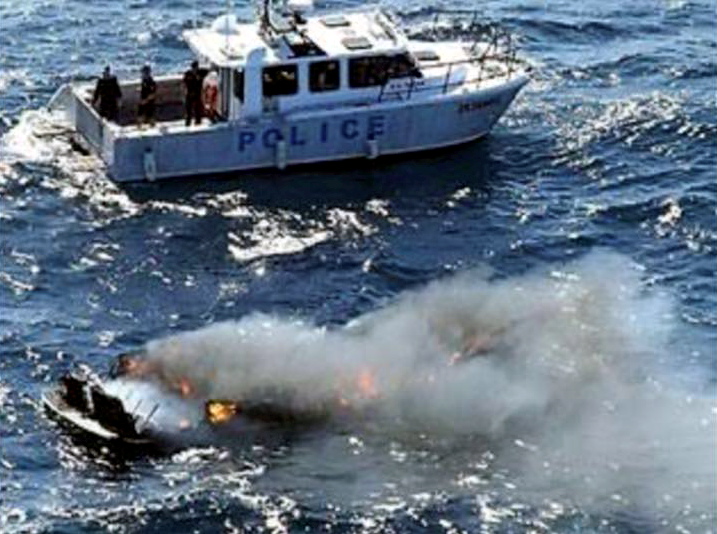
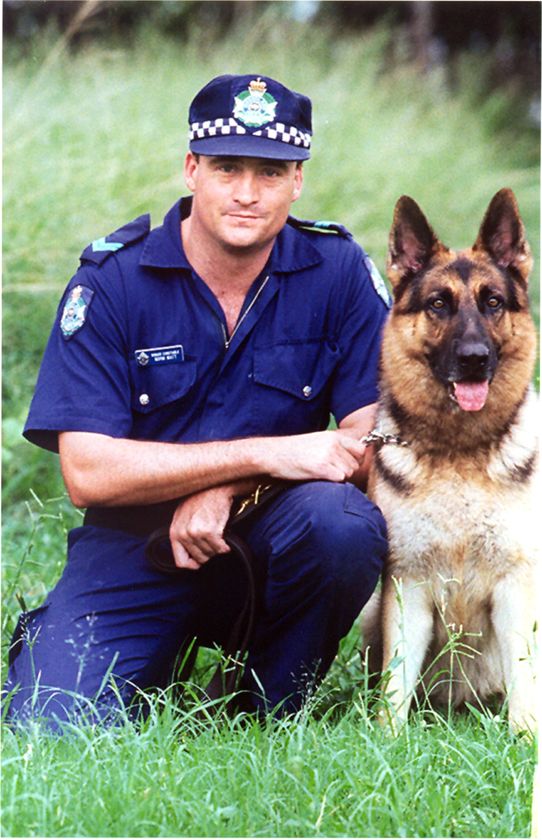
In 1988 Senior Constable Shean volunteered for the ‘Adopt a Cop’ program with the Waterford West State School. Following his death the staff and students of the School unveiled a plaque dedicated to his memory in their garden of conciliation and reflection.

On the 5 April 2001, while a member of the South Brisbane Traffic Branch, Senior Constable Shean responding on urgent duty to a crime in progress was killed when his police motorcycle collided with a truck at Eight Mile Plains in Brisbane.

Qld Police Vessel “D.A.SHEAN” – Gold Coast

“D.A.SHEAN”
The “D.A.SHEAN” launched 9th December 2005.The Honourable Judy Spence MP, Minister for Police and Corrective Services and the Commissioner for Police Mr Robert Atkinson APM, officiated at the commissioning and launching of the D. A. SHEAN at the Southport Yacht Club, Macarthur Parade, Main Beach.

Senior Constable Shean’s wife Paula and children Katie, Kimberley, Christopher and Matthew attended the launch.

The “D.A.SHEAN” is a 10 metre aluminium vessel constructed by Yamba Welding and Engineering Pty Ltd. The vessel is powered by twin 420hp (8.2 litre) M.P.I. fuel injected V8 inboard Mercruiser petrol engines with Mercruiser Bravo 3 stern drives fitted with dual propellers.

The “D.A.SHEAN” has a cruising speed of 22 knots and a top speed of 44 knots (80 km/hr) and is fitted with a dual fuel system with a total capacity of 1200 litres of unleaded petrol. The vessel is equipped with the latest electronic equipment for navigation and communication purposes and is registered in 2C commercial survey (50 nautical miles to sea) for 2 crew and 16 passengers.

http://www.qldwaterpolice.com/Bio/D_A_Shean.html
[divider_dotted]

Ashie Dave We at the Gold Coast Water Police are proud to have the Water Police Vessel named in his Honour. The Police Vessel D A Shean is our rescue vessel and has saved many lives. In Memory of Dave. I’m proud to say I have been its Master on many rescues.

[divider_dotted]


Norman James WATT

Norman James WATT

( grew up in Chinchilla )

Queensland Police Force

Joined Qld Police Force via Qld Police Cadet System 1986 – 1987

Regd. #  ?

Rank:  Senior Constable

Stations:  Dog Squad – death

ServiceFrom  ? ? 1986  to  21 July 2000 = ? years Service

Awards:  No find on It’s An Honour

Born:  ? ? ?

Died on:  21 July 2000

Cause:  Shot – murdered – Alton Downs, Qld

Age:  33

Funeral date:  25 July 2000

Funeral location:

Buried at:  Nerimbera Memorial Cemetery, Rockhampton, Qld

Memorial location:


Norman James WATT - SenCon - Shot at siege - Qld - 21 July 2000
Norman James WATT – SenCon – Shot at siege – Qld – 21 July 2000.  Pictured with his dog – Zeus

[alert_green]NORM IS mentioned on the Police Wall of Remembrance[/alert_green]


At 9.22pm on Thursday 20 July 2000 Information was received at the Rockhampton communications room regarding a serious domestic dispute that was taking place on a property at Alton Downs 15kms north-west of Rockhampton.

An ex-serviceman named Royce William Cooper (58yrs) had fired three (3) shots at a friend during an argument at the property.

Senior Constable Norm Watt the dog squad officer on duty was one of a number of police directed to attend the scene. Officers arrived at the property and immediately placed a cordon around the residence.

In the darkness Cooper had exited his house and camouflaged himself amongst bushes in the yard.

At a little after midnight Senior Constable Watt and another officer went to view the house from another vantage point. As Senior Constable Watt moved toward the house a shot was heard and Senior Constable Watt fell to the ground. Fellow officers were unable to safely approach their fallen colleague to render assistance as they were unaware of Cooper’s exact location.

An armoured vehicle from the Rockhampton correctional Centre was summoned and recovered the body of Senior Constable Watt.

The officer was officially pronounced dead at 3.47am.

A post mortem examination revealed that the bullet had severed Senior Constable Watt’s femoral artery causing death within minutes of being hit.

After a seven hour siege Cooper surrendered to police. He was later charged and convicted of murder in the Rockhampton Supreme Court and sentenced to life imprisonment.

Senior Constable Norman James Watt is buried in the Nerimbera Memorial Cemetery Rockhampton.


Cemetery locationGrave location isSect. ROG  Row. 8  Grave 12


Police remember slain dog squad officer

Updated Wed 21 Jul 2010, 3:15pm AEST

http://www.abc.net.au/news/2010-07-21/police-remember-slain-dog-squad-officer/914086

A memorial service has been held at Rockhampton in central Queensland to honour a police officer killed in the line of duty.

Today marks 10 years since the shooting death of Senior Constable Norman James Watt.

The 33-year-old dog squad officer was killed while responding to a domestic disturbance on a property at Alton Downs, west of Rockhampton.

Queensland Police Service commissioner Bob Atkinson says Senior Constable Watt paid the ultimate sacrifice and died serving the community he had sworn to protect.

“Norm was many things – a husband, a brother, an uncle, a friend, a colleague, a fine police officer, and with his dog Zeus they were a fine team,” he said.

Mr Atkinson says the bond between dog squad officers and their animals is incredible, and dogs live with their handlers full-time.

“In most cases those officers work alone and most of the time they work through the night alone with their dog, and the bond they form is very close,” he said.

Zeus was retired immediately after the shooting and was cared for by Senior Constable Watt’s wife, until he died of kidney failure 18-months later.

Officer’s family joins march

Widow Anna Watt and her niece took part in this morning’s march from Rockhampton City Hall to the memorial garden at the Rockhampton Police Station.

She was flanked by two dog squad officers with pups-in-training, followed by a large number of Rockhampton police officers.

The Queensland Police Pipes and Drums led the procession.

During the ceremony, family, friends and former colleagues of Senior Constable Watt laid floral tributes under a plaque commemorating his death.

Senior Constable Watt’s brother, Greg Watt said it was an honour to witness the respect shown by colleagues and the community.

Commissioner Bob Atkinson says Senior Constable Watt was one of three Queensland police officers killed in the line of duty in the past ten years.

Police march for slain police officer Norm Watt, Rockhampton, July 21st 2010 - 10th anniversary
Police march for slain police officer Norm Watt, Rockhampton, July 21st 2010 – 10th anniversary

The Queensland Police Pipes and Drums led the march to remember Norm Watt.

Floral tribute
Floral tribute

Touch Stone, National Police Memorial, ACT.


http://www.police.qld.gov.au/Resources/Internet/services/reportsPublications/annualReport/2001/documents/11_honoursAwards.pdf

Policing in Queensland has long been a respected and valued profession but it is also an inherently dangerous one. This fact was tragically highlighted with the deaths of
two serving officers this year. The untimely deaths of Senior Constable Norm Watt and Senior Constable Dave Shean brings to one hundred the number of serving Queensland police officers who have died in the performance of duty. A tribute has been included in this Annual Report as a mark of respect to these two officers and to acknowledge the terrible loss felt at their passing by the Service, their families and friends and by their police colleagues who supported them throughout their careers.
Senior Constable Norman James Watt
The newly built Dog Squad facility in Brisbane has been named the Norm Watt Complex as a tribute to Senior Constable Norman James Watt.
Senior Constable Norm Watt was shot and killed while attending a domestic violence incident near Rockhampton on 21 July 2000.
Senior Constable Watt’s operational career began in 1987 with a posting to Rockhampton. During his career, he proved himself to be an able and reliable officer serving in a variety of positions within the area including small stations, the CIB and the Rockhampton Traffic Branch. Senior Constable Watt was also commended by the then Central Region Assistant Commissioner for his work as an undercover operative during Operation Breaker in 1990.
He was commended on a number of other occasions for good police work and was the recipient of many letters of appreciation from politicians, fellow police officers and
members of the public. As the Adopt-a-Cop at Parkhurst State School, Senior Constable Watt earned the respect of the school community and his efforts were recognised by the then Police Minister, the Honourable Terry MacKenroth MP.
Norm was promoted to Senior Constable, Rockhampton Dog Squad, on 21 February 1994. Together with police dog Zeus, he attended a wide variety of operational matters including the incident that tragically ended his career. The dedicated service which Senior Constable Watt provided to the people of Queensland is well summed up in the words of the then Police Commissioner, Jim O’Sullivan, who, when dedicating the Norm Watt Complex, described Norm as “an officer who made the ultimate sacrifice in his role to serve and protect the community … and whose sacrifice will not be forgotten.”
Senior Constable Watt will be sorely missed by his family, friends and colleagues and by the community he so ably served.
 [divider_dotted]

15 years may have passed, but Norm is still alive in our hearts

Senior Constable Norm Watt

Senior Constable Norm Watt with PD Zeus

Police across the State will take a moment today to remember Senior Constable Norman James Watt who died whilst on duty in Rockhampton fifteen years ago.

At 9.22pm on Thursday July 20 2000, officers were called to a hobby farm at Alton Downs, west of Rockhampton, after reports that a serious domestic dispute was taking place during which a man had fired three shots at a friend.

Senior Constable Norm Watt, a member of the Rockhampton Dog Squad, was also called to the scene with his dog, PD Zeus.

Officers arrived and began to put a cordon around the residence. It was just after midnight when a shot was heard and Senior Constable Watt was seen to fall to the ground.

Senior Constable Watt was pronounced dead on Friday July 21 at 3.47am. After a seven hour siege the offender surrendered to police and was later charged with murder and found guilty.

Senior Constable Watt was buried in the Nerimbera Memorial Cemetery Rockhampton and is remembered as a dear friend, a dedicated officer and a ‘stand up’ guy.

Fifteen years may have passed but to those who knew Norm, he is still alive in our hearts.

After Norm’s passing, Police Dog Zeus lived a happy retirement with Norm’s partner and passed away from old age a few years ago.

[divider_dotted]


Adam Stuart GARDENER

Adam Stuart GARDENER

Late of Parklea, NSW

New South Wales Police Force


NSW Goulburn Police Academy Class # ???

Regd #: ?????


Rank:  Commenced Training at Goulburn Police Academy on ? ? 2012?

Probationary Constable – appointed ? ? ?

Constable – appointed ? ? ?

Constable 1st Class – appointed ? ? ?


Final Rank:  Constable 1 / Class


ServiceFrom ? ? 2012? to 1 March 2014 = ? Years service


Awards:  No Find on Australian Honours system


Stations?, Parramatta LAC GDs & Licencing Unit – Death


Date of Birth? ? ?

Date of death:  Saturday  1 March 2014

Age:  28 years


Cause:      Illness – Cancer – Lymphoma leading to heart attack


Event Date:  Diagnosed TWO Weeks before his passing


Funeral Parlour: Hills Family Funerals,  ( HillsFamilyFunerals.com.au )

Funeral date:  Saturday  8 March 2014@ noon

Funeral Location:  Castlebrook Garden Chapel, Windsor Road, Rouse Hill, NSW


Buried at?

Grave GPS?


Memorial: NSW Police force Service Memorial Wall, Sydney Police Centre, Surry Hills, F4 ( Right Wall )


Adam Stuart GARDENER, Adam GARDENER

Adam Stuart GARDENER, Adam GARDENER

Adam Stuart GARDENER, Adam GARDENER

GARDENER, Adam Stuart
Passed away peacefully on 1st March, 2014
Late of Parklea
Dearly beloved husband of Gail,
loved and cherished father of Brendan, Bree and Caleb.
Much loved and adored son of Pam and John,
son-in-law to Sandra and Neil,
loving brother-in-law to Susie, Mitch and Belinda.
Will also be sadly missed by all his family, extended family and friends.
Aged 28 Years
Taken from us too soon, forever in our hearts”
Relatives and friends of ADAM are warmly invited to attend his Funeral Service to be held in the Castlebrook Garden Chapel, Windsor Road, Rouse Hill on Saturday, 8th March, 2014 commencing at 12noon.
Published in The Daily Telegraph on 05/03/2014

GARDENER, Adam Stuart Passed away peacefully on1st March, 2014 Late of Parklea Dearly beloved husband of Gail, loved and cherished father of Brendan, Bree and Caleb. Much loved and adored son of Pam and John, son-in-law to Sandra and Neil, loving brother-in-law to Susie, Mitch and Belinda. Will also be sadly missed by all his family, extended family and friends. Aged 28 Years”Taken from us too soon, forever in our hearts”Relatives and friends of ADAM are warmly invited to attend his Funeral Service to be held in the Castlebrook Garden Chapel, Windsor Road, Rouse Hill on Saturday, 8th March, 2014 commencing at 12noon.
Funerals
Published in The Daily Telegraph on 05/03/2014

– See more at: http://tributes.dailytelegraph.com.au/notice/27002242/view#sthash.rjJNlhz4.dpuf

A few days ago I told of the sudden and unexpected death of one of our own, Adam Gardener.
Adam was only twenty eight and not in his early thirties as I first thought. A wife and young family made it all the more tragic, tragic beyond words.
Adam was buried today in a very moving and massively attended funeral in Rouse Hill.
The NSW Police did him and itself proud.
I mention this tonight to tell you that Superintendent Wayne Cox, the Local Area Commander for Parramatta, Adams station, gave all his people last night, today and tonight off on Special Leave to enable those wishing to the time to attend.
With all the talk these days of the ever precious budget and the penny pinching that Commanders are forced to do, I can’t help but feel that this altruistic gesture stands out.
I know I’d go a little further for a boss like that.
RIP Adam.
Adam was diagnosed with lymphoma about two weeks prior to his death and passed away from a heart attack as there was a growth from the disease on his heart.
At the time of his passing, his best mate and his wife were with him.
May Adam forever Rest In Peace.


Colin Stanley WINCHESTER

Colin Stanley WINCHESTER  APM

Regd. #  157

Rank:  Assistant Police Commissioner

Stations: ACT Police

Australian Federal Police ( AFP )

ServiceFrom 19 March 1962   to  10 January 1989 = 27+ years Service

Awards: National Medal – granted 14 July 1977

Australian Police Medal ( APM ) – granted 26 January 1987

1st Clasp to National Medal – granted 8 June 1988

Born: 18 October 1933

Died on:  10 January 1989

Cause:  Shot – Murdered

Age: 55

Funeral date:

Funeral location:

Buried at:  ?


Colin Stanley WINCHESTER ACT / AFP Police Commissioner
Colin Stanley WINCHESTER
ACT / AFP Assistant Police Commissioner

Colin Stanley WINCHESTER ACT / AFP Police Commissioner
Colin Stanley WINCHESTER
ACT / AFP Assistant Police Commissioner


Touch plate at the National Police Wall of Remembrance, Canberra.


[alert_green]COLIN IS mentioned on the Police Wall of Remembrance[/alert_green]

Australian Federal Assistant Commissioner shot dead.
Colin Stanley Winchester APM, (18 October 1933 – 10 January 1989) was an Assistant Commissioner in the Australian Federal Police (AFP).

He was a baker’s son who’d worked in the mines at Captain’s Flat and a good-humoured larrikin.

Friends and work colleagues described him as being of great strength, courage, integrity and love, who was tough, hard-working, honest and compassionate.

Colin Winchester had been a police officer for 27 years, first in the Australian Capital Territory Police Force and then in the AFP.

On 10 January 1989, the Canberra suburb was particularly quiet, drowsing in the still, warm, evening air, ACT Policing Chief Police Officer Colin Winchester drove to his Deakin home.

At 9.15pm, as he stepped from his car Assistant Commissioner Winchester was dead, shot twice in the head at point blank range with a Ruger 10/22 .22-caliber semi-automatic rifle fitted with a silencer.

Colin Winchester’s death made headlines around the world and sparked one of the most complex criminal investigations in Australian history. It ran for more than five years.

There were many allegations of mafia involvement and that the Assistant Commissioner had been executed by the Mafia when it was revealed he’d been part of a controversial investigation targeting drug financiers and suppliers.

At a sting involved a marijuana plantation at Bungendore, a Mafia informant who told his bosses that Colin Winchester was corrupt. It was said that the police chief was shot because Mafia bosses Winchester was cleared when an independent auditor found that with no unexplained wealth to his name, it was unlikely that Colin Winchester had been on the take.

David Harold Eastman was convicted of Winchester’s murder on November 11, 1995, after a four year surveillance investigation.

Justice Ken Carruthers during his sentencing remarks said “the scientific aspect of the case resulted in

“one of the most skilled, sophisticated and determined forensic investigations in the history of Australia”.

Justice Carruthers sentenced Eastman to life imprisonment.

Winchester was Australia’s most senior police officer to have been killed.

http://alldownunder.com/aus/viewtopic.php?f=49&t=185

[divider_dotted]


COLIN Winchester, a former miner then 29, joined the ACT police force in 1962. Some of the ACT police were said to act like country cousins of Sydney police, and rather looked up to some of the more flashy, if dubious, detectives therein. It has been asserted that Winchester was corrupt, at least at any earlier period when he is said to have handled bribes relating to a Canberra illegal casino. However, an audit of his financial affairs after his murder revealed nothing untoward.

The ACT Police and Commonwealth Police were merged in 1979 to form the Australian Federal Police (AFP). Channel 10 reporter Christopher Masters says that factional infighting deriving from the original divisions remain, and have impeded the Winchester investigation.

http://www.canberracouriers.com.au/canberra-couriers-articles/1989/8/18/colin-winchester-and-the-calabrian-connection/

[divider_dotted]