Thank you for the page on Lawrence Blake Leonard. I thought you might be interested to know he had a brother in the NSW Police & another in the Queensland Police. I understand William was posted to Moulamein, Broken Hill and then Albury. The following is copied from Trove : Western Herald 1 Jul 1903
Constable William Leonard, brother of Constable J. B. Leonard, of Enngonia, died on Friday last at the Hospital, Albury, from pueumonia. Deceased was a married man and about 37 years of age. Very general sympathy is extended to both Mr and Mrs Leonard, who have each lost a brother within a few days, and also to the young widow and remainder of the family.
William had married Emily Theresa Stevens in Moulamein.
A third brother, Joseph Blake Leonard, joined the Queensland Police. This is from the Daily Mercury, Mackay (Trove) 1939
Many friends will regret the passing of Mr. Joseph Blake Leonard, who was a retired Sergeant of Police, death taking place in Brisbane on Monday last. The late Mr. Leonard spent many years in Mackay, and after serving a short period in the North, went to Gayndah. After his retirement Mr. and Mrs. Leonard built a home at Ashgrove, where Mrs. Leonard died in 1938. Their son, Blake, survives them.
The three were the children of James Leonard, (an assisted emigrant from Woodford Galway in 1850) and his wife Catherine Blake. All three were born at Jerrara, Goulburn, New South Wales. James was a farmer.
Stations: ?, Manning River – Taree, Major’s Creek Gold Fields ( 1851 as a Sgt ), Sergeant’s Point – Little River ( Braidwood District ) – ( 9 years to Retirement )
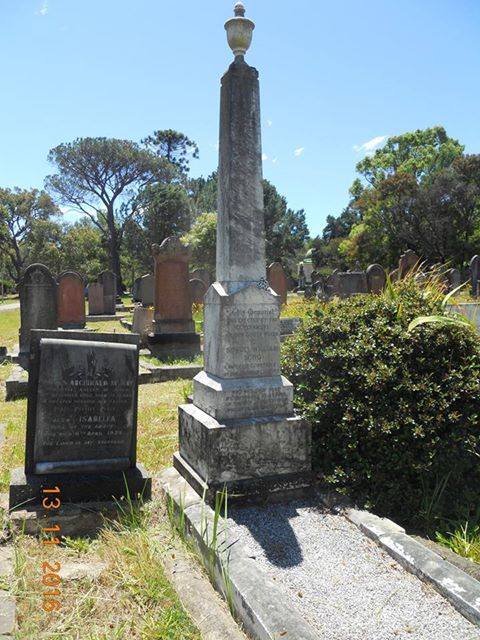
SMITH. — The Friends of the deceased Mr. RICHARD SMITH, late of Sergeant’s Point, Little River, Braidwood, are kindly invited to attend his Funeral; to move from Iona, Fernhill, Canterbury, THIS MONDAY, at 1.45, for the Ashfield Station, thence to the Necropolis.
Mrs. P. KIRBY and SON
Undertakers,
113 Miller-street, N. Syd.
.
SMITH. — The Friends of Messrs. T. WILLIAM,
JOHN and CORNELIUS SMITH are kindly invited to attend the funeral of their dearly beloved FATHER, Richard Smith to move from Iona, Fern Hill Canterbury THIS MONDAY at 1 45 pm for Ashfield Station thence to the Necrópolis
Australian Town and Country Journal (Sydney, NSW : 1870 – 1907),
Wednesday 10 June 1903, page 26
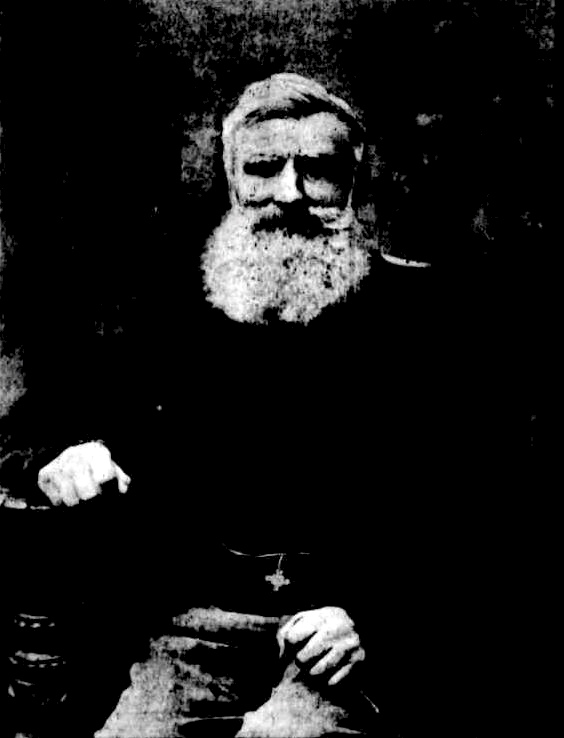
Lived 107 Years.
THE LATE MR. RICHARD SMITH.
Though so many people are living at the present time that it cannot be claimed that there is anything exceptionally remarkable about the mere fact that a man continues to exist, still the older we get the harder it is to keep going. When, therefore, a man reaches his hundredth year, the occurrence is an extremely rare one, as was demonstrated by the fact that the last census only resulted in the discovery of sixteen persons in all New South Wales whose ages exceeded 100. But even of centenarians only a very small percentage attain the great age of the late Mr. Richard Smith, who died on May 30 at Canterbury, as reported in last issue of the “Town and Country Journal,” aged 107 years.
Though, probably, the oldest man in New South Wales, Mr. Smith retained his faculties to an astonishing degree almost up to the time of his death. Some interesting personal details concerning the life of this veteran of veterans were afforded by Mr. J. R. Smith, of “Willathran,” Vernon-street, Woollahra, the deceased gentleman’s eldest son.
A native of Wiltshire, England, where he was born in 1796, he began life amid the surroundings of a farm, and his youth and early manhood were spent in agricultural pursuits. Many of his relatives, however, had joined the army, and he followed their example. That was upwards of
NINETY YEARS AGO.
He enlisted in the 50th Regiment, known as “The Blind Half-Hundred.”
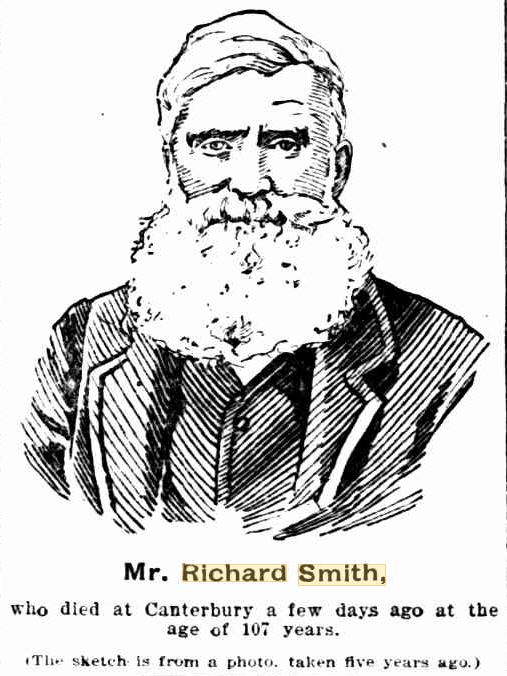
The Late Mr. Richard Smith, aged 107 Years.
When he came to Australia as a member of the 12th Regiment, in 1835, he was approaching what is usually termed middle-age, and had fifteen years‘ military ‘service to his credit, though William IV. was still King of England, and the late Queen Victoria – then Princess Victoria – was still a girl of 16.
“Shortly after his arrival here,” said his son. “he was chosen for duty as one of the governor’s orderlies. In the course of a year or two he went over to the police service. The force at that time was very differently constituted to what is the case now, and it was under a commissioner. I remember that he has sometimes spoken of a terrible drought which occurred here in 1837, and at that time he was doing police duty on the Manning River.”
“For over 23 years, or right up till 1860, he remained connected with the police force,” said Mr. J. R. Smith, “at the end of which time he retired, being then 64 years of age. His retirement was not, however, due to his years, for he was still very vigorous. He merely left the police because he wished
TO OPEN A HOTEL,
notwithstanding the fact that if he had remained in the force another year or so, he would have been entitled to a pension of 8s 6d per day.”
“It’s a good thing for the country that he didn’t serve the other year,” said the reporter. “Let’s see – 8s 6d per day since 1861 – that means that he would have drawn something like £6000 or £7000 before he died,” .
“Yes,” said Mr. Smith, “I suppose so. But he was drawing another pension right up to the time of his death, for his fifteen years’ military service, performed before he joined the police at all.”
“He qualified for that 66 years ago, then?” said the reporter.
“Well, not exactly. You see he wasn’t eligible for it, under the regulations, until he was 66 years of age, and. as a matter of fact, he didn’t get it until at least fourteen years after that.”
Mr. Smith said that his late father, as was only to he expected, had a wonderful store of knowledge respecting incidents of the early days, and would frequently talk of his adventures with bushrangers and other lawless characters whom he encountered in the curse of his police duties.
“On one occasion he told me,” said he, “a party of police, of whom he was one, was out in pursuit of a gang, who had just previously
STUCK UP A POLICE MAGISTRATE
and others. The approach of the attacking party was at first unobserved, and one of the desperadoes was seen to be parading before the fire, greatly to the amusement of the others, in the magistrate’s frock coat, silk hat, and goggles, which had been stolen. Not obeying the order of their pursuers to surrender, one or two of the gang were shot, and the rest captured.”
“Another incident I remember him telling me about occurred, I believe, he said, somewhere up in the direction of Maitland. An old couple had a visitor – the man’s brother, just out from England – staying with them, and, while he was out strolling one day, half a dozen bushrangers surrounded the place. As they did so the brother returned, and the crowd, seizing him unaware, pushed him in front of them in a rush at the door, thinking that the man Inside would not shoot. He, however, unaware that his brother was there, fired, and shot him dead. This attack was thought at the time to have been the work of convicts, but the guilty ones, when caught, were discovered to have been free men.”
“On one occasion he was one of an escort, which brought down five prisoners from Goulburn bushrangers – who were afterwards hanged on Church Hill. One of the condemned men, after being pinioned, asked for, and was granted leave to examine and select which of the five ropes that had been provided he should be hanged with.
“I think,” said Mr. Smith, “that my father was the first policeman sent out to the gold fields. In 1851 he was sent to Major’s Creek, as the sergeant in charge of nine men. Sergeant’s Point, Little River
IN THE BRAIDWOOD DISTRICT
was called after him. He remained there until his retirement from the force, nine years later.”
“He and the late Inspector Hogg, of Braidwood, who died some years ago at a ripe old age. were close friends all their lives out here, they both enlisted in the army in England on the same day.”
“When did your father retire from active work?” asked the reporter.
“He remained at Braidwood as an hotelkeeper for about 16 years,” was the reply, “and then he removed to the Queanbeyan district, where he lived for from 12 to 15 years, afterwards removing to Sydney. While he was in the Queanbeyan district, he was still able, I believe, to do a day’s ploughing with almost any man, although he was between 80 and 90 years old – In fact, I have heard an offer made to match him to plough against anybody. He had learned all about farm work, as I said before, previous to joining the army, and had not forgotten it.”
In reply to questions, Mr. Smith said that his father, who had not married until what, in most people, would be termed “late in life” ( though with him it proved to be comparatively early ), had left surviving him six sons and one daughter. Three of the sons reside at present in Sydney, the other two, besides himself, being Messrs. Cornelius and William Smith, both of whom live at Fern Hill, Canterbury, where their aged father died.
There were 21 grandchildren of whose existence he was aware, though he could not quite say how many children his brothers and sister had as they were in other countries. He did not think there were any great-grandchildren. One of his own sons, Mr. Harry Smith, besides being a very successful swimmer, had twice been champion long-distance runner of New South Wales, and was chosen by Simonetti, the sculptor, as the model for the figures surrounding the statue of Governor Phillip.
“Were there any other instances of remarkable longevity in your father’s family?” Mr. Smith was asked.
“I can tell you very little about that,” was his answer; “though I know that when we last heard of one of his brothers, many years ago, he was 96 years of age. I don’t know at what age his father died.”
“Was there anything exceptional about your father’s mode of living? Was he a teetotaler, or a smoker, and did he have any peculiarities in his ideas as regards diet?”
“No; nothing very particular, except for the rather strange circumstances that he abjured tobacco and spirits.
WHEN HE WAS 100 YEARS OF AGE.
He had been an inveterate smoker all his life. In fact, I well remember, when I was a youth, that he would often get up two, or three times in the night to have a smoke; but, just about seven years ago, he threw his pipe away, gave away some tobacco he had, and he never smoked again.”
The reporter wondered how long the old man might have lived had he not given up his pipe.
“He had always been fond of a glass, too,” continued Mr. Smith, “but he gave up spirits at the same time, and never touched them afterwards.”
“As for his diet, he would eat anything. I never heard him complain of digestive troubles In my life, and it is, I think, a remarkable fact that after he died it was found that every tooth in his head was
PERFECTLY SOUND;
he had not lost one. I have been fortunate in that respect too, up to the present; for I have not lost one of my teeth yet.”
“His eyesight was also excellent, right up to the time of his death. He never wore glasses, at any time.”
“Since removing from Queanbeyan to Sydney, some 12 or 14 years ago,” said Mr. Smith, in reply to another question, “my father has resided, at various times, at Church-street, Camperdown; at Ross-street, Forest Lodge ; at Parramatta-road ; at Balmain-road, Leichhardt; and at North Sydney and Greenwich. He only removed to Canterbury a few weeks before his death.”
“He was quite active up till about five years ago, and used to take upon himself all the care of my brothers’ horses and waggons, and they were doing a pretty extensive business, too. And, although he was not so active latterly, he retained his faculties surprisingly well.”
“Was he a big man?” the reporter Inquired.
“No; his height was only about 5ft 8in,” was the reply.
“There is one thing I may mention,” said Mr. Smith, in conclusion, “and that is, my father always went to bed very early, and was always a very early riser.”
The above story was basically reproduced on Saturday 6 June 1903 in the Braidwood Dispatch and Mining Journal but with the added text from the Editor B.D. about SMITH.
Braidwood Dispatch and Mining Journal (NSW : 1888 – 1954),
Saturday 6 June 1903, page 2
Death of a Centenarian.
The above account does not agree in several particulars with what is known by several oil residents of the district regarding the Sergeant Smith after whom Sergeant’s Point, on the Mongarlowe River, was named.
In the first place the Sergeant Smith who came here at the breaking out of the goldfields, and who was a contemporary of the later Inspector Hogg, of Braidwood, was a much younger man than the Mr Richard Smith above referred to and died we believe, several years since.
The Sergeant Smith of Mongarlowe never kept a public house in Braidwood.
Another Smith, the late Mr Edward Smith, who died some years ago, leaving a large family well known in Braidwood, Mr A. Smith, of this town, being one of the sons, also the late Mr. S. Smith, kept a public house here for a short time some forty years since, but of course it cannot be him.
However, we are not disposed to be too critical as to his identity or at all desirous of disclaiming as one of our old identities one who has lived to such a good round age.
It is certainly very singular that the deceased’s eldest son should err so much in his recollection of his father’s history, but all the same, there is a mistake somewhere. — Ed. B.D.
Braidwood Dispatch and Mining Journal (NSW : 1888 – 1954),
Wednesday 10 June 1903, page 2
The Death of Mr. SMITH. –
With reference to the death of Mr. Richard Smith, of Canterbury, near Sydney, at the age of 107 years, reported in your last issue, the ‘old hands‘ We quite endorse your remarks that he was not the Sergeant Smith who formerly occupied a position in the district, Mr W. B. Bruce, who knew the Sergeant Smith with whom Mr. Richard Smith is evidently confounded intimately, informs us that the former gentleman was drowned in the Moruya river some years ago.
Braidwood Dispatch and Mining Journal (NSW : 1888 – 1954),
Saturday 20 June 1903, page 2
LOCAL NEWS.
The Late Sergeant Smith.—
In a letter in another column Mr Hennessy sets the matter at rest about which some doubts have been expressed as to the late Mr. Richard Smith who died at Camperdown, near Sydney, at the age of 107 being identical with the Police Sergeant of that name after whom Sergeant’s Point at Little River was named.
Other persons in the district besides the writer referred to have informed us that they knew the deceased when he was stationed at Little River and held the rank of Sergeant, and when he afterwards kept the public house there under the sign of the Rising Sun, which it still bears.
Mr. J, D. Cargill, of Budawang, was one of those who knew him well in 1859. This was after be had retired from the police, when he must have been over 60 years of age. He afterwards with his family removed to Budawang, where he took a farm and resided for ten years, his wife dying while he was there, she being buried in the Church of England Cemetery as her tombstone at the present time testifies.
He afterwards with his three sons moved to Rob Roy station in the Queanbeyan district, and some years later they went to Canterbury where the old gentlemen died.
Mr. R. Geelao, who was then in the police, also knew him well at Little River, as did Mr Peter Wedd, of Durran Durra, and other old residents.
The Sergeant Smith referred to by Mr. Bruce as having been drowned some time since in the Moruya River was the officer in charge at Nelligen for several years, who on his retirement from the police went to live at Moruya.
Braidwood Dispatch and Mining Journal (NSW : 1888 – 1954),
Saturday 20 June 1903, page 2
Original Correspondence.
[ To the Editor of the Dispatch.]
Sir, — In your issue of June 6th you express a doubt that the late Sergeant Smith who recently died at the ripe age of 107 was ever stationed at Little River. Your Araluen correspondent follows on in the same strain. I think I can supply you with a few facts that will remove all doubts as to the Sergeant Smith alluded to being in charge of the police station at Little River.
I think it was late in 1856 I went with a- party of men to a rush that had taken place at Little River some time previous to that date. We found on arrival at Sergeant’s Point the late D. Barrett, who died some time since in the Braidwood Hospital, keeping an hotel.
Opposite the pub, was a store kept by E. McEvoy, brother-in-law to Barrett. Lower down on the river bank was another store, kept by the late W. J. Bennison. Pat. Bollard also kept a butcher’s shop on the Point.
Sergeant Smith was the officer in charge of the police station. Under Smith was a trooper named Charlie Walmsley, who, I believe, some time after rose to the rank of sergeant and was for some time in charge of the police station at Araluen.
One member of our party was a young man named Lane, a native of Windsor. Lane‘s father had been a member of the N.S.W. Mounted Police for a great number of years, and had only retired from active service just about the time young Lane started for the diggings.
Judge of young Lane‘s surprise when he met Sergeant Smith at Little River, for he knew the sergeant to be a staunch friend of his father’s, for they bad been comrades in many a fierce encounter with blacks and bushrangers, and it is more than probable that when the bushranger dressed up in the police magistrate’s rig-out, was creating some amusement for his companions in crime.
Lane‘s father was one of the approaching body of police that put an end to the fun.
Like Sergeant Smith‘s son, Lane tells of encounters with bushrangers that he had heard from his father’s lips.
One encounter of which he has heard his father speak was with the notorious Jack Donoghoe, whose heroic fight single handed with the police was celebrated in song.
When deserted by his four companions Donoghoe took up a position under cover and awaited the attack, the police bever fashion separated and sought shelter also, both parties blazed away for some time without drawing blood.
Amongst the troopers engaged in the affray was a young recruit anxious to get his name up, the young trooper fired rapidly and bad fired all his ammunition, with the exception of one charge, when loading his pistol with the last charge, he called out to his nearest companion that he was about to fire the last shot, having exhausted his stock of ammunition.
Just then Donoghoe, trying to get a view of the enemy, exposed his head. The young trooper fired, and the bullet crashed through the bushranger’s brain.
In a future communication later on I will detail the circumstances under which Donoghoe was driven into the bush to take up arms against law and order.
I dare say, I saw Sergeant Smith, three or four times every week for 12 months. I never spoke to the old man, I, at that time, being a boy entering my teens.
Constable Joseph Nash, who was in charge of the local police station, was found dead in the barrack-room at noon today.
The police authorities in Sydney have received a telegram stating that Constable Nash had been found dead with a bullet wound in the head, the circumstances of the case pointing to suicide.
An officer at Armidale has been sent to North Guyra to make full inquiries.
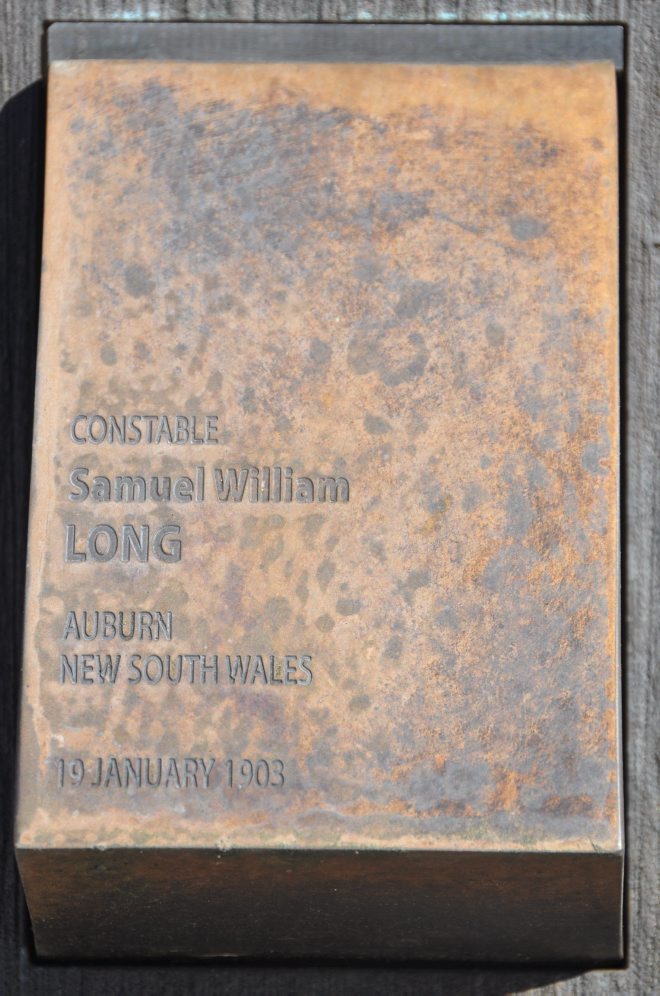
In the early hours of 19 January, 1903, Theodore Trautwein, the licensee of the Royal Hotel at Auburn was awakened by a loud noise. The sound had appeared to come from the bar area of the hotel, and taking a revolver with him, Trautwein went to investigate. In the bar he saw and heard a person lying on the floor, apparently in great pain. As other residents of the hotel appeared, a candle was lit and it was found that the injured person was a local constable, Samuel Long. A doctor was called and it was found that the constable had suffered a severe gunshot wound to his head. He died a short time later, unable to identify his attacker. A lengthy investigation eventually revealed that the constable had been shot while trying to apprehend two offenders, Digby Grand and Henry Jones, whom he had caught after they had broken into the hotel. After the shooting the offenders had escaped by horse and sulky, however they were both later arrested, charged and convicted of the murder of Constable Long.
The North Western Advocate of 8 July, 1903 announced the execution of the murderers.
EXECUTION OF AUBURN MURDERERS
Sydney, Tuesday ” The State Cabinet having considered the petition for the respite of Digby Grand and Jones, convicted for murdering Constable Long at Auburn, declined to interfere and the men were hanged this morning at 9 o’clock. ”
The constable was born in 1865 and joined the New South Wales Police Force on 6 July, 1894. At the time of his death he was stationed at Auburn.
[divider_dotted]
The Auburn Murder Trial.
The Sydney Mail 11 February 1903 p 8
At the Central Police Court on Monday, before Mr. E. H. Wilshire, S.M., the hearing of the case in which Digby Grand, 32, alias Newbold, alias Stephens, alias Ward, bootmaker, a native of Victoria ; John Thomas Woolford, 27 butcher ; and Albert Yeomans, 24, horse trainer, were charged with having, in company, feloniously and maliciously murdered Constable Samuel William Long, at Auburn, on January 19 last year, was resumed.
Mr. Cargill, of the Crown Law Office, appeared to prosecute ; Mr. E. R. Abigail appeared for the accused Grand, and Mr. W. Niland for the accused Yeomans.
Mr. Cargill said that there was no further evidence to call against Woolford, and he was discharged.
Joseph Daniel Gallagher and William Gallagher were cross examined by Mr. Abigail and Mr. Niland as their personal habits and connection with the police.
Francis Henry Furnval, qualified medical practitioner, residing at Auburn gave evidence as to having examined the dead body of Constable Long about 2.30 on the morning of the murder.
JONES ARRESTED.
Henry Jones, for whom the Government offered 200 pound reward, was arrested in a terrace house at Ada street, Ultimo, on Tuesday afternoon.
Sergeant Carson and Constable MacKay, plain clothes officers at No. 4 station located the suspect. Sergeant Carson and Constable Clarke went to the front of the house about 2.30pm and Detectives Jones, MacKay, and Lenehan to the rear.
They entered simultaneously, revolvers drawn, and found the man they wanted seated playing cards with other men and women. He differed from the photo we published last week in that he had grown a pointed reddish beard, and with the protection of this disguise was in the habit of going out by night. He admitted his identity on the police entering, revolvers drawn, and attempted no resistance. The inmates of the house said he had been only living with them a week.
He was taken to the Central Police Court and placed in the dock with Grand and Yeomans at 3.30pm. Their trial had been proceeding for an hour before Mr. Wilshire, and Woolford was in the witness box giving evidence, which followed the lines of his confession given by us last week, and which was to the effect that he saw Grand and Jones enter the hotel bar after vainly endeavouring to get him to actively participate, saw Constable Long come along and go through the open door to investigate, heard a shot, and saw Grand and Jones rush out and run away. Jones, described as alias John Maguire, alias Baker, 36, clerk, was charged and remanded for eight days. Grand and he exchanging a few quiet words as he left the dock, and the hearing of the evidence was then resumed.