1

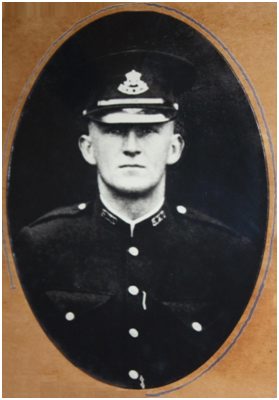
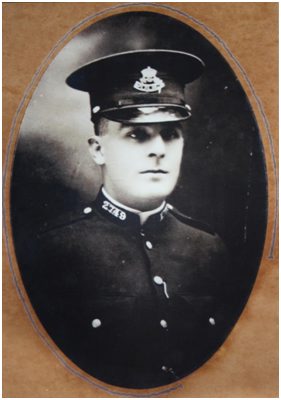
Donald Alexander Shepherd ALCHIN

Donald Alexander Shepherd ALCHIN

AKA  Don

Late of 1 Dudley Ave, Roseville, NSW

NSW Redfern Police Academy Class #  ? ? ?

New South Wales Police Force

Regd. #  ‘Q‘ 8623

For the purposes of this website ‘Q‘ represents those Police joining between 1 March 1862 ( commencement of NSWPF ) – 23 February 1915 ( Commencement of NSWPF current numbering system )

Rank:  Commenced Training on ? ? ?

Probationary Constable- appointed 11 March 1907

Constable – appointed ? ? ? 

Constable 1st Class – appointed ? ? ? 

Detective – appointed ? ? ?

Senior Constable – appointed ? ? ? 

Sergeant 3rd Class – appointed ? ? ? 

Sergeant 2nd Class – appointed ? ? ? 

Sergeant 1st Class – appointed ? ? ? 

Final RankDetective Sergeant

Stations?, C.I.B. – Surry Hills

Service:  From ? pre March 1907   to   31 May 1931 24+ years Service

Awards?


Born:  Sunday  2 November 1879

Died onSunday  31 May 1931

Age:  51

Cause?, ” Long Illness ” ?

Event location:  Royal North Shore Hospital, NSW

Event date ?


Funeral dateMonday  1 June 1931 @ 2pm

Funeral location:  Christ Church, Lavender Bay, NSW

Funeral Parlour:  MOTOR FUNERALS LIMITED, 76 Walker-street, North Sydney.

Teles., X5227, M6277.


Buried atNorthern Suburbs Cemetery, Plassey Rd & Delhi Rd, Macquarie Park, NSW

 Grave location?


Memorial / Plaque / Monument located at: ?

Dedication date of Memorial / Plaque / Monument: Nil – at this time ( April 2020 )


DONALD is NOT mentioned on the Police Wall of Remembrance  *NEED MORE INFO


FURTHER INFORMATION IS NEEDED ABOUT THIS PERSON, THEIR LIFE, THEIR CAREER AND THEIR DEATH.

PLEASE SEND PHOTOS AND INFORMATION TO Cal


May they forever Rest In Peace

https://www.facebook.com/groups/AustralianPolice.com.au/

https://www.facebook.com/groups/NSWFallenPolice/


ALCHIN.—May 31, 1931, at the Royal North Shore Hospital, Donald Alexander Sheperd Alchin, beloved husband of Margaret and dear daddy of Bryan.

At rest.

ALCHIN. —The Relatives and Friends of Mrs. MARGARET ALCHIN and SON, BRYAN, of 1 Dudley-avenue, Roseville, are invited to attend the Funeral of her beloved HUSBAND and his FATHER, Donald Alexander Sheperd Alchin (late detective-sergeant); to leave Christ Church, Lavender Bay, THIS AFTERNOON, after a service commencing at 2 o’clock, for Church of England Cemetery, Northern Suburbs, per Motor Service.

Please leave floral tributes at Christ Church.

MOTOR FUNERALS LIMITED,

76 Walker-street,

North Sydney.

Teles., X5227, M6277.

[1-6-1931 SMH]

https://austcemindex.com/inscription?id=3507096


Sydney Morning Herald (NSW : 1842 – 1954),

Monday 1 June 1931, page 10

SERGEANT D. ALCHIN.

Detective-sergeant Donald Alchin died at the Royal North Shore Hospital yesterday at the age of 52 years.

Detective-sergeant Alchin Joined the police force in 1907, and served a short period in uniform before being transferred to the plainclothes branch, and then to the Criminal Investigation Branch.

He was very successful as a detective, and played a leading part in solving a number of crimes, most important, perhaps, being his work in securing the clue which led to the arrest of an Italian gang at the Commercial Banking Company’s branch in Castlereagh-street a few years ago.

The gang was arrested red-handed on the premises.

Detective Alchin is survived by Mrs. Alchin and a young son.

The Interment will take place in the Northern Suburbs Cemetery this afternoon, after a service at Christ Church. Lavender Bay, commencing at 2 o’clock.

https://trove.nla.gov.au/newspaper/article/16782223


Daily Telegraph (Sydney, NSW : 1931 – 1954),

Tuesday 2 June 1931, page 9

100 POLICE HEAD CORTEGE FUNERAL OF DETECTIVE

One hundred policemen in uniform marched at the head of the funeral of the late Detective-Sergeant Alchin, through the streets of North Sydney yesterday, the cortege being nearly half a mile long.

The pall-bearers were Detective-Sergeants Ryan, Eaton, Garlick, Regan, Mackie and Wilson, and others present included Superintendent Mackay, C.I.B., Inspectors Pattinson ( representing the Commissioner of Police ), Scott, Mortimer and Prior, and ex-Inspector Young.

Rev. Frank Cash held a short service in Christ Church, Lavender Bay, before the funeral moved off, and at the graveside, at Northern Suburbs Cemetery, the Masonic funeral service was conducted by Wor. Bro. W. Whitehead. W.M.. Lodge Glebe, assisted by Bros. G. S. Jackson. P.M.. F. H. Williams. P.M.. W. Kilner. S.M., and W. Andrews, treasurer.

https://trove.nla.gov.au/newspaper/article/246248829


Burrowa News (NSW : 1874 – 1951),

Friday 5 June 1931, page 1

Too Clever for ” The King “

DETECTIVE SERGEANT ” DON ” ALCHIN DEAD

Recognised as a man who knew more about foreign criminals and their methods than anyone in the Criminal Investigation Branch, the police force lost one of its cleverest detectives by the death, after a long illness, of Det-Sergeant Donald Alchin.

If ‘Don’ Alchin had done nothing else of note in a career of over twenty years, he would have been entitled to the great reputation he had in the C.I.B. for his work in the sensational arrest of Lucci ( ” The King ” ) and his famous gang of Italian cracksmen.

Australia has never known a gang so daring, so cunning, and so successful in their operations, as the Italian of whom Lucci, son of an Italian police chief, was leader.

Using giant cutters and tools which opened safes as if they had been made of tin, the gang brought off coup after coup, outwitting detectives at every turn. Det.Sergeant Alchin was the man who finally got on their tracks, and after weeks of relentless search finally ran them to earth.

It was Alchin who learnt of their plans to rob a Castlereagh Street bank, and he was the leader of a posse of detectives who arrested the gang at revolver-point just as they were about to set to work on a strong-room confining thousands of pounds.

Alchin brought to book many foreign criminals, mainly Italians, and was an expert on coining cases.

( The Police Band will be in attendance at the funeral which leaves his residence, Dudley Ave, Roseville, for the Northern Suburbs Cemetery this afternoon. )

https://trove.nla.gov.au/newspaper/article/102376536

https://trove.nla.gov.au/newspaper/article/246247062
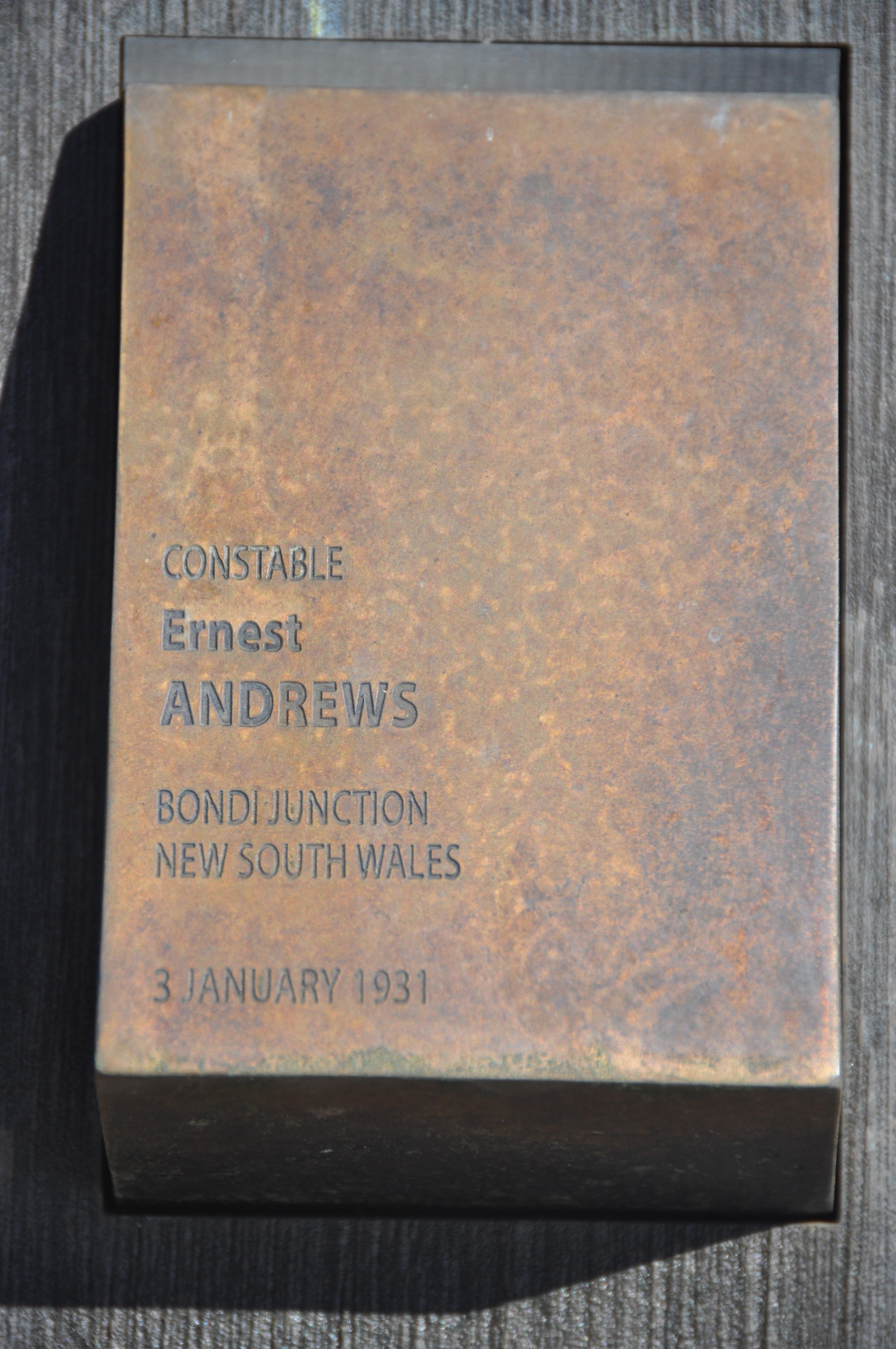


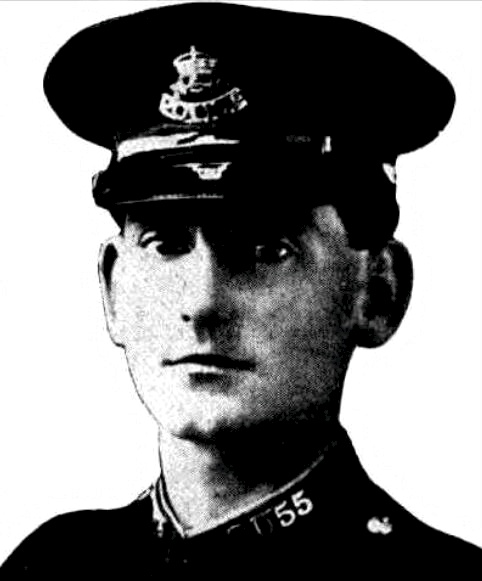
Ernest ANDREWS

Ernest ANDREWS

New South Wales Police Force


Rank:  Constable


Regd. #  31??


Stations:  George Street North Police Station


ServedFrom  24 April 1929 to 3 January 1931 = 1+ years Service


Awards:  No find on It’s An Honour


Born? ? 1908

Died:  3 January 1931

Age:  23

Cause:  Shot – Murdered at Bondi Junction


Funeral date:  5 January 1931

Funeral location:  Rookwood Cemetery


Buried:  Buried in Rookwood Cemetery ( side by side with Norman Thomas ALLEN )

Zone: C  Section:  09  Grave 4211

DOUBLE POLICE MURDER

Memorial location:


Ernest ANDREWS touch plate at the National Police Wall of Remembrance, Canberra


Ernest IS mentioned on the Police Wall of Remembrance

Constable Norman Thomas Allen ( 1931 )

Constable Ernest Andrews ( 1931 )


Constable Allen was shot in the street at Bondi Junction while attempting to detain an armed, deranged man named Kennedy who had earlier had an altercation with a local shopkeeper. The constable had been directing traffic and when informed of the dispute he found and confronted the offender. As he approached Kennedy from behind, the man spun around and shot Constable Allen in the chest at point blank range. He then shot the constable twice more in the heart. At this time Constable Andrewsunarmed, off duty and heading for the beach – passed by in a tram and saw a crowd gathered around the body of Constable Allen. Alighting from the tram he joined in the pursuit of Kennedy who managed to reach his home in nearby Lawson Street.


On arriving and finding the front door locked Constable Andrews went to the rear of the dwelling and burst through the back door. Unfortunately Kennedy was waiting with rifle raised and as Andrews lunged at him he shot him twice in the chest. He then took a knife and stabbed the constable in the throat. Sergeant Seery and Constable Johnson from Waverley Police then arrived and began to smash their way in through the front door. Although fired at by Kennedy, Constable Johnson returned fire, hitting Kennedy in the chest. Seery and Johnson then smashed their way in and found the offender in a bedroom bleeding to death. He died that night.


In the aftermath of the murders, the Brisbane Courier dated 5 January, 1931 published a complete account of the entire incident, and concluded with the following.

COMMISSIONER PRAISES MURDERED POLICE.


Both murdered constables were highly efficient and popular officers. Allen leaves a widow and young child. He lived in New Street, Bondi. Constable Andrews was single, his only relative in Australia being a sister, Mrs Clark. The men will be buried tomorrow with full police honours. The Commissioner of Police Mr. Childs, in an appreciation, said “I wish to pay a tribute to the manner in which both these young men carried out their duty according to the best traditions of the service. They saw their duty before them, and did not hesitate a moment in the execution of it. Although I would not make any distinction between them I cannot help referring to the action of Constable Andrews, who, though unarmed, rushed in to effect the arrest of a man who had already shot Constable Allen. “


Constable Norman Thomas ALLEN was born in 1901, joined the New South Wales Police Force on 14 May, 1926 and shortly thereafter resigned. He rejoined on 26 September, 1928. At the time of his death he was stationed at Waverley.


Constable Ernest ANDREWS was born in 1908 and joined the New South Wales Police Force on 24 April, 1929. At the time of his death he was stationed at George Street North Police Station.


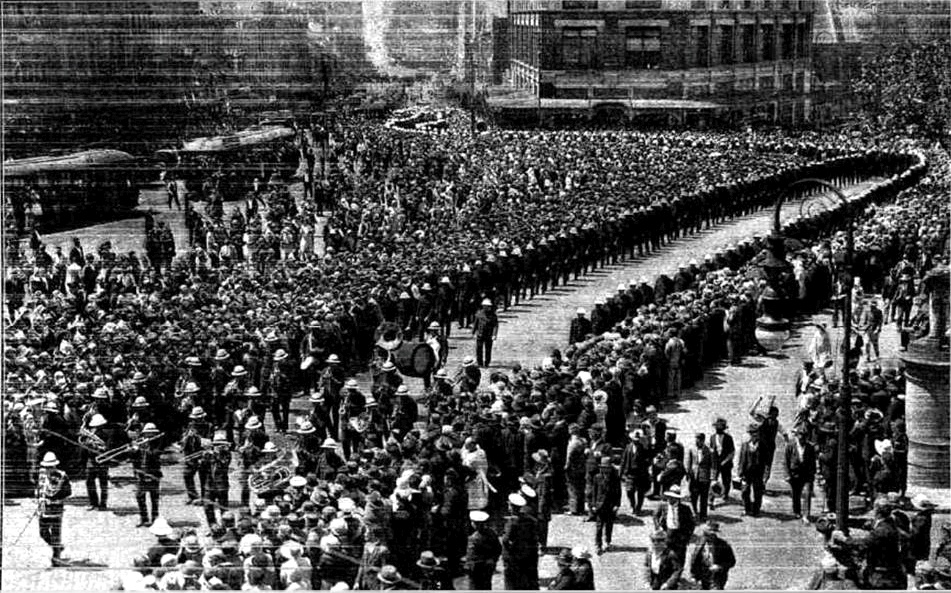
Funeral procession through Railway Square in 5 January 1931 for two police constables, Allen and Andrews, killed in the line of duty. Source: Sydney Mail newspaper 7 January 1931


The Sydney Morning Herald

Tuesday  6 January 1931                                       page 10 of 14

DEAD POLICEMEN.

Impressive Scenes at Funeral.

THOUSANDS PAY TRIBUTE.

The State paid homage yesterday to the two policemen, Constable Norman Thomas Allen and Constable Ernest Andrews who met their death at the hands of a madman at Bondi Junction on Saturday. There were mourners from almost every part of New South Wales.

Many thousands lined the route as the funeral cortege moved from Wood Coffill’s funeral parlours George-street to the mortuary station; the mortuary platform was   thronged when the funeral train moved off to Rookwood and thousands had assembled in the cemetery.

The scene in the vicinity of Wood Coffill’s funeral parlours is likely to be remembered by the thousands of people who thronged the streets leading into Railway-square. Early in the morning bearers of wreaths and floral tributes passed through the doors to deposit their tokens of sympathy. At the approach of noon people began to assemble on the footpath and many entered the chapel to view the coffins. The near relatives arrived at 1 o’clock and the chapel was cleared while     Constable Allen’s widow and her mother approached the silver mounted caskets which rested on trestles side by side. An affecting scene followed. Then the simple Church of England burial service was conducted by the Rev Frederick Riley and the coffins were borne to the waiting hearses.

MUFFLED DRUMS

The scene was unforgettable. A solid mass of people crowded the thoroughfares. Presently the mounted troopers urged their restive horses forward and with the deep roll of muffled drums the cortege moved off. Thousands of hats were removed.

Handel’s Dead March in “Saul” was played by the Police Band. Behind the band came a contingent of foot police under the direction of Superintendent Leary. Two hundred men drawn from the various stations, marched behind. Then came the hearses, the wreath-laden carriages, and the chief mourners, Firemen, the sun glinting on brightly-polished helmets, were represented by over 40 uniformed officers and men. At the end of the slow-moving procession came numbers of retired men, friends of the dead officers, and business people from the eastern suburbs.

Along the route to the mortuary thousands stood bareheaded as the cortege passed. At the mortuary gates another huge crowd paid tribute to the dead men.

Among those who marched in addition to the police and firemen, were employees of motor bus companies in the eastern suburbs.

“THEY SAW THEIR DUTY.”

A most affecting scene at the graveside in the Church of England section of the Rookwood Cemetery was the playing by the police band of the hymns “Lead Kindly Light” and “Abide With Me.” The remains were buried side by side.

“Let men’s opinions be what they may,” said the Rev. Frederick Riley in an address at the graveside, ” we should be doing violence to the most sacred emotions of human life if we were to allow our brethren to depart without a word of farewell. We are met here today to pay honour to the memory of two men who were comrades of yours men whom we all respected and loved. Let us remember that these two men died in the carrying out of their duty. They served their King and country as men and soldiers who fall for their King on the battlefield. They saw their duty and the fear of death could not deter them. They have not created a new tradition for the traditions of the police force of New South Wales are amongst the highest in the world already, but these two men have added a new lustre to the traditions of your past. These two young men Norman Thomas Allen and Ernest Andrews, died in the execution of their duty. There is no higher glory to which a man can aspire. We pray to God that those who have been so suddenly bereaved may share the comfort which we know these two brave men are experiencing in the nearer presence of God.”

MAGISTRATE’S TRIBUTE

At the Burwood Police Court yesterday Mr. G. R. Williams, S.M. commented on the bravery of the two constables. They acted nobly and upheld the traditions of the force,” he said.

PALL BEARERS AND MOURNERS.

The pall bearers were.- For late Constable Allen: Constables Tomkins, Martin, Moore, Hudson, Steele and White. For late Constable Andrews: Constables Booth, Kimber, Fraser, O’Neill, Morgan, and Wright.

The principal mourners were Relatives of the late Constable Allen: Mrs Allen (widow), Mrs Prankish (mother-in-law), Mr and Mrs N. Frankish (brother In law and sister in law), Mr and Mrs Sutcliffe (uncle and aunt) Mrs Lamb, Mrs Hourigan, and Mrs Cummings (aunts) and Mr Rowland Allen (cousin).

Relatives of the late Constable Andrews: Mr and Mrs Edward Clarke (sister and brother in law).

The Government was represented by Mr Gosling (Chief Secretary) and Mr McKell (Minister for local Government). Police representatives in addition to the non commissioned officers and men who marched were Mr W H Childs (Commissioner) Superintendents Leary, Mackay and Linegar, Inspectors Winter, Weir, Bennetts, McCauley, Woodrow, Lynch, Duffell, Roberts, McMaster, O’Brien, Chaseling, Anderson,  White, Long, Roser, Scott, Michaelis, Robson, Allen, Farley and Fowler.

Retired members of the police force who attended were ex-Commissioner James Mitchell, ex-Superintendents Roche, Cook, McIntosh, Sinclair, Thom, Drew and Park, ex Inspectors Fullerton, W J Jones (also representing the Navy and Army Veterans Association) Fraser, Tracey, Bolton, Smith, Fewster, Doran, Mankletow, Stutchbury, Briggs, Ewen, Dunn, O’Dea and Robertson, ex-Sergeants McDonald, T. Dobson, Payne, A. Smith, Taylor, J. Salmon, J. Loomes, R. C. Harper, Bath and Butcher, ex-Constables Swan and Dixon.

The Board of Fire Commissioners of New South Wales was represented by Mr T J Smith, M.L.C. (president) Mr J McNamara (Commissioner), and Mr H M Webb (secretary and executive officer).

Mr Nance chief officer New South Wales Fire Brigades was present and 38 men marched under Mr Grimmond (deputy chief officer). Inspector Neeve, District Officer McLachlan, and Station Officers Arthur, Neville, Parkes, McCarthy, Rust, Currier and Sclater.

Others who attended were:- Judge Sheridan, Mir George Cann, ex M.L.A., Mr J Herlihy ( Under-Secretary for Lands) representatives of the Prisons Department including Mr Seery (superintendent of the Long Bay Penitentiary) Mr T.W. Irish (Assistant Under Secretary for Lands) Mr H. B. Mathews, (Surveyor General Department of Lands).

Mr N. W. Bond (representing the head office Bank, of New South Wales) representatives of ambulance divisions, Mr. and Mrs. C. R. Law, Mr. A. L. Parker (representing Superintendent O. H. Parker, of Goulburn) Mr Foster Doolan (vice president Police Association), Mr B Fortescue (secretary Police Association), Mr C T Thackeray (Police Association staff), Mr F M Jackson (representing Mr F C Hackett of Merriwa), Mr W T Missingham,

M.L.A., Mr A J Pollack, M.L.A., Mr W P Monaghan (Waverley Cemetery bus service), Mr W M Niland Mrs A Shuttleworth, Mr H L Harnett (representing Mr F M Burke, Speaker of the Legislative Assembly), Mr W E Clapin (representing Sir John Peden, President of the Legislative Council), Alderman David Hunter (Mayor of Waverley), Mr T J Thompson (Deputy Town Clerk of Waverley), Mr and Mrs A Williams, Miss Williams, Miss Beryl Williams, Miss   Brady, Mr and Mrs McMorland, ex Warder Charles Stone, ex Warder Little and a number of eastern suburbs business people.

The wreaths Included those from the mother and other relatives of the late Constable Allen, relatives of the late Constable Andrews, the New South Wales Police Commissioned Officers Association, comrades of No 2 Division, Redfern Police, New South Wales Police Association, members of the Railway Detective Office, officers, detectives, and staff of the C.I.B., No 3 Police, comrades of No. 10 Division, cyclists and drivers of police headquarters, officers and men of Circular Quay Fire Station, comrades at No. 4 Station, police at No 7 Station, “police pals at Bondi Junction.” end eastern suburbs bus drivers and conductors.

http://trove.nla.gov.au/ndp/del/article/16743642


Trevelyn Cuthbert NOWLAND

Trevelyn Cuthbert NOWLAND

New South Wales Police Force

Constable

Drowned

31 years

Bendemeer

6 October, 1931

Trevelyn Cuthbert NOWLAND


In 1931 Constable Nowland was the lone policeman attached to the Bendemeer Police Station. On the night of Sunday 4 October, 1931 a man came to the station to complain that he had been camped under the bridge at the river and had been accosted by a “madman” who had threatened to kill him. He requested that the constable come down to the bridge, which was at the McDonald River, a distance of less than 300 metres to look for the madman. The constable obliged, however after a brief search under and around the bridge, the alleged “madman” could not be found. The following night the man again came to the police station with the same complaint. (It was believed to have been the same man both nights as Mrs Nowland heard his voice on both visits, although she never actually saw him). The constable took his revolver and set out to search the bridge area again. When he failed to return home by the morning Mrs Nowland telephoned the police at Tamworth.


Police from Tamworth quickly travelled to Bendemeer and, with the assistance of an Aboriginal tracker, began to search for the missing man. Later that afternoon Constable Nowland’s body was found and recovered from the McDonald River. He was still fully clothed, except for his cap, and the body had no apparent signs of violence, although apparently the constable’s nose had been bleeding before he fell or was thrown into the water. At the spot where the body was found the water was only three to four feet (about 1 metre) deep.


The Brisbane Courier dated 7 October, 1931 reported that “The police believe that Nowland was insensible or dead before he entered the water. It is thought that Constable Nowland did not reach the bridge last night. His way would have taken him past a hotel, and beneath brilliant lights, and it is considered that he would certainly have been seen had he gone direct to the bridge from the police station. It is thought probable that he was attacked almost as soon as he left the police station, and was then taken to the river and thrown into the water insensible. The police are handicapped by the absence of any description of the man who twice called at the police station and spoke of the lunatic. Constable Nowland was the only one who saw him.”


The Sydney Morning Herald of 10 November, 1931 reported the open finding of the inquest into the constable’s death, as follows.

“BENDEMEER MYSTERY – CORONER’S OPEN VERDICT.
TAMWORTH. Monday.
The inquest into the death of Constable Nowland, whose body was found in the McDonald River on October 5, came to an end to-day, when the coroner (Mr. Geikie, P.M.) returned an open verdict. Six sessions of the inquest have been held, and 24 witnesses have been examined. In delivering his finding, Mr. Glekie said that the case was marked by many conflicting and mysterious statements. If it was suicide, then the deceased must either have been sane or insane. If he was sane, the first thing was to look for the motive, and the evidence adduced no such motive. If he was insane, no motive need be looked for. There was not a tittle of direct evidence of mental derangement in the constable up to the time of his death. His finding would be that Nowland was found dead in the McDonald River without any marks on the body; further, that death was due to drowning, but how or by what means drowning came about the evidence did not say.”

The mystery of what exactly happened to the unfortunate Constable Nowland has apparently never been solved, although theories ranging from suicide to poisoning to murder have long been put forward. A coroner’s inquest into the death gave the cause of death as drowning, however the surrounding circumstances remain unknown.


The constable was born in 1901 and was aged 31 years when he died.  He joined the New South Wales Police Force on 25 August, 1922. At the time of his death he was stationed at Bendemeer. He is not listed in the official New South Wales Police Honour Roll.


[divider_dotted]


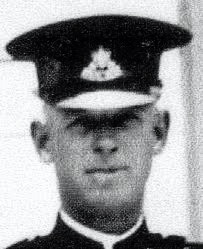
George Thomas WHITELEY

George Thomas WHITELEY

AKA ?
Late of ?

NSW Penrith Police Academy Class # ? ? ?

New South Wales Police Force

Regd. #  ‘Q‘ 9081

For the purposes of this website ‘Q‘ represents those Police joining between 1862 ( commencement of NSWPF ) – 23 February 1915 ( Commencement of NSWPF current numbering system )

Rank:  Constable ( Mounted Police Trooper ) – appointed 15 March 1910

Sergeant 3rd Class – appointed ? ? ?

Final Rank = Sergeant 3rd Class

Stations: ?, Hill End ( Constable – 1913 ), Fifield ( SenCon 1920 ), Berrigan ( 2 years ) – Death

Service: From 15 March 1910 to 25 March 1931 = 20+ years Service


[blockquote]

World War I

Australian Imperial Force       1914 – 1919  ( completed 4 years & 235 days in the A.I.F. with 4 years & 72 days of that overseas )

Regiment:                                     Army / Flying Corps – 4th Battalion ( 1914 ), 1st Australians ( 1915 ), 1st Div HQ ( ? – 231016 ), AIF Depot in U.K. ( ? – 160419 – Retired from Duty – Ulcerated stomach ),

Enlisted:                                       25 August 1914 at Kensington, NSW  ( 51 pages of records )

Service #                                       88

Rank:                                             Private ( 250814 ), Corporal  ( 101115 ), – Acting Sgt ( 090417 ), Corporal ( 030318 ), ER Sgt ( 040318 – 230818 )

Embarkation:                              201014 at Sydney on H.M.A.T. A14 ‘Euripides”

Age at embarkation:                  25 yrs 10 mths

Occupation:                                 Mounted Police Trooper

Address:                                       Bega

Next of kin:                                  Father:  George Edward WHITELEY – A farmer

Religion:                                       Roman Catholic

Single / Married:                       Single

Returned to Australia:            191018 from Plymouth, England on D24, “Sardinia”

Awards:                                         1914 /15 Star,  Returned Solider badge # 87105

Injuries:                                        gunshot ( shrapnel ) wound to lower lip – 130515. 9 days under treatment.  Gunshot wound to left leg, left foot & right side of head.  He stated that while serving in Gallipoli, he suffered from indigestion for the first time and has suffered on and off whit it ever since.  In the past twelve ( months ) the attacks of pain with occasional vomiting have been more frequent….  Twelve days before admission and on the 5th July, he vomited about a couple of pints of blood.

Attributable to service during war and active service conditions in Gallipoli.

Discharge #:                                56009

Previously Served in the Colonial Force.

Description:  5′ 8″ tall, fair complexion, blue eyes and fair hair.  Chest = 34.5 – 40″.  11 stone 12 lbs. No marks on body.

[/blockquote]

Sgt George Thomas WHITELEY ( 29 old ) of 1st Division H.Q., ( The Hutment Camp, Abbotsbury Rd, Wyke Regis, U.K. married Kate HARPER ( 22 old ), Spinster of 2 Block A, The Flats, Tidworth, England ( occupation: Clerk ) at St. Augustine’s Chapel, Dorchester Rd, Melcombe Regis, Weymount, England by Roman Catholic Priest Thomas Sheehan on the 3 October 1918.  Registrar’s Reference # 80.

In 1936 – after the explosion, his wife was living at 134 Railway Pde, Carlton, NSW.  This address ( 2019 ) is / was the Westpac Bank, Kogarah.


Awards: No find on It’s An Honour

Born: ? ? 1886 – Bega, NSW

Died on:  Wednesday 25 March 1931

Age: 44 – 45

CauseGas Cylinder Explosion

Event location: outside Momalong Hotel, Berrigan

Event date:   Wednesday 25 March 1931

Funeral date: ? ? ?

Funeral location: ?

Wake location: ?

Funeral Parlour: ?

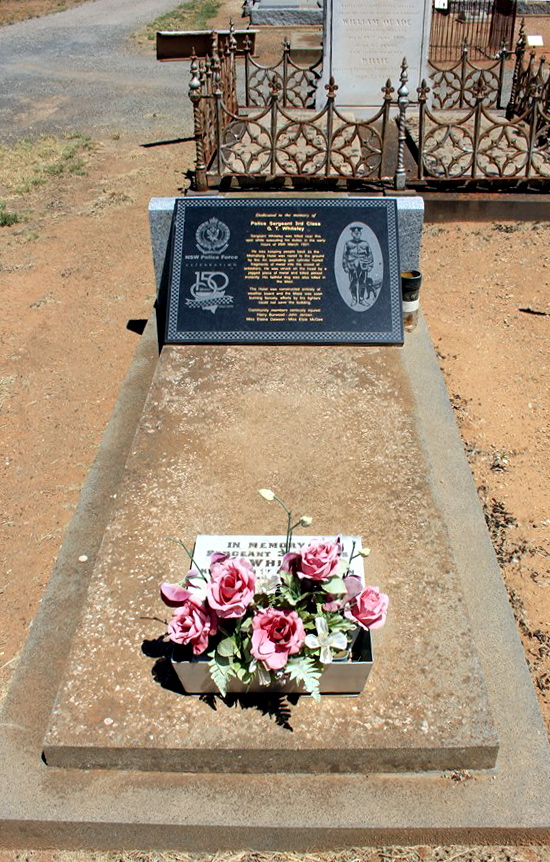
Buried at:  Berrigan Cemetery, Momalong St, Berrigan

Memorial located at: Photo hanging inside of Berrigan Police Station

Sgt George Thomas WHITELEY - Explosion - 25 March 1931

[alert_green] GEORGE IS mentioned on the Police Wall of Remembrance[/alert_green]

[divider_dotted]


Funeral location: TBA

[divider_dotted]

FURTHER INFORMATION IS NEEDED ABOUT THIS PERSON, THEIR LIFE, THEIR CAREER AND THEIR DEATH.

PLEASE SEND PHOTOS AND INFORMATION TO Cal

[divider_dotted]

May they forever Rest In Peace

[divider_dotted]

About 4am on 25 March, 1931 Sergeant Whiteley and Constable McRae attended a fire at the Momalong Hotel, Berrigan.

During the fire both police officers were standing on the roadway outside the hotel when a gas cylinder exploded and a piece of flying metal struck the sergeant in the face, causing “injuries of a terrible nature” and killing him instantly.

Three bystanders (of an estimated two thousand who were watching the blaze) were also badly injured in the blast and another five were hit by flying steel, however all others recovered.

The sergeants faithful dog, which was standing beside his master, was also struck by flying debris and killed instantly.


The Canberra Times of 26 March, 1931 carried the following account of the incident.


FATAL EXPLOSION IN FIRE AT BERRIGAN. Police officer killed by flying steel.

Sydney, Wednesday.

The explosion of a gas cylinder occurred during a fire at the Momalong Hotel, Berrigan. Within a few minutes the entire population had turned out. The flames spread with great rapidity. The occupants of the hotel made a speedy exit. When the cylinder exploded with a terrific roar, Sergeant Whiteley and Constable McRae were standing in the centre of the roadway. A piece of steel became embedded in Whiteley’s head. He was quickly conveyed to a local surgery where life was pronounced extinct.

Michael Hurood, Elsie McGee, and Elaine Dawson were struck by flying steel and badly injured about the body. They are expected to recover.

A bucket brigade did splendid work.

More than two thousand persons turned out to watch the fire, but when the explosion occurred there was a wild dash for safety.

Whiteley, who was 41, suffered injuries of a terrible nature, while a dog standing beside him was killed instantly.

Five other men were hurt by flying steel.

Whiteley was married with five children.


The sergeant was born in Bega in 1886 and joined the New South Wales Police Force on 15 March, 1910.

At the time of his death he was stationed at Berrigan.

https://www.facebook.com/groups/514697128544865/permalink/2058376927510203/

[divider_dotted]


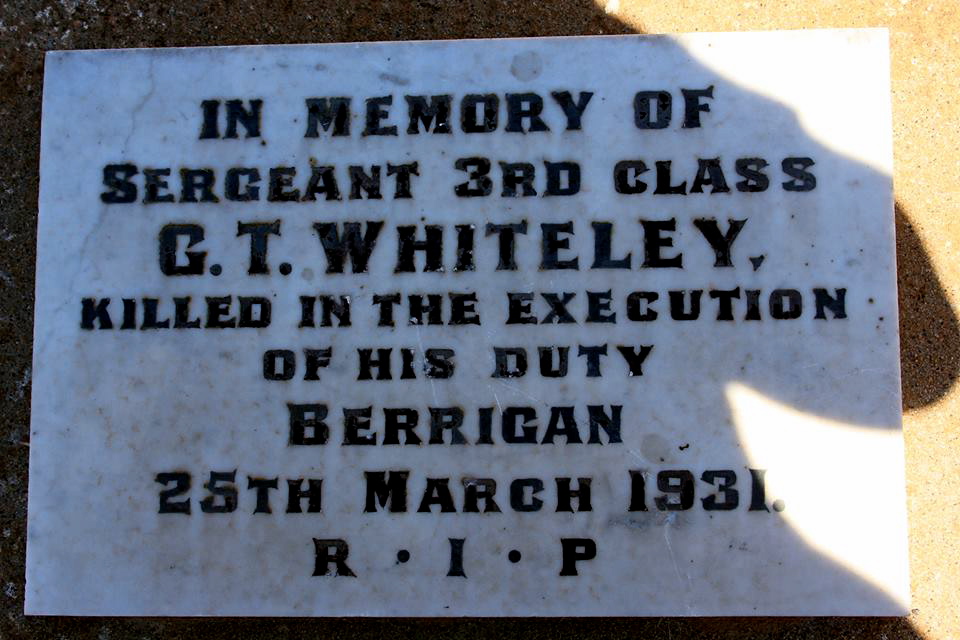
George Thomas WHITELEY In Memory of Sergeant 3rd Class G.T. WHITELEY, killed in the execution of his duty. Berrigan, 25th March 1931. R.I.P.

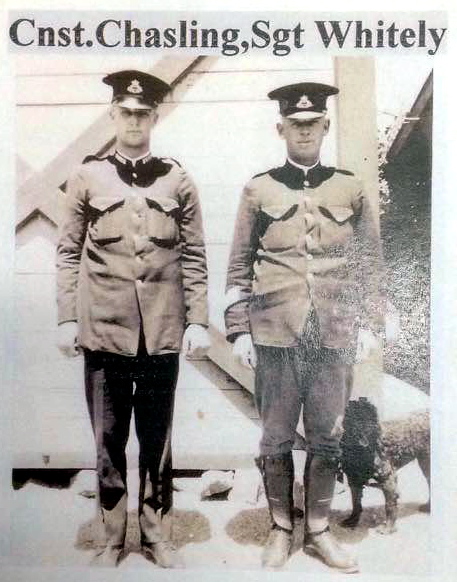
Constable Chasling & Sgt Whitely ( Whiteley ) at Berrigan Police Station.
Constable Chasling & Sgt Whitely ( Whiteley ) at Berrigan Police Station. And, no doubt, the “faithful dog of Sgt Whiteley” also killed in the explosion.


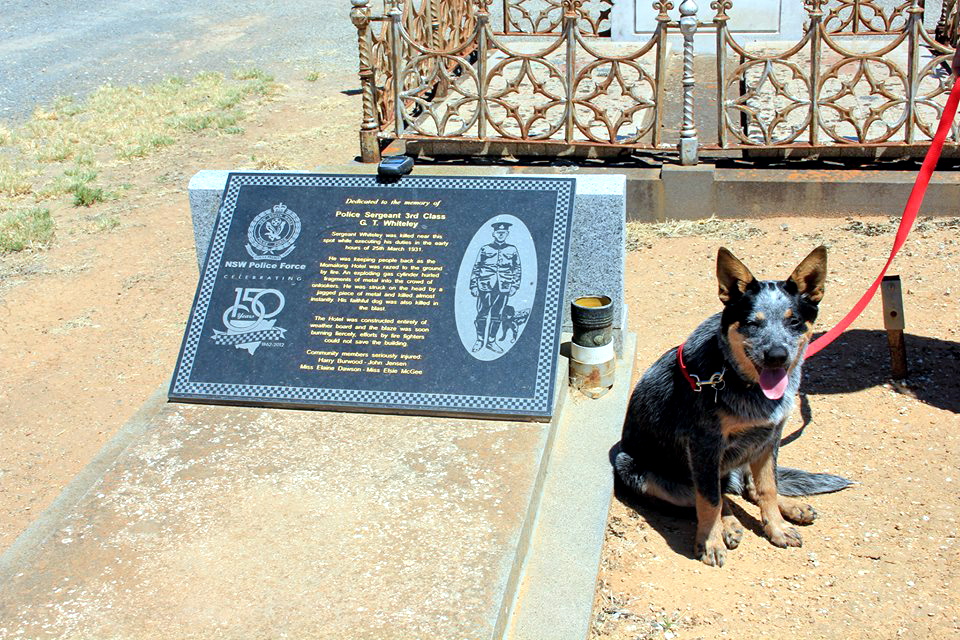
Grave of George Thomas WHITELEY

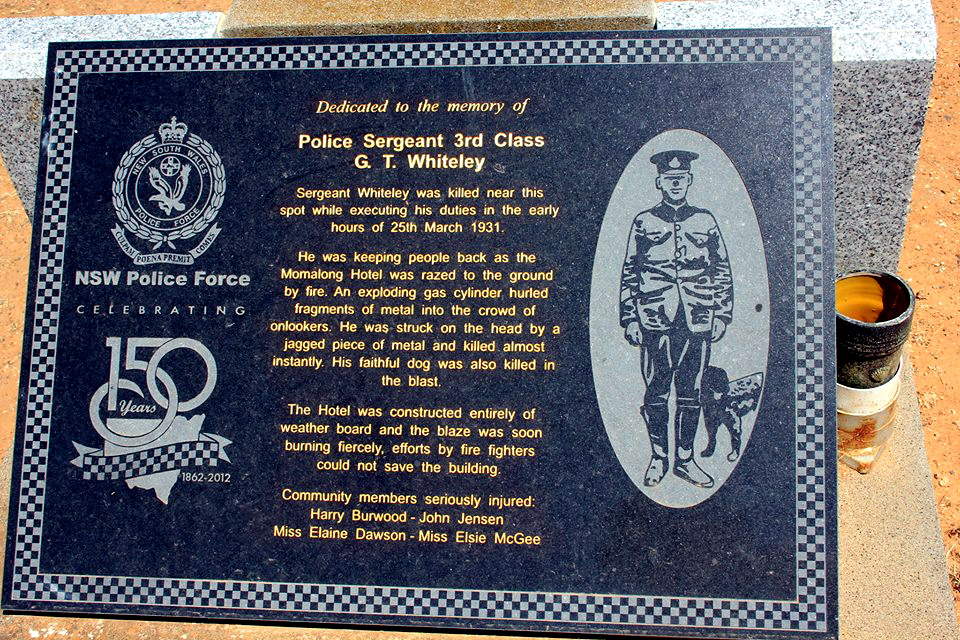
INSCRIPTION:<br /> Dedicated to the memory of<br /> Police Sergeant 3rd Class<br /> G. T. Whiteley<br /> Sergeant Whiteley was killed near this spot while executing his duties in the early hours of 25th March 1931.<br /> He was keeping people back as the Momalong Hotel was razed to the ground by fire. An exploding gas cyclinder burled fragments of metal into the crowd of onlookers. He was struck on the head by a jagged piece of metal and killed almost instantly. His faithful dog was also killed in the blast.<br /> The Hotel was constructed entriely of weather board and the blaze was soon burning fiercely, efforts by fire fighters could not save the building.<br /> Community members seriously injured:<br /> Harry Burwood - John Jensen - Miss Elaine Dawson - Miss Elsie McGee

INSCRIPTION: Dedicated to the memory of Police Sergeant 3rd Class G. T. Whiteley Sergeant Whiteley was killed near this spot while executing his duties in the early hours of 25th March 1931. He was keeping people back as the Momalong Hotel was razed to the ground by fire. An exploding gas cyclinder burled fragments of metal into the crowd of onlookers. He was struck on the head by a jagged piece of metal and killed almost instantly. His faithful dog was also killed in the blast. The Hotel was constructed entriely of weather board and the blaze was soon burning fiercely, efforts by fire fighters could not save the building. Community members seriously injured: Harry Burwood - John Jensen - Miss Elaine Dawson - Miss Elsie McGee


 Western Argus ( W.A. )  Tuesday  31 March 1931  page 13 of 36

GAS CYLINDER EXPLODES POLICE SERGEANT KILLED. DISASTROUS FIRE AT BERRIGAN. Sydney, March 25.

A police sergeant was killed, three people were hurt and nearly 1000 others scattered in terror when, during a fire at the Momolong Hotel, Berrigan, a gas cylinder exploded. The dead man is Sergeant C. George Whitley (41) married, with five children.

Whitley saw service at the war, and was at the Gallipoli landing. Mick Hurwood, Miss McGee and Miss Elaine Dawson ( was a former Echuca girl, living in High Street ) were injured by flying fragments of steel and wood. The two girls were taken to hospital.

The entire population of 2000 turned out when a fire engine rushed up the main street at 4.30 a.m. Hundreds of people assisted the firemen in trying to quell the outbreak, but the hotel was burned to the ground. In the hotel was a 40 lb. gas cylinder, which exploded during the height of the blaze. With a terrific roar it burst into flames, and sparks shot high in the air. The crowd scattered in terror. Whitley and Constable McRae were standing in the middle of the roadway assisting the fire fighters when there was a yell from the crowd. “Look out,” shouted a number of men, and they and the police ran for safety. McRae tried to catch hold of Sergeant Whitley and threw himself flat on the ground. A piece of steel, became embedded in Whitley’s head. McRae was not injured. Pieces of steel and wood cut their way into Hurwood’s leg, and the two girls were hurt about the body. They are expected to recover. The cause of the fire is unknown. Residents of the hotel hurriedly left the building, which was a single storied one, when the outbreak occurred.

http://trove.nla.gov.au/ndp/del/article/34579561

[divider_dotted]


Daily Standard (Brisbane, Qld. : 1912 – 1936), Thursday 26 March 1931, page 9

POLICE SERGEANT KILLED BY EXPLOSION

FIRE BURSTS CYLINDER.

SYDNEY, Wednesday.

Police-sergeant George Thomas Whitley, 41, married, with five children, was killed, three persons hurt, and about 1000 others scattered in terror this morning, when, during a fire at the Momolong Hotel, Berrigan, a gas cylinder burst.

A fire broke out at 4.30 o’clock, and the entire population turned to in an effort to save the hotel. Nothing, however, could be saved, and the hotel was burnt to the ground, though adjoining premises were saved from destruction.

There was a 40lb cylinder of carbonic acid gas in the hotel, and during the fire this exploded with a terrific roar.

Sergeant Whitley was standing in the roadway with Constable McRae when the cylinder burst. McRae threw himself to the ground, endeavoring to pull Whitley with him, but a piece of steel embedded in Whitley’s head, killing him instantly.

Michael Hurwood, Elsie McGee, and Elaine Dawson were injured about the legs and body by flying steel, all being seriously hurt. They were taken in motor cars to Corowa Hospital.

Whitley was a well-known and popular officer, aged 43, and joined the force 21 years ago.

Mrs. Whitley is prostrate with grief.


trove.nla.gov.au/newspaper/article/180982752


NSW Government Gazette – issue 108, page 3292.  Friday  4 June 1920

Electoral Appointments

Second Class Constable George Thomas WHITELEY, Fifield ( near Trundle ). – Electoral District: Murrumbidgee – Polling place: Fifield   In lieu of McLean – on leave. To take effect on 22 March 1920

https://trove.nla.gov.au/newspaper/article/222081648/15452524


Bathurst Times (NSW : 1909 – 1925), Wednesday 8 January 1913, page 4

POLICEMAN ASSAULTED.

CASE AT HILL END.

HILL END, Tuesday.

Considerable interest was centred in the local Police Court proceedings on Saturday morning, when Vivian Clyde Cook, a resident of Hill End, was charged with assaulting Constable George Thomas Whitley while in the execution of his duty.

The accused was represented by Mr. Casey, solicitor, from Orange, and Inspector Rank appeared for the police.

The facts of the case as stated by Constable Whitley were that on New Year’s night he was in Clarke-street when he heard the Roman Catholic Church bell ringing. He hastened away to the church, and when near there heard stones being thrown on the church. He also saw three men running away.

Witness and Constable Creevy gave chase. After running about 400 yards he came up with one of them, whom he recognised to be the accused. Witness said, “Alright, Cook, I will give you a summons for this.” Then he turned to run after the other two. When he had gone a few paces he was hit on the head with a stone, which knocked him down on the ground. He got up again quickly, and saw the accused lying on the ground, he also heard him saying someone had hit him.

Then witness and Creevy arrested Cook, and locked him up for the night.

Dr. Michael John Ryan stated that about 2.30 on New Year’s morning Constable Whitley was brought to him suffering from a severe wound on the head. He dressed the wound and put in two stitches. The wound was about a quarter of an inch from the temple.

The doctor said that he considered the constable was out of danger, but Constable Whitley could not go on duty for at least one week yet.

At this stage, Mr. Casey, solicitor, made a very strong appeal to the P.M. not to send the accused to gaol.

He pointed out that he had never been before the Court before; that he was a hard-working young man; that he was extremely sorry for what he had done, and that he belonged to a very respectable family.

There were a number of young men, most of whom were in the Court, at the time, who had made up their minds to give the police all the trouble they could. They were known as the “Kelly Gang.”

The police had had no trouble whatever with anyone.

The P.M. said that the case was a very serious one indeed, and on hearing the doctor’s evidence he had made up his mind to send accused to gaol.

The accused promised to be of good behavior.

The P.M. then imposed a fine of £15 and £3/4/ costs.

Four days were allowed in which to pay.

Two other charges— one for insulting language and the other riotous behavior were withdrawn.

https://trove.nla.gov.au/newspaper/article/111211867


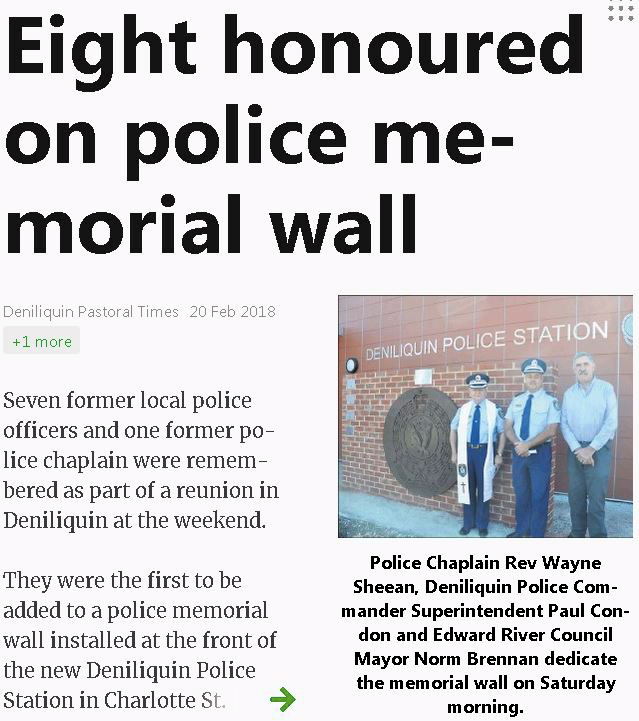
2/1/2019, Deniliquin Times.

Eight honoured on police memorial wall’ –

Seven former local police officers and a former police chaplain were honoured during a police reunion in Deniliquin.
They were the first to be added to the police memorial wall at the new Deniliquin police station.
Honoured were
Constable Charles Chapman (died 5/3/1866),
Senior Const James Morrison (19/1/1898),
Senior Const Thomas Smith (19/4/1910),
Superintendent Henry Grugeon (10/1/1911),
Sergeant George Thomas Whiteley (25/3/1931),
Detective Senior Const Risto Vic Baltoski (2/1/1989) and
Senior Const Jennifer Louise Edgerton (August 2015) and

Rev David Bond.


HARRY GRUGEON


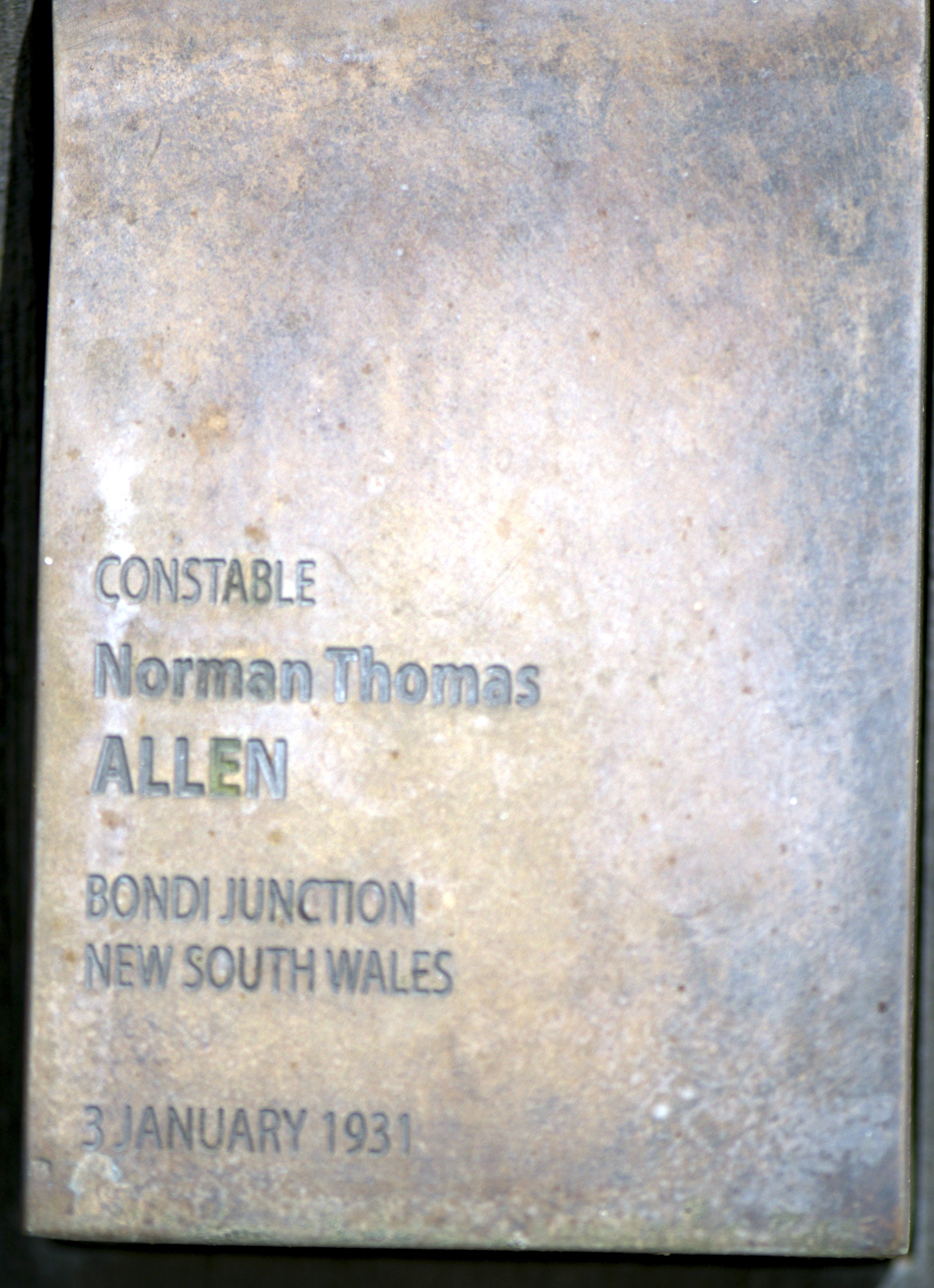
Norman Thomas ALLEN

Norman Thomas ALLEN

New South Wales Police Force

Rank:  Constable

Regd. #  32??

Stations:  Waverley

ServedFrom  14 May 1926 & Resigned then rejoined on 26 September 1928 to 3 January 1931 = 3+ years Service

Awards:  No find on It’s An Honour

Born? ? 1901

Died:  3 January 1931

Age:  29

Cause:  Shot – Murdered at Bondi Junction

Funeral date:  5 January 1931

Funeral location: Rookwood Cemetery

Buried:  Buried in Rookwood Cemetery ( side by side with Ernest Andrews )

Zone: C  Section:  09  Grave 4212

DOUBLE POLICE MURDER

Memorial location:

Constable Norman Thomas Allen ( 1931 )


Constable Ernest Andrews ( 1931 )


Norman Thomas ALLEN touch plate at the Australian National Police Wall of Remembrance

[alert_green]NORMAN IS mentioned on the Police Wall of Remembrance[/alert_green]


Constable Allen was shot in the street at Bondi Junction while attempting to detain an armed, deranged man named Kennedy who had earlier had an altercation with a local shopkeeper. The constable had been directing traffic and when informed of the dispute he found and confronted the offender. As he approached Kennedy from behind, the man spun around and shot Constable Allen in the chest at point blank range. He then shot the constable twice more in the heart. At this time Constable Andrewsunarmed, off duty and heading for the beach – passed by in a tram and saw a crowd gathered around the body of Constable Allen. Alighting from the tram he joined in the pursuit of Kennedy who managed to reach his home in nearby Lawson Street.


On arriving and finding the front door locked Constable Andrews went to the rear of the dwelling and burst through the back door. Unfortunately Kennedy was waiting with rifle raised and as Andrews lunged at him he shot him twice in the chest. He then took a knife and stabbed the constable in the throat. Sergeant Seery and Constable Johnson from Waverley Police then arrived and began to smash their way in through the front door. Although fired at by Kennedy, Constable Johnson returned fire, hitting Kennedy in the chest. Seery and Johnson then smashed their way in and found the offender in a bedroom bleeding to death. He died that night.


In the aftermath of the murders, the Brisbane Courier dated 5 January, 1931 published a complete account of the entire incident, and concluded with the following.

COMMISSIONER PRAISES MURDERED POLICE.

Both murdered constables were highly efficient and popular officers. Allen leaves a widow and young child. He lived in New Street, Bondi. Constable Andrews was single, his only relative in Australia being a sister, Mrs Clark. The men will be buried tomorrow with full police honours. The Commissioner of Police Mr. Childs, in an appreciation, said “I wish to pay a tribute to the manner in which both these young men carried out their duty according to the best traditions of the service. They saw their duty before them, and did not hesitate a moment in the execution of it. Although I would not make any distinction between them I cannot help referring to the action of Constable Andrews, who, though unarmed, rushed in to effect the arrest of a man who had already shot Constable Allen. “


Constable Norman Thomas ALLEN was born in 1901, joined the New South Wales Police Force on 14 May, 1926 and shortly thereafter resigned. He rejoined on 26 September, 1928. At the time of his death he was stationed at Waverley.


Constable Ernest ANDREWS was born in 1908 and joined the New South Wales Police Force on 24 April, 1929. At the time of his death he was stationed at George Street North Police Station.

[divider_dotted]


Funeral procession through Railway Square in 5 January 1931 for two police constables, Allen and Andrews, killed in the line of duty. Source: Sydney Mail newspaper 7 January 1931


[divider_dotted]


The Sydney Morning Herald                                     Tuesday  6 January 1931                                       page 10 of 14

DEAD POLICEMEN.

Impressive Scenes at Funeral.

THOUSANDS PAY TRIBUTE.

The State paid homage yesterday to the two policemen, Constable Norman Thomas Allen and Constable Ernest Andrews who met their death at the hands of a madman at Bondi Junction on Saturday. There were mourners from almost every part of New South Wales.

Many thousands lined the route as the funeral cortege moved from Wood Coffill’s funeral parlours George-street to the mortuary station; the mortuary platform was   thronged when the funeral train moved off to Rookwood and thousands had assembled in the cemetery.

The scene in the vicinity of Wood Coffill’s funeral parlours is likely to be remembered by the thousands of people who thronged the streets leading into Railway-square. Early in the morning bearers of wreaths and floral tributes passed through the doors to deposit their tokens of sympathy. At the approach of noon people began to assemble on the footpath and many entered the chapel to view the coffins. The near relatives arrived at 1 o’clock and the chapel was cleared while     Constable Allen’s widow and her mother approached the silver mounted caskets which rested on trestles side by side. An affecting scene followed. Then the simple Church of England burial service was conducted by the Rev Frederick Riley and the coffins were borne to the waiting hearses.

MUFFLED DRUMS

The scene was unforgettable. A solid mass of people crowded the thoroughfares. Presently the mounted troopers urged their restive horses forward and with the deep roll of muffled drums the cortege moved off. Thousands of hats were removed.

Handel’s Dead March in “Saul” was played by the Police Band. Behind the band came a contingent of foot police under the direction of Superintendent Leary. Two hundred men drawn from the various stations, marched behind. Then came the hearses, the wreath-laden carriages, and the chief mourners, Firemen, the sun glinting on brightly-polished helmets, were represented by over 40 uniformed officers and men. At the end of the slow-moving procession came numbers of retired men, friends of the dead officers, and business people from the eastern suburbs.

Along the route to the mortuary thousands stood bareheaded as the cortege passed. At the mortuary gates another huge crowd paid tribute to the dead men.

Among those who marched in addition to the police and firemen, were employees of motor bus companies in the eastern suburbs.

“THEY SAW THEIR DUTY.”

A most affecting scene at the graveside in the Church of England section of the Rookwood Cemetery was the playing by the police band of the hymns “Lead Kindly Light” and “Abide With Me.” The remains were buried side by side.

“Let men’s opinions be what they may,” said the Rev. Frederick Riley in an address at the graveside, ” we should be doing violence to the most sacred emotions of human life if we were to allow our brethren to depart without a word of farewell. We are met here today to pay honour to the memory of two men who were comrades of yours men whom we all respected and loved. Let us remember that these two men died in the carrying out of their duty. They served their King and country as men and soldiers who fall for their King on the battlefield. They saw their duty and the fear of death could not deter them. They have not created a new tradition for the traditions of the police force of New South Wales are amongst the highest in the world already, but these two men have added a new lustre to the traditions of your past. These two young men Norman Thomas Allen and Ernest Andrews, died in the execution of their duty. There is no higher glory to which a man can aspire. We pray to God that those who have been so suddenly bereaved may share the comfort which we know these two brave men are experiencing in the nearer presence of God.”

MAGISTRATE’S TRIBUTE

At the Burwood Police Court yesterday Mr. G. R. Williams, S.M. commented on the bravery of the two constables. They acted nobly and upheld the traditions of the force,” he said.

PALL BEARERS AND MOURNERS.

The pall bearers were.- For late Constable Allen: Constables Tomkins, Martin, Moore, Hudson, Steele and White. For late Constable Andrews: Constables Booth, Kimber, Fraser, O’Neill, Morgan, and Wright.

The principal mourners were Relatives of the late Constable Allen: Mrs Allen (widow), Mrs Prankish (mother-in-law), Mr and Mrs N. Frankish (brother In law and sister in law), Mr and Mrs Sutcliffe (uncle and aunt) Mrs Lamb, Mrs Hourigan, and Mrs Cummings (aunts) and Mr Rowland Allen (cousin).

Relatives of the late Constable Andrews: Mr and Mrs Edward Clarke (sister and brother in law).

The Government was represented by Mr Gosling (Chief Secretary) and Mr McKell (Minister for local Government). Police representatives in addition to the non commissioned officers and men who marched were Mr W H Childs (Commissioner) Superintendents Leary, Mackay and Linegar, Inspectors Winter, Weir, Bennetts, McCauley, Woodrow, Lynch, Duffell, Roberts, McMaster, O’Brien, Chaseling, Anderson,  White, Long, Roser, Scott, Michaelis, Robson, Allen, Farley and Fowler.

Retired members of the police force who attended were ex-Commissioner James Mitchell, ex-Superintendents Roche, Cook, McIntosh, Sinclair, Thom, Drew and Park, ex Inspectors Fullerton, W J Jones (also representing the Navy and Army Veterans Association) Fraser, Tracey, Bolton, Smith, Fewster, Doran, Mankletow, Stutchbury, Briggs, Ewen, Dunn, O’Dea and Robertson, ex-Sergeants McDonald, T. Dobson, Payne, A. Smith, Taylor, J. Salmon, J. Loomes, R. C. Harper, Bath and Butcher, ex-Constables Swan and Dixon.

The Board of Fire Commissioners of New South Wales was represented by Mr T J Smith, M.L.C. (president) Mr J McNamara (Commissioner), and Mr H M Webb (secretary and executive officer).

Mr Nance chief officer New South Wales Fire Brigades was present and 38 men marched under Mr Grimmond (deputy chief officer). Inspector Neeve, District Officer McLachlan, and Station Officers Arthur, Neville, Parkes, McCarthy, Rust, Currier and Sclater.

Others who attended were:- Judge Sheridan, Mir George Cann, ex M.L.A., Mr J Herlihy ( Under-Secretary for Lands) representatives of the Prisons Department including Mr Seery (superintendent of the Long Bay Penitentiary) Mr T.W. Irish (Assistant Under Secretary for Lands) Mr H. B. Mathews, (Surveyor General Department of Lands).

Mr N. W. Bond (representing the head office Bank, of New South Wales) representatives of ambulance divisions, Mr. and Mrs. C. R. Law, Mr. A. L. Parker (representing Superintendent O. H. Parker, of Goulburn) Mr Foster Doolan (vice president Police Association), Mr B Fortescue (secretary Police Association), Mr C T Thackeray (Police Association staff), Mr F M Jackson (representing Mr F C Hackett of Merriwa), Mr W T Missingham,

M.L.A., Mr A J Pollack, M.L.A., Mr W P Monaghan (Waverley Cemetery bus service), Mr W M Niland Mrs A Shuttleworth, Mr H L Harnett (representing Mr F M Burke, Speaker of the Legislative Assembly), Mr W E Clapin (representing Sir John Peden, President of the Legislative Council), Alderman David Hunter (Mayor of Waverley), Mr T J Thompson (Deputy Town Clerk of Waverley), Mr and Mrs A Williams, Miss Williams, Miss Beryl Williams, Miss   Brady, Mr and Mrs McMorland, ex Warder Charles Stone, ex Warder Little and a number of eastern suburbs business people.

The wreaths Included those from the mother and other relatives of the late Constable Allen, relatives of the late Constable Andrews, the New South Wales Police Commissioned Officers Association, comrades of No 2 Division, Redfern Police, New South Wales Police Association, members of the Railway Detective Office, officers, detectives, and staff of the C.I.B., No 3 Police, comrades of No. 10 Division, cyclists and drivers of police headquarters, officers and men of Circular Quay Fire Station, comrades at No. 4 Station, police at No 7 Station, “police pals at Bondi Junction.” end eastern suburbs bus drivers and conductors.

http://trove.nla.gov.au/ndp/del/article/16743642

[divider_dotted]