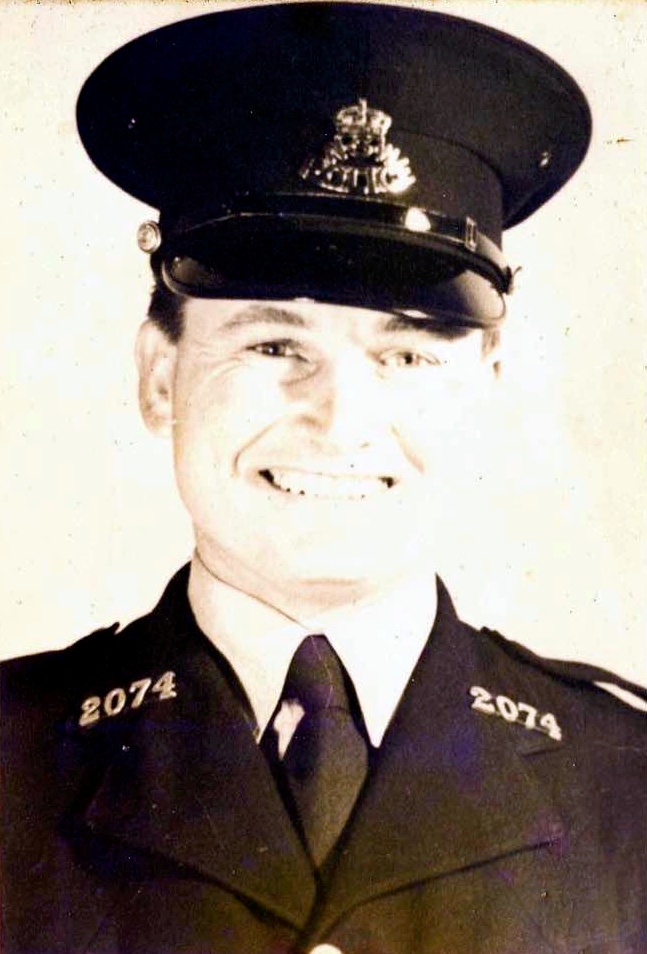
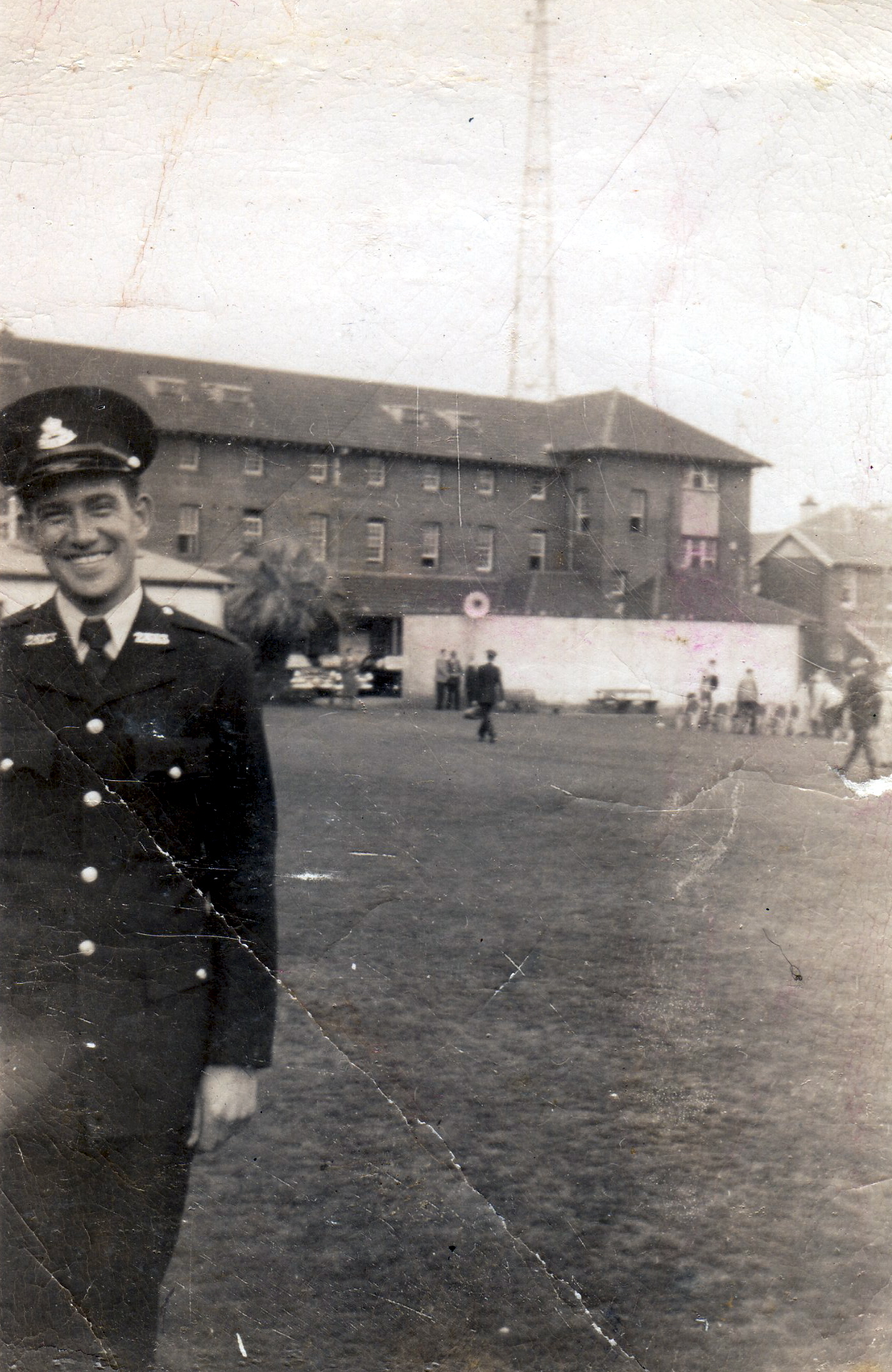
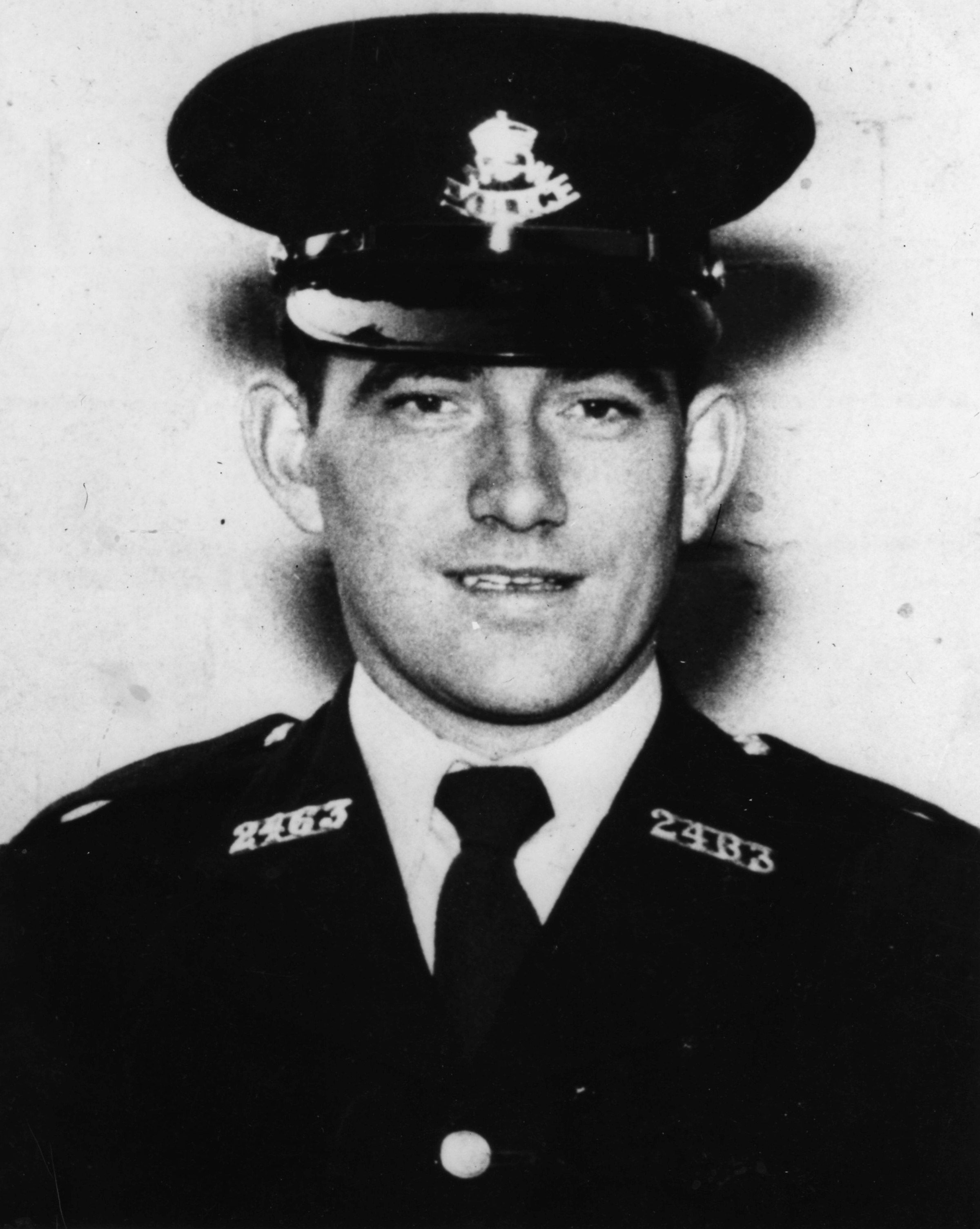
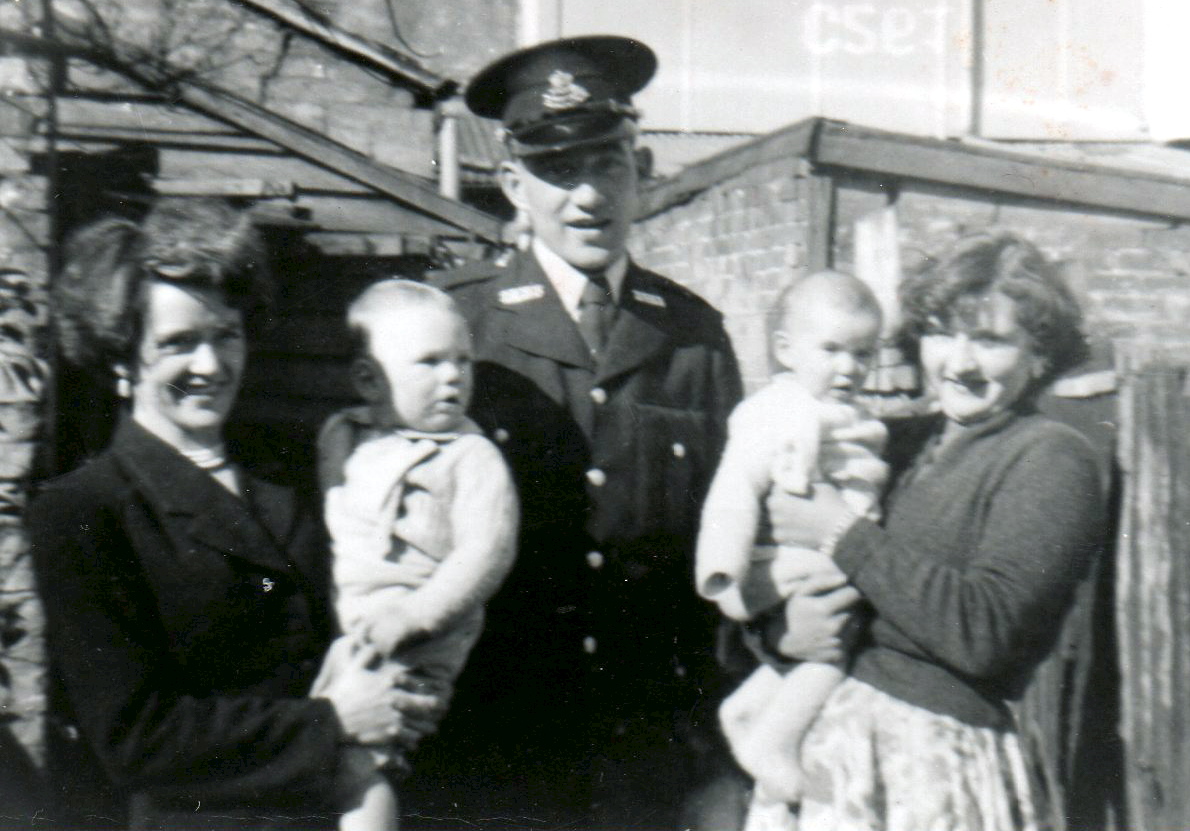
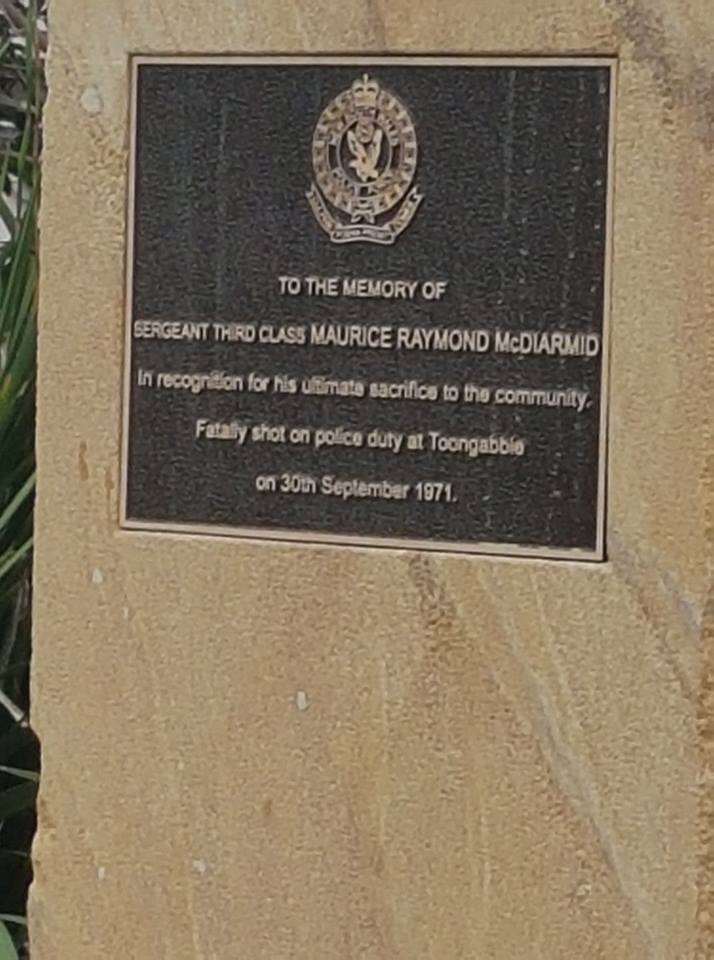
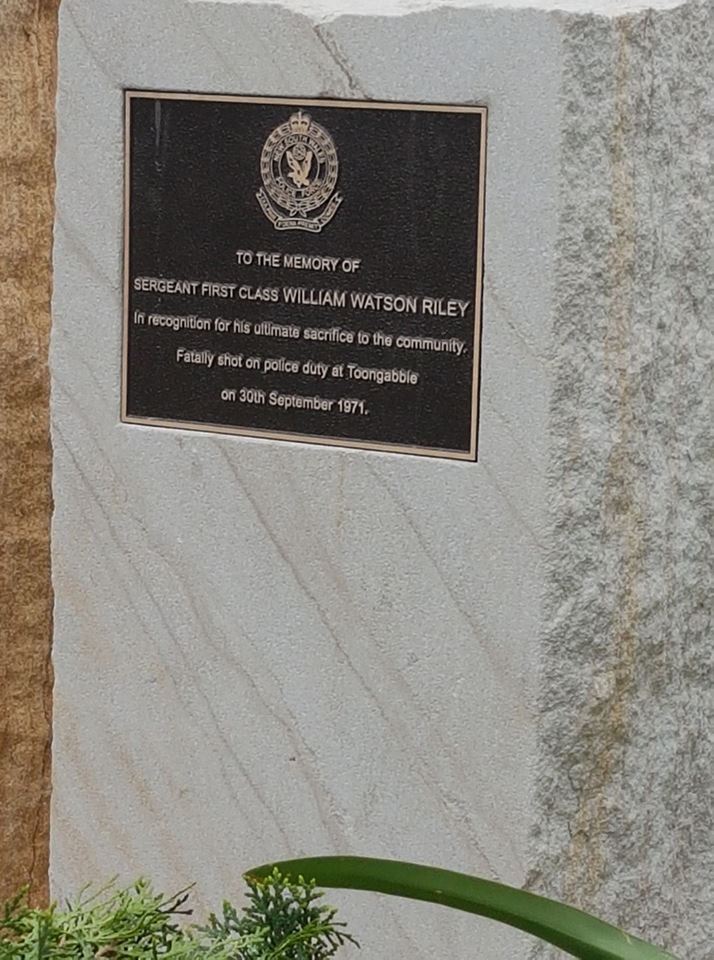
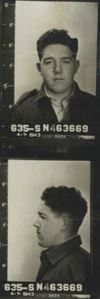
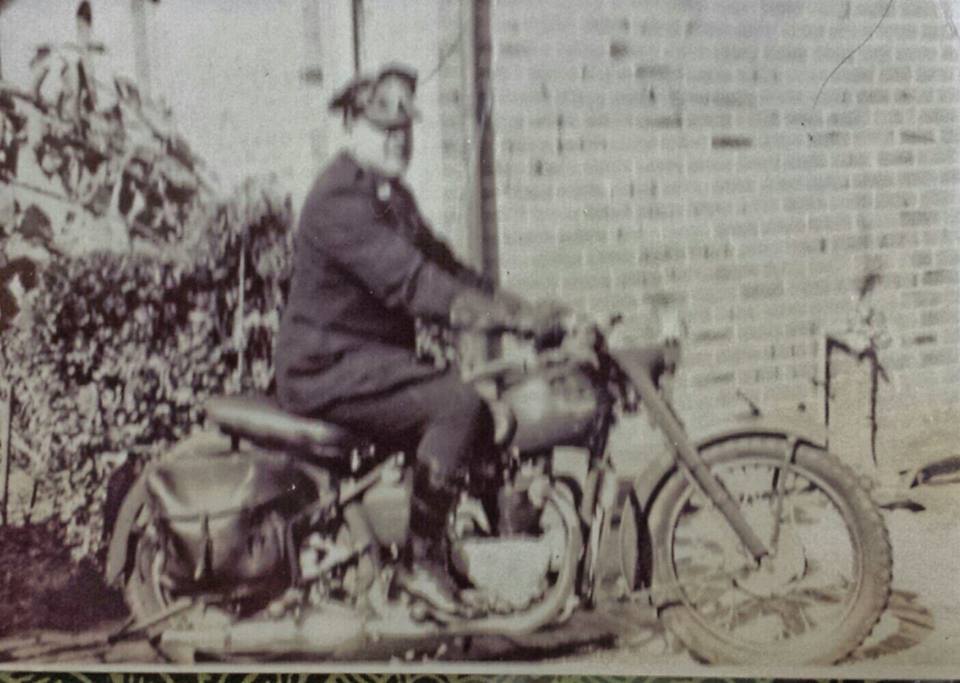
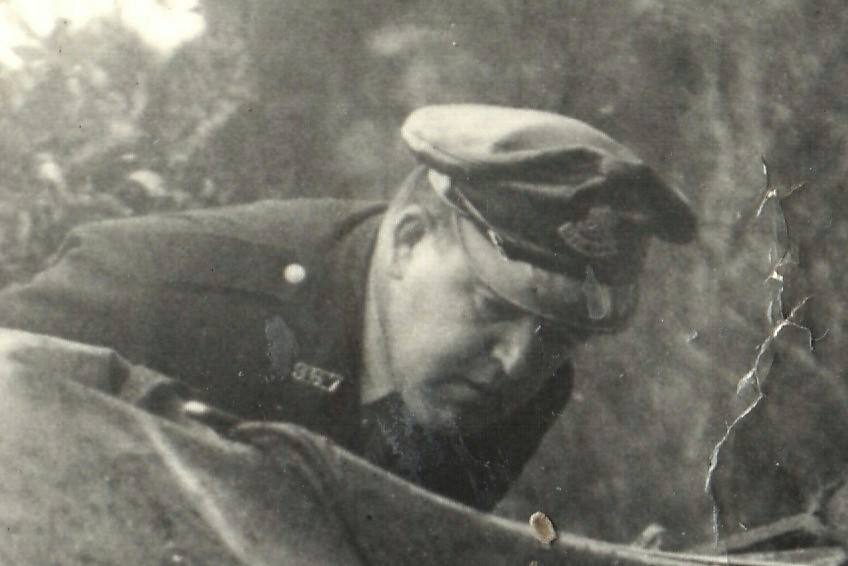
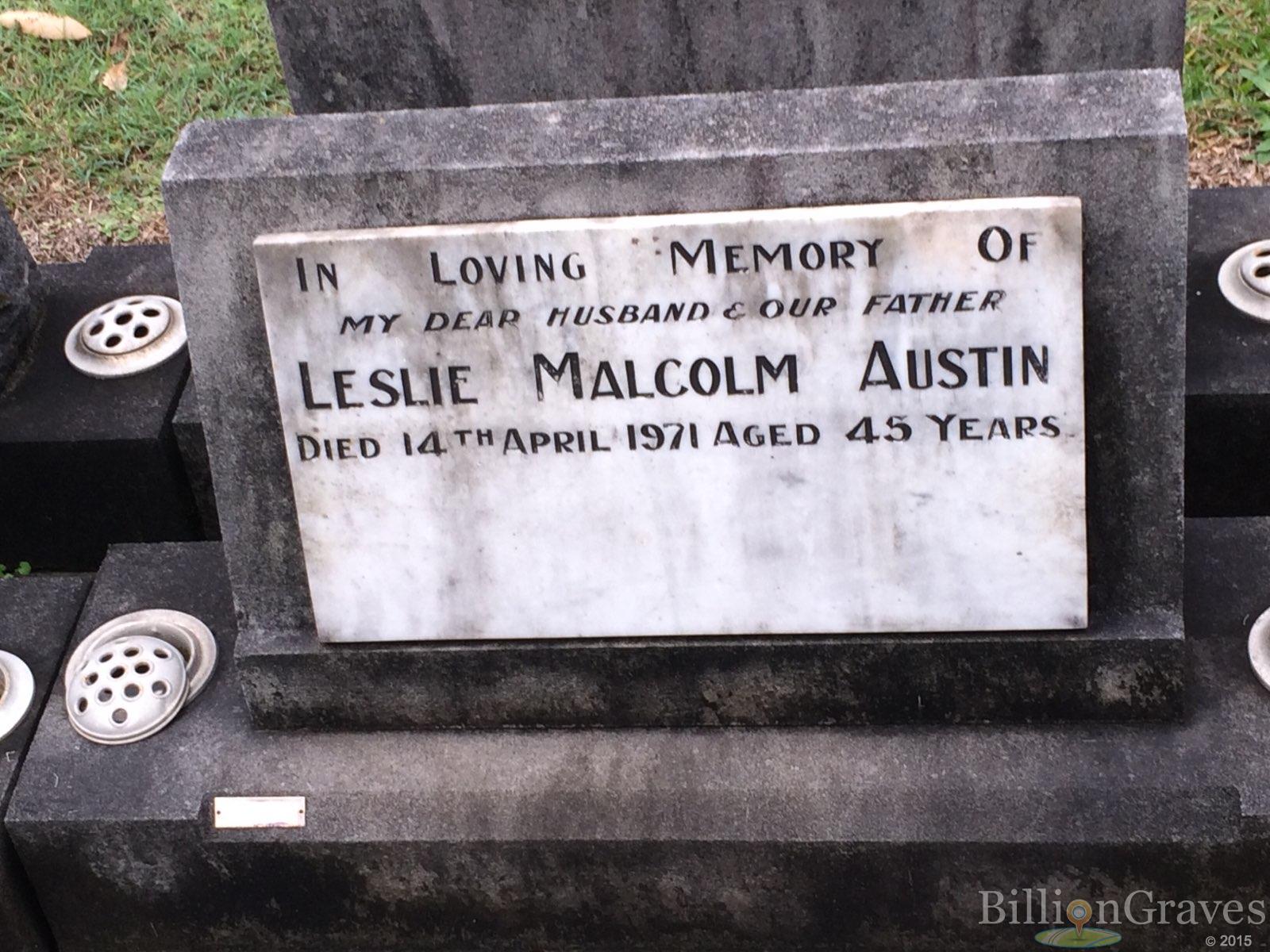
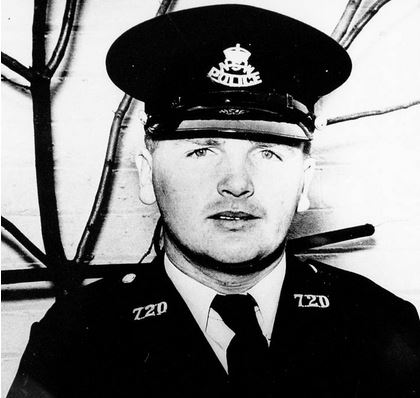
On 30 September, 1971, Sergeant 2nd Class Riley and Senior Constable McDiarmid attended a dwelling in Mimosa Avenue, Toongabbie to investigate a report that a man had shot and killed his brother at that address. On arrival the police saw the offender RonaldClarke who quickly ran to the rear of the house. Senior Constable McDiarmid followed him while the sergeant entered through the front door. As the senior constable entered through the back door the offender opened fire with a shotgun, inflicting a fatal wound. It appears the offender then went back through the house where he also shot and killed Sergeant Riley. Although the senior constable was still alive when other police arrived he died a short time later in an ambulance on the way to hospital. The offender was shot and killed by police ( Cst 1/c Alf GREGORY ) the same day.
William Riley was born in 1921 and joined the New South Wales Police Force on 3 December, 1945. At the time of his death he was stationed at Blacktown. He was posthumously promoted to Sergeant 1st Class.
Maurice McDiarmid was born in 1932 and joined the New South Wales Police Force on 9 July, 1956. At the time of his death he was stationed at Blacktown. He was posthumously promoted to Sergeant 3rd Class.
George Lewis Memorial Trophy
This trophy for the year 1971, which is for the most courageous act performed by a member of the New South Wales Police Force, was awarded posthumously to the late Sergeant 1st Class W. W. Riley and the late Sergeant 3rd Class M. R. McDiarmid who were stationed at 27 Division.
The trophies were presented to Mrs Riley and Mrs McDiarmid at the Police Academy during 1972.
PETER MITCHELL TRUST AWARDS
The ten awards under this Trust for the year 1971 were made to the following police, the trophies being presented at the Police Academy during 1972:
Most Courageous Act Posthumously awarded to the late Sergeant 1st Class W. W. Riley and the late Sergeant 3rd Class M. R. McDiarmid in conjunction with the George Lewis Memorial Trophy.
[divider_dotted]
Canberra Times (ACT : 1926 – 1995), Tuesday 21 March 1972, page 3
Plaque
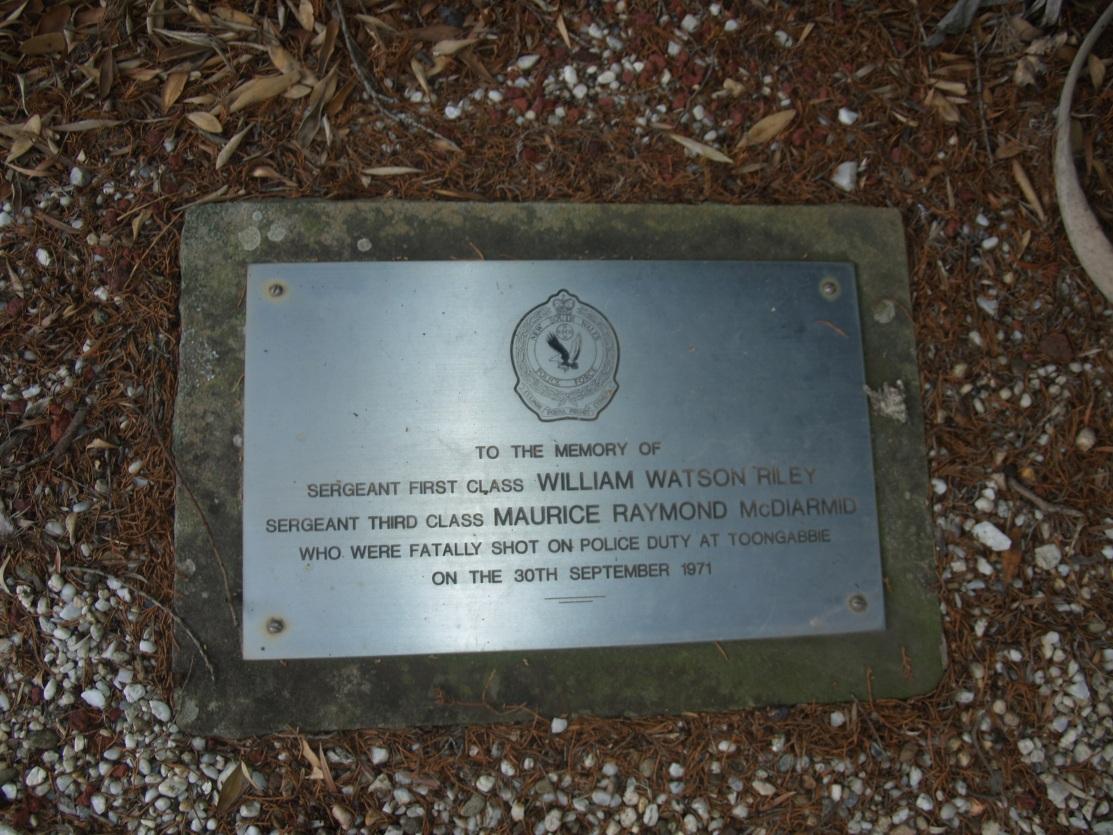
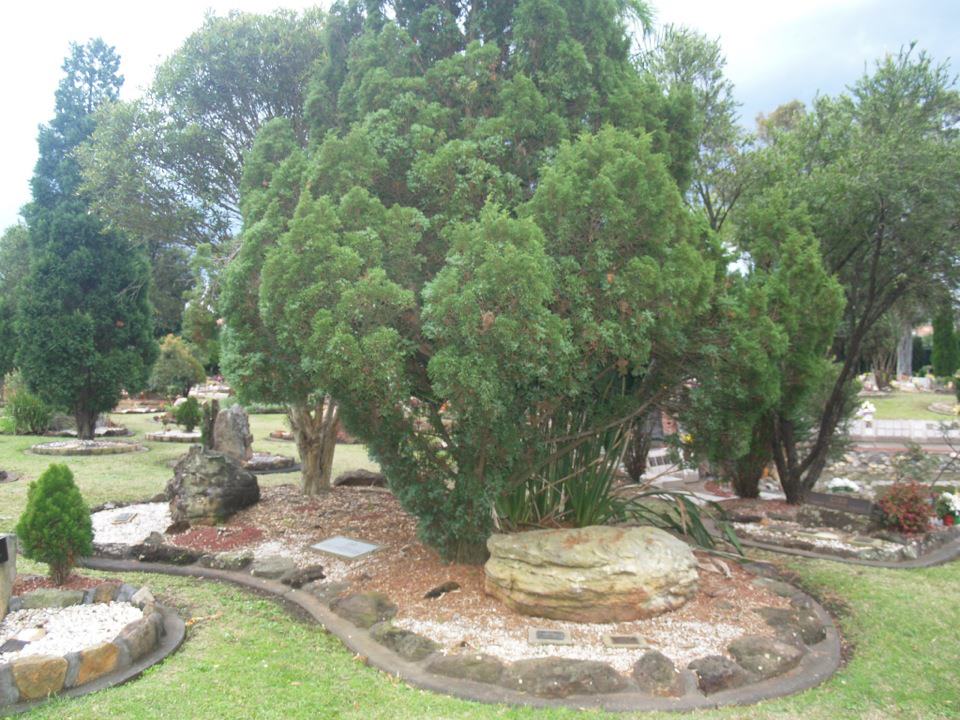
SYDNEY, Monday. — At the Pine Grove Memorial Park near Rooty Hill today, Bishop Hulme-Moir, chaplain of the NSW Police Force, dedicated a plaque in memory of Sergeant Maurice McDiarmid and Sergeant William Riley, who were shot when attempting to arrest an armed man at Toongabbie on September 30 last year.
Canberra Times (ACT : 1926 – 1995), Wednesday 6 October 1971, page 3
Funeral
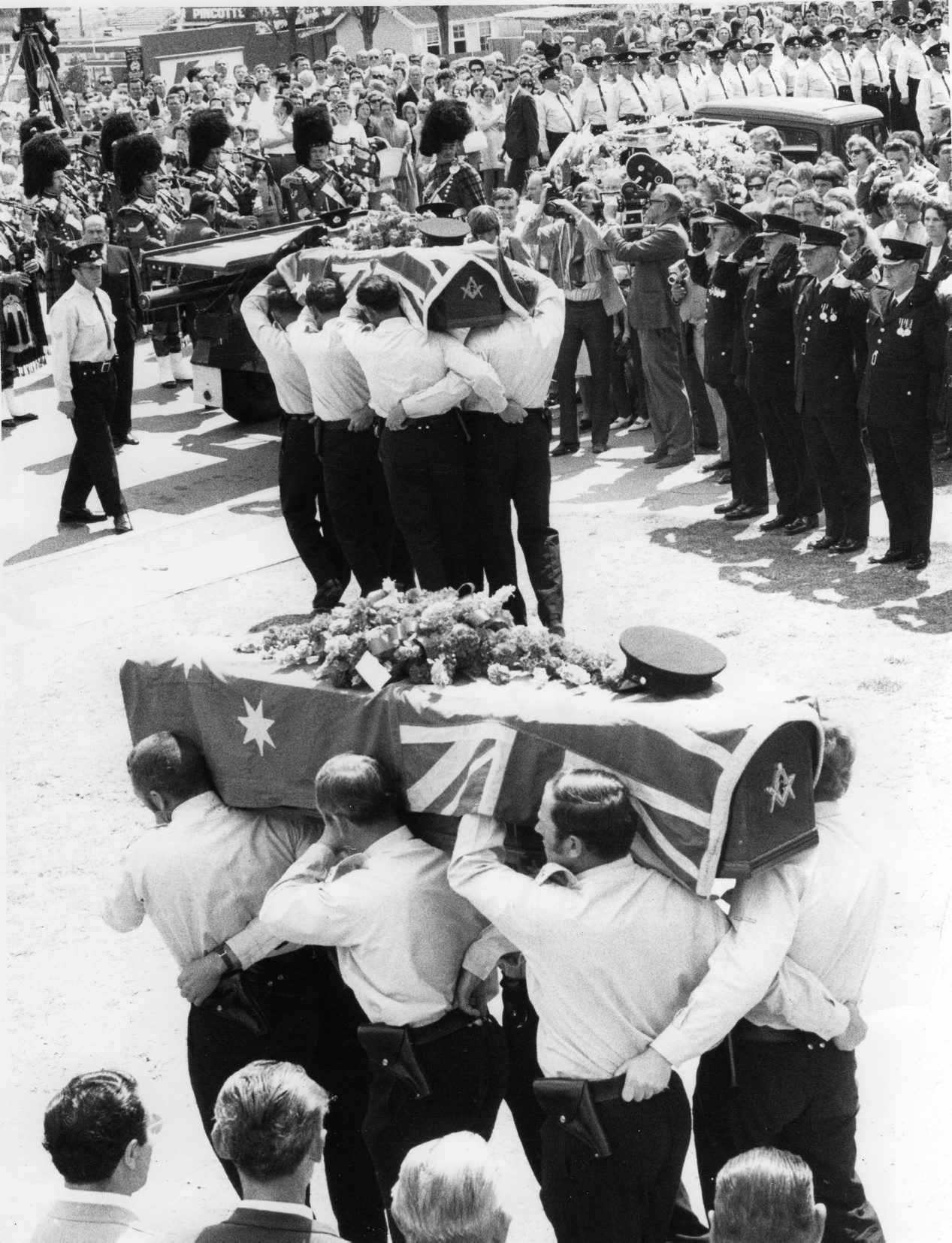
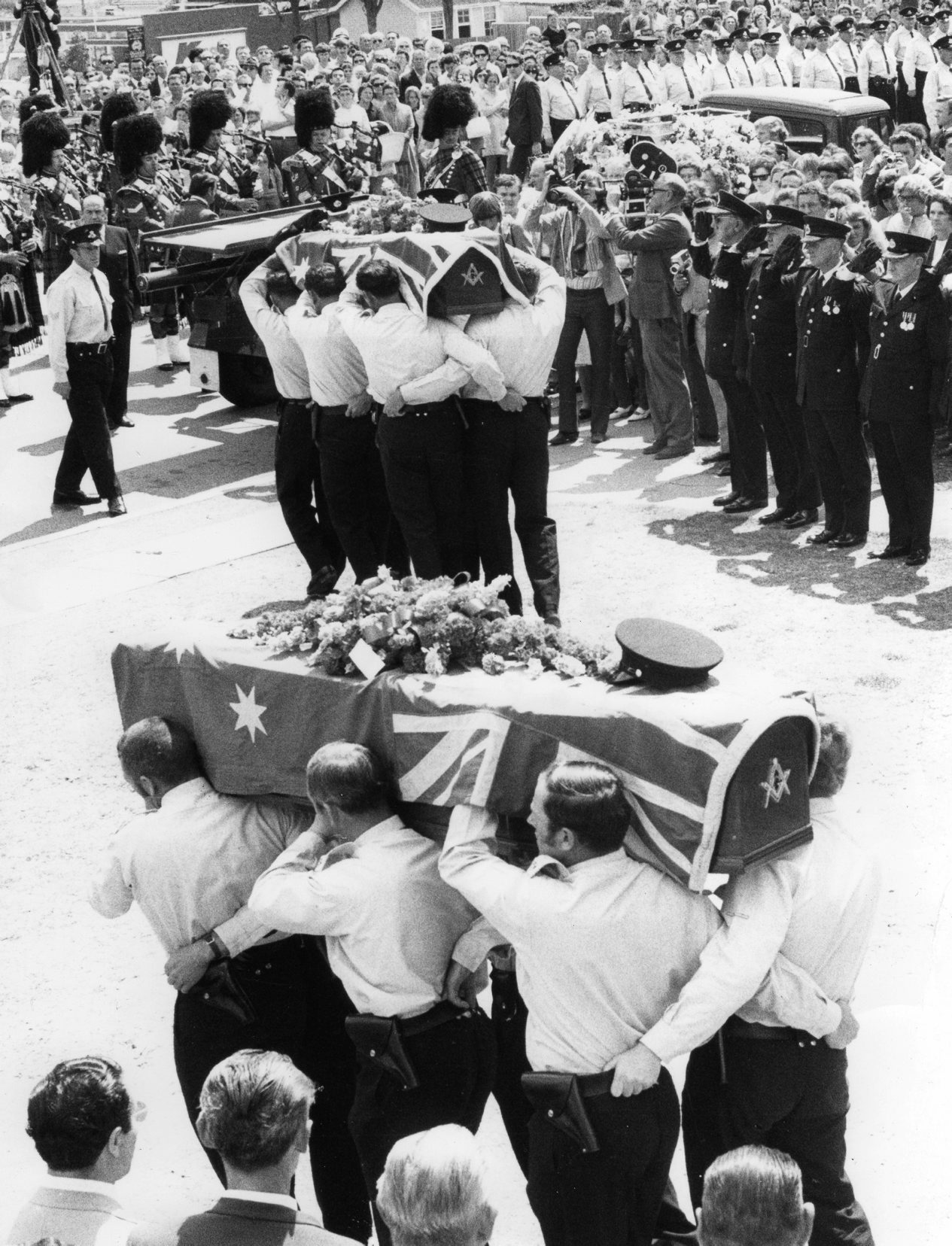
SYDNEY, Tuesday. -More than 400 policemen attended the funeral this morning of the two policemen shot by a man in Toongabbie last Thursday. Both men, Sergeant William Watson Riley and Senior Constable Maurice Raymond McDiarmid, were given full police honours at their funeral.
Canberra Times (ACT : 1926 – 1995), Thursday 13 January 1972, page 11
Payments to 3 police widows
SYDNEY, Wednesday. – The NSW Government agreed today to make, as “an act of grace”, lump-sum payments of $12,500 to each of three police officers’ widows.
“The Premier, Sir Robert Askin, said the payments would be in addition to the pensions and dependant’s allowances already paid out of the police superannuation and reward fund.
The three policemen involved in the payments are Senior Constable W. E. King, who was murdered at East Gresford police station on August 13 last year, and Sergeants W. Riley and M. McDiarmid, who were shot by a man at Toongabbie on September 30 last year.
Sir Robert said members of the police force had always been specifically excluded from the definition of “worker” under the Workers Compensation Act.
He said the Commissioner of Police, Mr Allan, had brought to the notice of the Government that, in certain matters of workers’ compensation, police were in an anomalous position in relation to other Crown employees.
Sir Robert said a full examination would be made of overall benefits of workers’ compensation available to police.
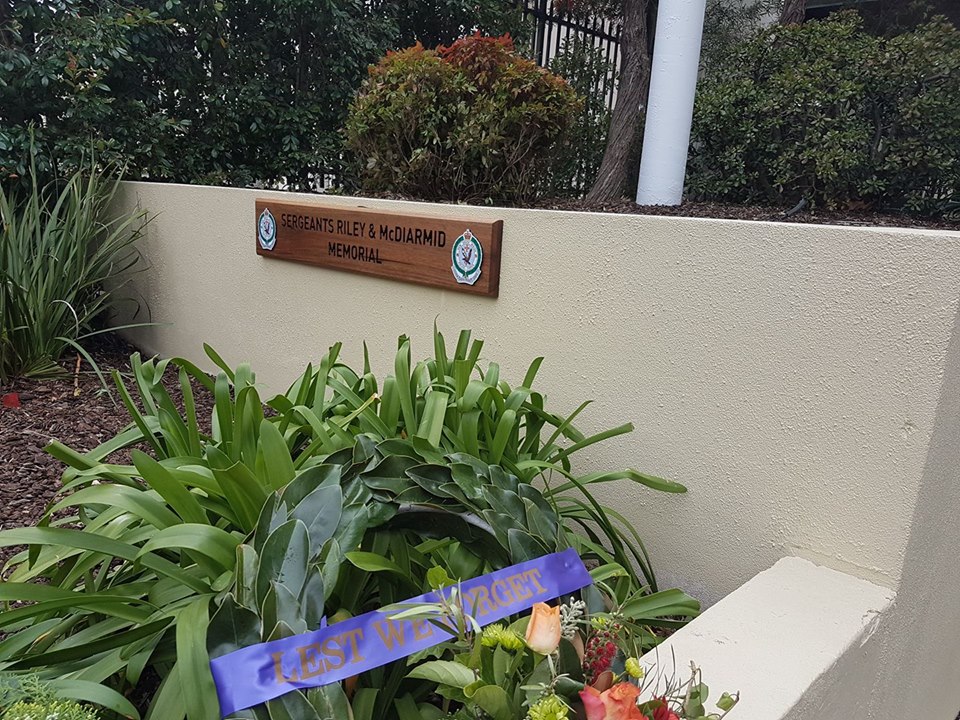
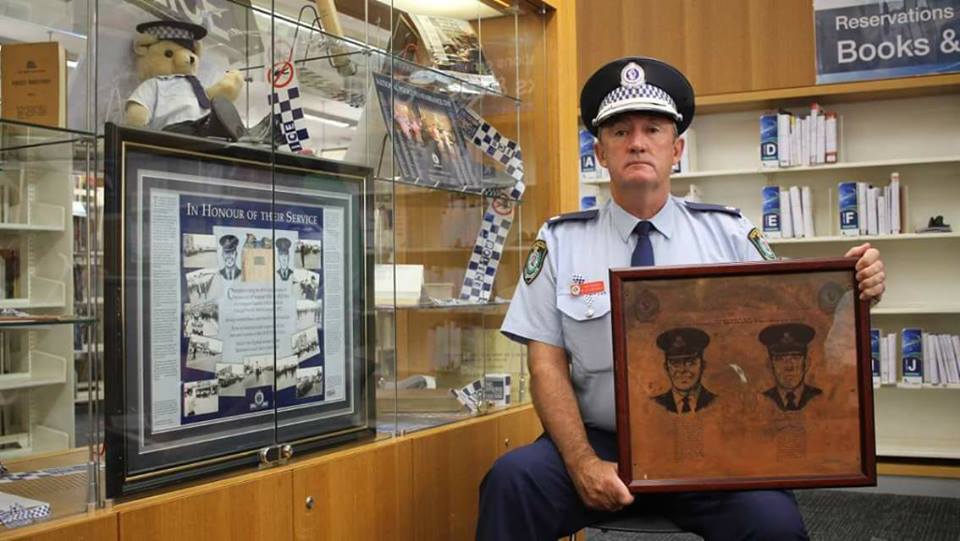
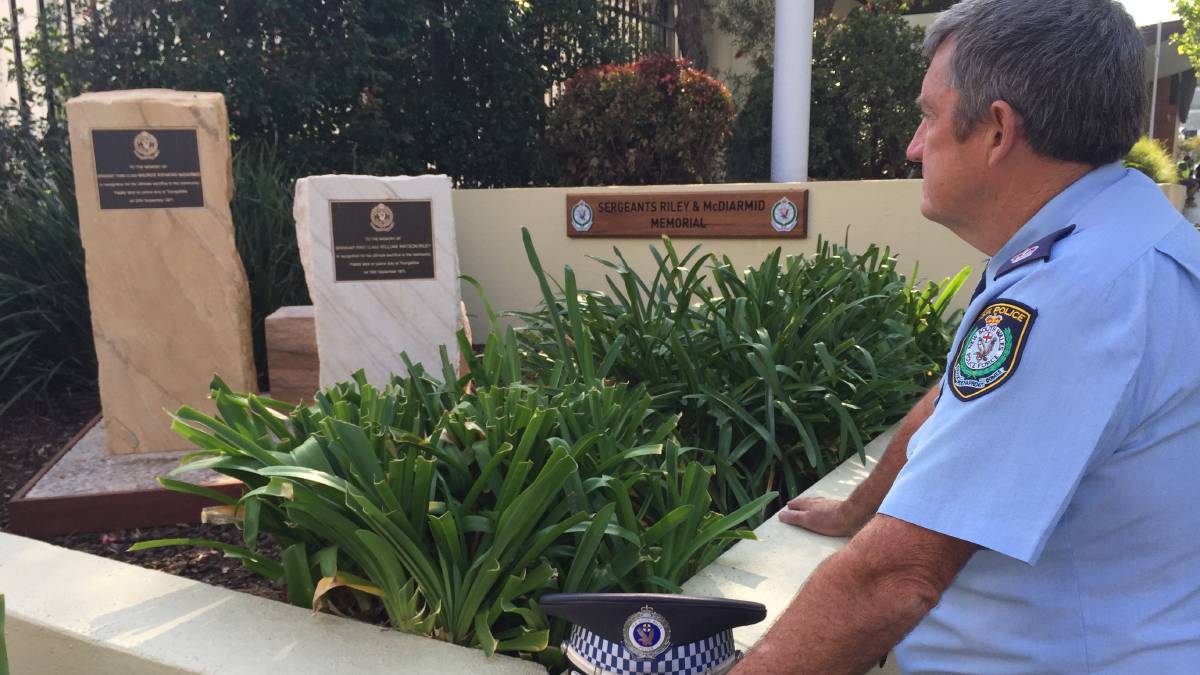
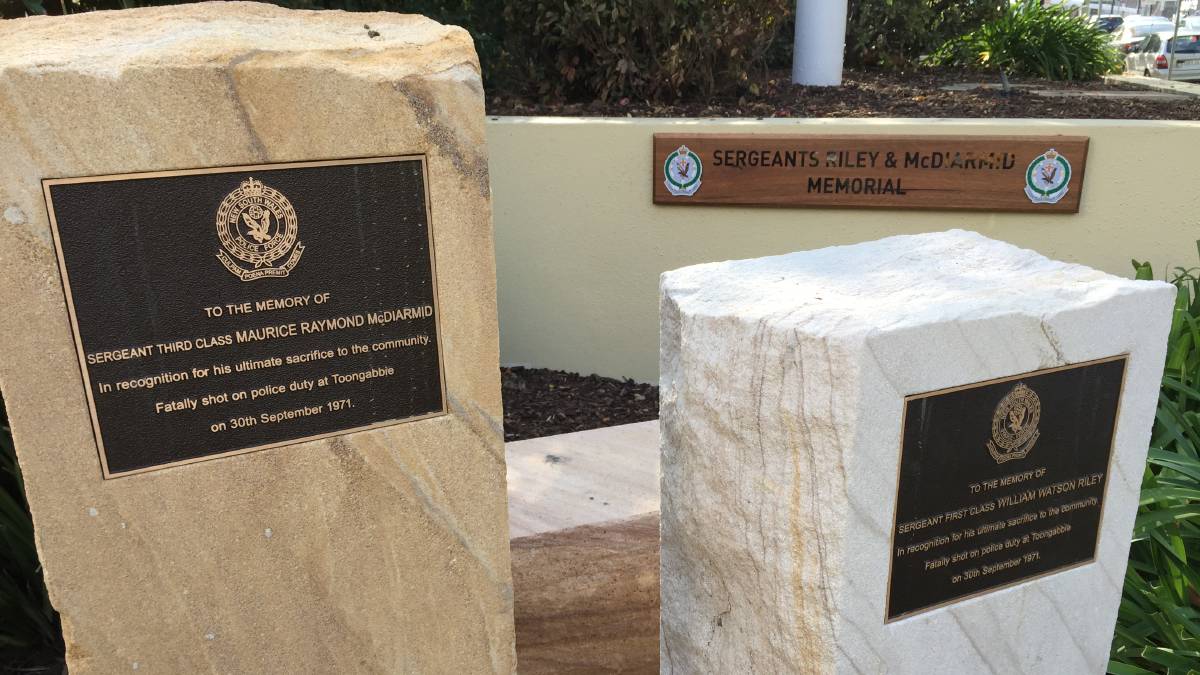
NOT FORGOTTEN: Blacktown Police Chief Inspector Bob Fitzgerald pays his respects at a memorial to slain officers Sergeant 1st Class William Riley and Sergeant 3rd Class Maurice McDiarmid. Picture: Harrison Vesey
A solemn memorial stands to remind Blacktown police officers of the price paid by two of their colleagues.
William Riley and Maurice McDiarmid were both killed in the line of duty on September 30, 1971, while trying to apprehend a murder suspect in Toongabbie.
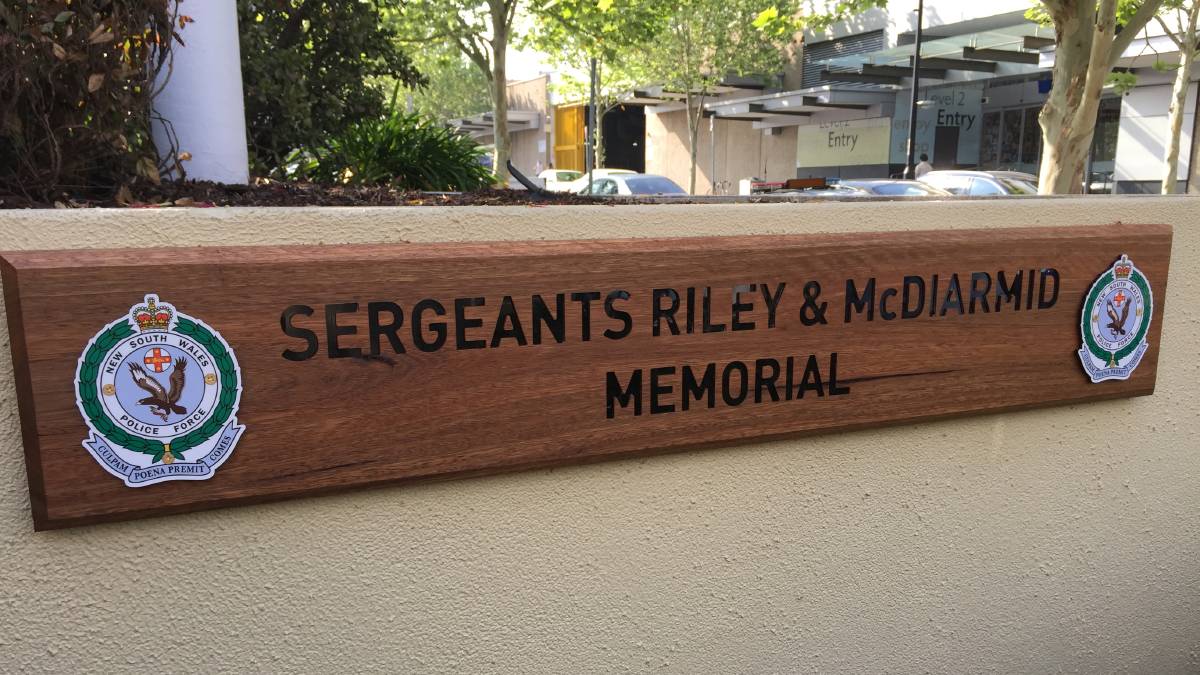
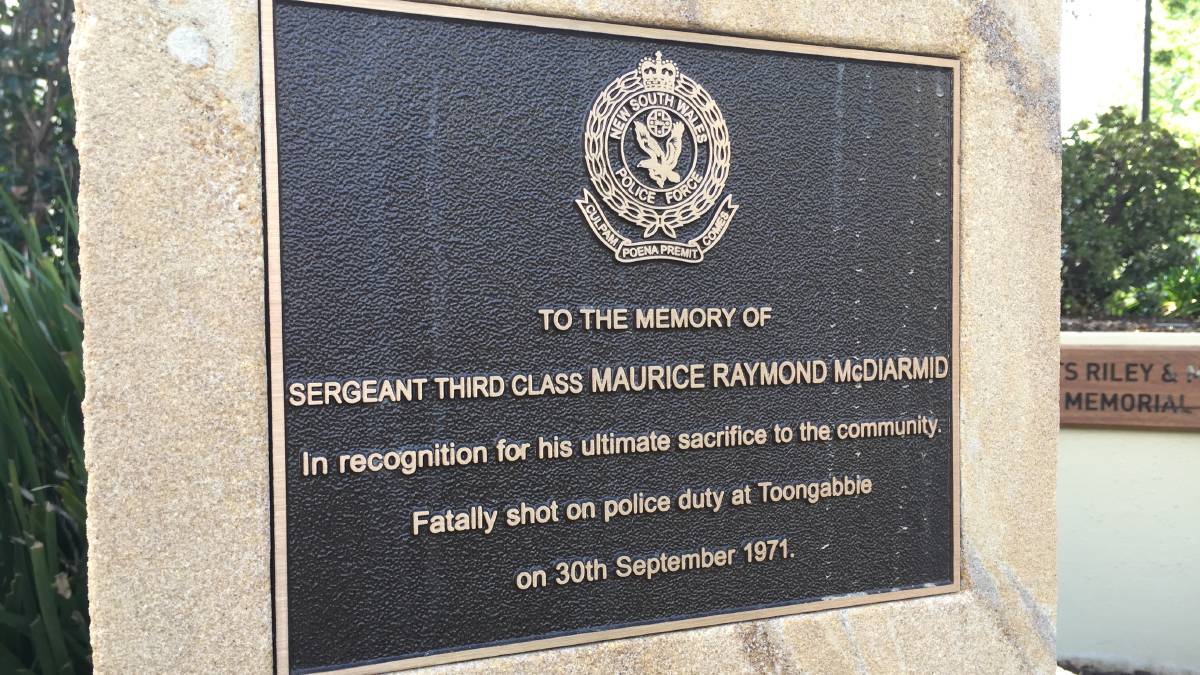
They are now remembered by commemorative plaques outside Blacktown Police Station, as well as a plinth at the entrance to the memorial rose garden at the NSW Police Academy.
The plinth features two police caps pictured the way they fell when the men were murdered, and bears the words: “For The People”.
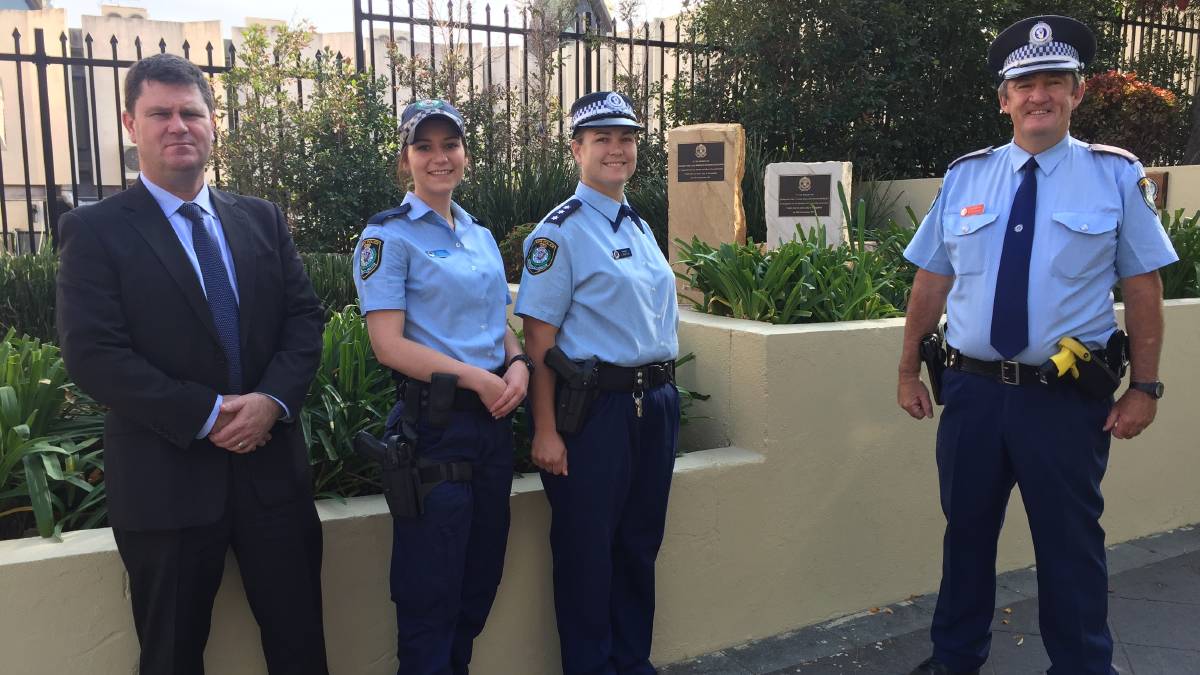
Detective Senior Sergeant Adam Wilson, Probationary Constable Peta Kendall, Acting Inspector Lauren Martin and Chief Inspector Bob Fitzgerald.
Chief Inspector Bob Fitzgerald said the permanent memorials were important for police and the community.
“I hope it’s a reminder when you come to work, you do the job to the best of your ability and go home to your family,” he said.
Acting Inspector Lauren Martin said Police Remembrance Day gave every officer a chance to think about those who didn’t make it home.
“It’s good to have a visual reminder so you can reflect on what could happen when you come to work,” she said.
Sergeant 2nd class Riley and Senior Constable McDiarmid were attending a home in Mimosa Avenue, Toongabbie, following reports a man had raped a woman and shot her lover, who was also his brother.
The offender, Ronald Clarke, shot and killed both officers as they attempted to surround him. He was shot and killed by police in Hillview later that day.
“It is a very sad day for all those who believe in upholding the law and order,” Police Commissioner Norman Allen said at the time.
Both officers were posthumously promoted for their outstanding courage and devotion to duty.
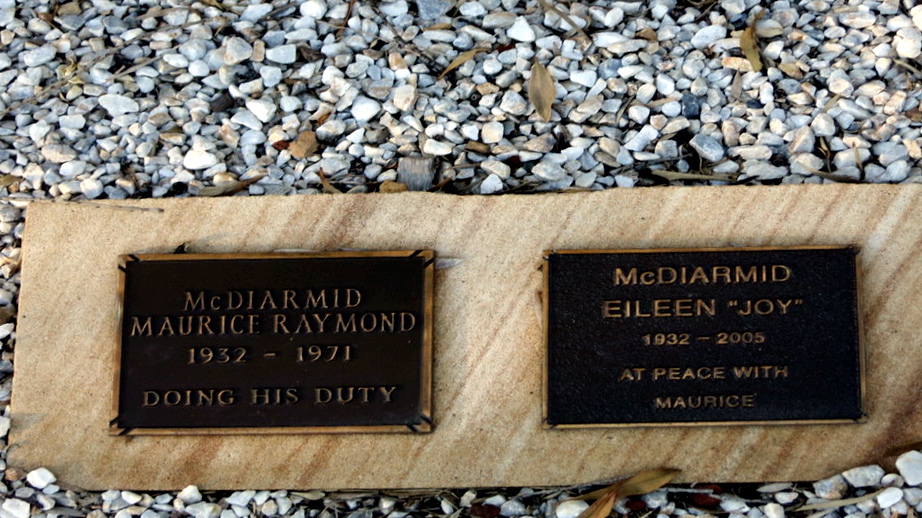
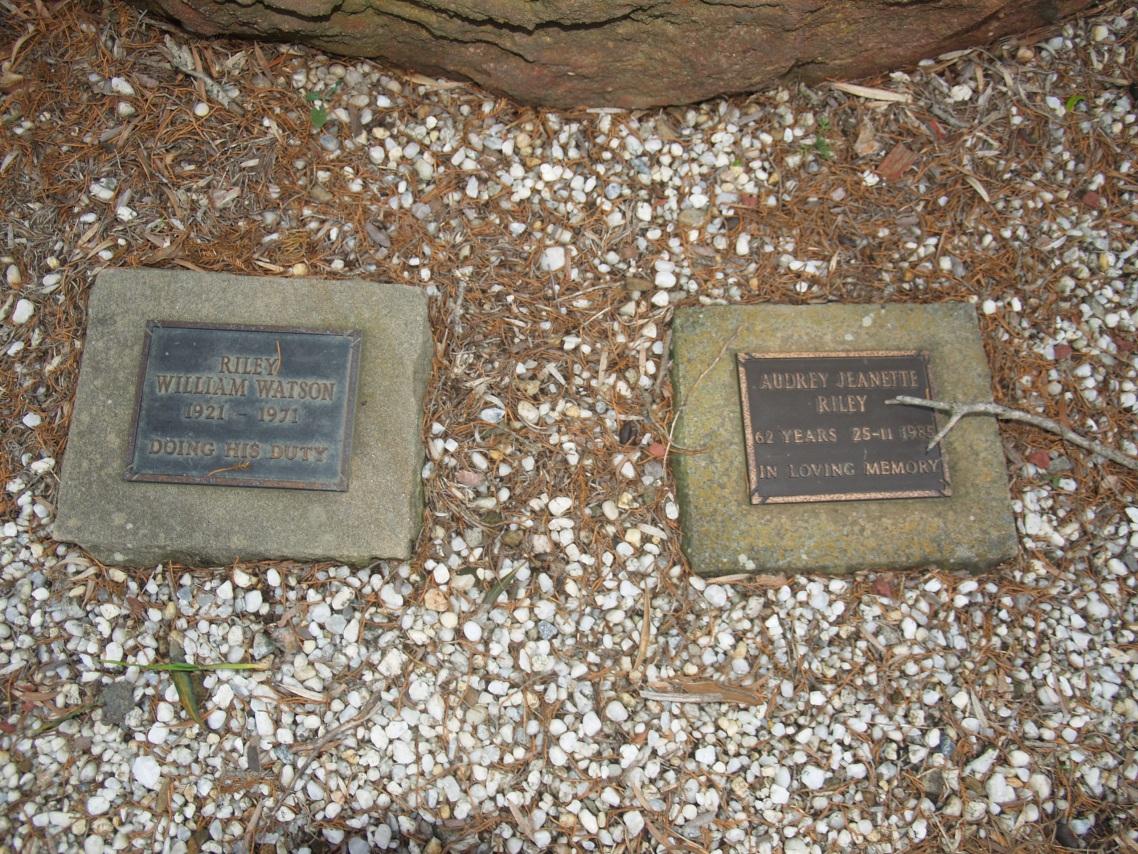
More than 400 officers attended their funeral in Blacktown. They were laid to rest at Pinegrove Cemetery with plaques bearing the inscription: “Doing His Duty”.
Canberra Times (ACT : 1926 – 1995), Saturday 27 November 1971, page 9
Two policemen commended by coroner
SYDNEY, Friday. — A Sydney coroner has commended two policemen who chased and stopped “an armed and desperate man“.
The man, Mr Ronald Desmond Clarke, had earlier shot and killed two other policemen after having killed his own brother in Toongabbie on September 30.
The coroner, Mr J. Parnell, SM, found on Wednesday that Mr Clarke in turn died in a car of cerebral lacerations and gun shot wounds to the brain inflicted by a person defending himself.
Constable A. C. Gregory, giving evidence at the inquest into the deaths of the four men, said that he and Constable L. ( Les ) A. Crawford in a police truck had rammed Mr Clarke‘s car, causing him to lose control.
Constable Gregory had seen Mr Clarke transfer a gun from his left hand to his right. The gun had been pointing at the policeman’s face and the constable had fired “one shot towards his shoulder“.
“The impact of this bullet appeared to throw him towards the passenger side of his car, but he still had the revolver, which he now held in both hands, levelled at my face“, Constable Gregory said.
“He appeared to be endeavouring to discharge the gun and it was then that I fired two quick shots at him“.
The four men who were killed were Sergeant First Class William Watson Riley, 50, and Sergeant Maurice Raymond McDiarmid, 39, of Blacktown, and Ronald Desmond Clarke, 20, and Warren John Clarke, 22, both of Toongabbie.
( Both policemen were promoted posthumously. Sergeant Riley was raised from second-class to first class, and Sergeant McDiarmid from senior constable to sergeant third class. )
Mr Parnell found that Mr Warren John Clarke died from gunshot wounds inflicted by his brother, Mr Ronald Desmond Clarke.
He found also that Sergeant Riley died from a fractured skull and lacerations to the brain, and Sergeant McDiarmid died in an ambulance between Toongabbie and Blacktown Hospital.
Both died as a result of bullet wounds inflicted by Clarke.
He said Mr Ronald Clarke, a professional criminal, had shot his brother, Warren Clarke, after having raped his brother’s de facto wife.
Canberra Times (ACT : 1926 – 1995), Friday 1 October 1971, page 1
Shooting in Sydney Brothers, two police die
SYDNEY, Thursday. – Two policemen and two other men were shot dead in the outer western Sydney suburb of Toongabbie today.
The policemen were shot while investigating a report of rape and murder.
Earlier, Mr Warren Clark about 22, died in his bed. Police said his elder brother, Ronald. 23, had shot him through the head with a .22 calibre repeater rifle.
A young woman, living in the house in Mimosa Ave, Toongabbie. with Mr Warren Clark, told police that Mr Ronald Clark had awakened her and then shot his brother.
The woman alleged that Mr Ronald Clark then raped her and forced her to accompany him in his car.
After driving her around for several hours, he had released her at Black town.
The woman went to Blacktown police station.
She was in a hysterical condition.
Sergeant Second-Class William Riley, 50. and Senior-Constable Morrie McDiarmid, 39. left the station immediately to go to the house.
While they were on their way the police radio directed other police to the house.
The next-door neighbour, in Mimosa Ave, Toongabbie. Mrs Ethel Roberts, 54. said she first knew something was wrong when a police officer ran down a driveway at the side of her house.
He began kicking on the door of the house next door.
“He eventually forced the door and went inside”, she said.
“All was quiet for perhaps two minutes, then three shots rang out.
“I ran to the front porch as a young blond man ran from the house with a rifle in his hand, entered a car and screeched off down the road”‘. Mrs Roberts said.
“After he drove off, I saw a policeman’s blood stained hand grasping the back steps of the house”.
Stem flow of blood
“I ran to the road where a woman was delivering bread and told her to call an ambulance”.
Another neighbour, Mrs Dawn Harris, was called by Mrs Roberts, who was trying to stem the flow of blood from Constable McDiarmid.
“When I reached the house a policeman was propped against the back steps”, Mrs Harris said.
“His mouth and part of his face were torn and shredded from the shotgun blast.
“Another policeman was lying dead on the ground.
“In a bedroom in the house another man covered with a sheet was also dead and blood could be seen everywhere”.
Police said later they believe Sergeant Riley died immediately when he was shot at point-blank range with a shotgun.
Constable McDiarmid was taken by ambulance to Blacktown Hospital. He died shortly after arrival.
Meanwhile an all-points bulletin was broadcast over the VKG police network for all cars to be on the lookout for a bright blue 1950 sedan.
The broadcast warned, ‘This man is dangerous. He has a .22 rifle, a shotgun and two police pistols”.
“We have sighted him”, one car replied. “He is going toward Hillview”.
“We have stopped the car”, was the officer’s next report.
Constable Alfred Gregory and Constable Les Crawford said later they had rammed the suspect’s car with their police van.
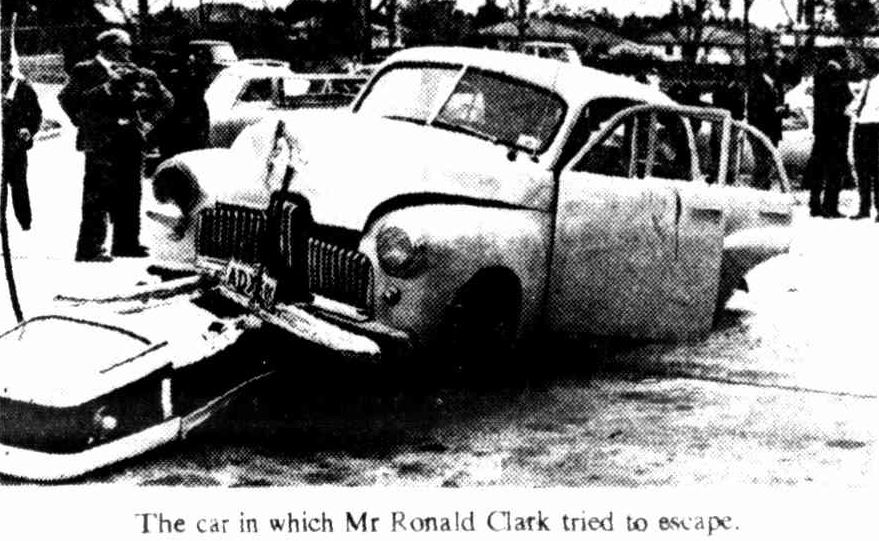
The sedan got out of control and crashed into a bowser at a service station.
Constable Gregory jumped out of the van. As he approached the car he saw Mr Clark take one of the police pistols from the seat and transfer it to his right hand.
Three shots from pistol
Constable Gregory fired three shots from his pistol.
One of his shots struck Mr Clark in the side of the head, killing him.
In the car, police found several Commonwealth Bank cash bags, a blood stained nightgown and two suitcases containing mostly women’s clothing.
Two police revolvers, a .22 repeater rifle and a sawn-off shotgun were also recovered.
Tonight forensic and ballistic experts were still examining them.
The policemen killed are each survived by a widow and two children.
Sergeant Riley joined the force in 1945 and Constable McDiarmid in 1956.
A CIB spokesman said this afternoon the families were eligible for a special allowance paid to police killed while on duty.
He said that the lack of witnesses, particularly when the two policemen were shot, was hampering investigations.
POLICE KILLED OR WHO DIED FROM INJURIES RECEIVED IN THE EXECUTION OF THEIR DUTIES
On 13th August, 1971, Senior Constable William Edward King, who was then the officer-in-charge of police, East Gresford, was shot dead at East Gresford Police Station by a man who fired upon him with a rifle.
On 29th August, 1971, Constable 1st Class Patrick Mark Hackett died from injuries received in a motor accident at Polis, Cyprus, whilst performing duty with the New South Wales Police component of the Australian Police Contingent of the United Nations Peace Keeping Force.
On 30th September, 1971, Sergeant Second Class William Watson Riley and Senior Constable Maurice Raymond McDiarmid, both then attached to Blacktown Police Station, were shot dead in a house at Toongabbie which they had entered to arrest a man who a short time before had murdered his brother and raped a woman in the same house.
A police funeral with full ceremonial honours was accorded these deceased officers at which appropriate tributes were paid.
In recognition of their outstanding courage Sergeant Riley and Senior Constable McDiarmid were posthumously promoted by me to Sergeant 1st Class and Sergeant 3rd Class respectively. In addition, I submitted recommendations to the Premier for favour of consideration of Royal Awards being granted in both cases.
To assist the widows of the deceased police the Premier approved the payment to each of them of the sum of $12,500 as a gratuity. This payment did not in any way affect their entitlements to payments under the provisions of the Police Regulation (Superannuation) Act.
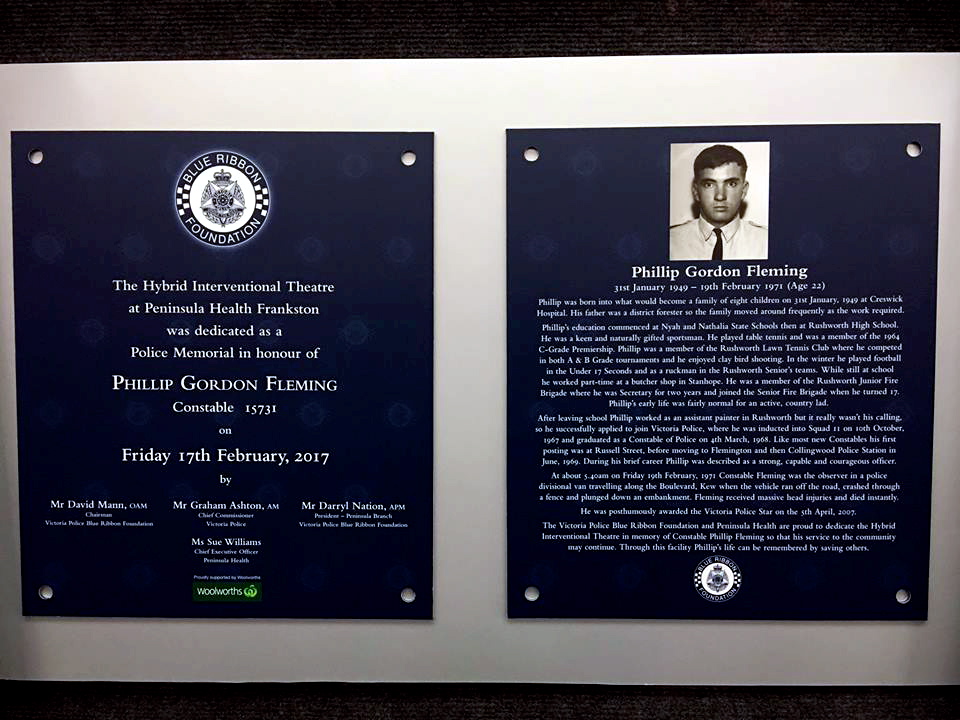
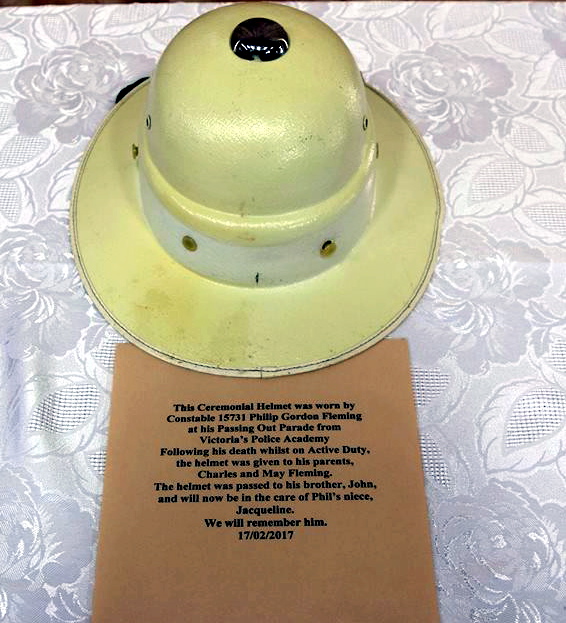
About 5.40am on Friday 19 February 1971, Constable Fleming was the observer in a police divisional van travelling along the Boulevard, Kew, when the vehicle ran off the road, crashed through a fence and plunged down an embankment. Fleming received massive head injuries and died instantly.
He was posthumously awarded the Victoria Police Star on the 5 April 2007.
[divider_dotted]
Western Port News, Victoria Tuesday 17 January 2017 Page 12
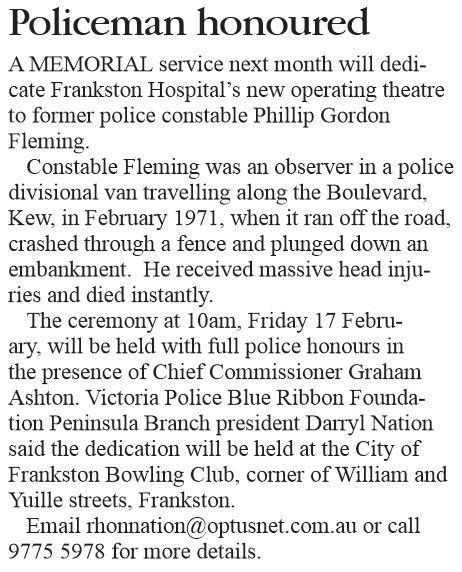
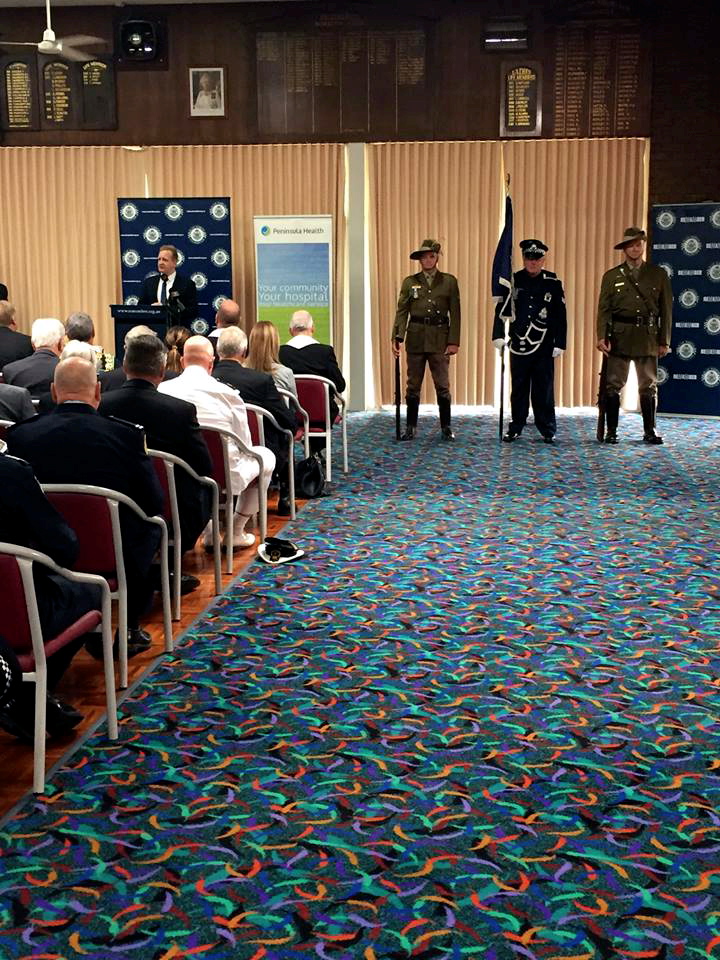
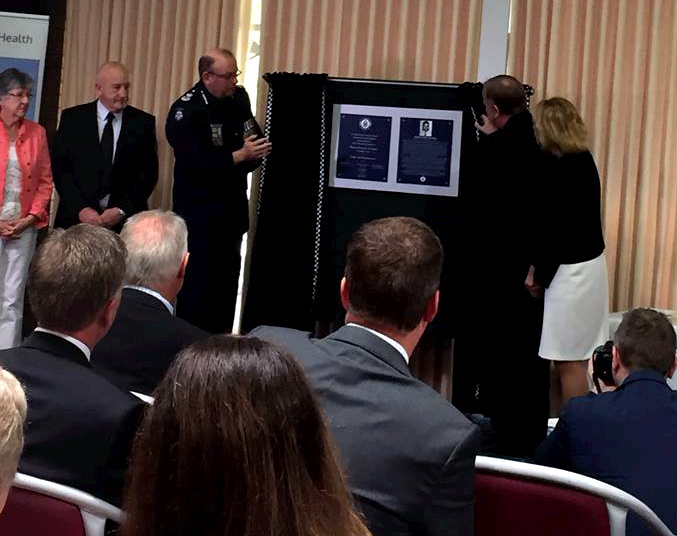
The Mornington Peninsula Branch of the Blue Ribbon Foundation together with our local police, Chief Commissioner and other distinguished guests today hosted a dedication to Constable Phillip FLEMING 15731 who was killed on duty in a motor vehicle accident on 19 February 1971.
The ceremony with Police Honours dedicated a purpose built emergency operating theatre at Peninsula Health as a permanent memorial to Constable FLEMING.
The service was a moving tribute to his memory and the creation of this new state of the art facility at Peninsula Health will ensure his memory lives on.
I take this opportunity to thank the Blue Ribbon Foundation, business and community alike for enabling the creation of this important medical facility.
Brett Coloe
A/Inspector
[divider_dotted]
A committed officer takes the exit ramp
John Silvester
THE sight of the apparently unflappable senior policeman giving calm television updates as the state burnt provided just a measure of reassurance as we faced our greatest natural disaster.
On Black Saturday, and in the days and weeks that followed, Deputy Commissioner Kieran Walshe was the front man, running the police response, from initial evacuation to the grim process of identifying victims.
With the death toll by late Saturday standing at 16, he knew it would get ”much worse”, but no one could have imagined the count would rise to 173.
Much has been said about then chief commissioner Christine Nixon choosing to head to a North Melbourne pub for a meal on the night of February 7, 2009, as Victoria burned.
But little has been said about how Walshe ran the emergency operation, providing strong leadership for police out in the carnage and a measured tone for the community trying to come to terms with an event almost beyond imagination.
What few knew at the time was that, behind the carefully constructed professional facade, the deputy commissioner was in turmoil as – like so many – he had been touched by those fires.
The father of four daughters, he had feared early on that his son-in-law’s family had been caught in one of the blazes. The worst was confirmed the next day. ”His mother and brother were victims who were lost in the Strathewen fires,” he says.
”I was trying to provide support for my daughter and her husband, but at the same time we had a job to do. I believe that if you take on a role, then you have to step up during the testing times.”
It has been part of the philosophy that has sustained him during his 44-year career, which has seen him rise from a 16-year-old police cadet to a deputy commissioner who served under three chiefs.
Big, broad and bald, with a copper’s handshake and a friendly manner, the senior policeman, now 61, will retire at the end of next week, proud at what he has achieved and confident the force has moved on from the poisonous office politics that previously infected its top ranks. This included assistant commissioner Noel Ashby’s bugged conversations that showed him trying to damage rival Simon Overland’s chances of becoming the next chief commissioner, and then deputy commissioner Sir Ken Jones’ well-documented spat with Overland.
”I have always believed that you must remain loyal to the organisation and to your leader,” says Walshe. ”So it was particularly disappointing when certain members of the executive showed less than true loyalty to the chief commissioner.”
The manner of Simon Overland’s forced resignation last year still grates. ”He had the organisation on the right track and was totally committed to the Victoria Police. The way he left remains one of the low points of my career.”
He says he also enjoyed working with Nixon. ”Christine has a different, more relaxed, management style. She recognised people’s skills and trusted them to do a job.”
Many kids flirt with the idea of joining the police. Most grow out of it. Walshe didn’t. Ever since he was nine, growing up in Bendigo, his career path was set. His father knew many of the local coppers, who left a lasting impression on the youngster, and as soon as he was old enough he moved to Melbourne to join.
It was 1968 and Australia was just starting to feel comfortable about decimal currency; former fighter pilot John Gorton was prime minister; and Richard Nixon moved into the White House.
As a cadet, Walshe was sent to get experience at busy stations, including Northcote, where he no doubt got under the feet of the head of the crime section, a certain Detective Senior Sergeant Fred Silvester. After graduating, he went to Russell Street before transferring to Collingwood, where he experienced firsthand the dangers of his job.
On a night shift in 1971, the Ford divisional van he was driving along The Boulevard in Kew smashed through a fence and plunged 45 metres down an embankment. When he regained consciousness he tried to help his partner, Constable Phillip Fleming, who was motionless in the passenger seat. Walshe radioed for help then clambered back up the hill, his head badly gashed. What he didn’t yet know was that his partner had been killed on impact.
Walshe, now finishing up as Victoria’s traffic chief, says that having been involved in a fatal accident (”losing a mate … you carry it your whole life”) taught him the consequences of each road death.
”There is the victim, the family and the friends. The effect is devastating to so many people. I think it is one of the reasons I have been passionate about road policing.”
Walshe moved around busy inner-city stations before moving to Ascot Vale and the CIB (criminal investigation branch). ”I tried to treat each investigation as a learning experience and a chance to build your skills.”
By the 1980s, he was in charge of the air wing, which he built up from one helicopter and two fixed-wing aircraft to a service that provided emergency rescues, ambulance response, transport, traffic observation, drug crop identification and criminal surveillance. Despite not being a pilot, he was once given a million dollars and told to go out and buy a single-engine helicopter. Considering the number of lame buys senior police have made over the years, including spending a fortune on a computer system with the power of a crystal set, it is a wonder he didn’t come back with a blimp.
His career – in which he has moved through all ranks and most areas of the force – proved to be the perfect grounding for high office. This included a stint with the ethical standards department, an area that he thinks too many police avoid as they ”don’t see it as a good career move”. While there are still police (including some elite investigators) who refuse to work in ESD, dubbing it ”The Filth” or ”The Toecutters”, Walshe says a spell in the area improves leadership skills. ”You learn to recognise the early warning signs of when someone might be about to make some poor decisions.
”ESD deals with serious criminal and disciplinary matters. We accept that when someone in the community commits a crime they should be prosecuted and we should have the same attitude when it comes to police.”
From 1999, Walshe also spent two years at Seymour, where he found a new respect for country police. ”Country policing is so different to metropolitan policing. There is no sense of anonymity as you live in the same community where you work. Everyone knows you are a police officer.” He sees police in Victoria’s 99 one-person country stations as ”the last bastion of authority. The house is usually next door to the station, so you are expected to be available 24/7.”
Like many, Walshe watched the aftermath of the terrorist attacks on New York’s World Trade Centre, soon realising it would change the face of policing. In 2005, he was made assistant commissioner counter terrorism and was involved in Australia’s two biggest terrorism investigations, Pendennis and Neath. ”These were significant disruption exercises. It remains of great concern that these cells were operating not only in Australia, but specifically Melbourne.”
He says there has been a marked shift in the expectations of police recruits today. ”It is a generational thing. The vast majority are as committed to serving the community as we were back in 1968, but more of them see it as a job rather than as a career. That never entered my mind when I joined, as I fully expected to stay until I retired – although I didn’t dream I would last 44 years.”
”When Ken [Lay] was appointed Chief Commissioner, I knew the time was right for me to go. There are some things I want to do while I am still fit enough to do them.” These include travel with his wife, Denise, and spending time with his family, including his eight (soon to be nine) grandchildren.
Mate and long-time colleague Lay told us, ”Kieran has had a magnificent career. I was his subordinate and he was the sort of boss you would die for. When we were peers I always appreciated his wise counsel and as my deputy he has been rock solid and loyal.
”You always know where you are with him. He will look you in the eye and tell you what he thinks. I will miss his wise advice, and the organisation will miss his leadership.”
Victoria’s top road safety policeman, Kieran Walshe says a fatal crash he was involved in 40 years ago puts him in a better position to understand road trauma.
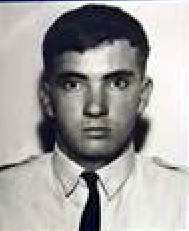
Constable Phillip Fleming was killed when a police van driven by Kieran Walshe crashed in Kew, in February 1971.
Deputy Commissioner Walshe has spoken publicly about the crash for the first time, ahead of the launch of the international decade of action for road safety.
He has rejected allegations he was driving inappropriately and has told ABC Local Radio, he is able to do his job well, because of his experience.
“I live with it, I deal with it. I think it makes me a better position to understand what other people endure when they experience and go through road trauma,” he said.
“I think it helps me be a little bit more passionate about the message that I need to make sure I give to the community of Victoria.”
He has spoken out because of questions from former officers about his ability to do his job.
“Obviously, for some reason, someone wants to challenge my reputation, or challenge my credibility to do my job,” he said.
“I dispute that. I think that I’ve done my job and continue to do my job very well and you never get over these things.”
MARK COLVIN: There’s been more controversy around senior figures in Victoria Police today, with revelations that the state’s top traffic cop was the driver in a fatal car crash in Melbourne 40 years ago.
The facts of the accident have resurfaced, just days after the State Government ordered an independent inquiry into the upper echelons of police.
Liz Hobday reports.
LIZ HOBDAY: Deputy Commissioner Kieran Walshe was driving a police wagon at a notorious accident spot on Kew Boulevard in 1971, when he lost control of his vehicle. The van ran off the road and plunged down an embankment, killing his passenger and good friend 22-year-old constable Phillip Fleming.
Kieran Walshe was 19 at the time, and says he woke up in hospital.
KIERAN WALSHE: I have no actual recollection of what took place at the time the vehicle left the road.
LIZ HOBDAY: A coronial inquest delivered an open finding.
KIERAN WALSHE: There has been a thorough investigation. There is no evidence to implicate or any impropriety in the way I drove the vehicle.
LIZ HOBDAY: The revelations emerged in the Herald Sun this morning, two days after the Victorian Government ordered an inquiry into the actions of those at the top of the force, after a string of controversies.
Kieran Walshe says he doesn’t know who told the newspaper about the crash, or why.
KIERAN WALSHE: I don’t know what their motivations are. All I can say is that I can only assume there’s some endeavour by somebody to discredit me.
LIZ HOBDAY: Kieran Walshe says he didn’t tell Chief Commissioner Simon Overland about the crash when he got the job of deputy commissioner, regional and road policing.
KIERAN WALSHE: Simon Overland has only been in Victoria Police for a little over eight years, nine years. It wasn’t something that I thought it was necessary to go and say to him. This happened 40 years ago.
LIZ HOBDAY: The Police Association’s Greg Davies says the latest story won’t affect morale; the problem is more the numerous inquiries now underway.
GREG DAVIES: Well we’ve got obviously at least three inquiries running at the moment into the police force, we’ve got turmoil at the top levels, that has to have a cascading effect to other levels of senior management, down all the way to the youngest constable.
LIZ HOBDAY: And he says retired officers could be behind the latest story.
GREG DAVIES: As far as who might be behind it, well we can only speculate. I’d be more inclined to think it would be a retired police officer than a current serving one.
LIZ HOBDAY: The latest inquiry into senior management at Victoria Police, is expected to report to Government within six months.
VICTORIA’S top traffic cop has spoken publicly for the first time about the trauma of crashing a car in which his passenger, a fellow police officer, died.
Deputy Commissioner Kieran Walshe lost control of the police divvy van he was driving 40 years ago as it was travelling on The Boulevard in Kew.
The Falcon van crashed through a fence and plunged 45m down a steep embankment, killing Constable Phillip Fleming, 22, about 5.40am on February 19, 1971.
Mr Walshe decided to tell his story to reject recent claims by former police officers that he was driving inappropriately on what has for decades been one of Melbourne’s most notorious street racing black spots.
“That’s not something that I ever did. It was not in my nature to drive in that manner and there is just no evidence to say that I did,” he told the Herald Sun.
Mr Walshe said Chief Commissioner Simon Overland was not aware of his involvement in the crash when he appointed him head of the traffic branch, but was now, and was happy for him to continue in the role.
Mr Walshe said: “I have been subjected to a thorough investigation. I have been subjected to a coronial inquiry and at no stage was there any evidence identified that gave any indication of any inappropriate behaviour on my part.”
Coroner Harry Pascoe recorded an open finding in 1971, saying from the evidence available it was not possible to determine if Constable Fleming’s death was “accidental or otherwise”.
The former officers this week claimed they were raising the issue only because Mr Walshe was recently put in charge of road safety policing in Victoria.
“The question arises how he, with any credibility, can criticise people in their 20s for hoon-type behaviour on Victorian roads,” one of them said.
But Mr Walshe, 60, said yesterday that having been involved in the fatal accident made him better able to do his job.
“I certainly have a greater appreciation than other people would who haven’t been involved in trauma like I have been,” he said.
“It makes me more passionate about the message I am trying to deliver out there – anybody can be involved in road trauma.”
The death of Constable Fleming continued to haunt Mr Walshe.
“When you are the driver … and you lose a close mate it has an impact … that you carry for the rest of your life. It’s just a really difficult thing that you have to live with,” he said.
Mr Walshe was quizzed by accident investigator Sen-Constable James Kenneday about why he was driving on The Boulevard.
“Did you go to The Boulevard for a burn in the van?” Sen-Constable Kenneday asked in 1971.
Mr Walshe replied: “I don’t remember.”
The issue comes as the administration of VicPol has become a major political issue. Premier Ted Baillieu this week appointed Jack Rush, QC, to examine, among other things, the effectiveness of the senior structure of police command.
“Possibly” from Class 17 from Penrith Police College
Regd. # 5456
Uniform # 367
Rank: Probationary Constable – appointed Monday 13 January 1947 ( aged 21 years, 5 months, 23 days )
Constable – appointed ? ? ?
Constable 1st Class – appointed ? ? ?
Senior Constable – appointed ? ? ?
Sergeant 3rd Class – appointed ? ? ?
Sergeant 2nd Class – appointed 1 April 1968
Final Rank: Sergeant 2nd Class – death
Stations: Five Dock, Petersham, Parramatta STP ( 1949 – ), Hornsby STP ( 1950’s – ), North East District ( 1968 ), Gosford STP & General Duties – death
Service: From? ? pre January 1947to 14 April 1971 =23years Service
On 30 September, 1971, Sergeant 2nd Class Riley and Senior Constable McDiarmid attended a dwelling in Mimosa Avenue, Toongabbie to investigate a report that a man had shot and killed his brother at that address. On arrival the police saw the offender RonaldClarke who quickly ran to the rear of the house. Senior Constable McDiarmid followed him while the sergeant entered through the front door. As the senior constable entered through the back door the offender opened fire with a shotgun, inflicting a fatal wound. It appears the offender then went back through the house where he also shot and killed Sergeant Riley. Although the senior constable was still alive when other police arrived he died a short time later in an ambulance on the way to hospital. The offender was shot and killed by police ( Cst 1/c Alf GREGORY ) the same day.
William Riley was born in 1921 and joined the New South Wales Police Force on 3 December, 1945. At the time of his death he was stationed at Blacktown. He was posthumously promoted to Sergeant 1st Class.
Maurice McDiarmid was born in 1932 and joined the New South Wales Police Force on 9 July, 1956. At the time of his death he was stationed at Blacktown. He was posthumously promoted to Sergeant 3rd Class.
George Lewis Memorial Trophy
This trophy for the year 1971, which is for the most courageous act performed by a member of the New South Wales Police Force, was awarded posthumously to the late Sergeant 1st Class W. W. Riley and the late Sergeant 3rd Class M. R. McDiarmid who were stationed at 27 Division.
The trophies were presented to Mrs Riley and Mrs McDiarmid at the Police Academy during 1972.
PETER MITCHELL TRUST AWARDS
The ten awards under this Trust for the year 1971 were made to the following police, the trophies being presented at the Police Academy during 1972:
Most Courageous Act Posthumously awarded to the late Sergeant 1st Class W. W. Riley and the late Sergeant 3rd Class M. R. McDiarmid in conjunction with the George Lewis Memorial Trophy.
SYDNEY, Monday. — At the Pine Grove Memorial Park near Rooty Hill today, Bishop Hulme-Moir, chaplain of the NSW Police Force, dedicated a plaque in memory of Sergeant Maurice McDiarmid and Sergeant William Riley, who were shot when attempting to arrest an armed man at Toongabbie on September 30 last year.
SYDNEY, Wednesday. – The NSW Government agreed today to make, as “an act of grace”, lump-sum payments of $12,500 to each of three police officers’ widows.
“The Premier, Sir Robert Askin, said the payments would be in addition to the pensions and dependant’s allowances already paid out of the police superannuation and reward fund.
The three policemen involved in the payments are Senior Constable W. E. King, who was murdered at East Gresford police station on August 13 last year, and Sergeants W. Riley and M. McDiarmid, who were shot by a man at Toongabbie on September 30 last year.
Sir Robert said members of the police force had always been specifically excluded from the definition of “worker” under the Workers Compensation Act.
He said the Commissioner of Police, Mr Allan, had brought to the notice of the Government that, in certain matters of workers’ compensation, police were in an anomalous position in relation to other Crown employees.
Sir Robert said a full examination would be made of overall benefits of workers’ compensation available to police.
SYDNEY, Tuesday. -More than 400 policemen attended the funeral this morning of the two policemen shot by a man in Toongabbie last Thursday. Both men, Sergeant William Watson Riley and Senior Constable Maurice Raymond McDiarmid, were given full police honours at their funeral.
William RILEY’s son, Ian, also joined the NSW Police Force as a NSW Police Cadet, # 1953, on 17 August 1964, and was Sworn In on 14 December 1966 by Assistant Commissioner Joe BUCK in his office in the old Police Headquarters in Hunter St, Sydney, alongside of NSW Police Cadet Kevin TANT, Cadet # 1838.
William RILEY’s daughter, Jeanie, also joined the NSW Police Force in 1978 but had resigned several years later. Jeanie had Regd. # 18503. Was a Probationary Constable on 2 April 1979 and a Senior Constable on 2 April 1988.
Canberra Times (ACT : 1926 – 1995),
Friday 1 October 1971, page 1
Shooting in Sydney Brothers, two police die
SYDNEY, Thursday. – Two policemen and two other men were shot dead in the outer western Sydney suburb of Toongabbie today.
The policemen were shot while investigating a report of rape and murder.
Earlier, Mr Warren Clark about 22, died in his bed. Police said his elder brother, Ronald. 23, had shot him through the head with a .22 calibre repeater rifle.
A young woman, living in the house in Mimosa Ave, Toongabbie. with Mr Warren Clark, told police that Mr Ronald Clark had awakened her and then shot his brother.
The woman alleged that Mr Ronald Clark then raped her and forced her to accompany him in his car.
After driving her around for several hours, he had released her at Black town.
The woman went to Blacktown police station.
She was in a hysterical condition.
Sergeant Second-Class William Riley, 50. and Senior-Constable Morrie McDiarmid, 39. left the station immediately to go to the house.
While they were on their way the police radio directed other police to the house.
The next-door neighbour, in Mimosa Ave, Toongabbie. Mrs Ethel Roberts, 54. said she first knew something was wrong when a police officer ran down a driveway at the side of her house.
He began kicking on the door of the house next door.
“He eventually forced the door and went inside”, she said.
“All was quiet for perhaps two minutes, then three shots rang out.
“I ran to the front porch as a young blond man ran from the house with a rifle in his hand, entered a car and screeched off down the road”‘. Mrs Roberts said.
“After he drove off, I saw a policeman’s blood stained hand grasping the back steps of the house”.
Stem flow of blood
“I ran to the road where a woman was delivering bread and told her to call an ambulance”.
Another neighbour, Mrs Dawn Harris, was called by Mrs Roberts, who was trying to stem the flow of blood from Constable McDiarmid.
“When I reached the house a policeman was propped against the back steps”, Mrs Harris said.
“His mouth and part of his face were torn and shredded from the shotgun blast.
“Another policeman was lying dead on the ground.
“In a bedroom in the house another man covered with a sheet was also dead and blood could be seen everywhere”.
Police said later they believe Sergeant Riley died immediately when he was shot at point-blank range with a shotgun.
Constable McDiarmid was taken by ambulance to Blacktown Hospital. He died shortly after arrival.
Meanwhile an all-points bulletin was broadcast over the VKG police network for all cars to be on the lookout for a bright blue 1950 sedan.
The broadcast warned, ‘This man is dangerous. He has a .22 rifle, a shotgun and two police pistols”.
“We have sighted him”, one car replied. “He is going toward Hillview”.
“We have stopped the car”, was the officer’s next report.
Constable Alfred Gregory and Constable Les Crawford said later they had rammed the suspect’s car with their police van.
The sedan got out of control and crashed into a bowser at a service station.
Constable Gregory jumped out of the van. As he approached the car he saw Mr Clark take one of the police pistols from the seat and transfer it to his right hand.
Three shots from pistol
Constable Gregory fired three shots from his pistol.
One of his shots struck Mr Clark in the side of the head, killing him.
In the car, police found several Commonwealth Bank cash bags, a blood stained nightgown and two suitcases containing mostly women’s clothing.
Two police revolvers, a .22 repeater rifle and a sawn-off shotgun were also recovered.
Tonight forensic and ballistic experts were still examining them.
The policemen killed are each survived by a widow and two children.
Sergeant Riley joined the force in 1945 and Constable McDiarmid in 1956.
A CIB spokesman said this afternoon the families were eligible for a special allowance paid to police killed while on duty.
He said that the lack of witnesses, particularly when the two policemen were shot, was hampering investigations.
Government Gazette of the State of New South Wales (Sydney, NSW : 1901 – 2001),
Friday 28 April 1972 (No.44), page 1544
RE the estate of WILLIAM WATSON RILEY, late of St Marys, in the state or New South Wales, police sergeant, deceased. —
Probate of the will dated 21st June, 1951, granted by the Supreme Court of New South Wales on the 7th day of April, 1972.—
Pursuant to the Wills, Probate and Administration Act, 1898 -1954, Testator’s Family Maintenance and Guardianship of Infants Act, 1916 -1954, and Trustee Act, 1925 -1942, the Public Trustee, the executor of the will of the said William Watson Riley, who died on the 30th day of September, 1971, hereby gives notice that creditors and others having any claim against or to the estate of the said deceased are required to send particulars of their claims to the said Public Trustee at his Branch Office hereunder mentioned, on or before the 28th day of June, 1972, at the expiration of which time the said Public Trustee will distribute the assets of the said deceased to the persons entitled, having regard only to the claims of which he then has notice.
NOT FORGOTTEN: Blacktown Police Chief Inspector Bob Fitzgerald pays his respects at a memorial to slain officers Sergeant 1st Class William Riley and Sergeant 3rd Class Maurice McDiarmid. Picture: Harrison Vesey
A solemn memorial stands to remind Blacktown police officers of the price paid by two of their colleagues.
William Riley and Maurice McDiarmid were both killed in the line of duty on September 30, 1971, while trying to apprehend a murder suspect in Toongabbie.
They are now remembered by commemorative plaques outside Blacktown Police Station, as well as a plinth at the entrance to the memorial rose garden at the NSW Police Academy.
The plinth features two police caps pictured the way they fell when the men were murdered, and bears the words: “For The People”.
Detective Senior Sergeant Adam Wilson, Probationary Constable Peta Kendall, Acting Inspector Lauren Martin and Chief Inspector Bob Fitzgerald.
Chief Inspector Bob Fitzgerald said the permanent memorials were important for police and the community.
“I hope it’s a reminder when you come to work, you do the job to the best of your ability and go home to your family,” he said.
Acting Inspector Lauren Martin said Police Remembrance Day gave every officer a chance to think about those who didn’t make it home.
“It’s good to have a visual reminder so you can reflect on what could happen when you come to work,” she said.
Sergeant 2nd class Riley and Senior Constable McDiarmid were attending a home in Mimosa Avenue, Toongabbie, following reports a man had raped a woman and shot her lover, who was also his brother.
The offender, Ronald Clarke, shot and killed both officers as they attempted to surround him. He was shot and killed by police in Hillview later that day.
“It is a very sad day for all those who believe in upholding the law and order,” Police Commissioner Norman Allen said at the time.
Both officers were posthumously promoted for their outstanding courage and devotion to duty.
More than 400 officers attended their funeral in Blacktown. They were laid to rest at Pinegrove Cemetery with plaques bearing the inscription: “Doing His Duty”.
SYDNEY, Friday. — A Sydney coroner has commended two policemen who chased and stopped “an armed and desperate man“.
The man, Mr Ronald Desmond Clarke, had earlier shot and killed two other policemen after having killed his own brother in Toongabbie on September 30.
The coroner, Mr J. Parnell, SM, found on Wednesday that Mr Clarke in turn died in a car of cerebral lacerations and gun shot wounds to the brain inflicted by a person defending himself.
Constable A. C. Gregory, giving evidence at the inquest into the deaths of the four men, said that he and Constable L. ( Les ) A. Crawford in a police truck had rammed Mr Clarke‘s car, causing him to lose control.
Constable Gregory had seen Mr Clarke transfer a gun from his left hand to his right. The gun had been pointing at the policeman’s face and the constable had fired “one shot towards his shoulder“.
“The impact of this bullet appeared to throw him towards the passenger side of his car, but he still had the revolver, which he now held in both hands, levelled at my face“, Constable Gregory said.
“He appeared to be endeavouring to discharge the gun and it was then that I fired two quick shots at him“.
The four men who were killed were Sergeant First Class William Watson Riley, 50, and Sergeant Maurice Raymond McDiarmid, 39, of Blacktown, and Ronald Desmond Clarke, 20, and Warren John Clarke, 22, both of Toongabbie.
( Both policemen were promoted posthumously. Sergeant Riley was raised from second-class to first class, and Sergeant McDiarmid from senior constable to sergeant third class. )
Mr Parnell found that Mr Warren John Clarke died from gunshot wounds inflicted by his brother, Mr Ronald Desmond Clarke.
He found also that Sergeant Riley died from a fractured skull and lacerations to the brain, and Sergeant McDiarmid died in an ambulance between Toongabbie and Blacktown Hospital.
Both died as a result of bullet wounds inflicted by Clarke.
He said Mr Ronald Clarke, a professional criminal, had shot his brother, Warren Clarke, after having raped his brother’s de facto wife.
reported the murders of the two police in graphic detail.
“SYDNEY, Thursday – Two policemen and two other men were shot dead in the outer western Sydney suburb of Toongabbie today. The policemen were shot while investigating a report of rape and murder. Earlier, Mr Warren Clark about 22, died in his bed. Police said his elder brother, Ronald. 23, had shot him through the head with a .22 calibre repeater rifle. A young woman, living in the house in Mimosa Ave, Toongabbie with Mr Warren Clark, told police that Mr Ronald Clark had awakened her and then shot his brother. The woman alleged that Mr Ronald Clark then raped her and forced her to accompany him in his car. After driving her around for several hours, he had released her at Blacktown. The woman went to Blacktown police station. She was in a hysterical condition. Sergeant Second-Class William Riley, 50, and Senior-Constable Morrie McDiarmid, 39, left the station immediately to go to the house. While they were on their way the police radio directed other police to the house.
“The next-door neighbour, in Mimosa Ave, Toongabbie. Mrs Ethel Roberts, 54, said she first knew something was wrong when a police officer ran down a driveway at the side of her house. He began kicking on the door of the house next door. “He eventually forced the door and went inside”, she said. “All was quiet for perhaps two minutes, then three shots rang out. I ran to the front porch as a young blond man ran from the house with a rifle in his hand, entered a car and screeched off down the road”, Mrs Roberts said. “After he drove off, I saw a policeman’s blood stained hand grasping the back steps of the house. I ran to the road where a woman was delivering bread and told her to call an ambulance”. Another neighbour, Mrs Dawn Harris, was called by Mrs Roberts, who was trying to stem the flow of blood from Constable McDiarmid. “When I reached the house a policeman was propped against the back steps”, Mrs Harris said. “His mouth and part of his face were torn and shredded from the shotgun blast. Another policeman was lying dead on the ground. In a bedroom in the house another man covered with a sheet was also dead and blood could be seen everywhere”.
“Police said later they believe Sergeant Riley died immediately when he was shot at point-blank range with a shotgun. Constable McDiarmid was taken by ambulance to Blacktown Hospital. He died shortly after arrival.
“Meanwhile an all-points bulletin was broadcast over the VKG police network for all cars to be on the lookout for a bright blue 1950 sedan. The broadcast warned, ‘This man is dangerous. He has a .22 rifle, a shot gun and two police pistols”. “We have sighted him”, one car replied. “He is going toward Hillview“. “We have stopped the car”, was the officer’s next report. Constable Alfred Gregory and Constable Les Crawford said later they had rammed the suspect’s car with their police van. The sedan got out of control and crashed into a bowser at a service station. Constable Gregory jumped out of the van. As he approached the car he saw Mr Clark take one of the police pistols from the seat and transfer it to his right hand. Constable Gregory fired three shots from his pistol. One of his shots struck Mr Clark in the side of the head, killing him.
“In the car, police found several Commonwealth Bank cash bags, a blood stained nightgown and two suitcases containing mostly women’s clothing. Two police revolvers, a .22 repeater rifle and a sawn-off shotgun were also recovered. Tonight forensic and ballistic experts were still examining them. The policemen killed are each survived by a widow and two children. Sergeant Riley joined the force in 1945 and Constable McDiarmid in 1956.”
The Canberra Times of the 25 May, 1972 briefly recorded the awarding of bravery medals to both men, reporting that “Sergeant William Riley, 50, and Sergeant Maurice McDiarmid, 39, who were shot dead while trying to arrest a man at Toongabbie last year, have been posthumously awarded the Queen’s Police Medal for gallantry”.
The sergeant was born in 1921 and joined the New South Wales Police Force on 3 December, 1945. At the time of his death he was stationed at Blacktown. He was posthumously promoted to Sergeant 1st Class. He is listed in the official New South Wales Police Honour Roll.
POLICE KILLED OR WHO DIED FROM INJURIES RECEIVED IN THE EXECUTION OF THEIR DUTIES
On 13th August, 1971, Senior Constable William Edward King, who was then the officer-in-charge of police, East Gresford, was shot dead at East Gresford Police Station by a man who fired upon him with a rifle.
On 29th August, 1971, Constable 1st Class Patrick Mark Hackett died from injuries received in a motor accident at Polis, Cyprus, whilst performing duty with the New South Wales Police component of the Australian Police Contingent of the United Nations Peace Keeping Force.
On 30th September, 1971, Sergeant Second Class William Watson Riley and Senior Constable Maurice Raymond McDiarmid, both then attached to Blacktown Police Station, were shot dead in a house at Toongabbie which they had entered to arrest a man who a short time before had murdered his brother and raped a woman in the same house.
A police funeral with full ceremonial honours was accorded these deceased officers at which appropriate tributes were paid.
In recognition of their outstanding courage Sergeant Riley and Senior Constable McDiarmid were posthumously promoted by me to Sergeant 1st Class and Sergeant 3rd Class respectively. In addition, I submitted recommendations to the Premier for favour of consideration of Royal Awards being granted in both cases.
To assist the widows of the deceased police the Premier approved the payment to each of them of the sum of $12,500 as a gratuity. This payment did not in any way affect their entitlements to payments under the provisions of the Police Regulation (Superannuation) Act.
[alert_green]PATRICK IS mentioned on the Police Wall of Remembrance[/alert_green]
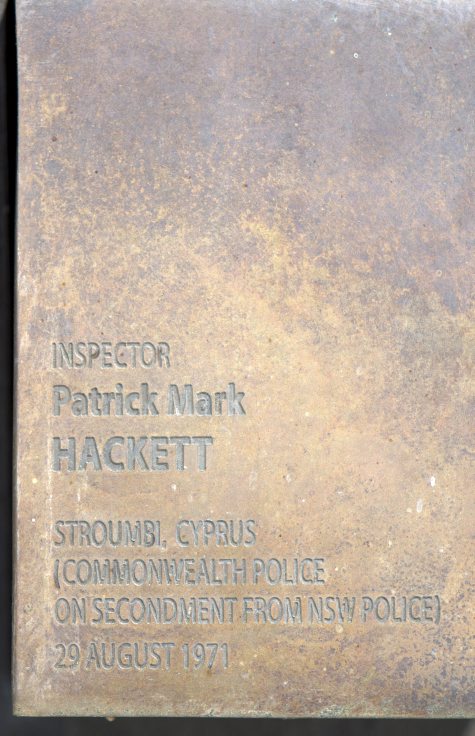
Touch Plate at the National Police Wall of Remembrance, Canberra, for Patrick Mark HACKETT
Constable Hackett was killed in Cyprus while on special duty in that country with the United Nations Civilian Police Force (UNCIVPOL). On the 29 August, 1971 he had driven to Episkopi and Paphos before setting out to return to Polis. Whilst negotiating a number of very sharp and dangerous hairpin bends, his vehicle left the roadway, crashed down an escarpment and overturned several times. Constable Hackett was killed instantly.
The constable was born in 1940 and joined the New South Wales Police Force on 25 February, 1963. At the time of his death he was attached to the Civilian Police Contingent in Cyprus.
[divider_dotted]
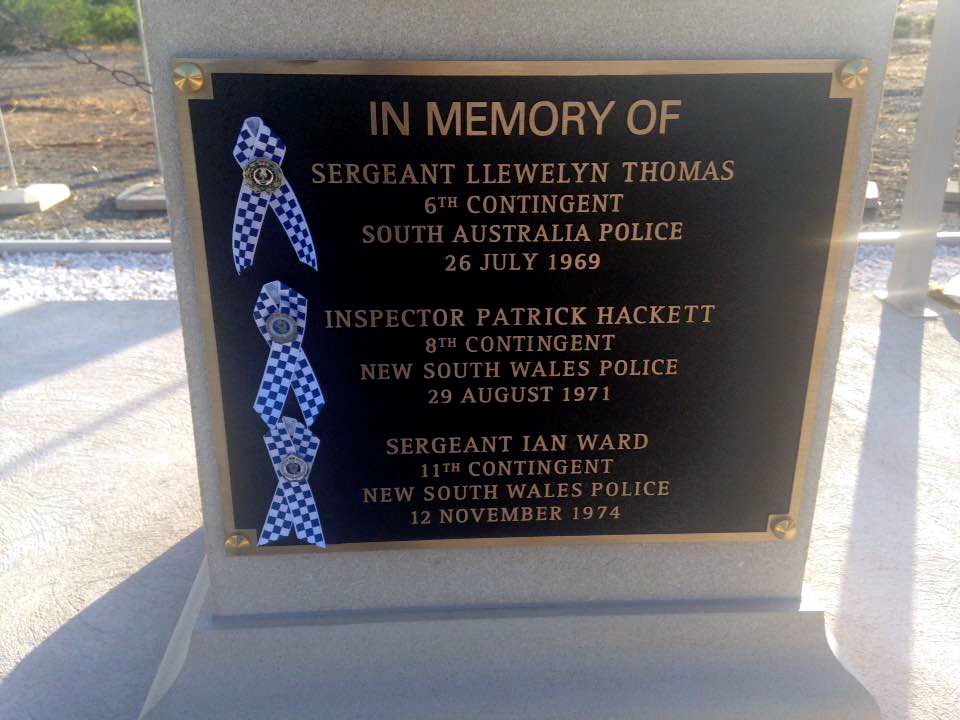
17 June 2017 – Malaysia Memorial in Cyprus taken today as Australian Police complete the long mission and are leaving Cyprus.
[divider_dotted]
27 May 1940 – 29 August 1971
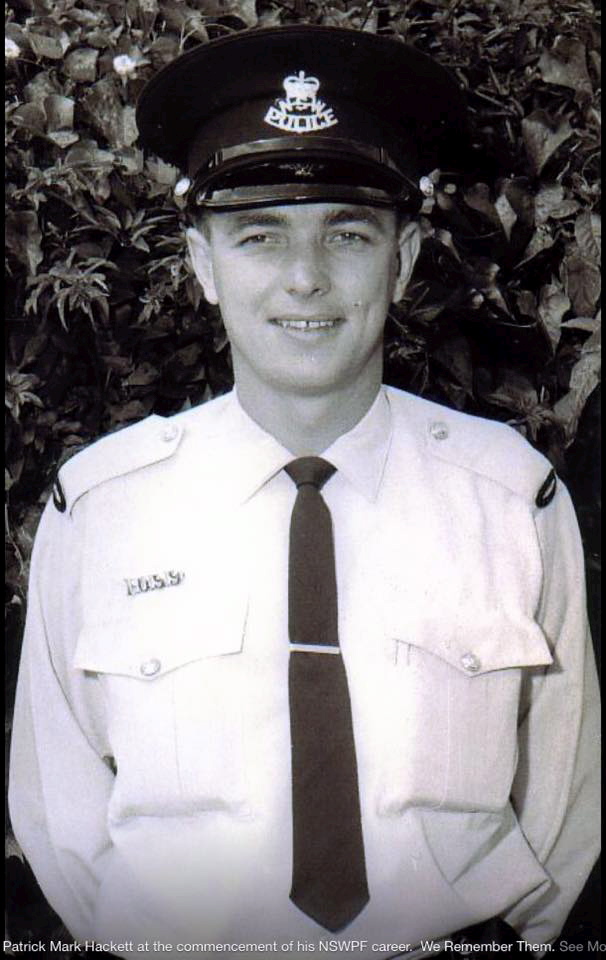
Patrick Hackett was a member of the NSW Police Force. He commenced as a Trainee in 1963 and was confirmed as a first class constable in 1968.
Patrick was sworn in as a Special Commonwealth Police Officer at the rank of inspector when he was selected to be part of Australia’s Eighth Contingent to Cyprus. The contingent, part of the United Nations Peacekeeping Mission to Cyprus, was deployed to Cyprus in 1971.
Inspector Hackett was tragically killed in a car accident near Stroumbi when his vehicle left the road on a sharp corner.
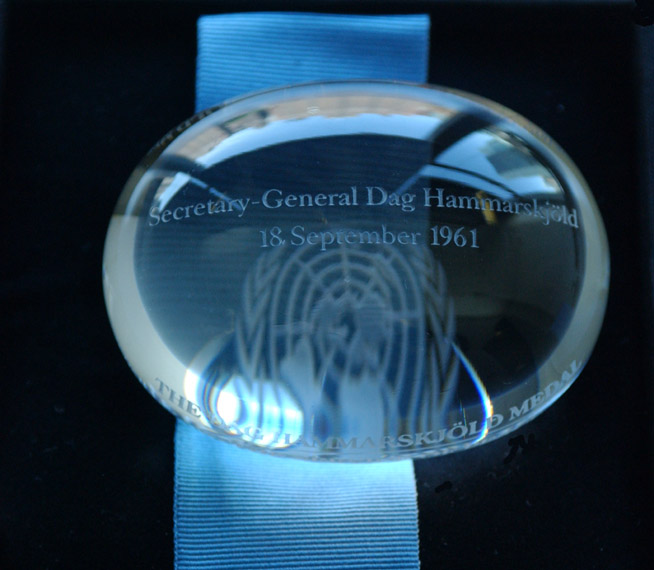
He was posthumously awarded the Police Overseas Service Medal with Cyprus clasp, the United Nations Service Medal and the Dag Hammarskjöld Medal.
Canberra: An Australian policeman serving in Cyprus has been killed in a traffic accident. He was Constable Patrick Mark Hackett, of the NSW Police force.
In 1997 the Dags Hammarskjold Medal is established by the United Nations to honour those who lost their lives whilst on a UN peacekeeping mission.
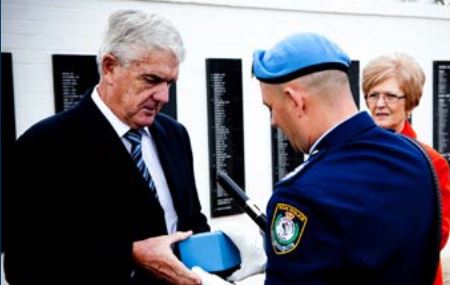
The family of Inspector Patrick Hackett receives the Dags Hammarskjold Medal in 2010 from Sergeant Mark Elms, NSW Police Academy.
Dag Hammarskjold Medal
[divider_dotted]
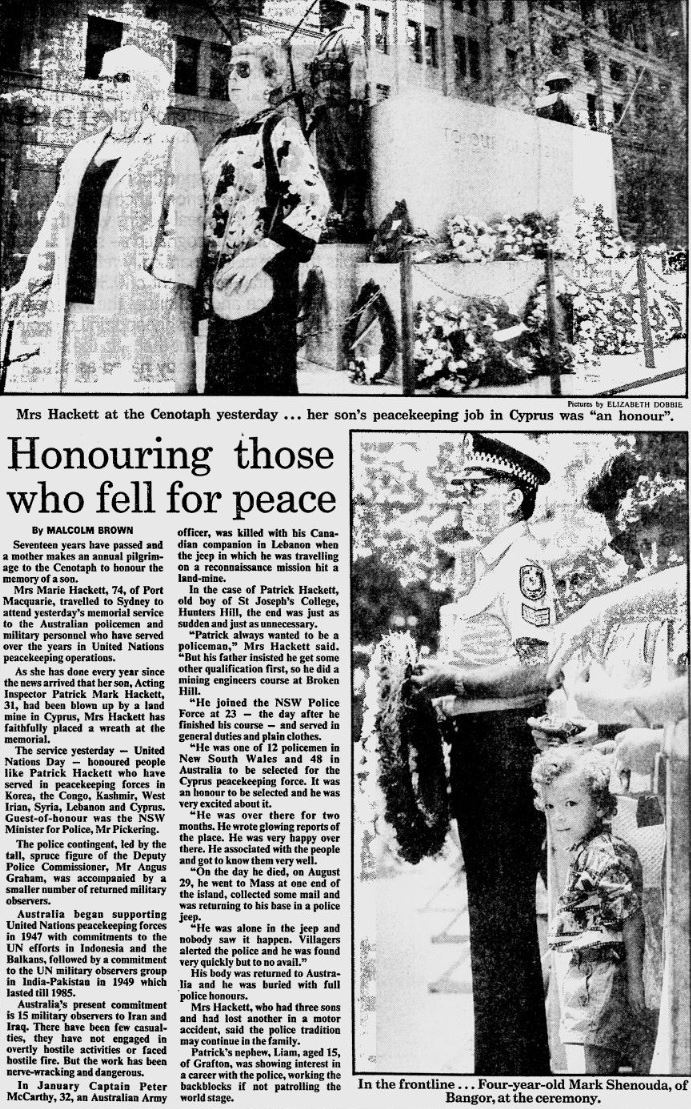
The Sydney Morning Herald Tuesday 25 October 1988 page 12 of 64
Patrick HACKETT – Mother at Cenotaph – 1988
[divider_dotted]
POLICE KILLED OR WHO DIED FROM INJURIES RECEIVED IN THE EXECUTION OF THEIR DUTIES
On 13th August, 1971, Senior Constable William Edward King, who was then the officer-in-charge of police, East Gresford, was shot dead at East Gresford Police Station by a man who fired upon him with a rifle.
On 29th August, 1971, Constable 1st Class Patrick Mark Hackett died from injuries received in a motor accident at Polis, Cyprus, whilst performing duty with the New South Wales Police component of the Australian Police Contingent of the United Nations Peace Keeping Force.
On 30th September, 1971, Sergeant Second Class William Watson Riley and Senior Constable Maurice Raymond McDiarmid, both then attached to Blacktown Police Station, were shot dead in a house at Toongabbie which they had entered to arrest a man who a short time before had murdered his brother and raped a woman in the same house.
A police funeral with full ceremonial honours was accorded these deceased officers at which appropriate tributes were paid.
In recognition of their outstanding courage Sergeant Riley and Senior Constable McDiarmid were posthumously promoted by me to Sergeant 1st Class and Sergeant 3rd Class respectively. In addition, I submitted recommendations to the Premier for favour of consideration of Royal Awards being granted in both cases.
To assist the widows of the deceased police the Premier approved the payment to each of them of the sum of $12,500 as a gratuity. This payment did not in any way affect their entitlements to payments under the provisions of the Police Regulation (Superannuation) Act.
Rank: Probationary Constable – appointed 7 November 1955
Senior Constable – appointed 7 November 1966
Senior Constable – Death
Stations: East Gresford Police Station
Service: From pre 7 November 1955 to 13 August 1971 = 15+ years Service
Awards: No find on It’s An Honour
Born: 31 January 1933
Died: 13 August 1971
Age: 38
Cause: Shot – Murdered
Event location: East Gresford Police residence
Funeral Date: ?
Funeral location: ?
Buried at: ?
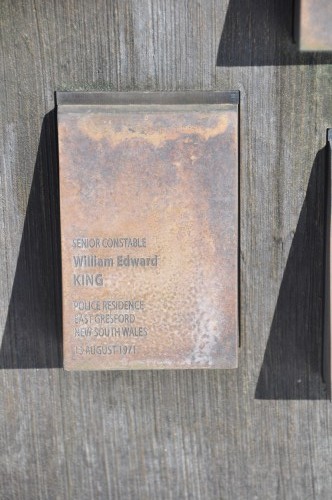
[alert_green]William IS mentioned on the Police Wall of Remembrance[/alert_green]
William KING
About 6.45pm on 13 August, 1971Senior Constable King went home to the East Gresford police residence for dinner. When he later answered a knock on the front door he was shot in the chest. He died a short time later. Enquiries later revealed that Senior Constable King had arrested the offender, a sixty-two year old labourer, the previous year for a drink driving offence (DUI). The offender was arrested two hours after the murder of Senior Constable King and later sentenced to life imprisonment.
The constable was born in 1933 and joined the New South Wales Police Force on 7 November, 1955. At the time of his death he was stationed at East Gresford.
William Edward KING
Location of Police residence
[divider]
The Canberra Times Tuesday 17 August 1971 3 of 20
Murder of constable alleged
NEWCASTLE, Monday. — Mr Arthur Clement Warr, 63, timber worker, of Church Street, East Gresford, appeared in Maitland court today charged with the murder of Senior-constable William Edward King, of East Gresford, last Friday.
The police prosecutor, Sergeant B. Bourne, said it would be alleged that last Friday Mr Warr had drunk at a Gresford hotel then had driven to East Gresford police station and that when Constable King had come from the residence in uniform Mr Warr had shot and fatally wounded him with a .22 rifle.
The Canberra Times Friday 24 September 1971 page 6 of 18
Man for trial over death
NEWCASTLE, Thursday.
A 62-year-old labourer was committed in Maitland Court today for trial at the Newcastle Supreme Court on November 8 on a charge of murdering a policeman.
Mr Wilde, SM, refused bail for the man, Mr Arthur Clement Warr, of East Gresford, who is charged with having murdered Senior Constable William Edward King at East Gresford on August 13.
A Gresford station hand, Mr Howard Huckstadt, told the court that Mr Warr had sung out to him, “I shot King Billy”.
He said he had heard Mr Warr refer to Constable King, of Gresford police station, as “King Billy” before.
Mr Warr had asked him if he had any bullets, but he had replied, “no”. He had then said that he had wanted the bullets “to shoot the cop that would come after him”.
Mr Huckstadt said he had asked Mr Warr why he shot Constable King and Mr Warr had replied, “He was all the time picking on me”.
The Canberra Times Saturday 20 November 1971 page 12 of 42
‘Life’ for murder
NEWCASTLE, Friday. — Mr Arthur Clement Warr, 63, fencing contractor, of Gresford, was jailed for life at Newcastle Supreme Court today for the murder of a police constable.
He had pleaded not guilty to a charge of having murdered Constable William Edward King, 38, at Gresford on August 13. Mr Warr did not give evidence or make a statement during his trial.
*** Although NOT confirmed, another article was found with this offenders name and the age between 1943 – 1971 is correct. ***
The Sydney Morning Herald Tuesday 31 August 1943 page 3 of 9
MILITIAMEN ON THEFT CHARGE
U.S. Army Clothing
Charges of having stolen United States Army clothing at Alexandria railway goods yard on August 17 were made against three australian militiamen, at a court-martial yesterday.
They were Privates Roy Westland Smith, 20; Arthur Edward Roberts, 47: and Arthur Clement Warr, 34.,
Alternative charges of having been unlawfully in possession of the goods were dismissed. On the charges of stealing the Court did not announce its decision.
Evidence was that the three men, members of an employment unit, were on duty at the goods yard unloading trucks. A warrant officer said that he saw the accused moving between two lines of trucks in a shed, and on being challenged they dropped several pairs of United States Army trousers.
Each of the accused said he had seen the articles lying on the ground and had picked them up, intending to examine the article in a better light. It was unusual, they said, to see anything lying about in the yards.
At a previous trial, Private John Henry Hanson, 27 was charged with having unlawfully removed a case containing 24 pairs of United States Army trousers from a railway truck at Alexandria on August 17.
Hanson, who pleaded not guilty, said he had not touched any of the clothing.
POLICE KILLED OR WHO DIED FROM INJURIES RECEIVED IN THE EXECUTION OF THEIR DUTIES
On 13th August, 1971, Senior Constable William Edward King, who was then the officer-in-charge of police, East Gresford, was shot dead at East Gresford Police Station by a man who fired upon him with a rifle.
On 29th August, 1971, Constable 1st Class Patrick Mark Hackett died from injuries received in a motor accident at Polis, Cyprus, whilst performing duty with the New South Wales Police component of the Australian Police Contingent of the United Nations Peace Keeping Force.
On 30th September, 1971, Sergeant Second Class William Watson Riley and Senior Constable Maurice Raymond McDiarmid, both then attached to Blacktown Police Station, were shot dead in a house at Toongabbie which they had entered to arrest a man who a short time before had murdered his brother and raped a woman in the same house.
A police funeral with full ceremonial honours was accorded these deceased officers at which appropriate tributes were paid.
In recognition of their outstanding courage Sergeant Riley and Senior Constable McDiarmid were posthumously promoted by me to Sergeant 1st Class and Sergeant 3rd Class respectively. In addition, I submitted recommendations to the Premier for favour of consideration of Royal Awards being granted in both cases.
To assist the widows of the deceased police the Premier approved the payment to each of them of the sum of $12,500 as a gratuity. This payment did not in any way affect their entitlements to payments under the provisions of the Police Regulation (Superannuation) Act.