Sergeant 2nd Class – 1984 ( Central Police Station )
Sergeant 1st Class – 9 August 1986
Chief Inspector – February 1989 ( Fairfield & Cabramatta )
Chief Inspector – Patrol Commander ( Cabramatta ) until Optional Retirement in April 1991
Stations: Central ( No. 1 Division ), Darlinghurst ( No. 3 Division ) to Liverpool ( 22 Division ) in November 1963, Merrylands ( 26 Division ), Cabramatta, Fairfield, Cabramatta ( 34 Division )
Service: From ? ? 1960? to ? April 1991 = 31? years of Service
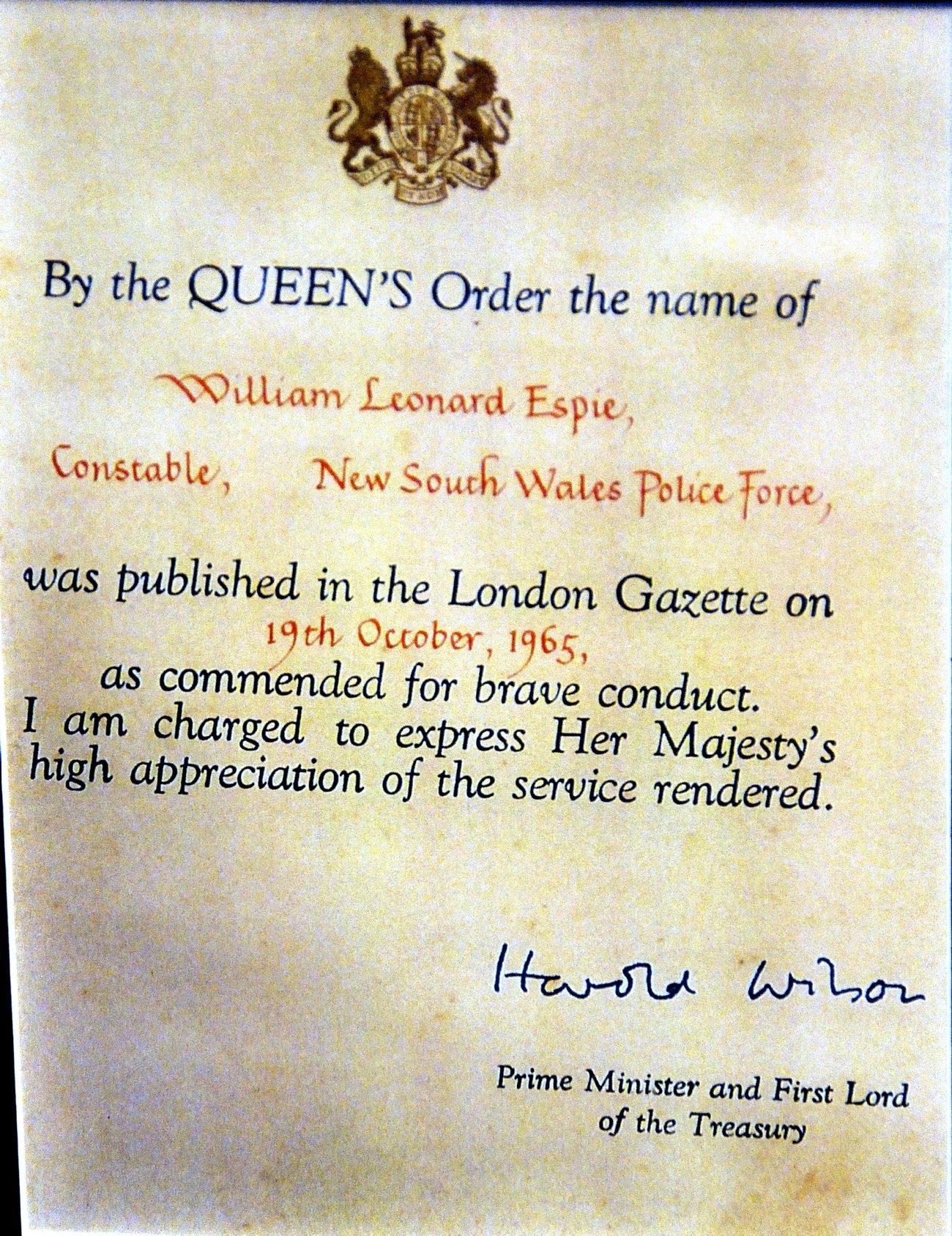
Awards: Queen’s commendation for Brave Conduct – granted 19 October 1965 ( rescue of two people from their burning vehicles after a collision – whilst standing in fuel )
Commissioner’s Commendation – rescue – 1965 ( rescue of two people from their burning vehicles after a collision – whilst standing in fuel )
Peter Mitchell Award, a perpetual trophy, for selfless & brave conduct – 1965 ( as above )
George Lewis Trophy “for the most courageous act by a member of the NSW Police Force in 1965” ( as above )
Australian Defence Medal
Commissioner’s Commendation – for pursuing & arresting an armed prison escapee – 1971
Commissioner’s Commendation – pursuit and arrest of an offender of a fatal shooting at Cabramatta – 1977
National Medal – granted 11 December 1980
1st Clasp to National Medal – granted 7 November 1988
Australian National police Service Medal
Born: 25 June 1935
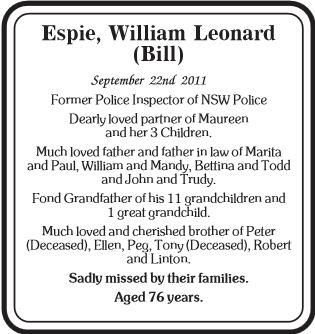
Died on: 22 September 2011
Cause: Dementia
Age: 76
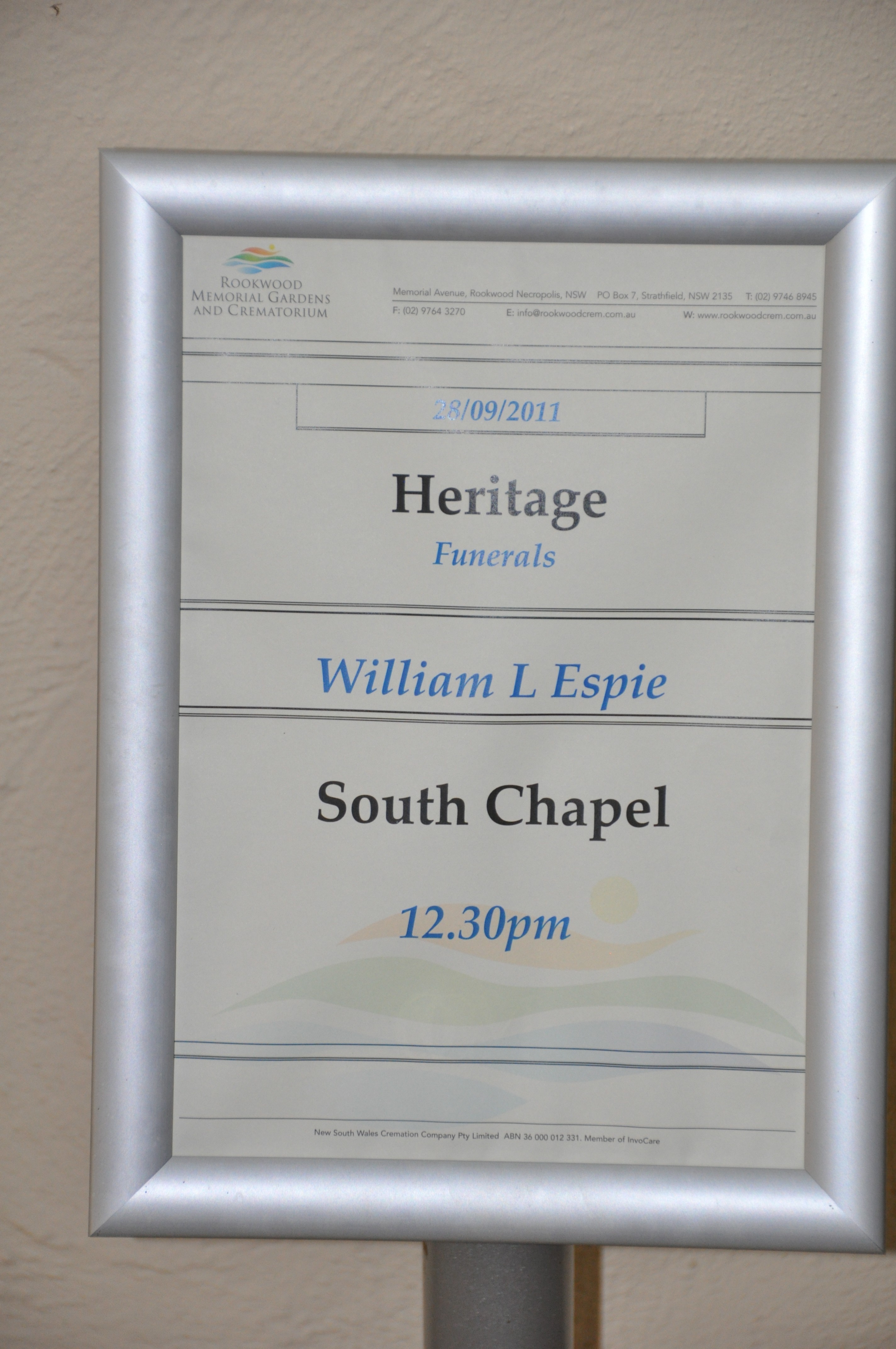
Funeral date: Wednesday 28 September 2011 @ 10.30am
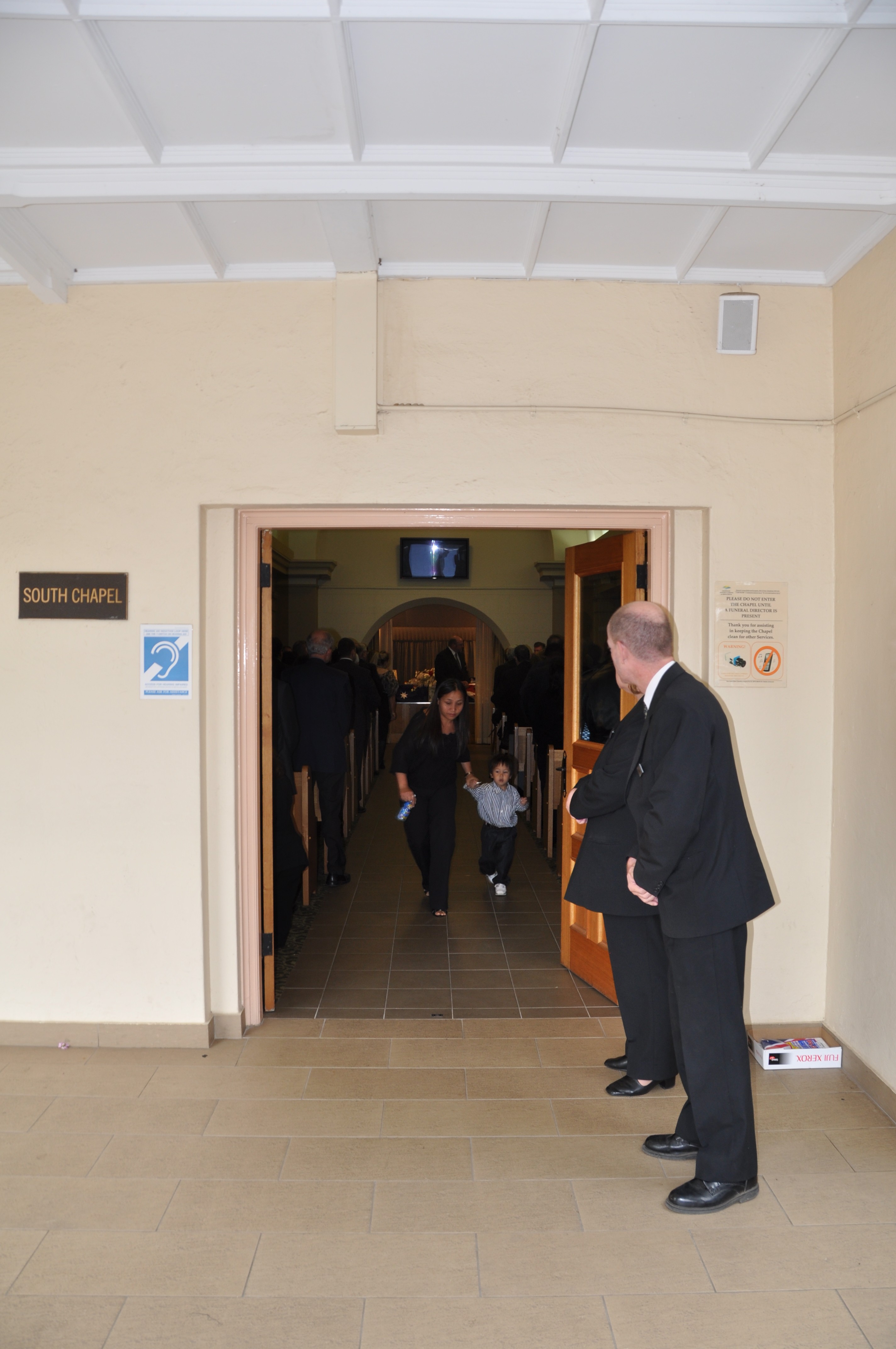
Funeral location: SOUTH CHAPEL, ROOKWOOD CREMATORIUM, ROOKWOOD
Buried at: Cremated
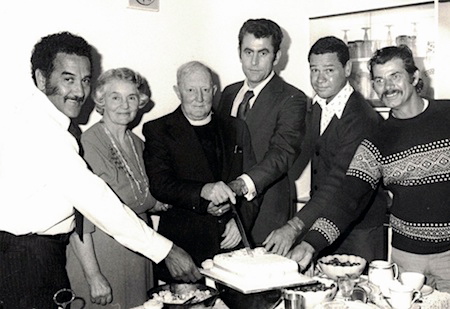
1976 Bill Espie standing next to Father Smith celebrating his 50 years of ordination – Charlie Perkins on far left next to Mrs Smith – Noel Hampton and David Woodford on far right
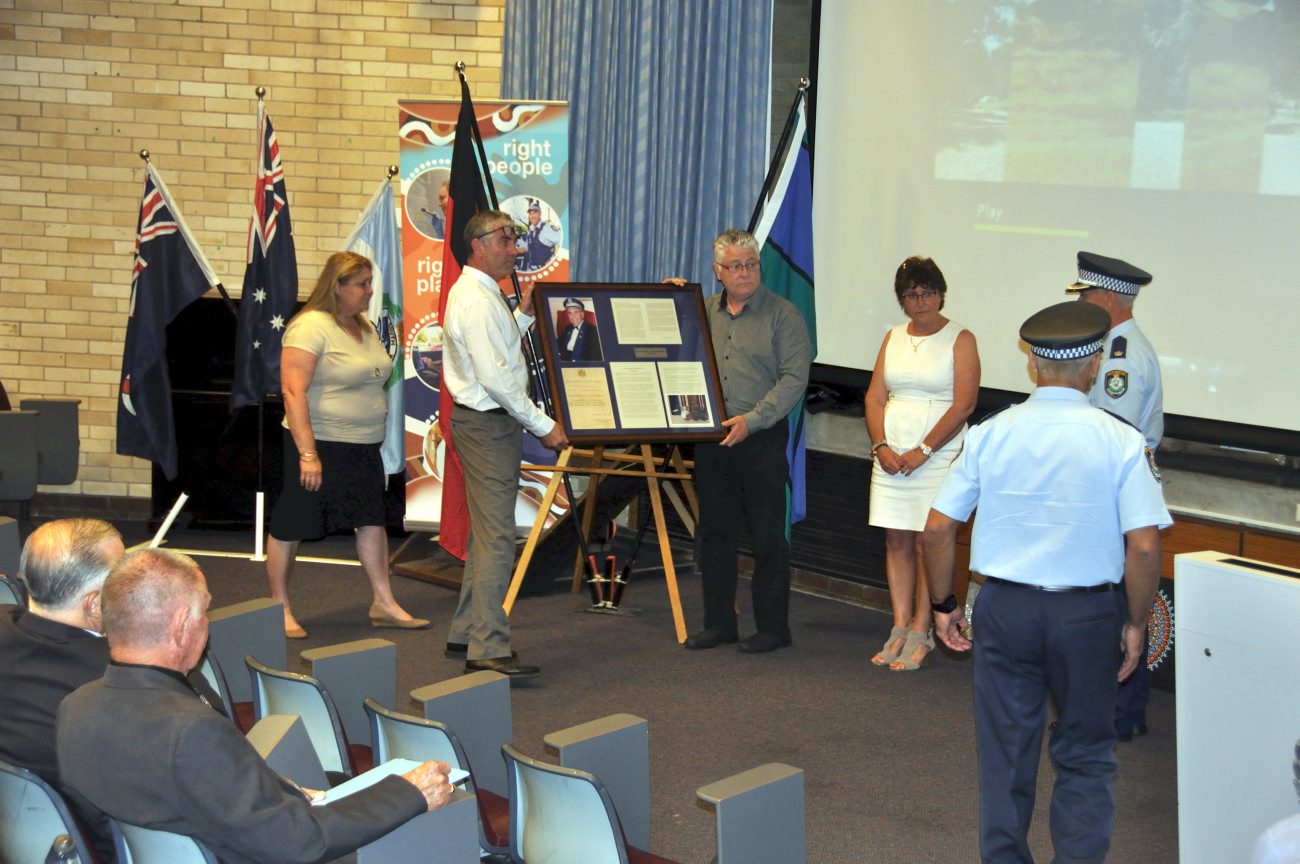
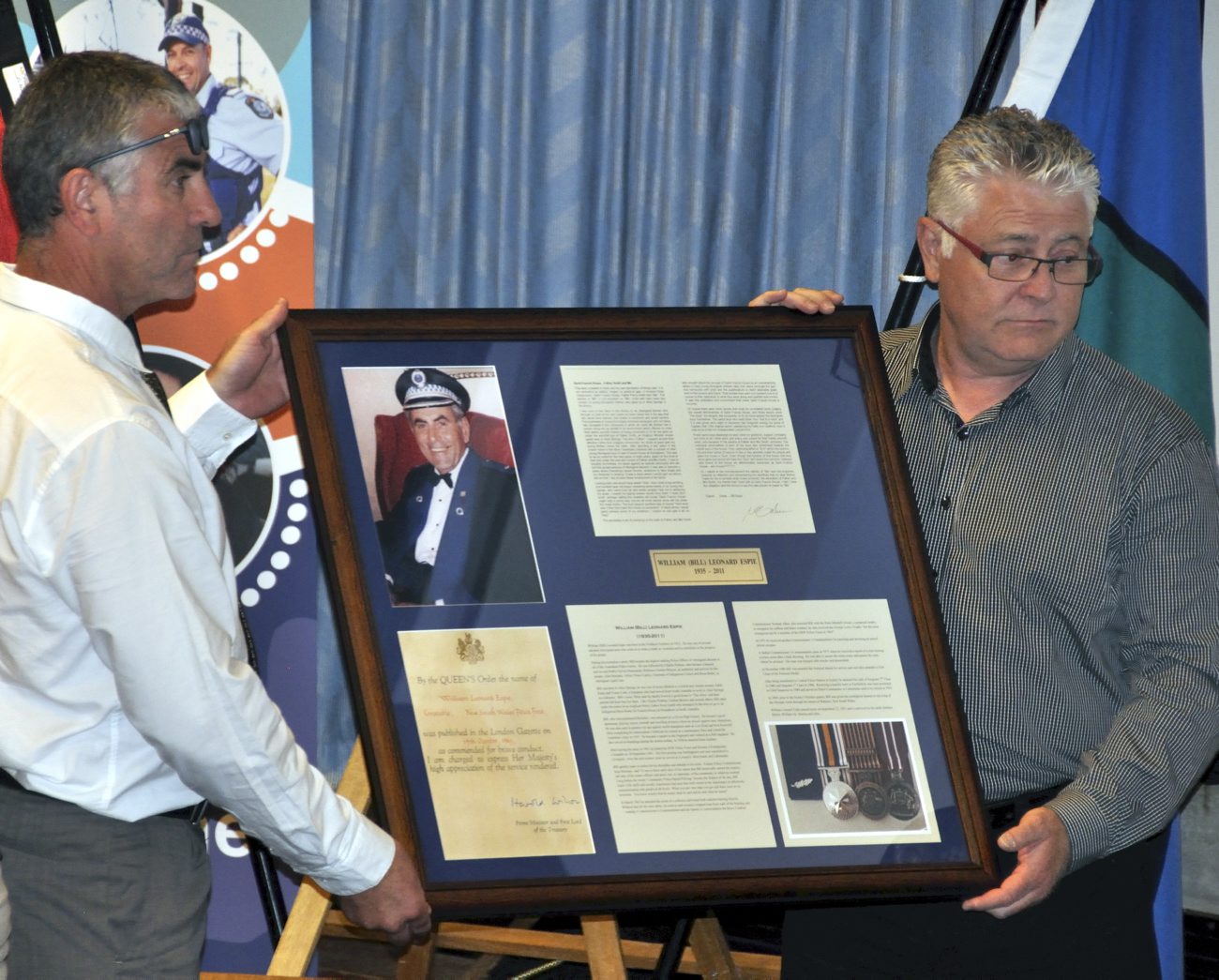
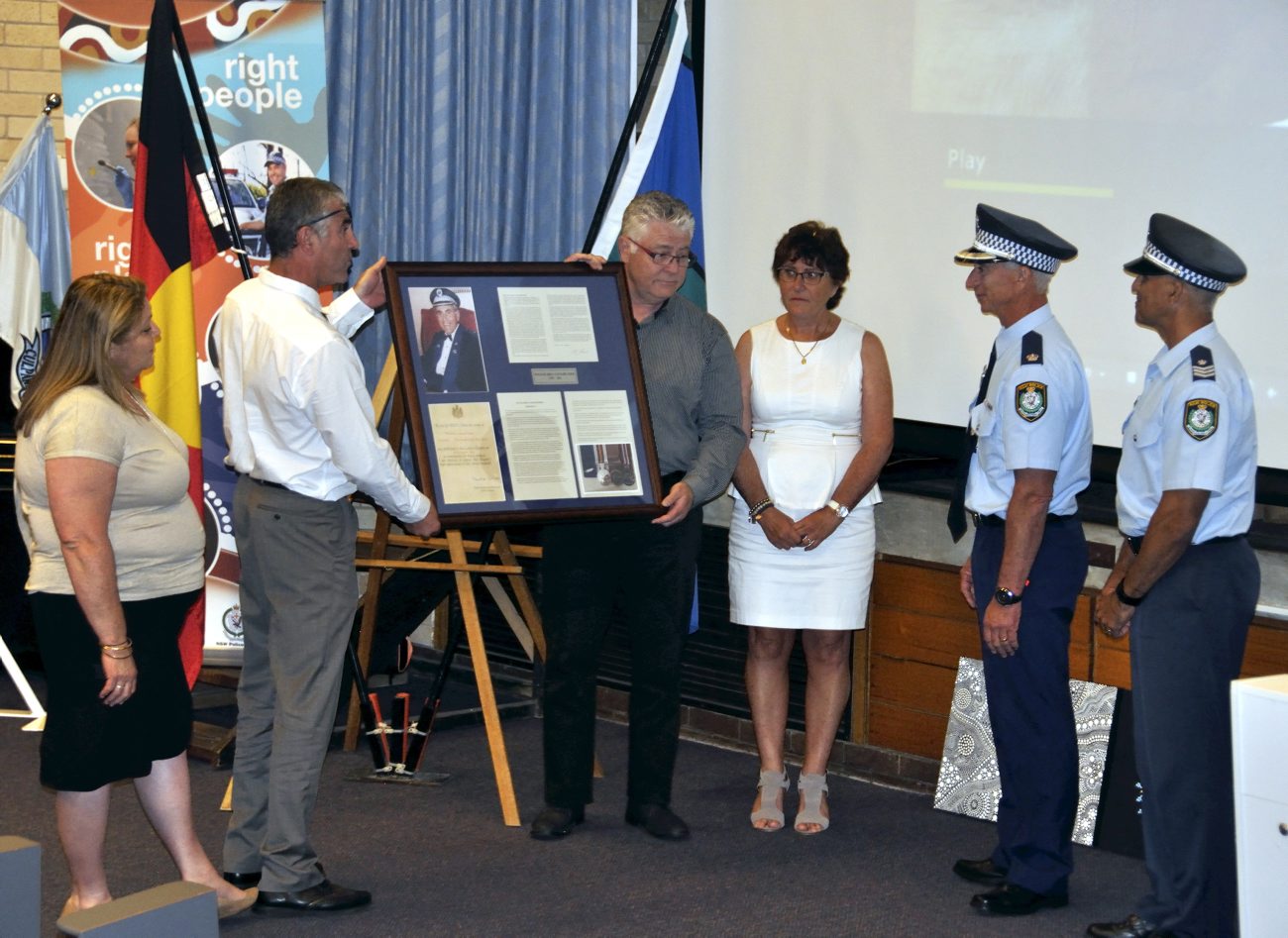
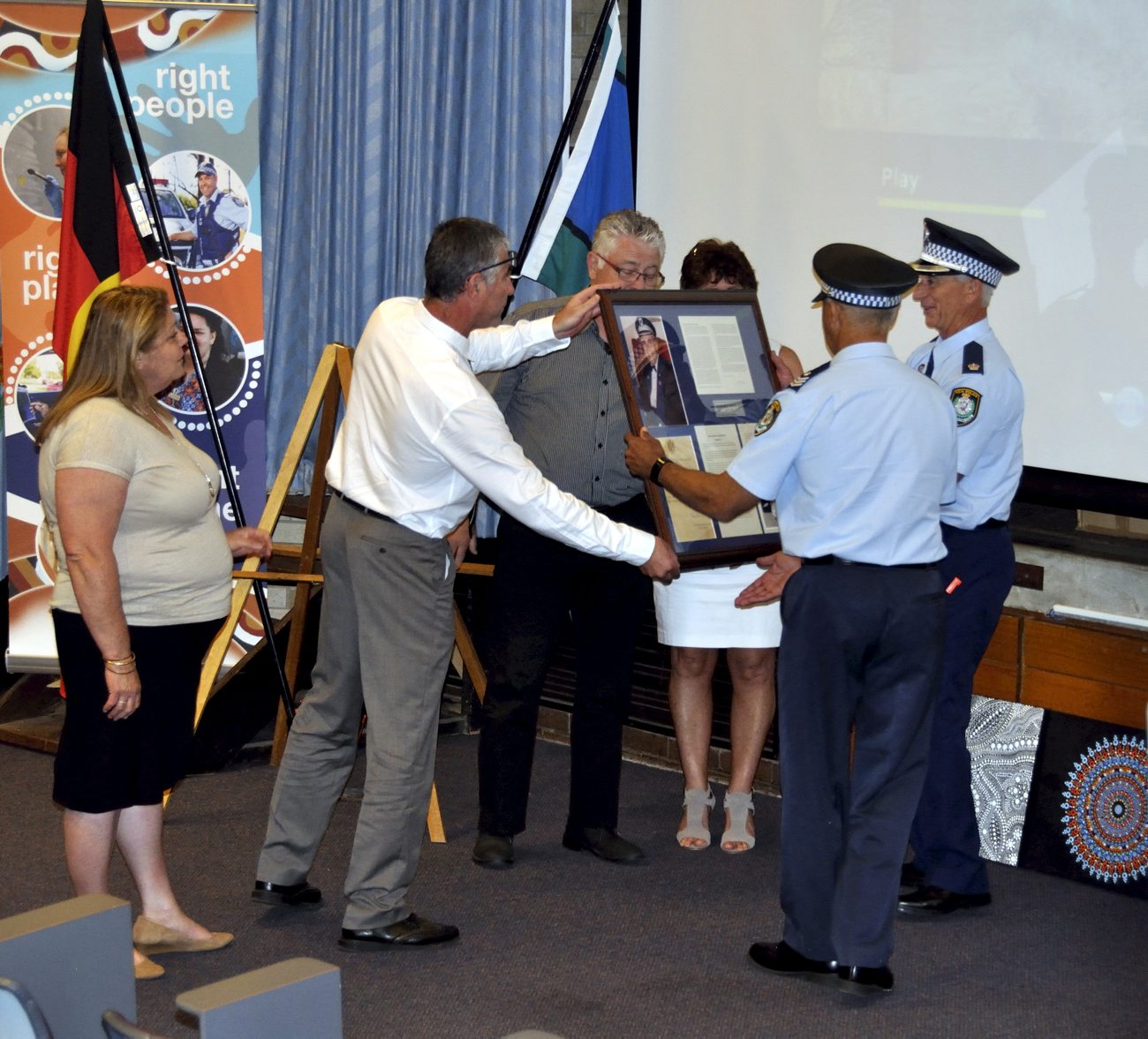
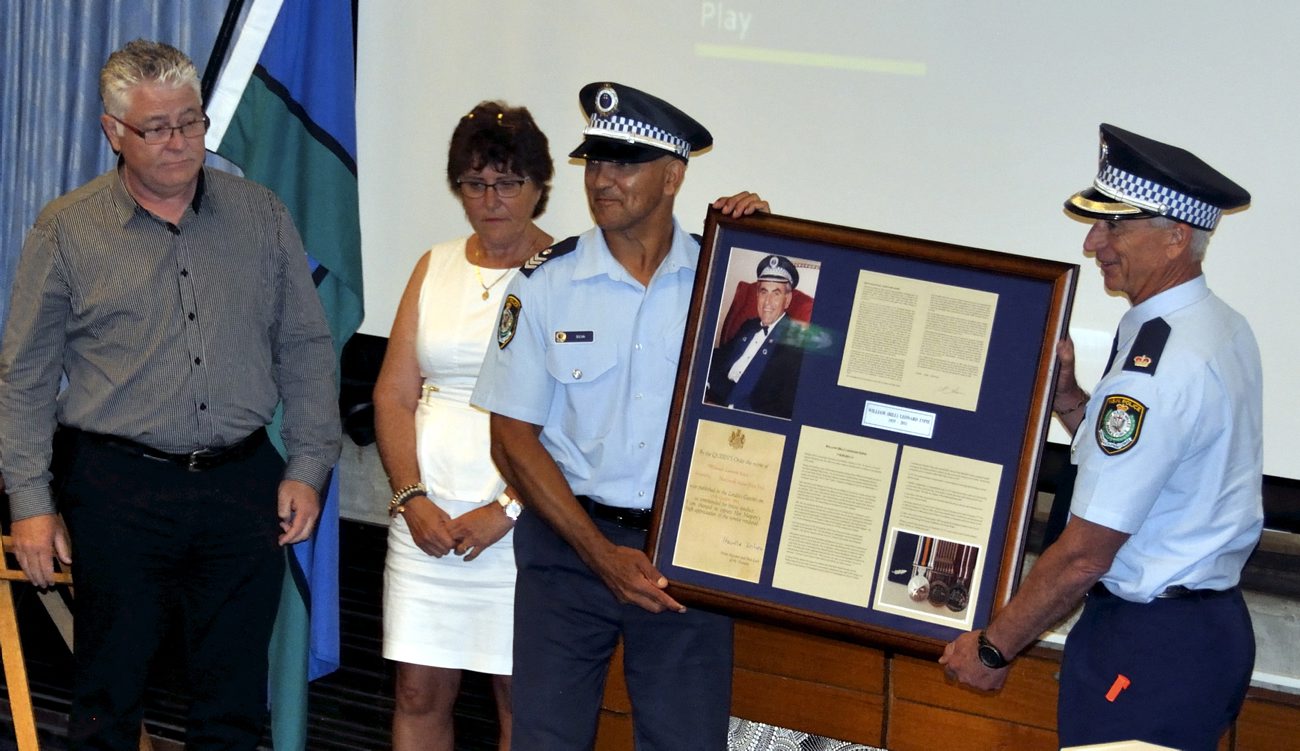
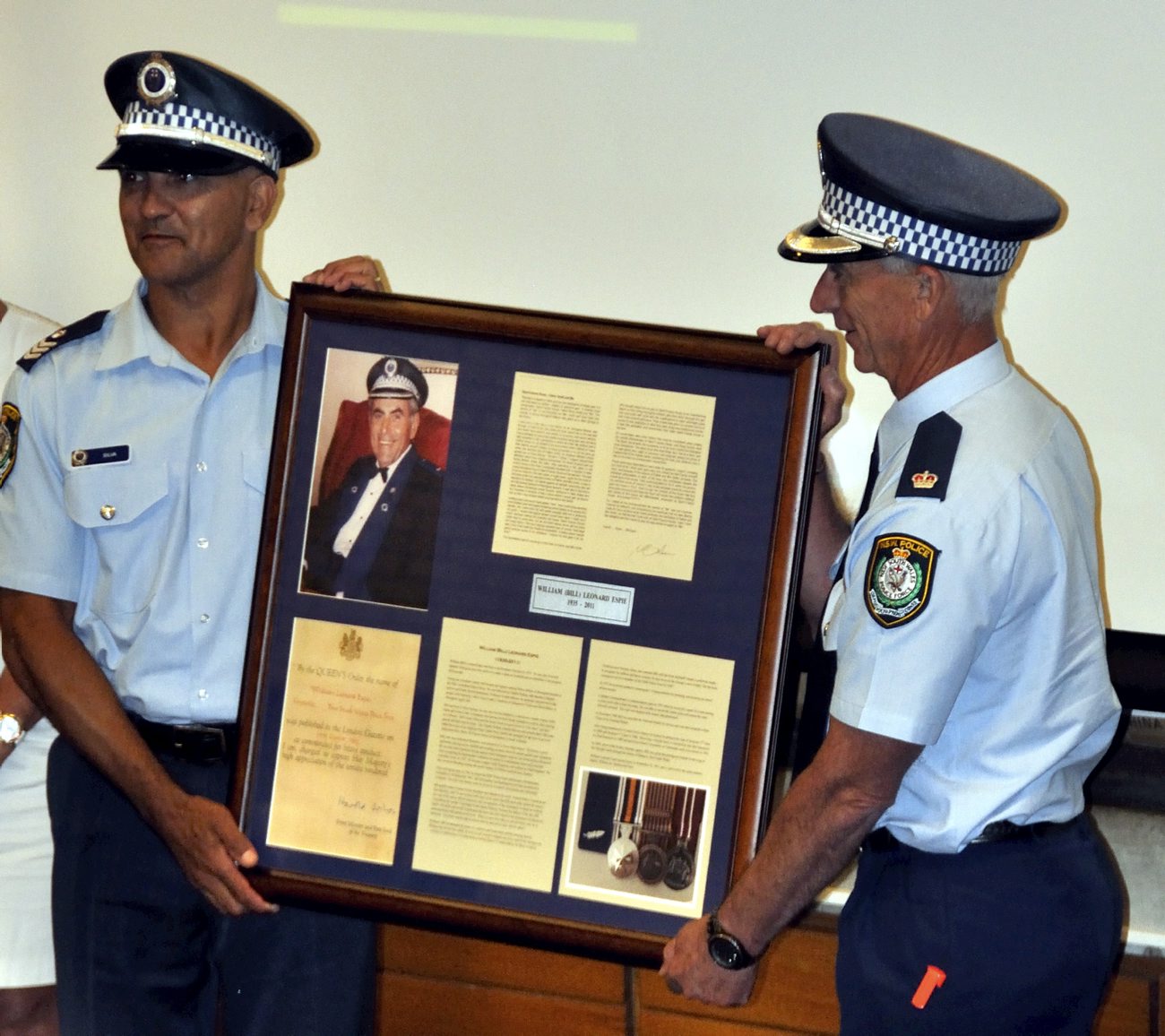
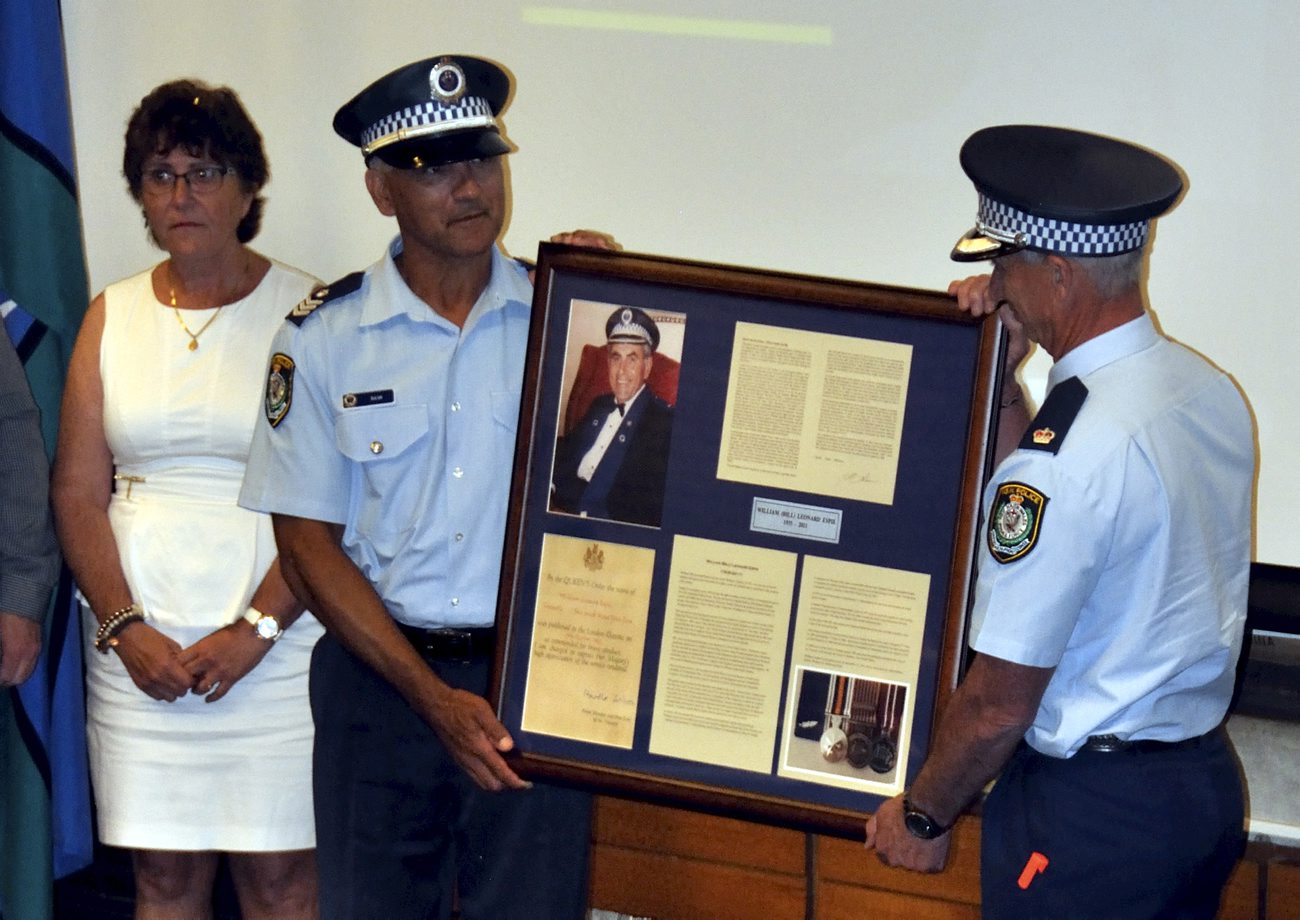
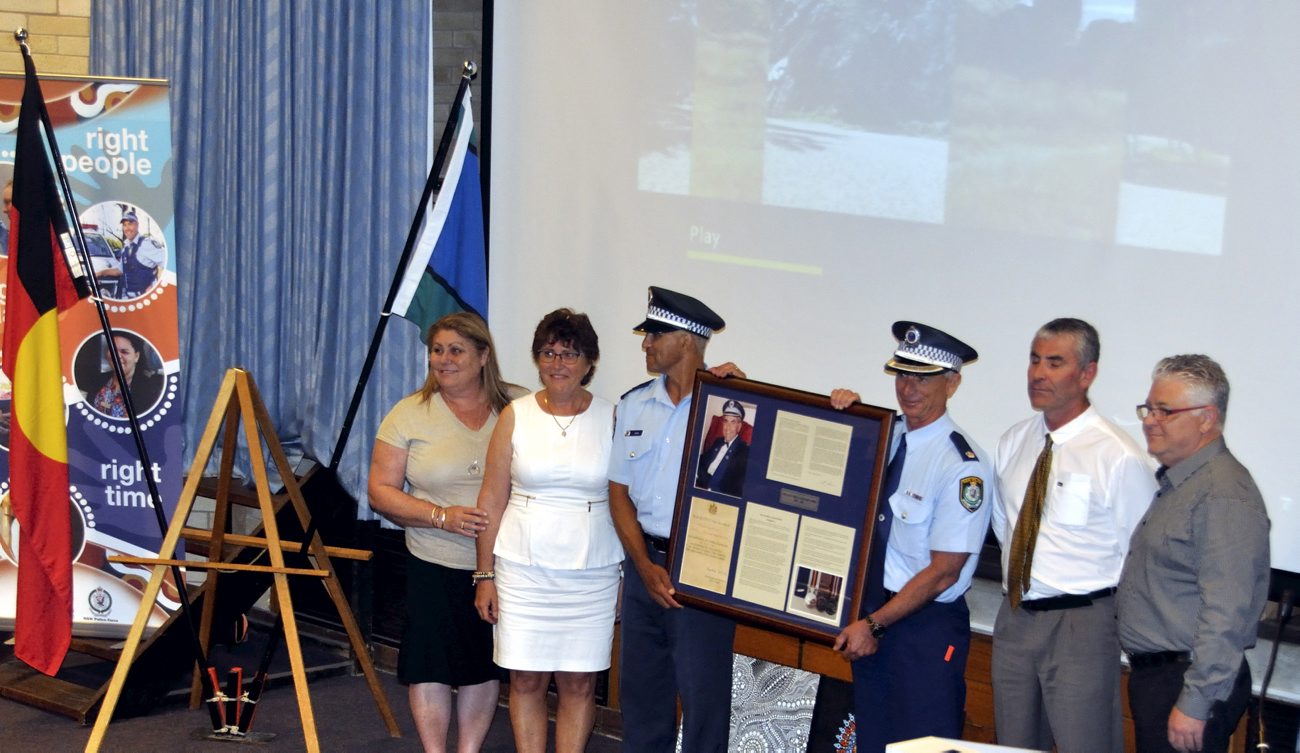
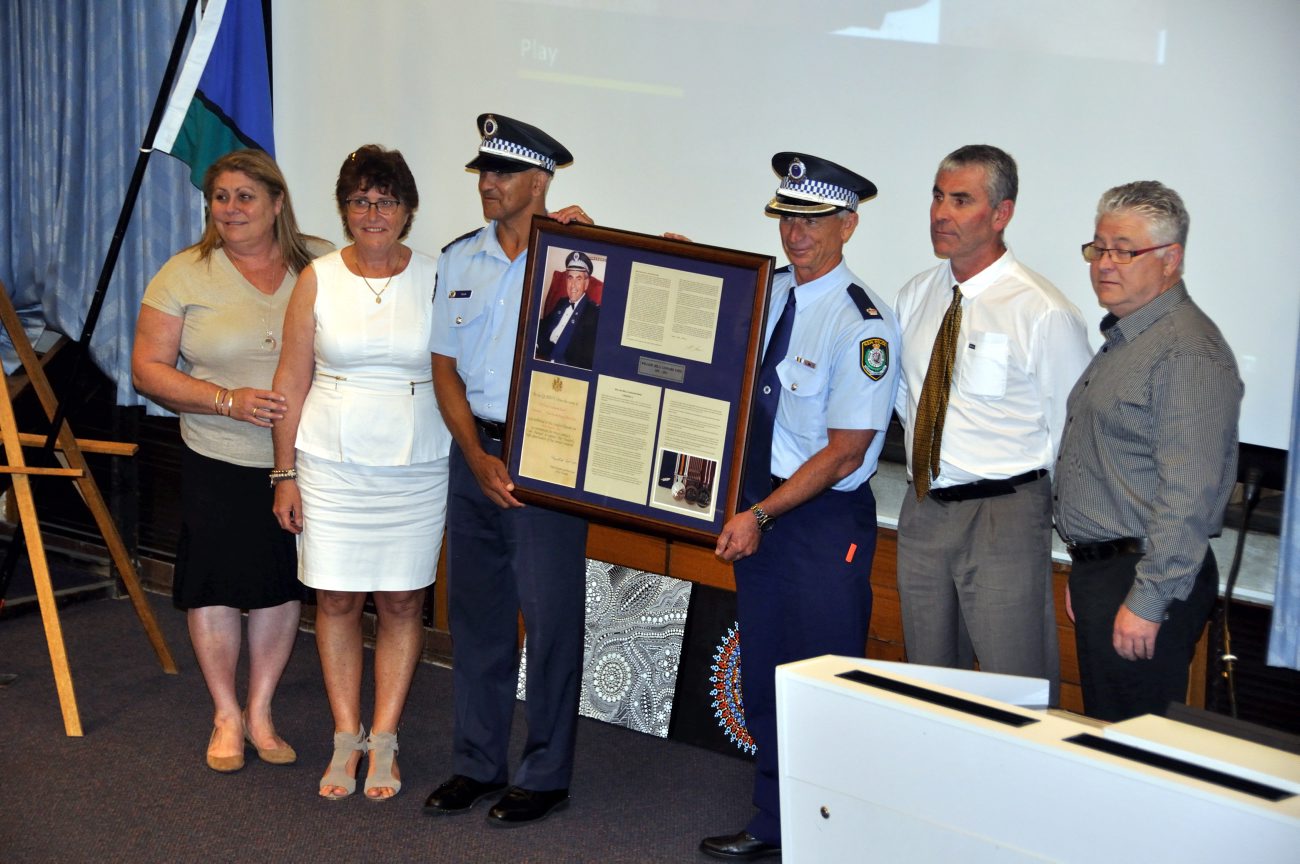
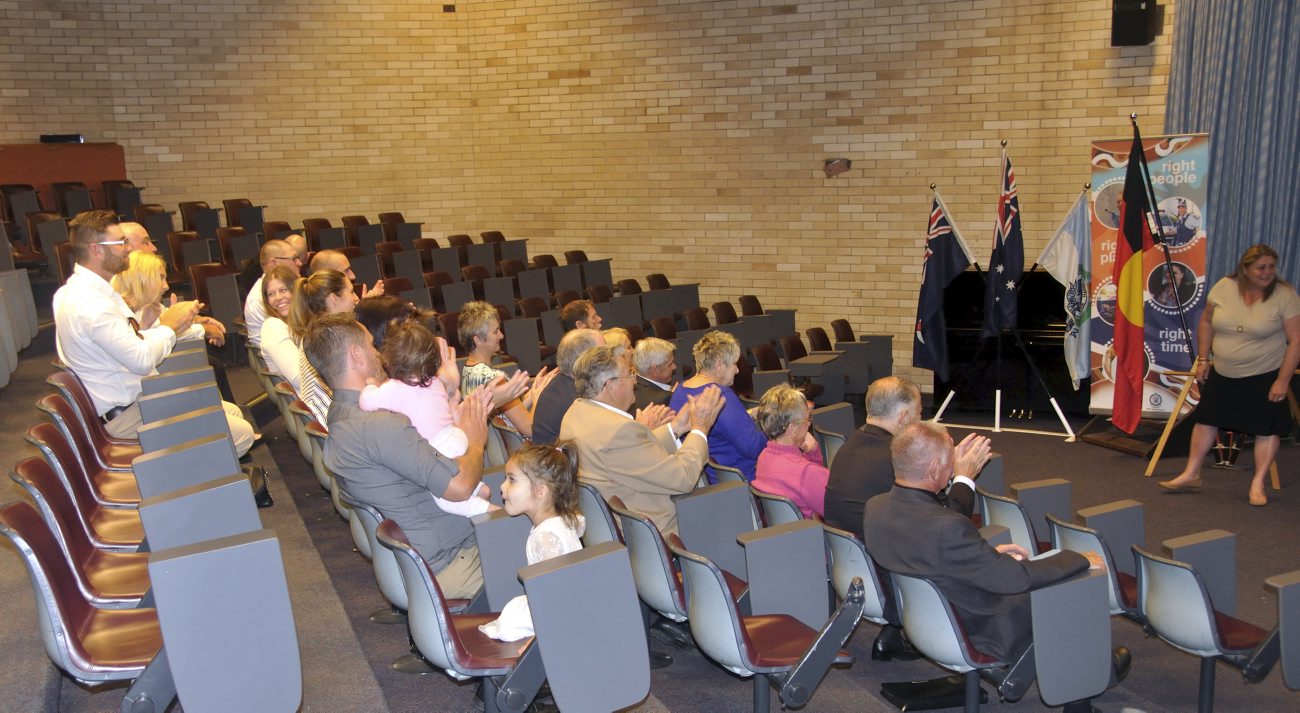
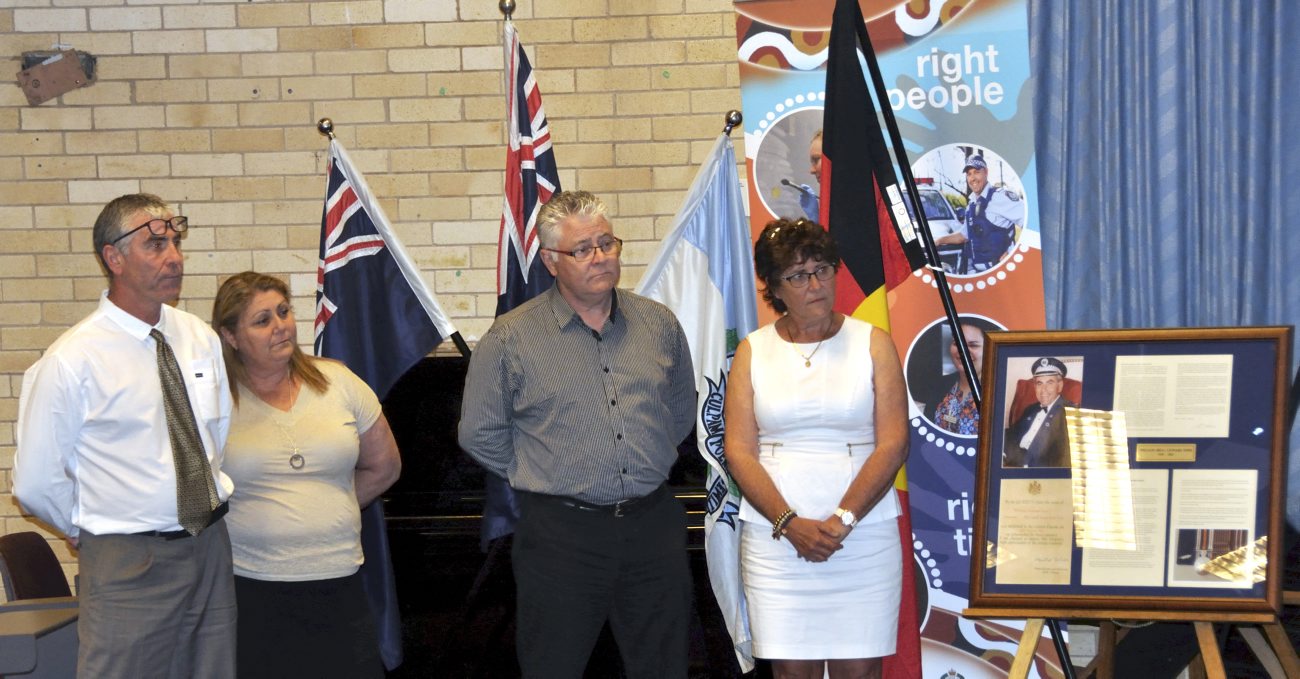
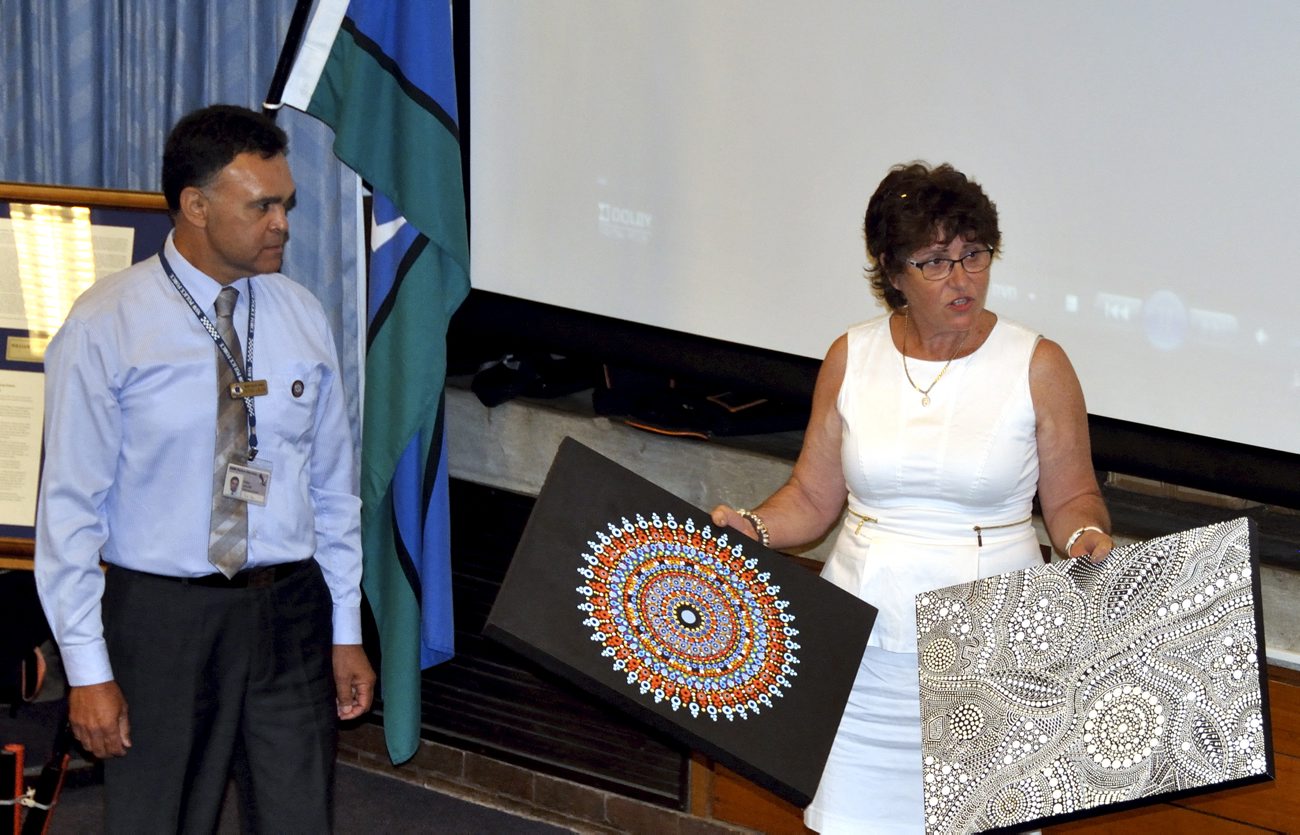
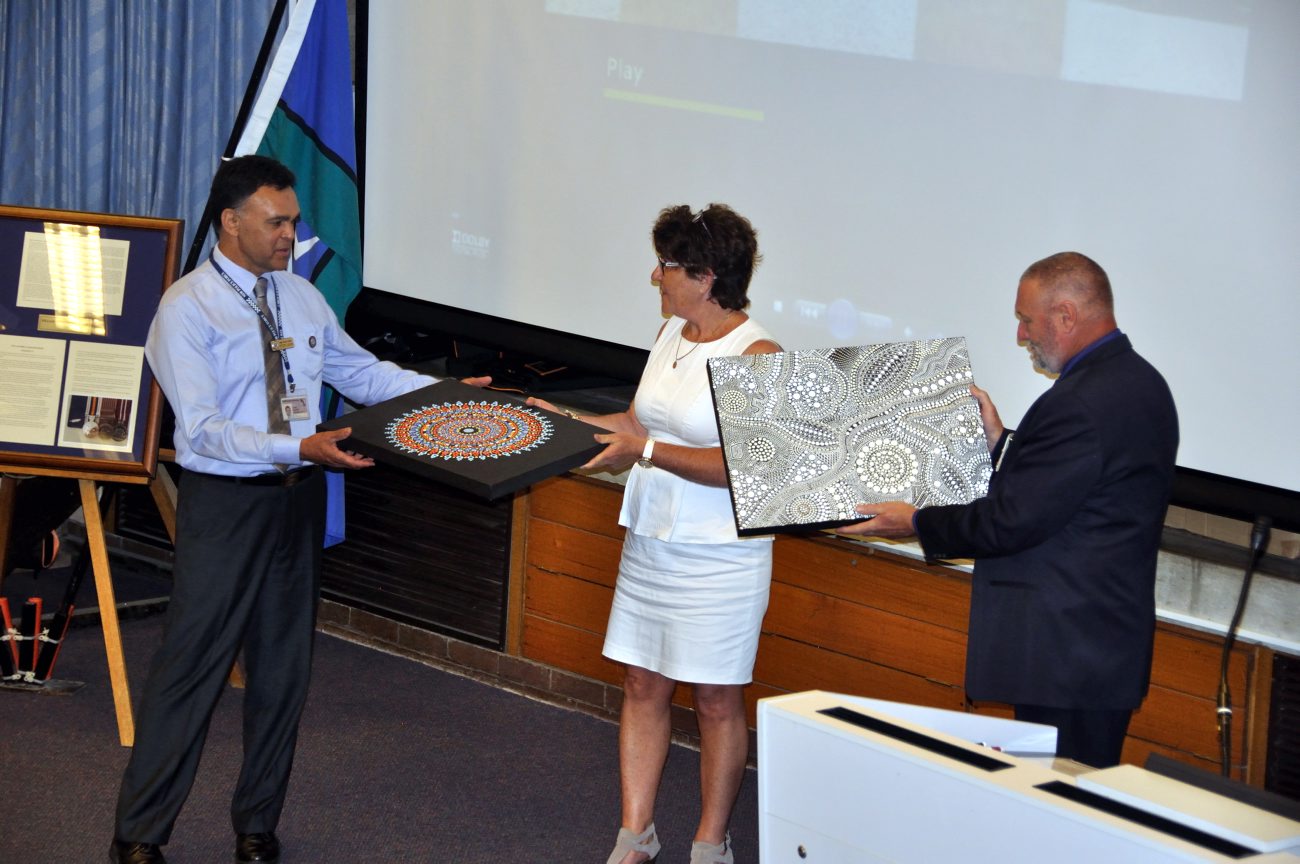
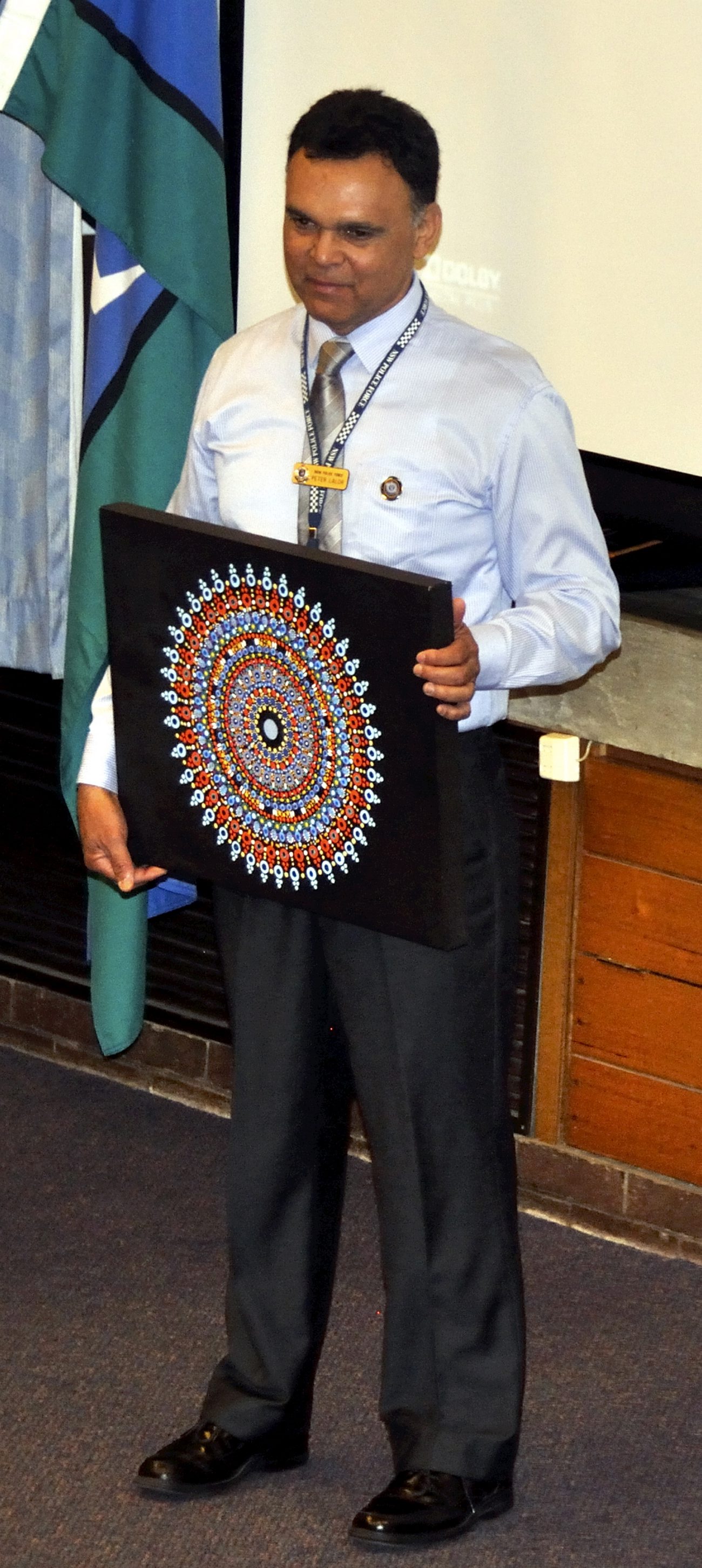
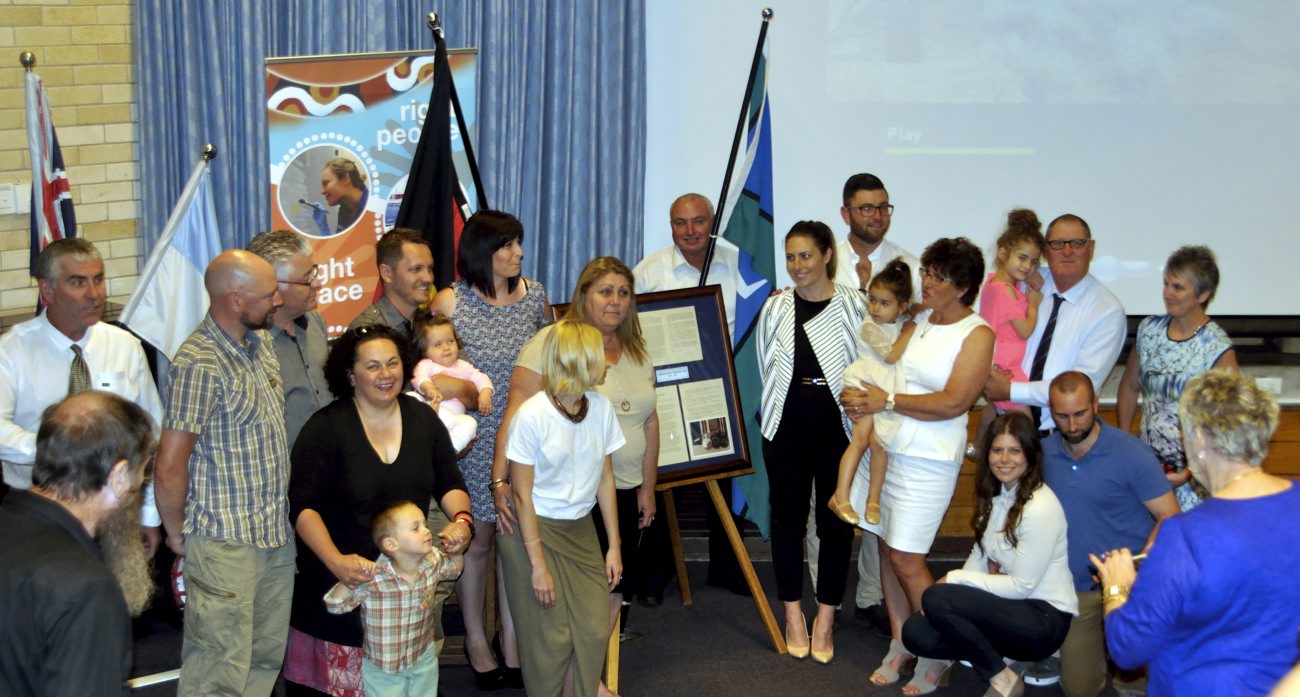
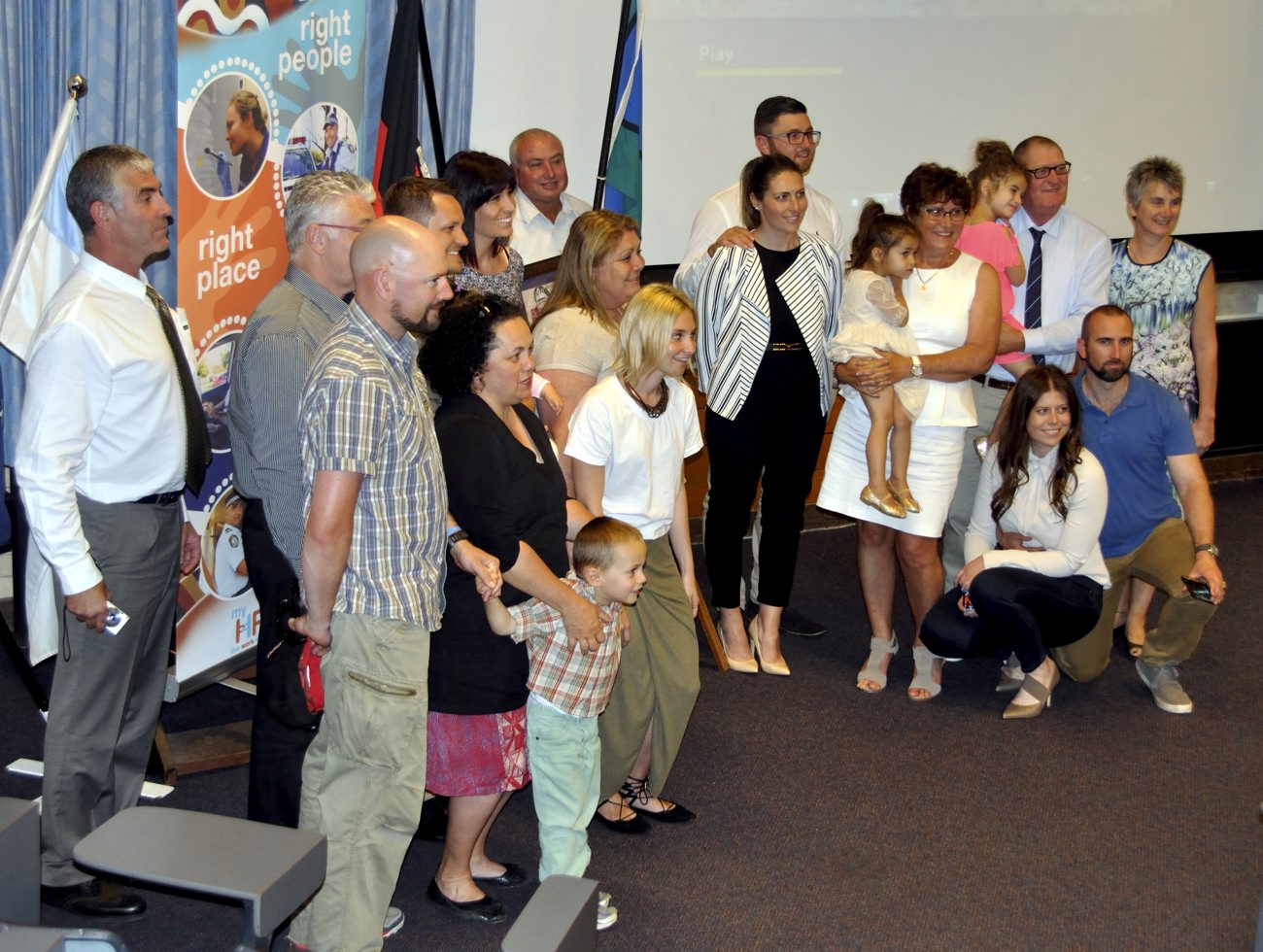
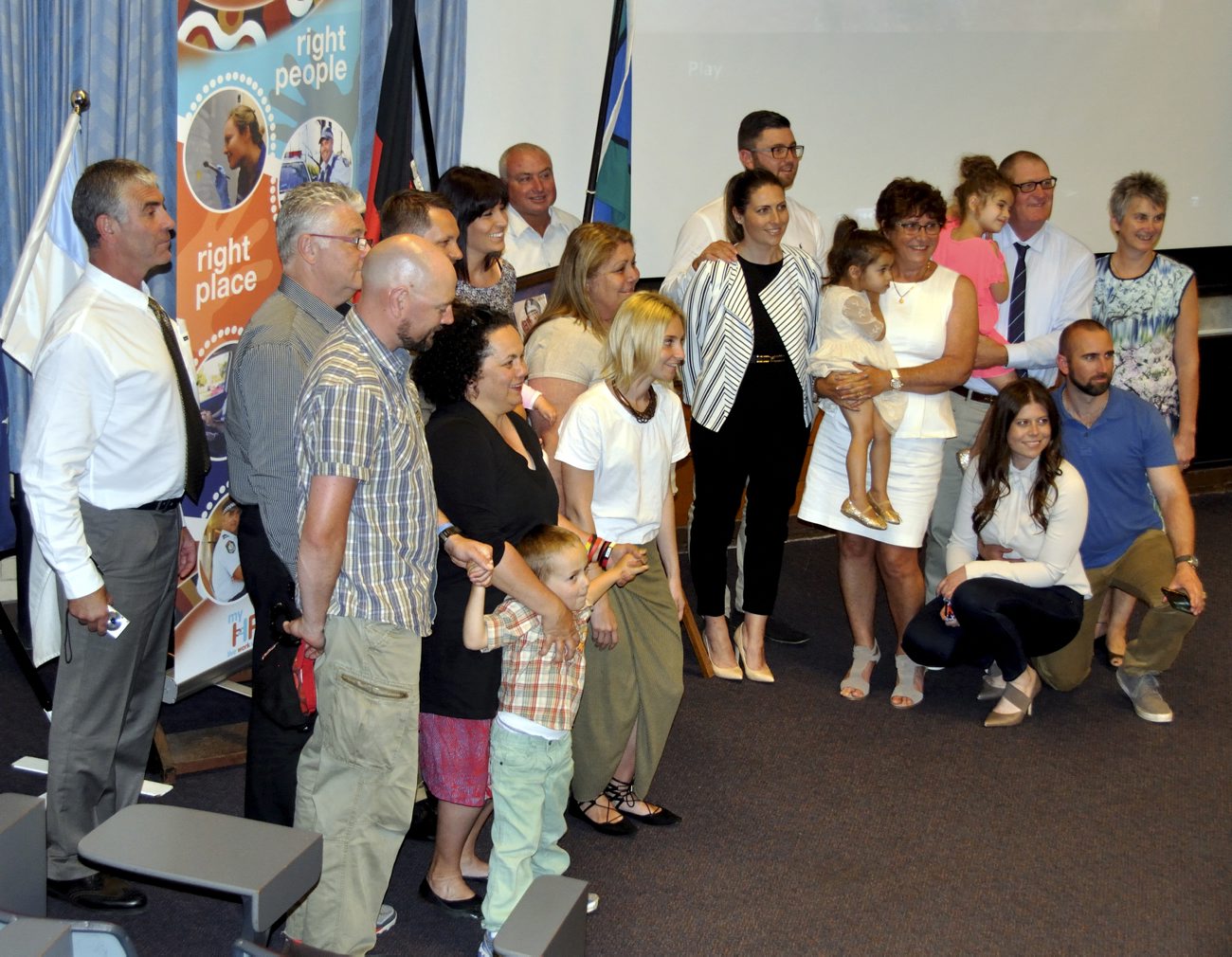
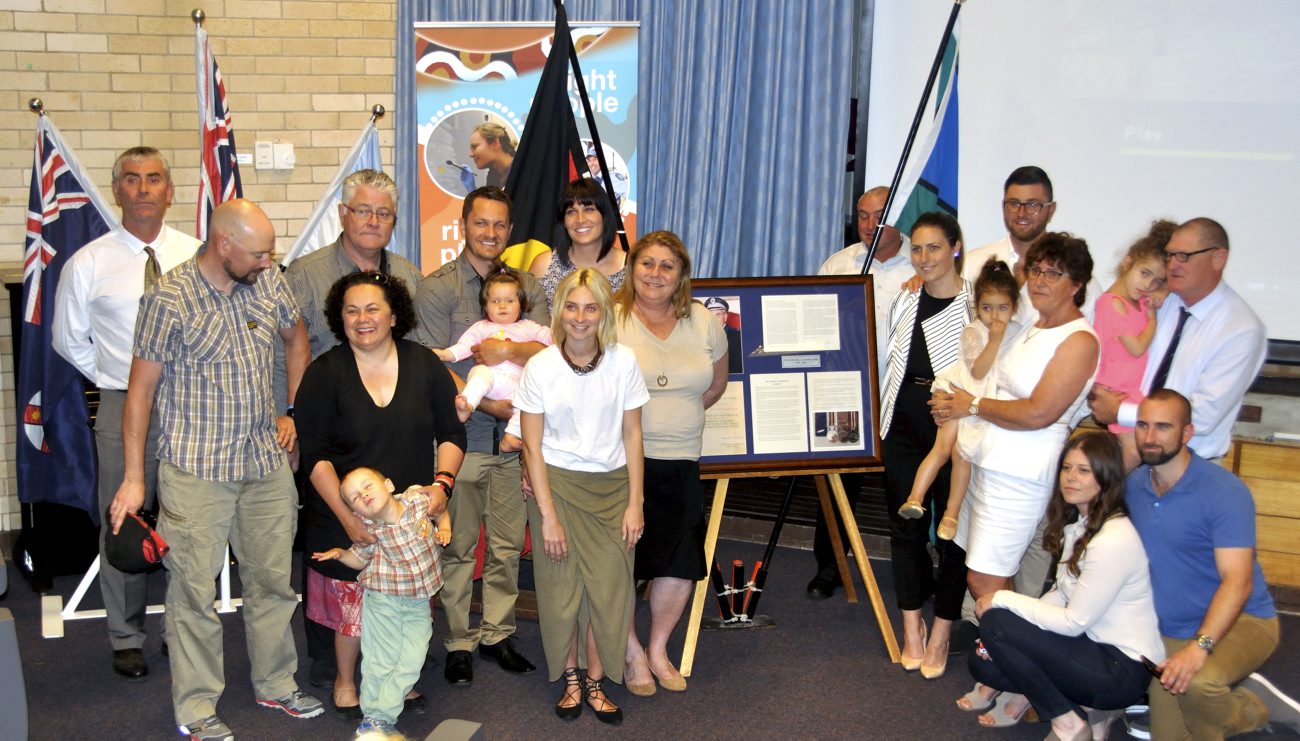
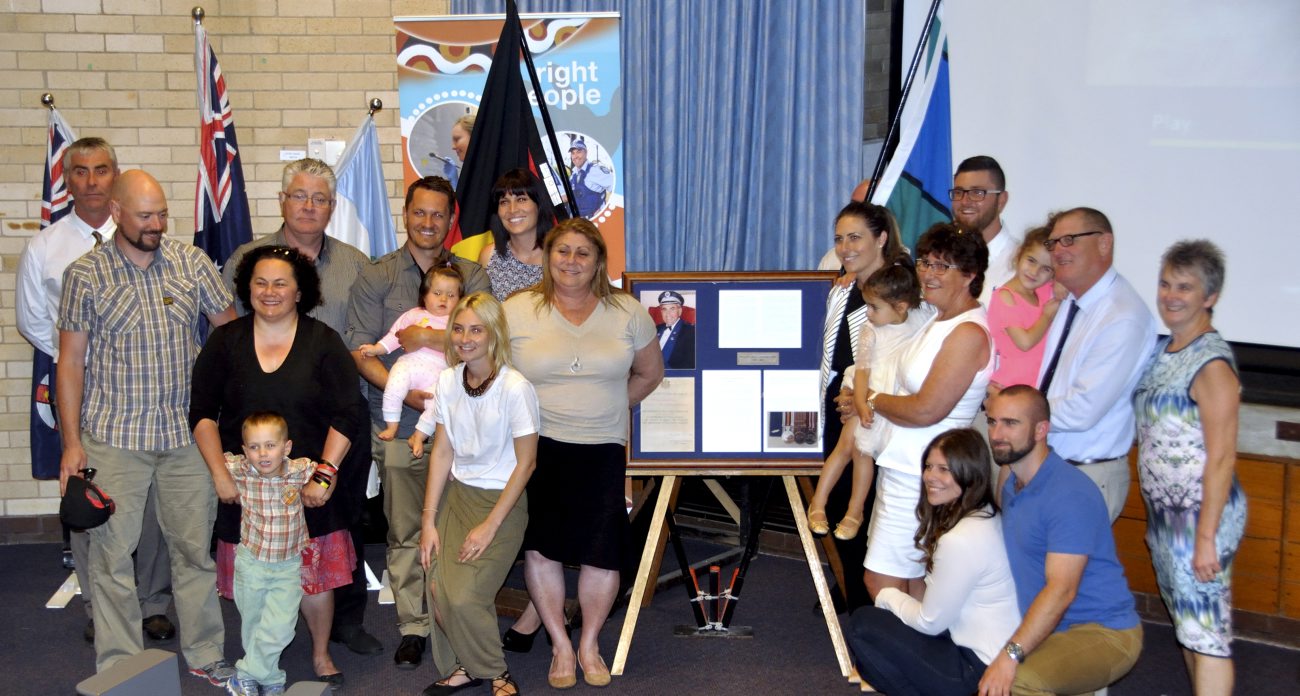
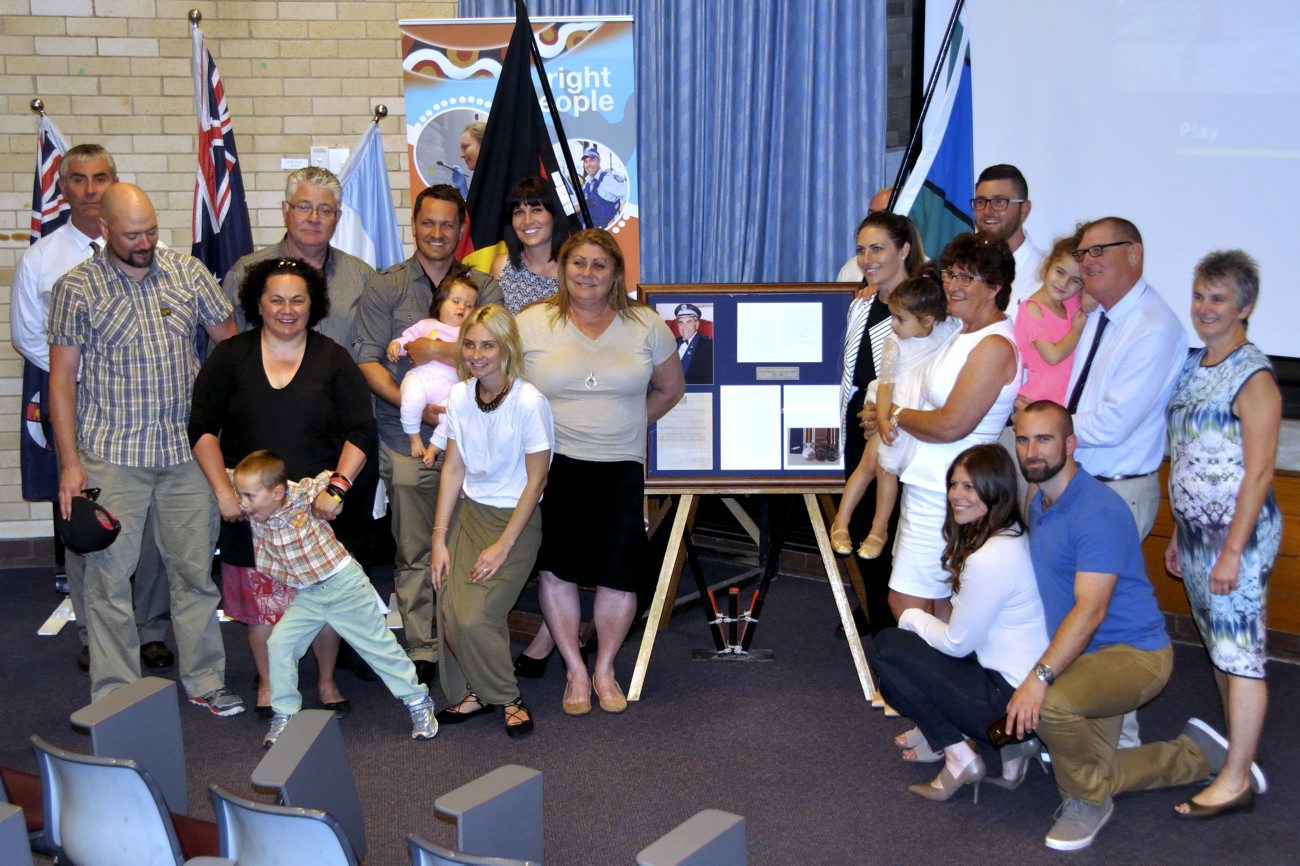
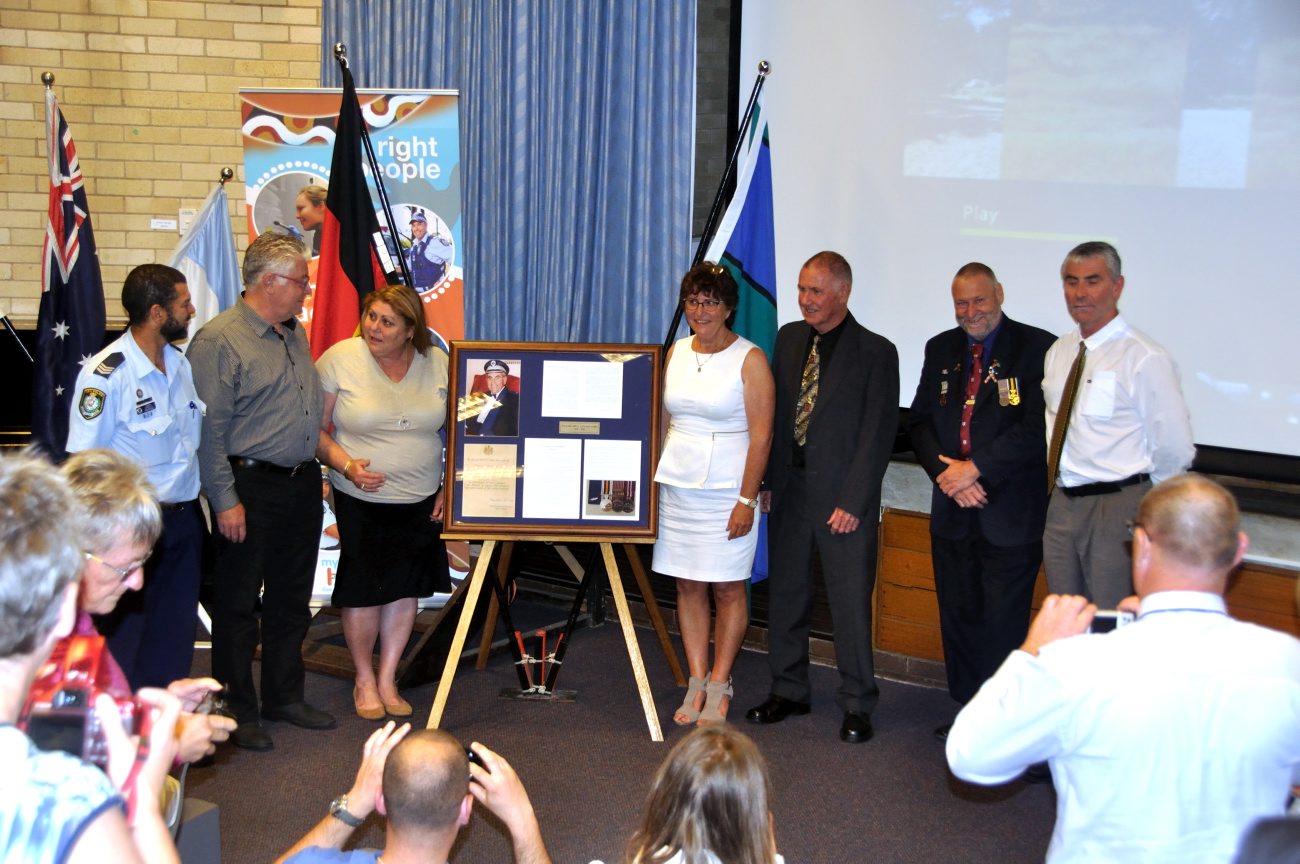
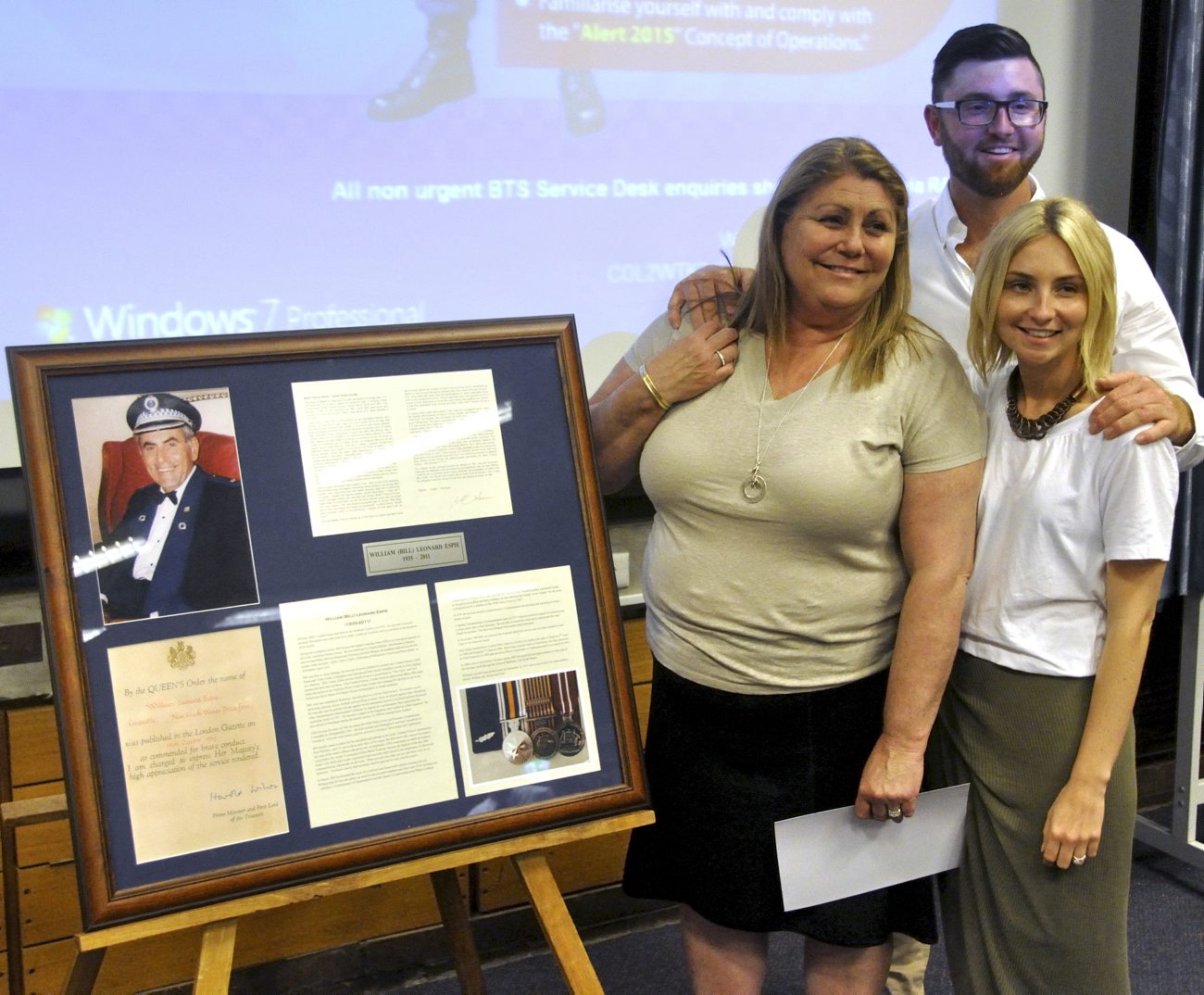
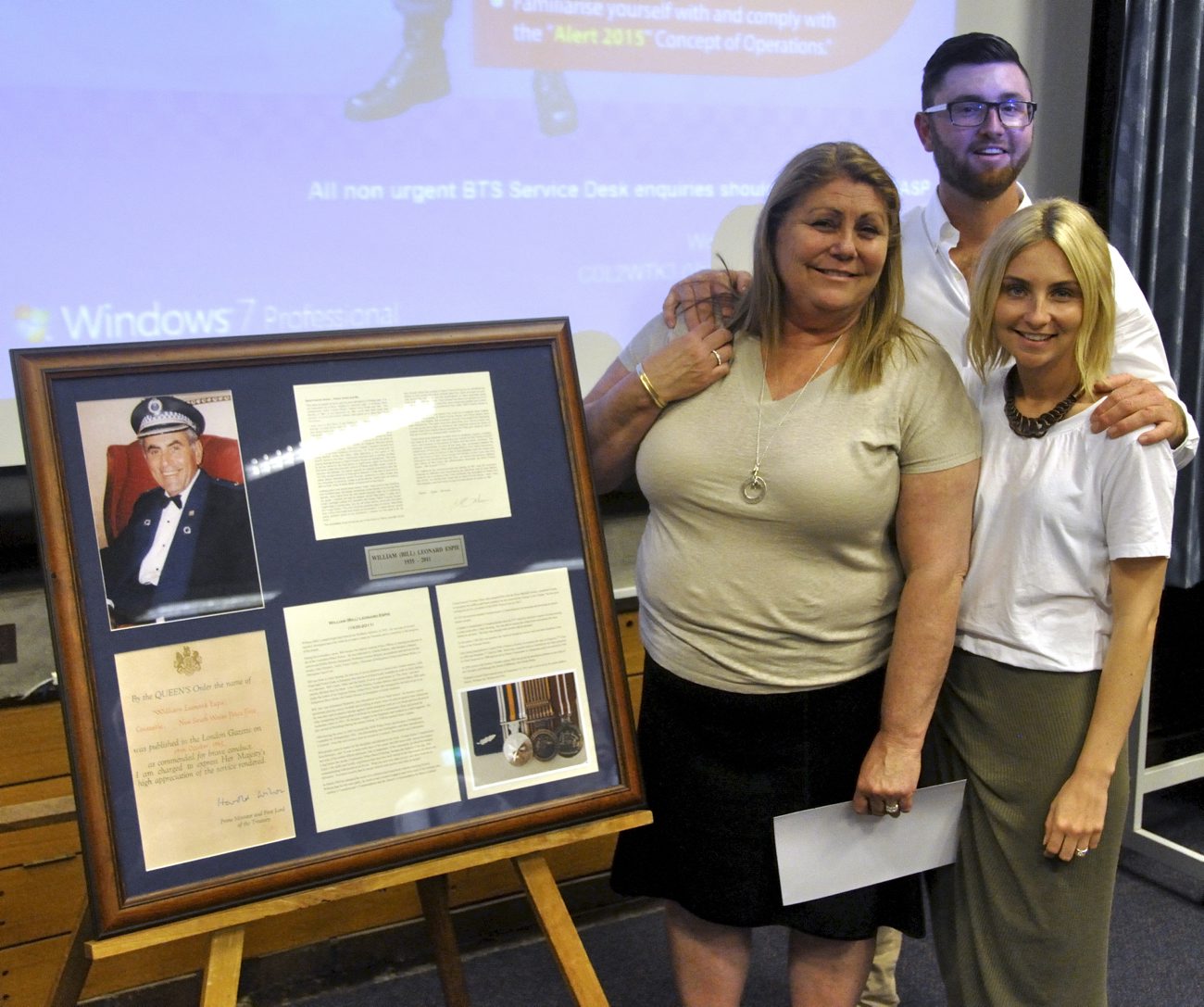
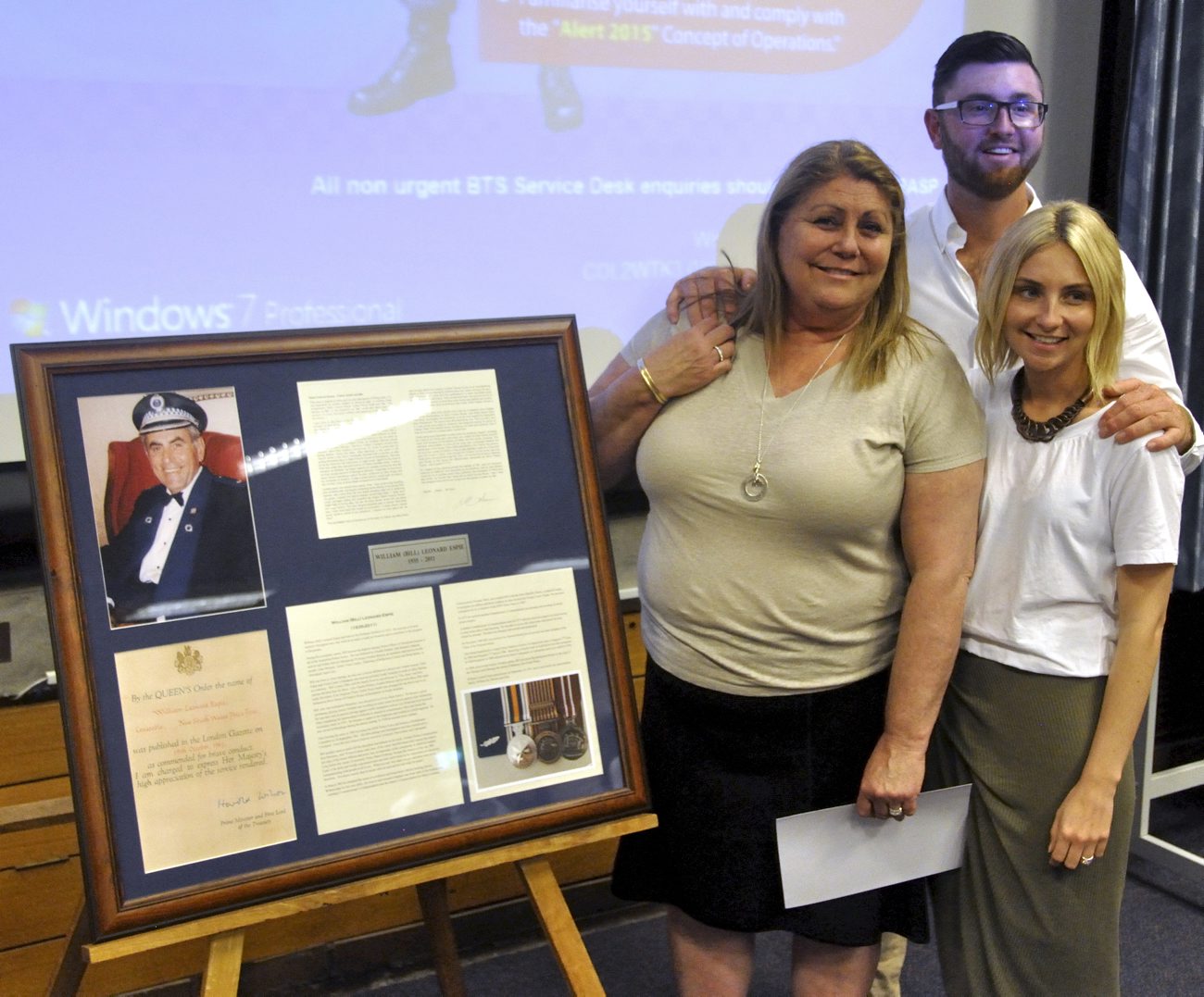
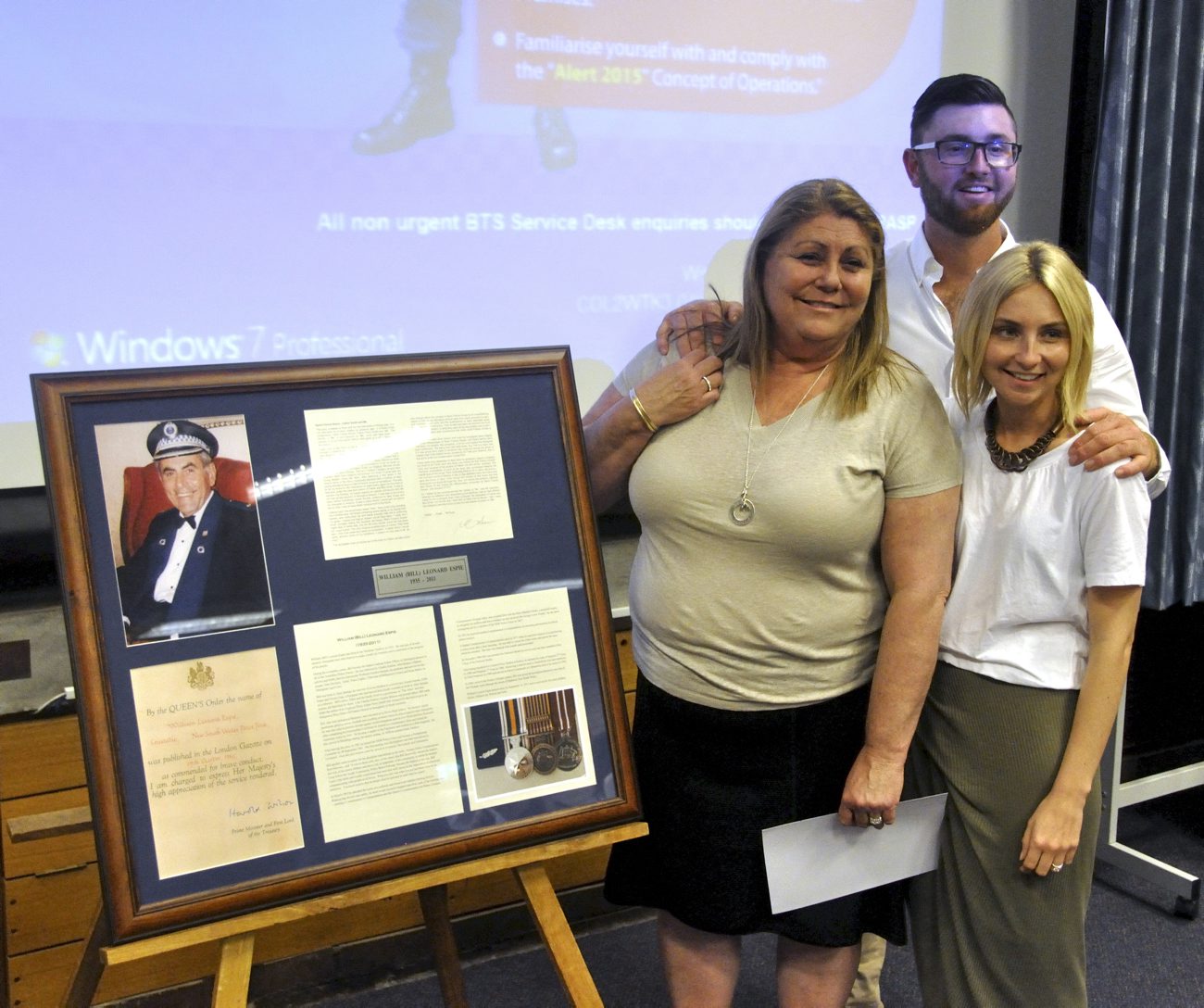
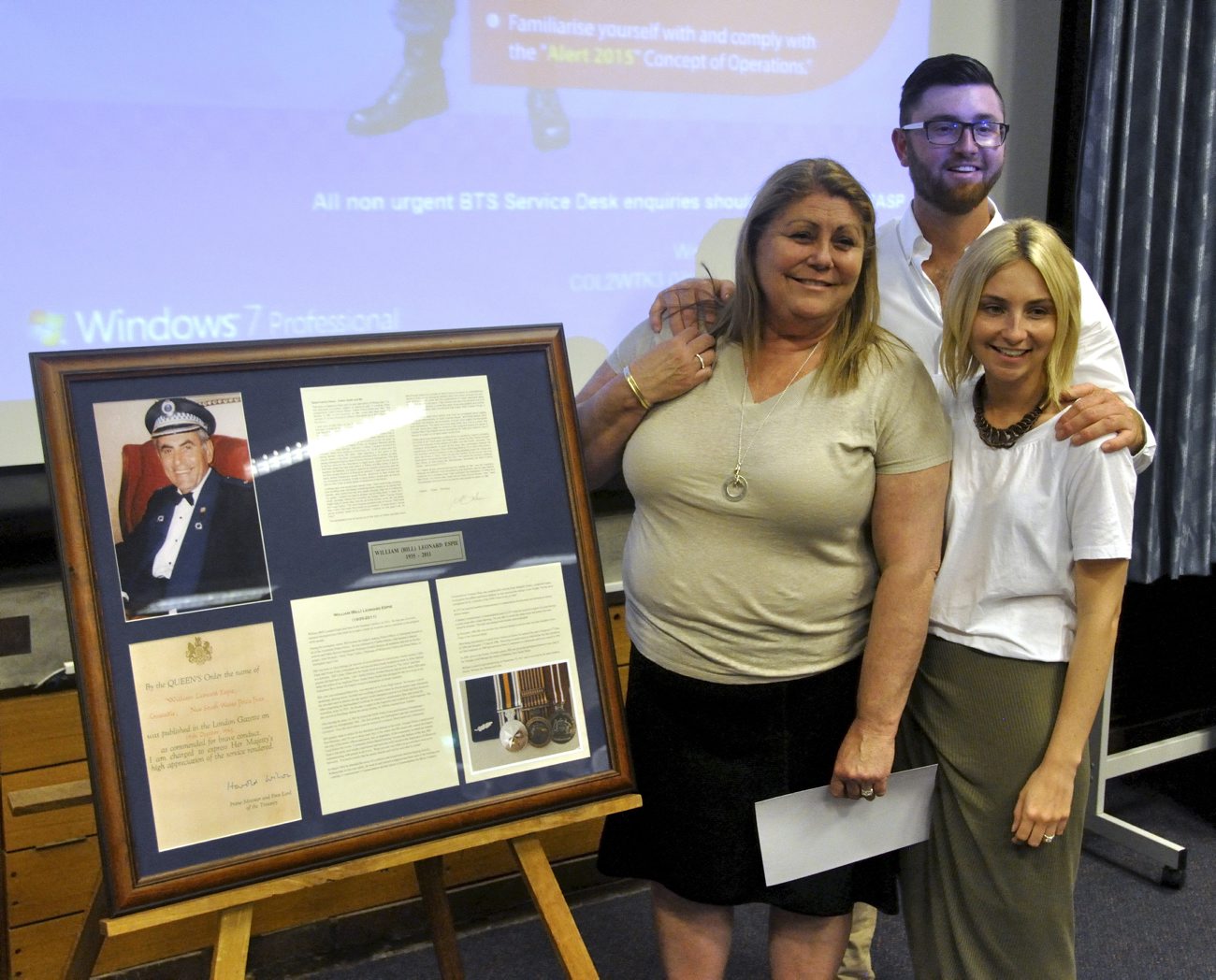
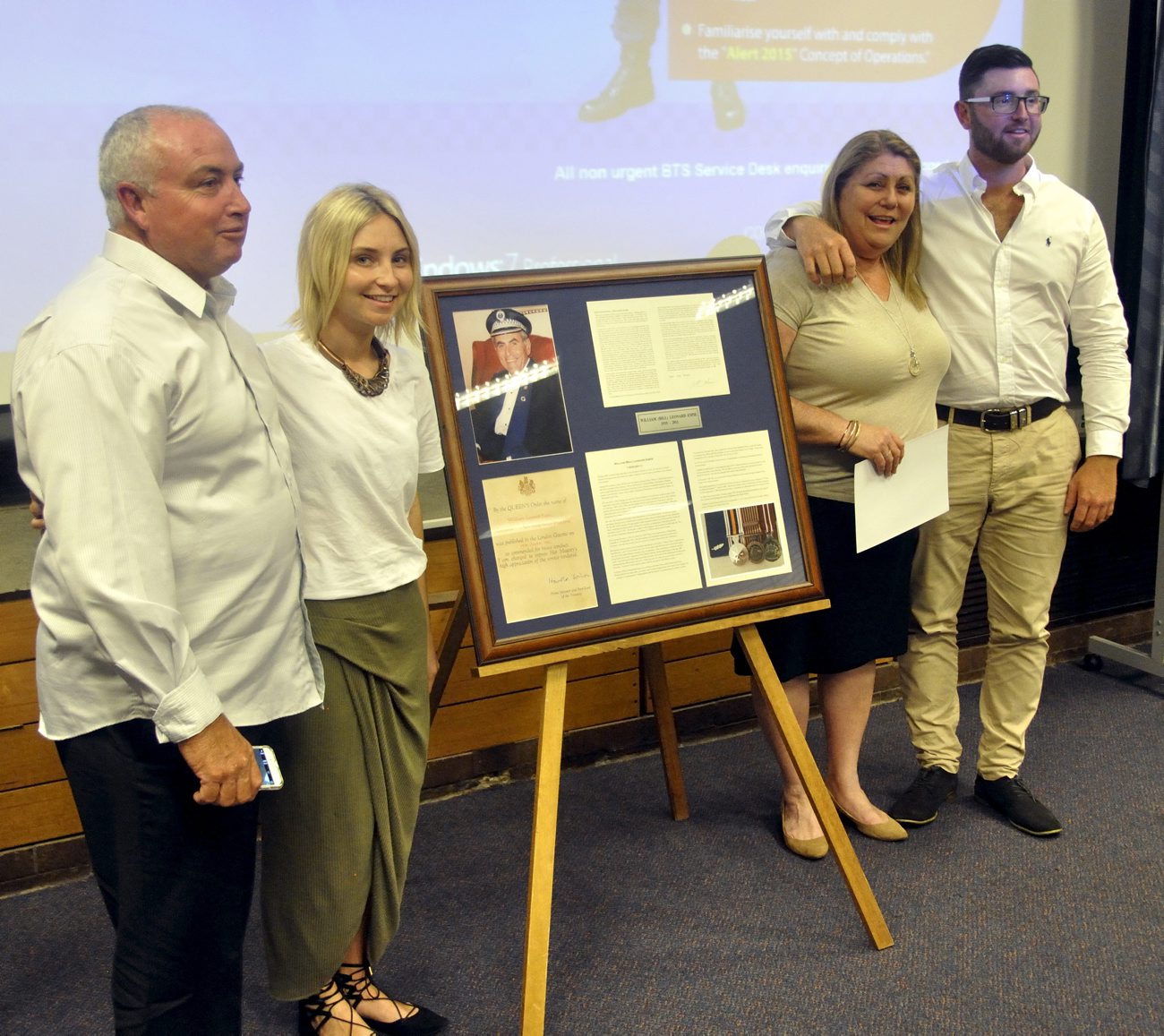
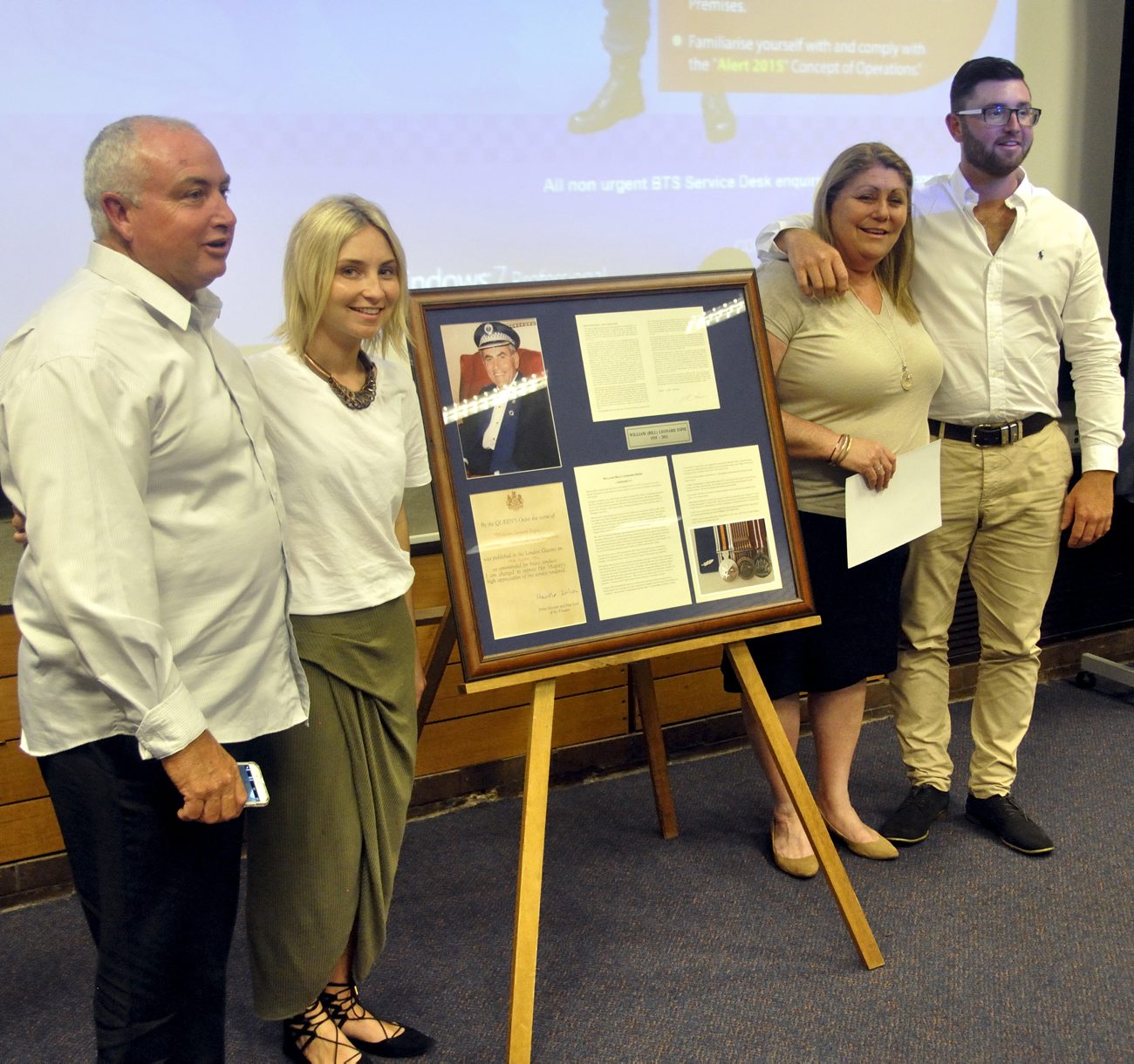
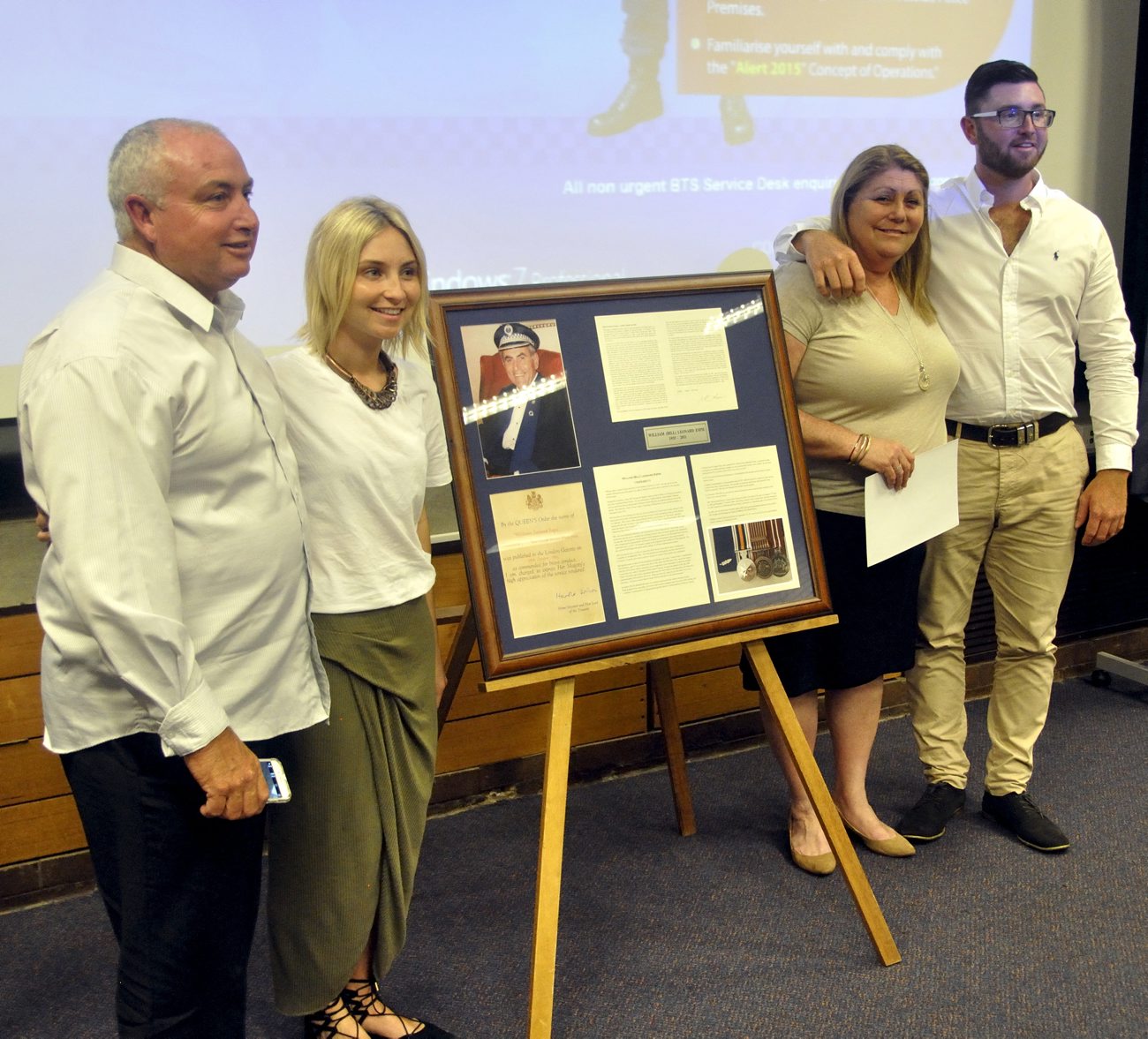
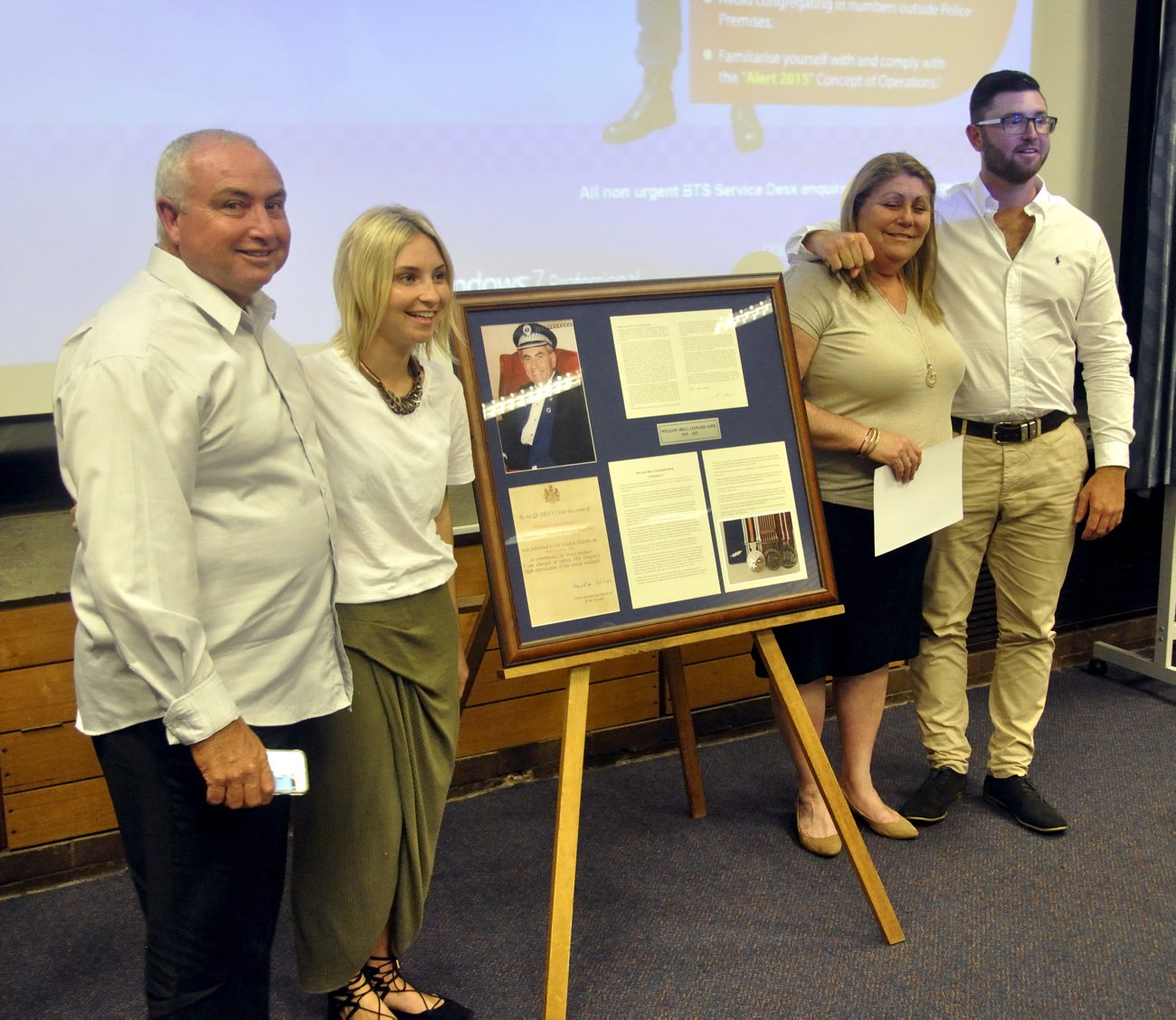
Memorial location 1: NSW Police Academy, Goulburn
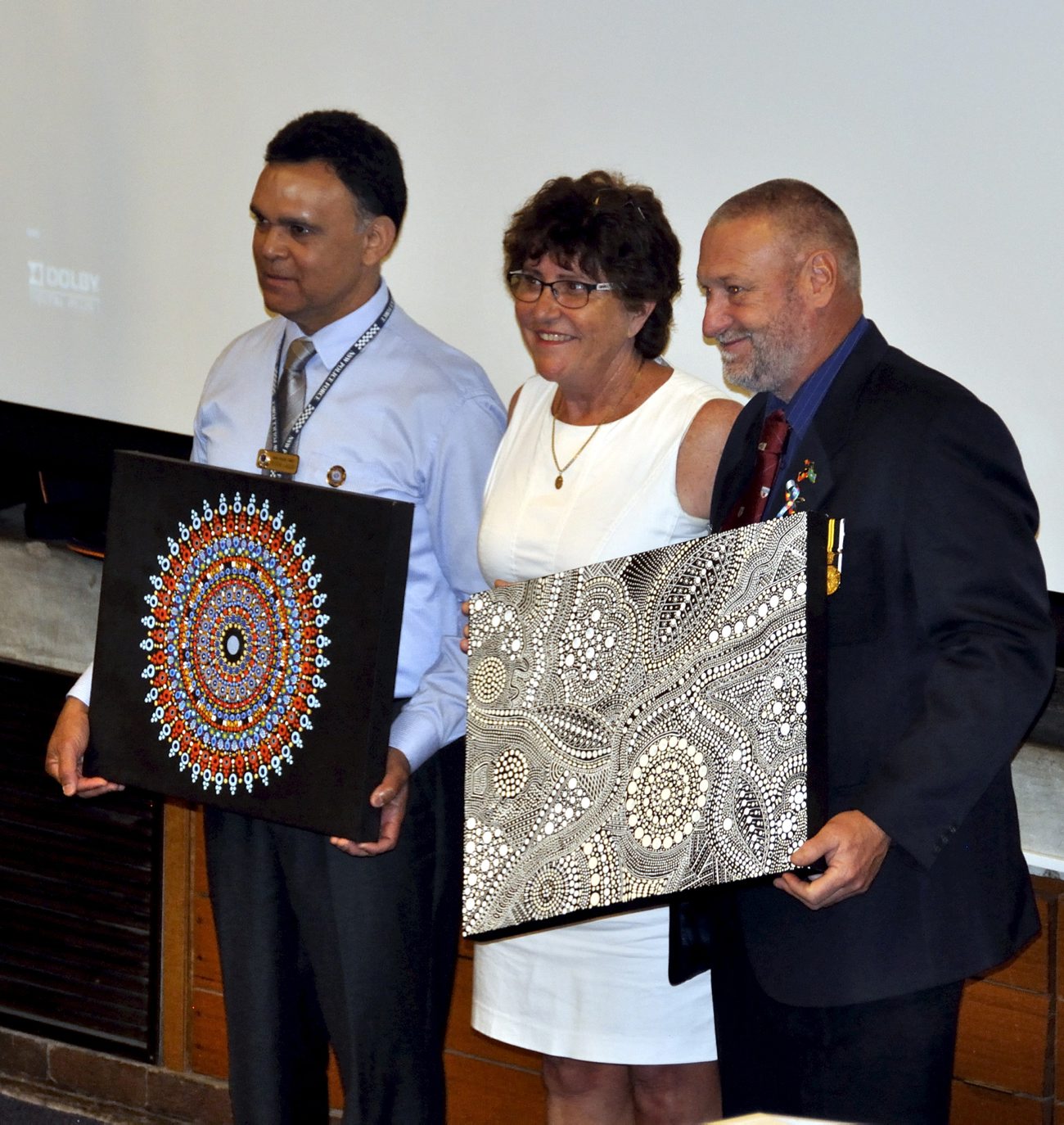
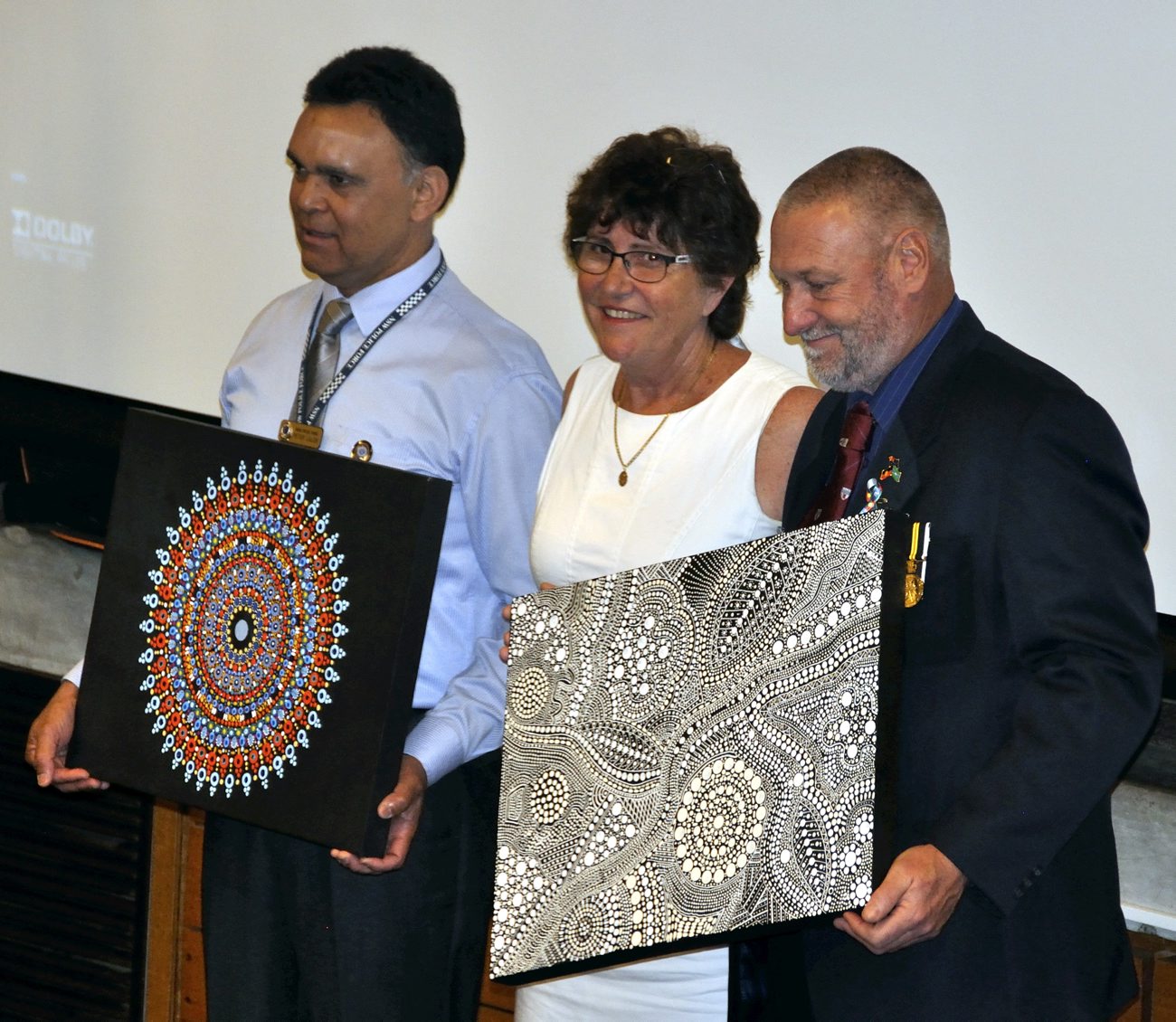
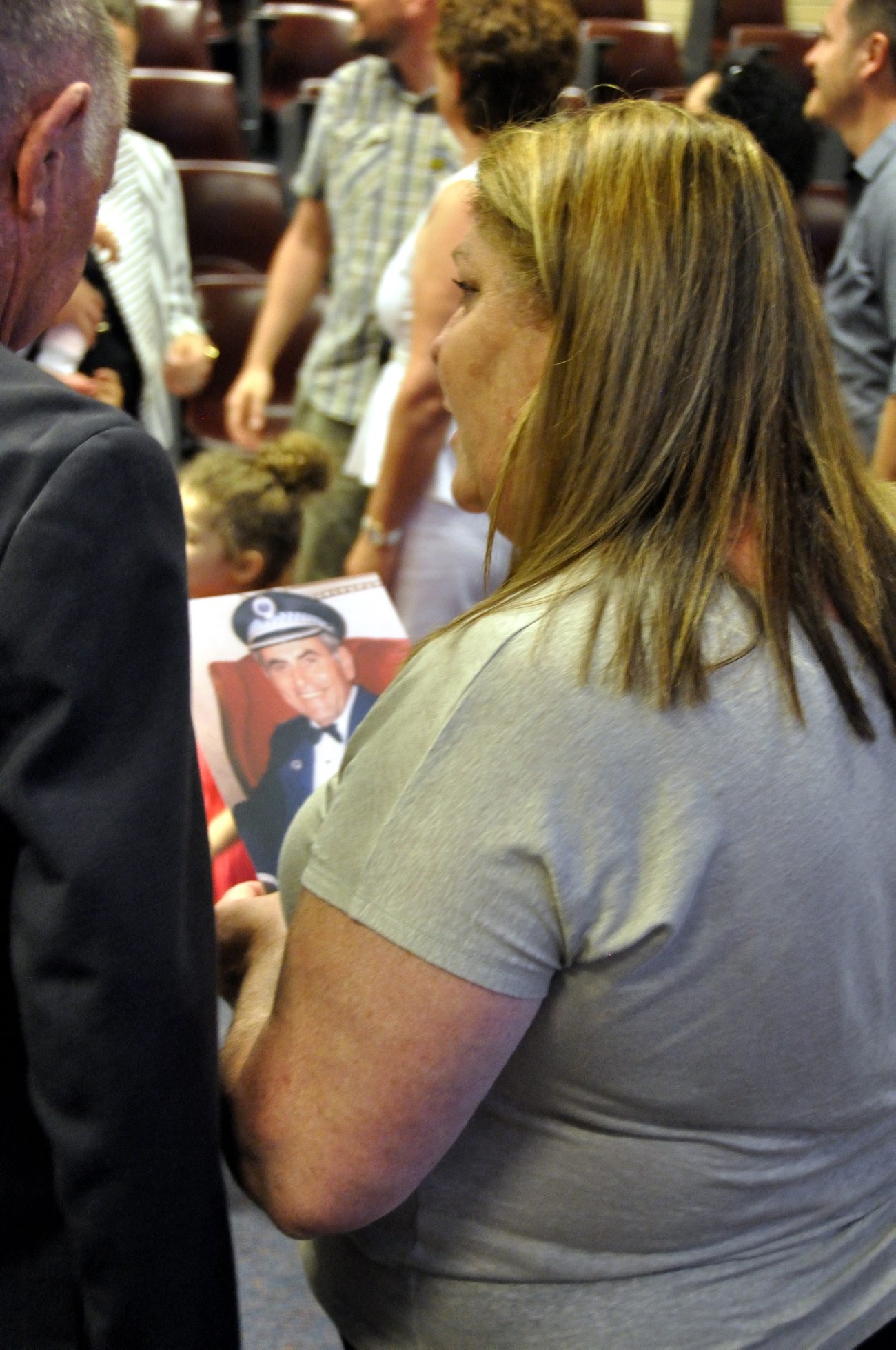
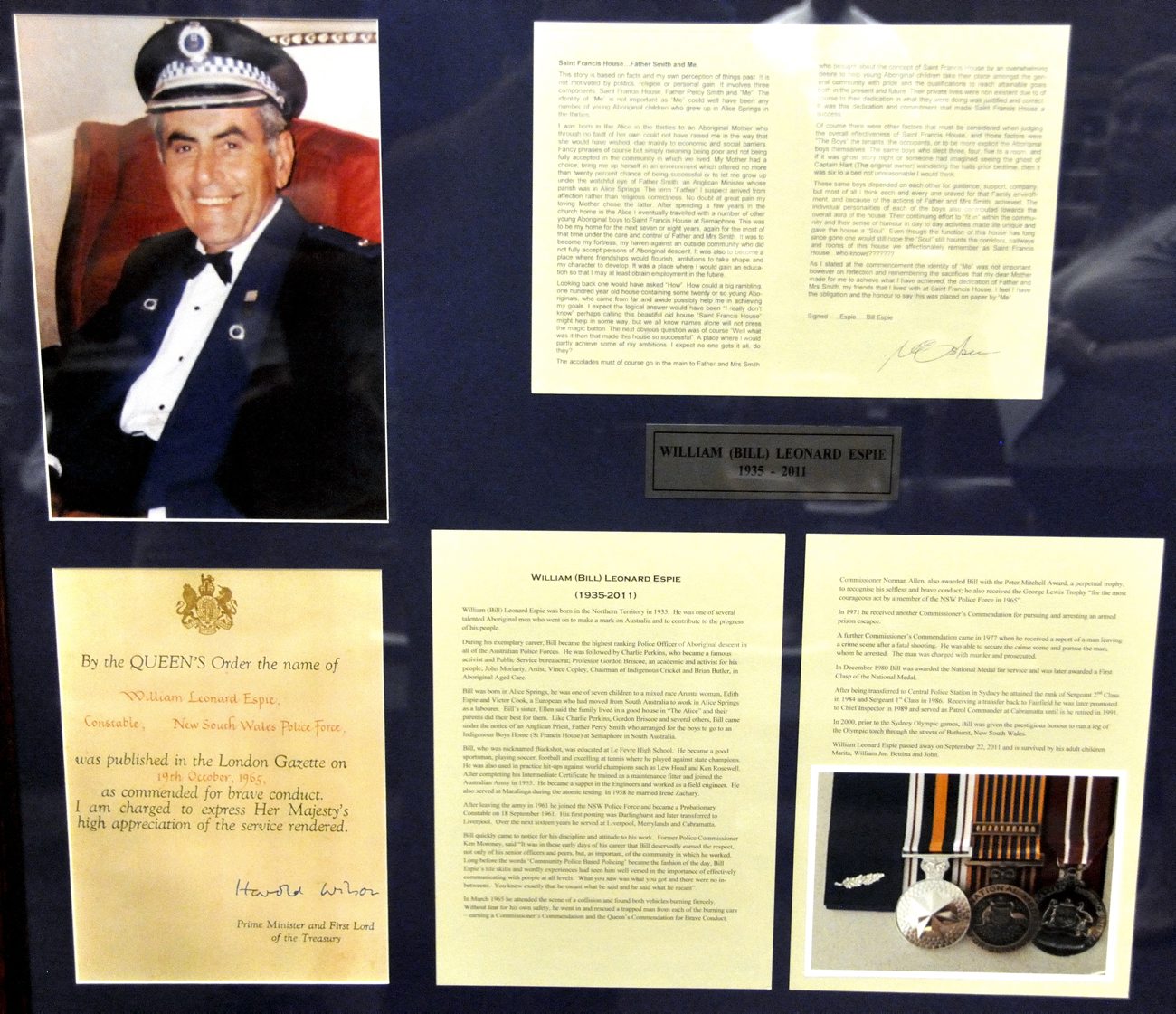
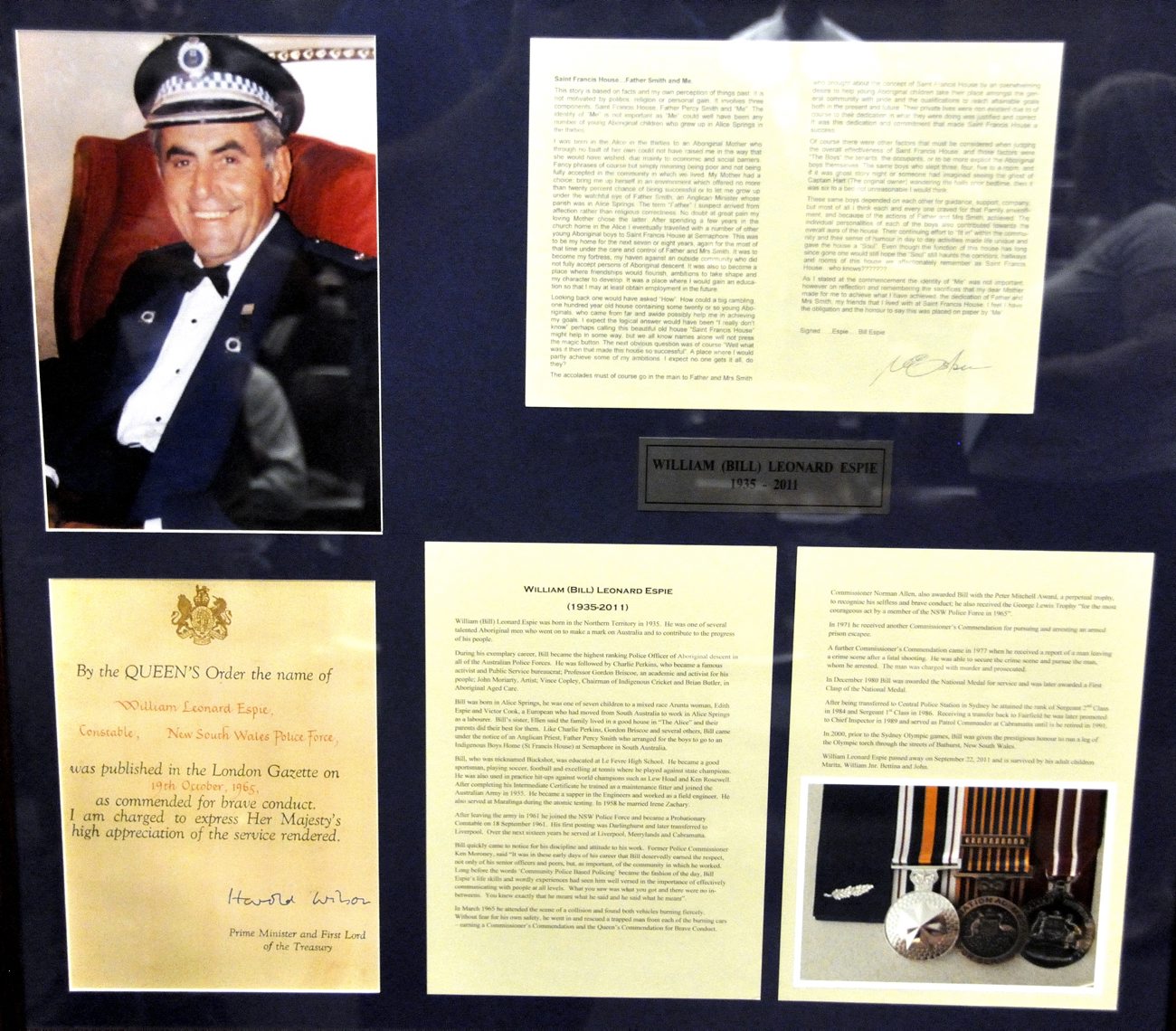
Memorial 1 description: Framed picture & literature in relation to Bill’s Service
Memorial date: 29 October 2015 @ 1pm
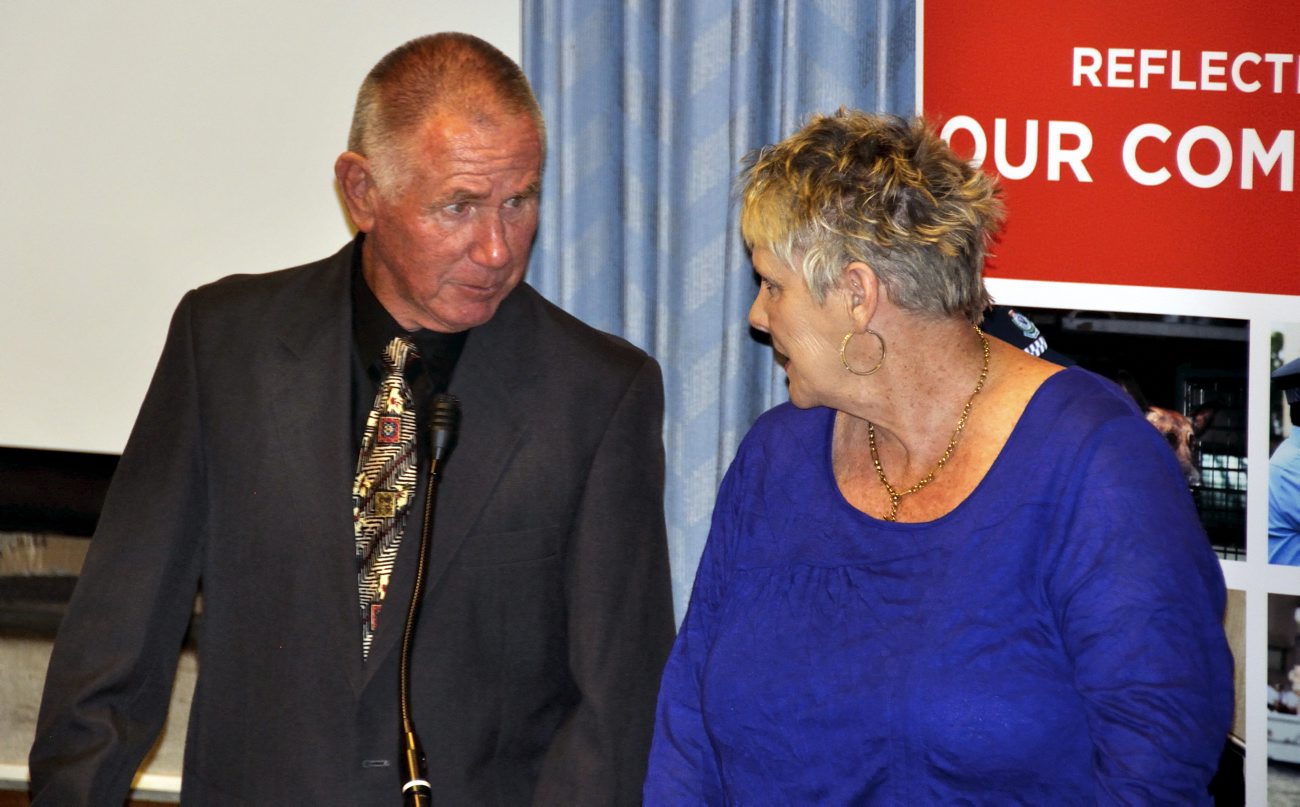
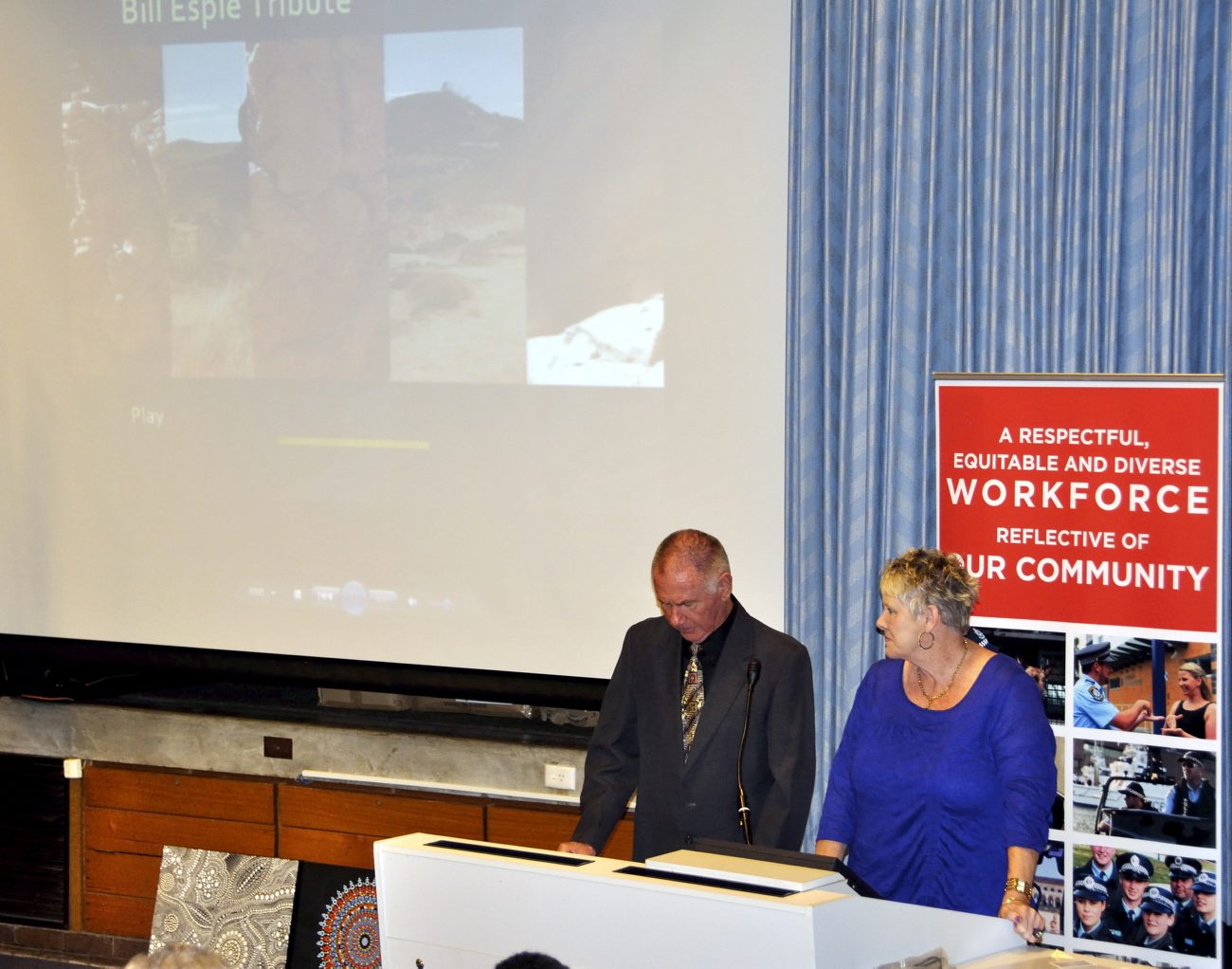
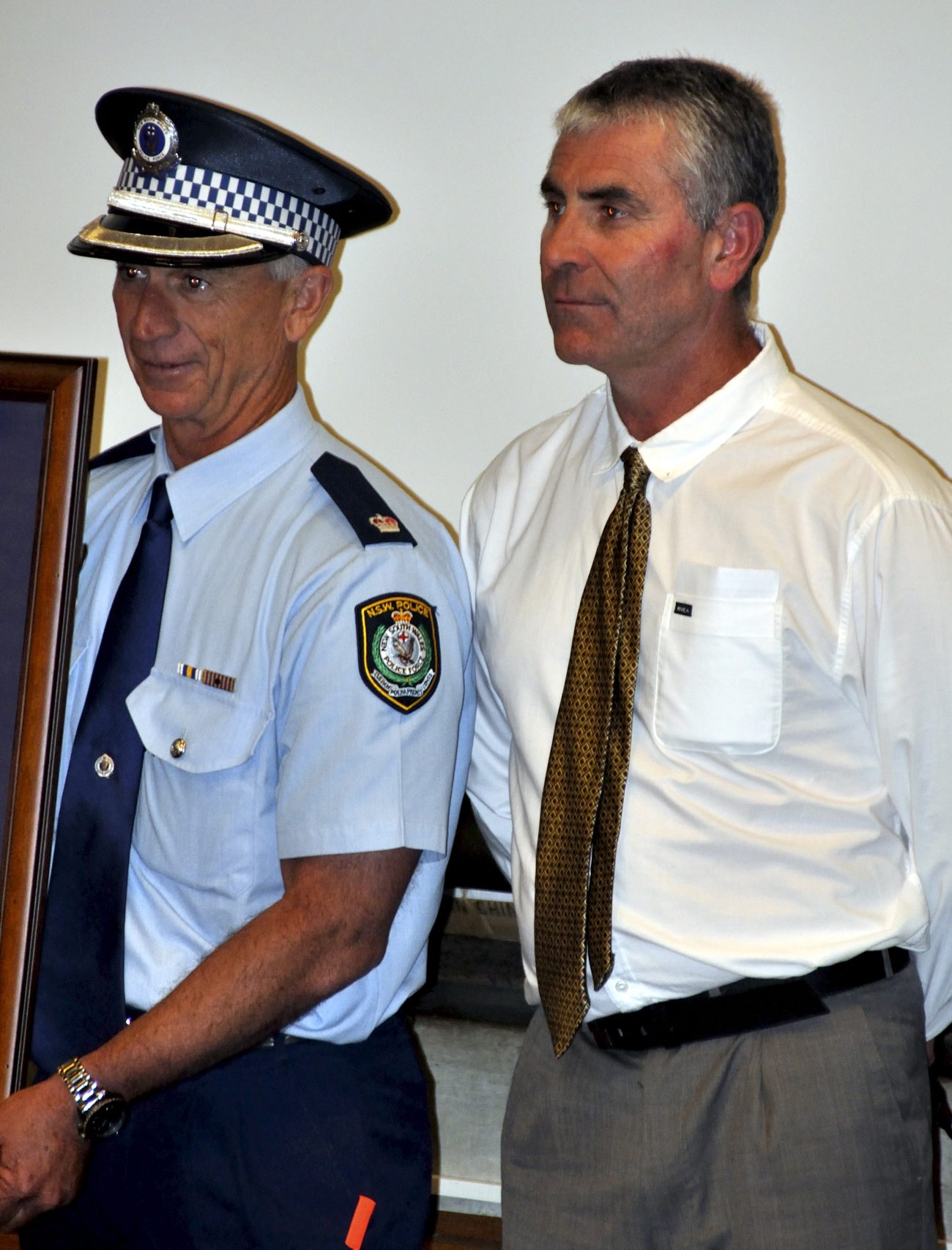
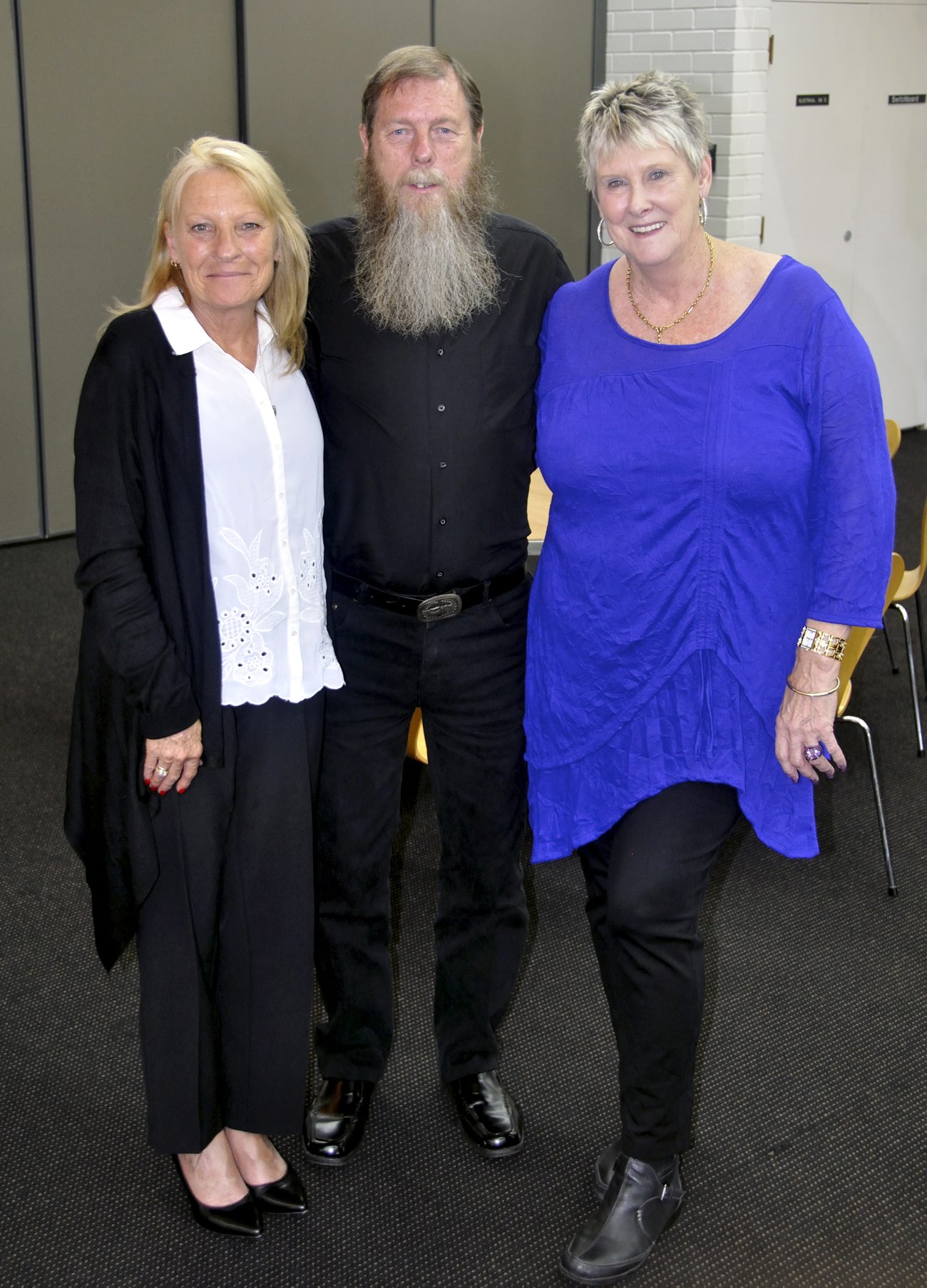
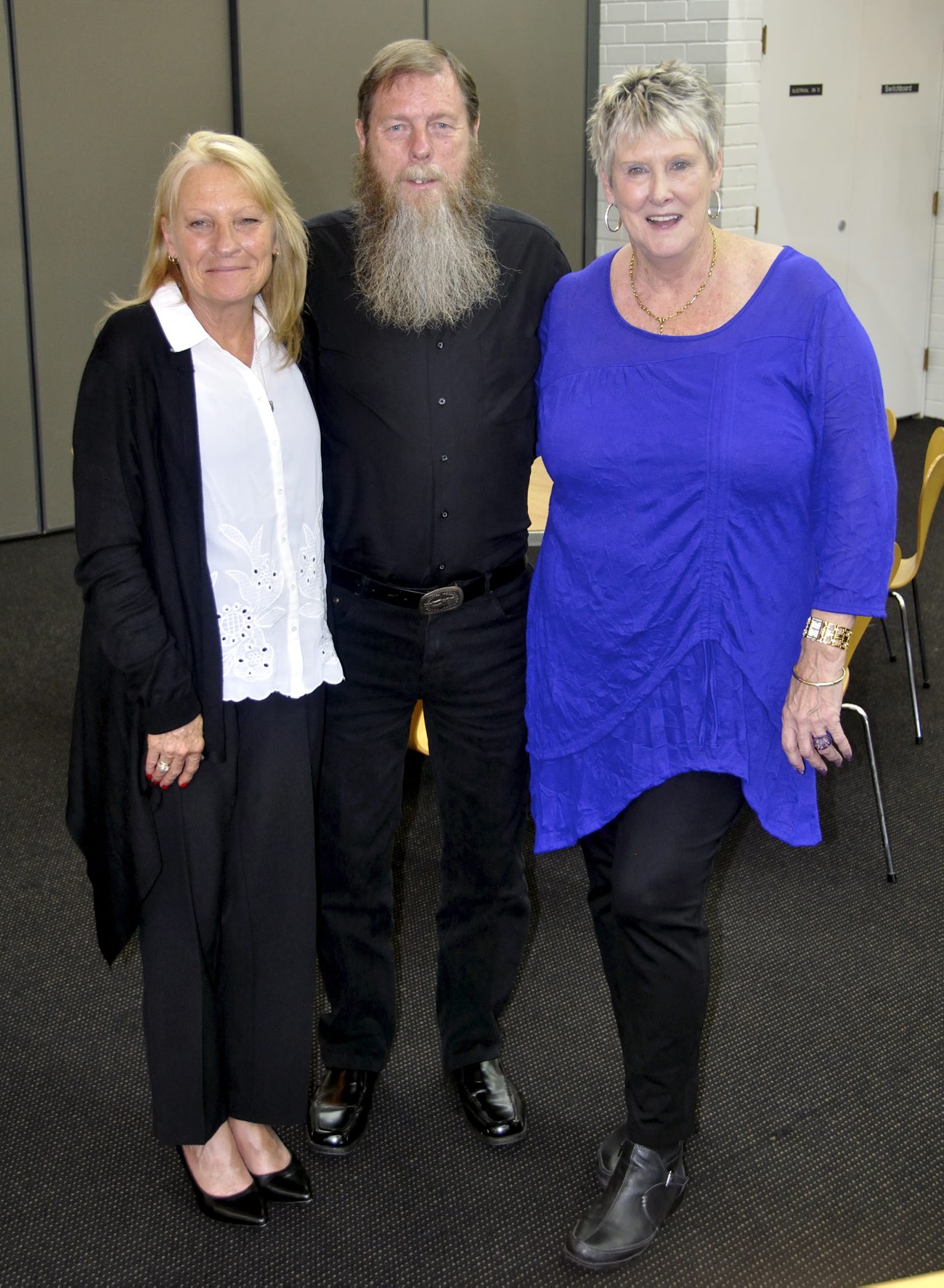
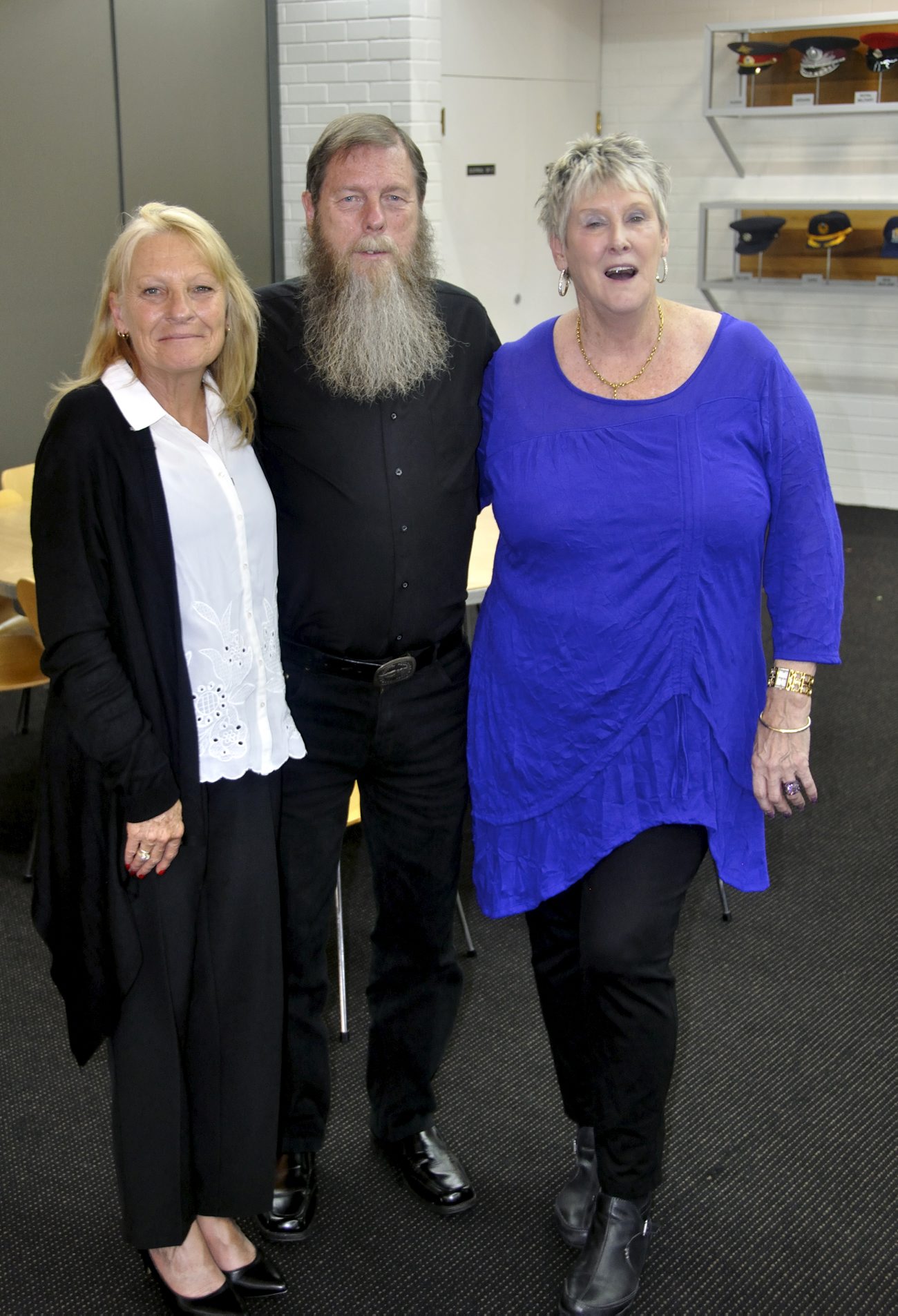
Former Det Sgt Peter Croucher & Former Sgt Sue Bytheway
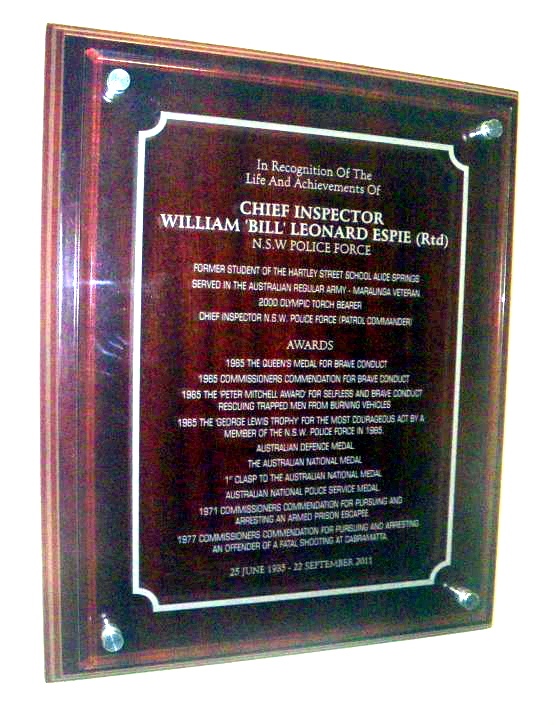
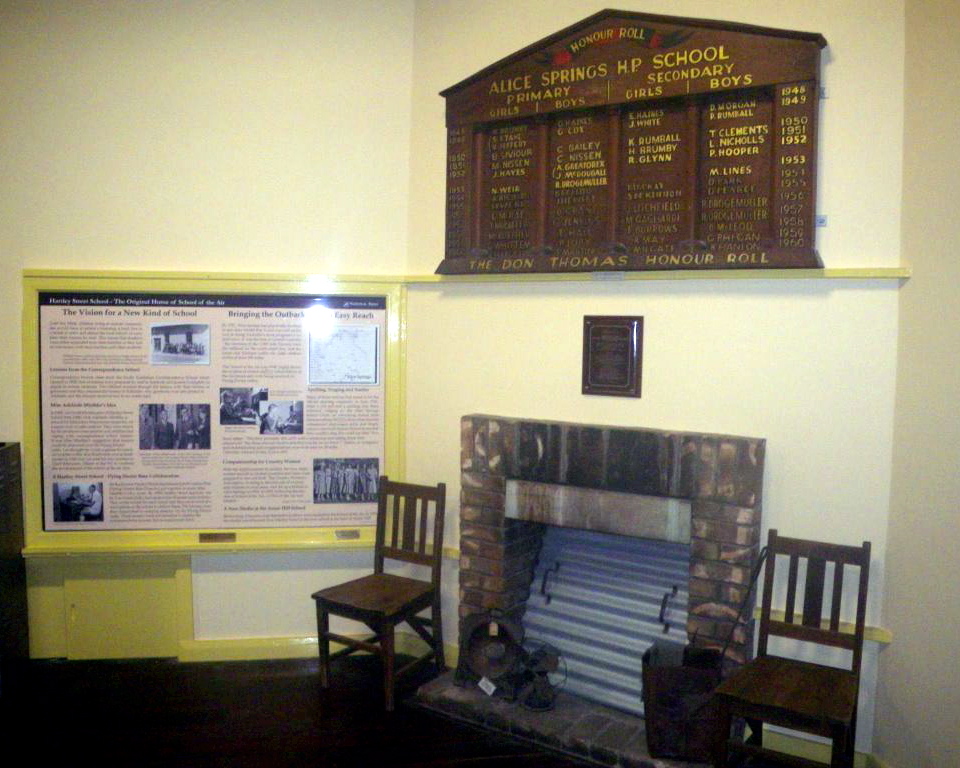
Memorial location 2: Hartley St School Museum, 39 Hartley St, Alice Springs, N.T.
Memorial 2 description: Plaque
Memorial date: 29 July 2017
BILL is NOT mentioned on the Police Wall of Remembrance * NOT JOB RELATED
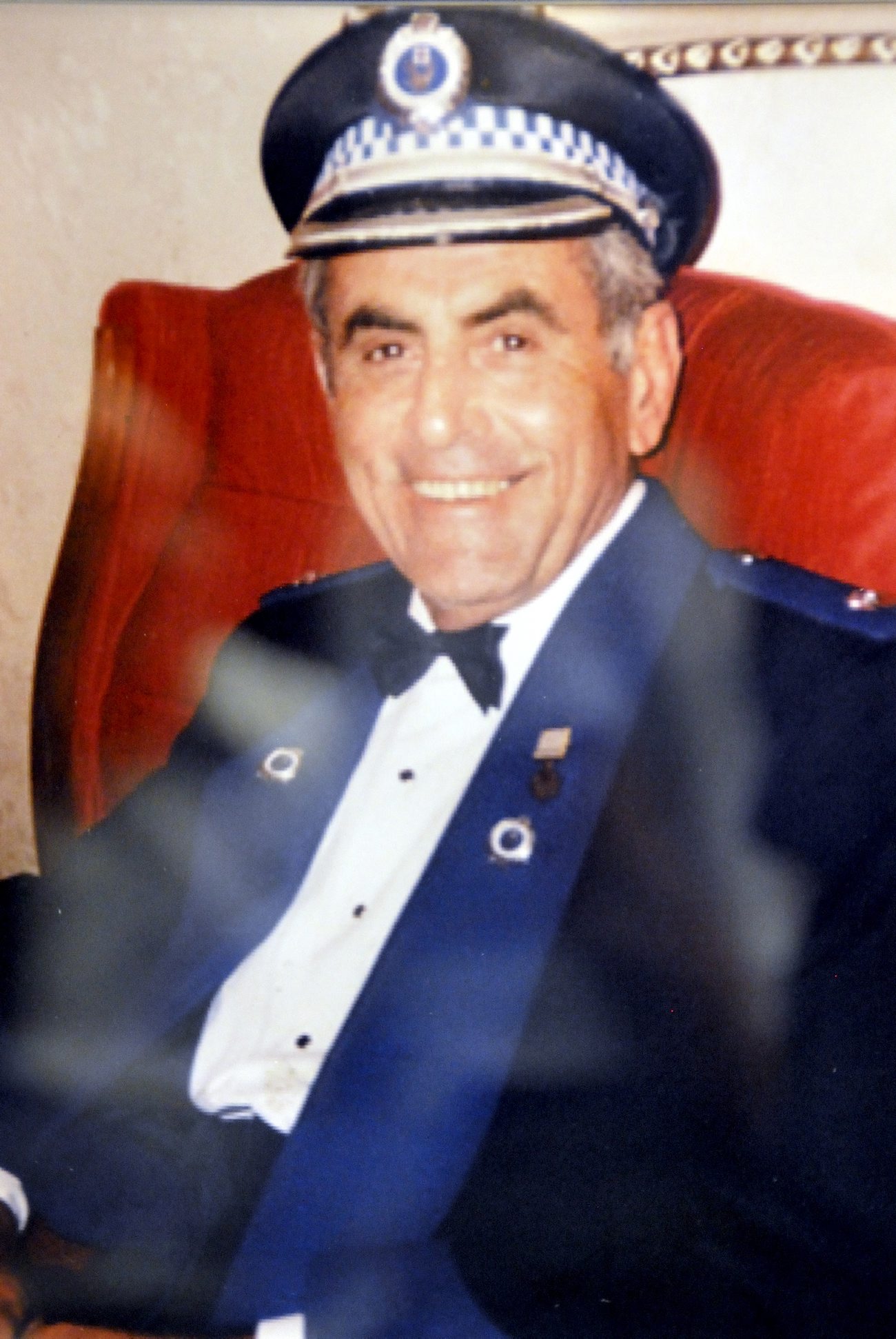
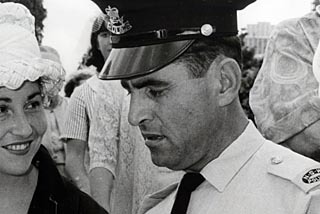
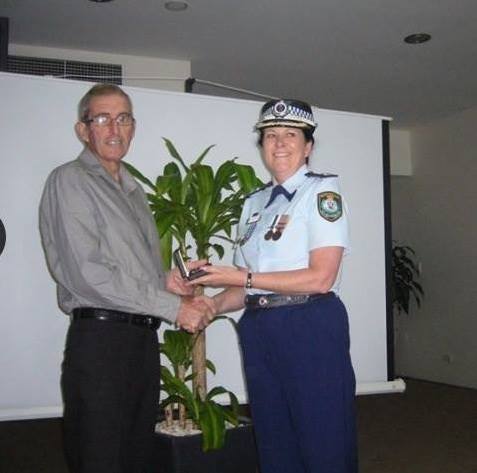
Bill Espie reading his Queen’s Commendation for Brave Conduct.
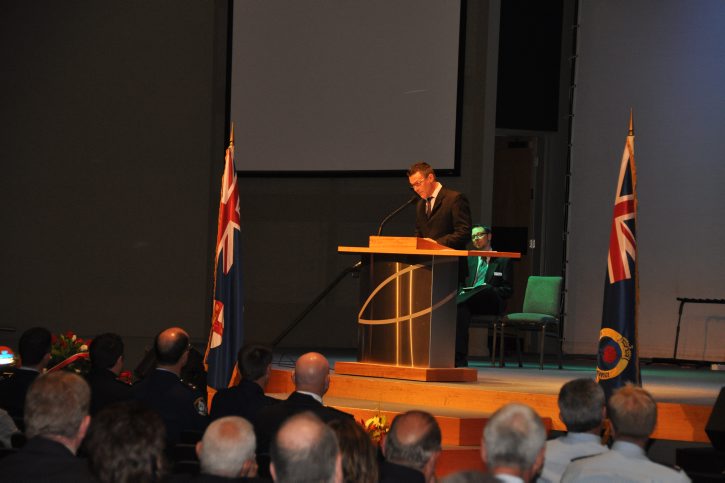
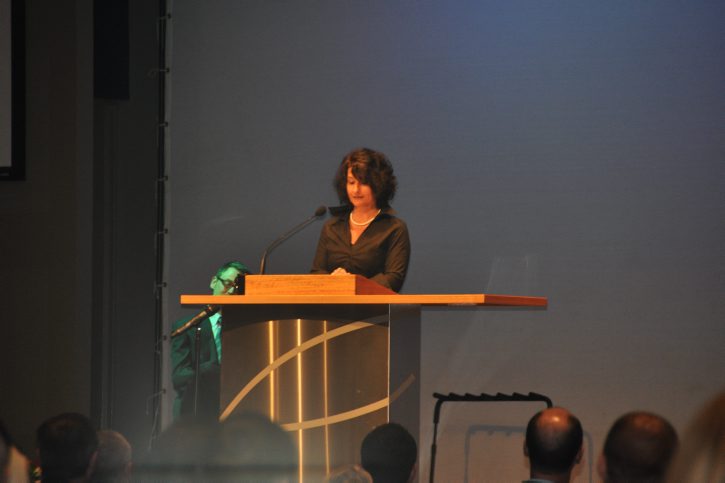
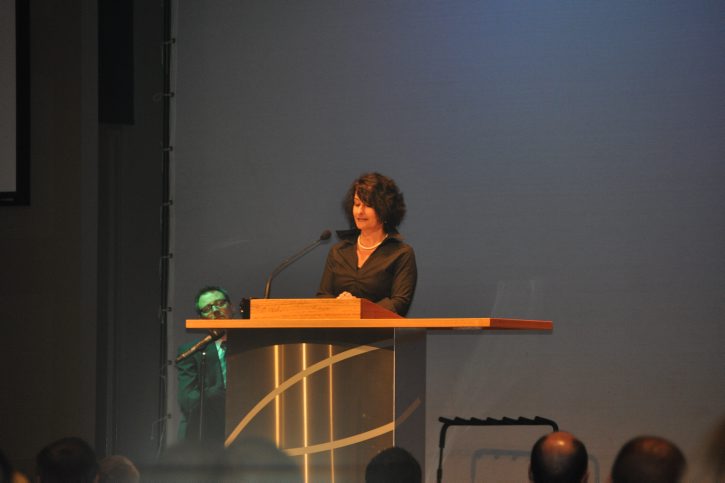
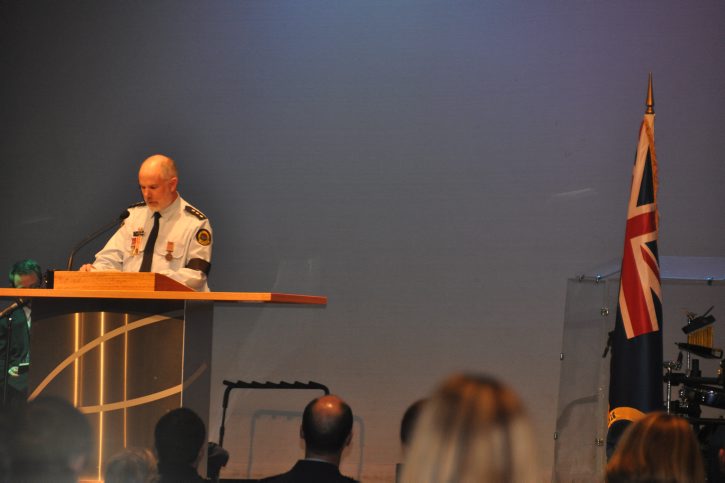
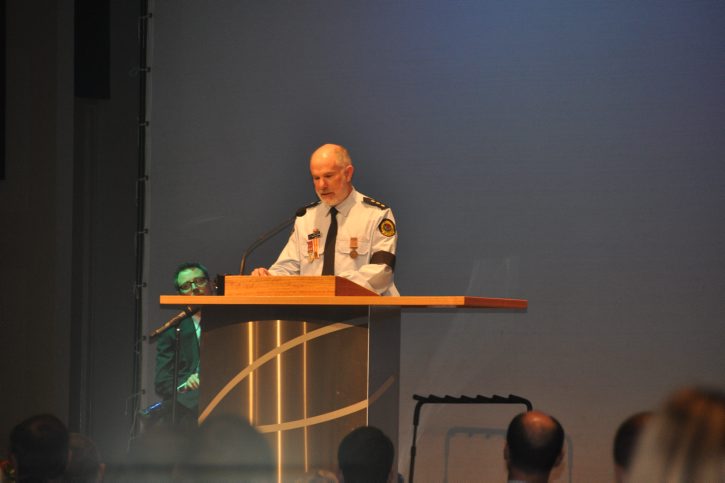
Former Police Commissioner Ken Moroney
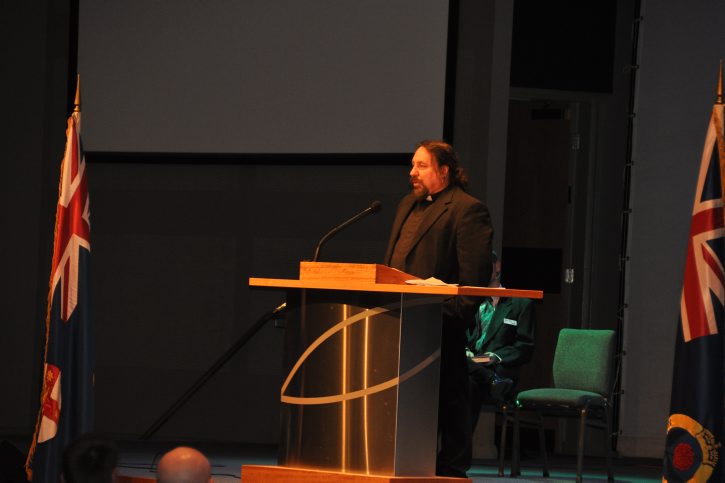
Former Detective Sergeant Peter Croucher
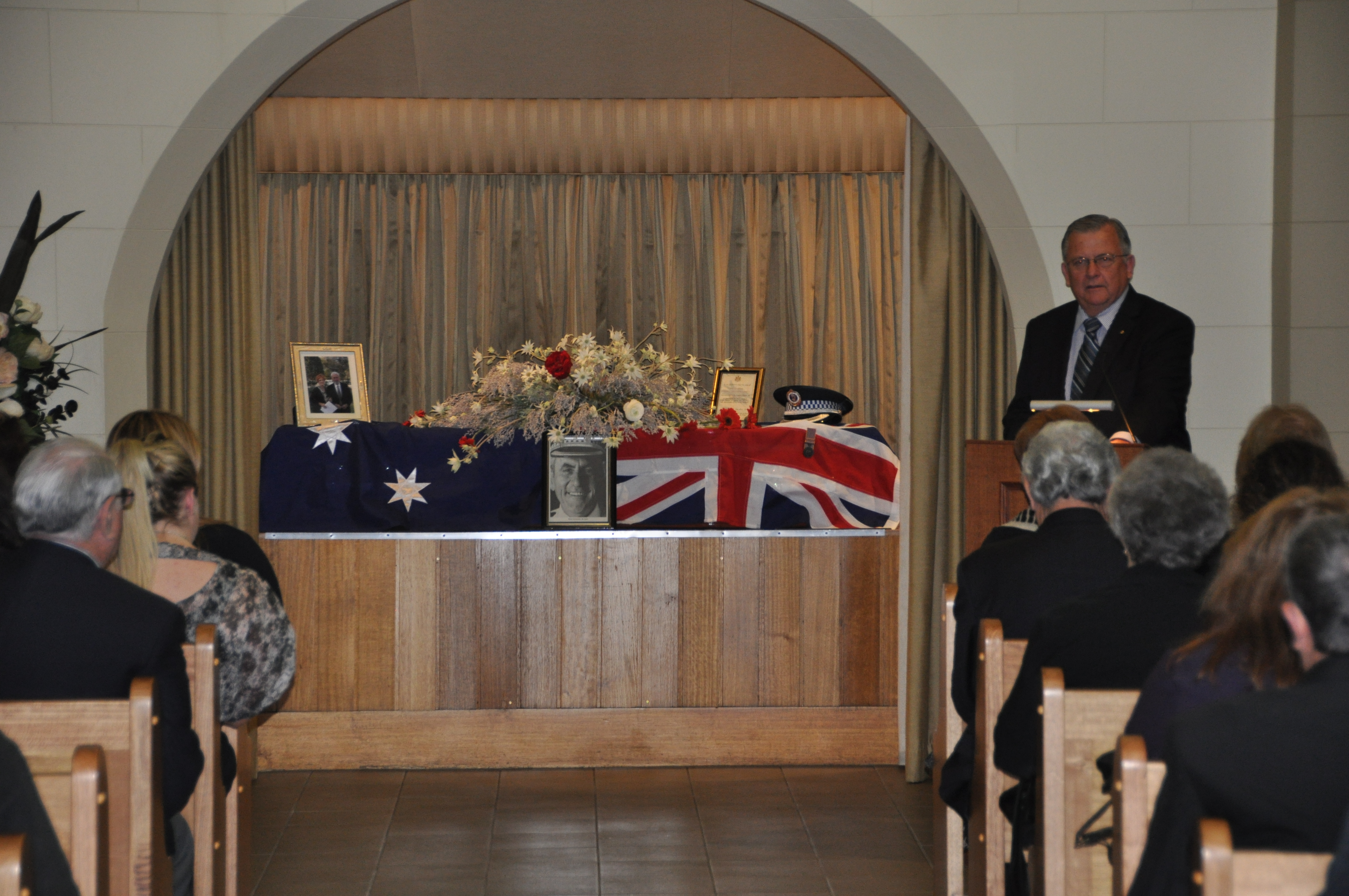
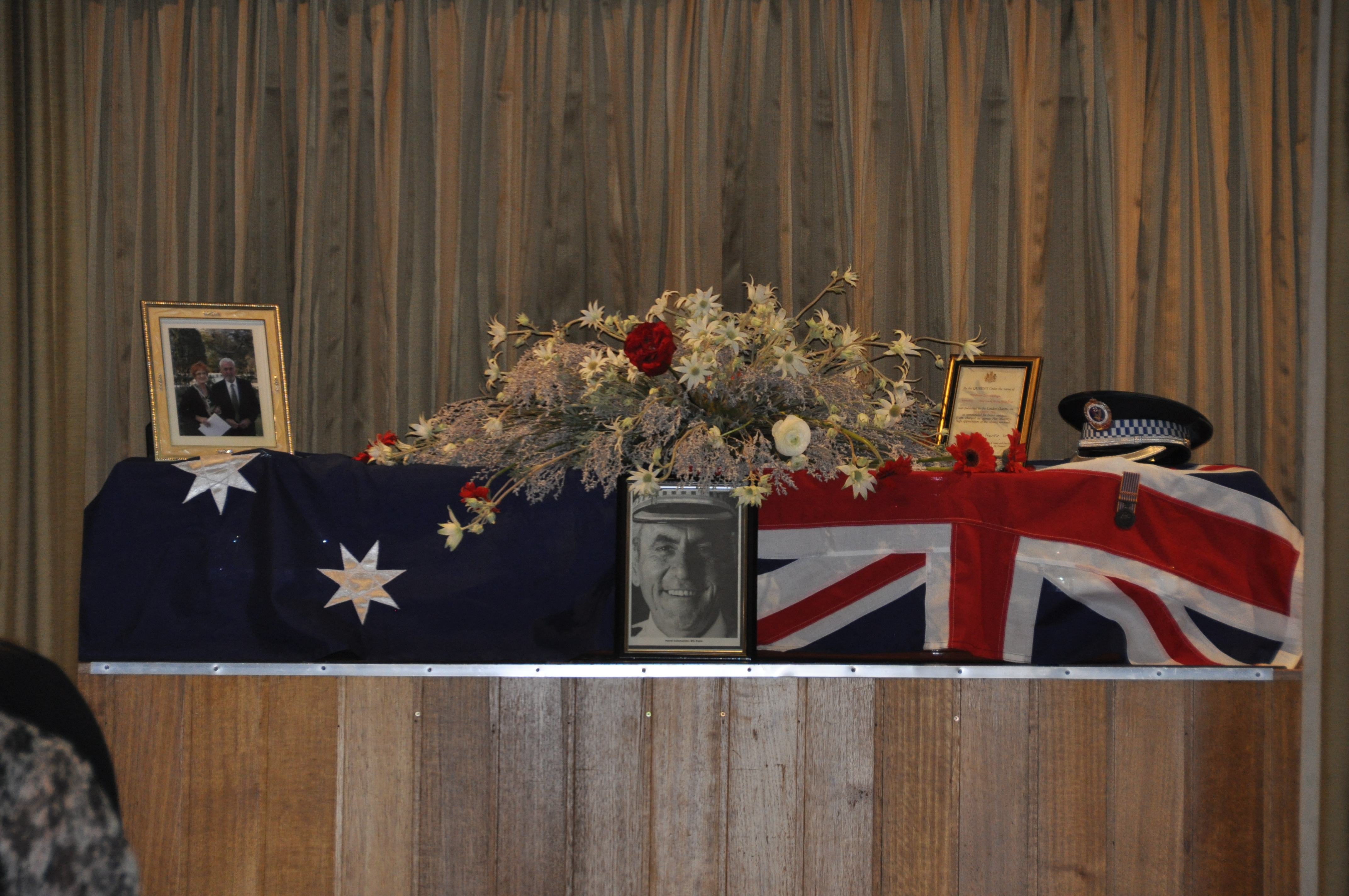
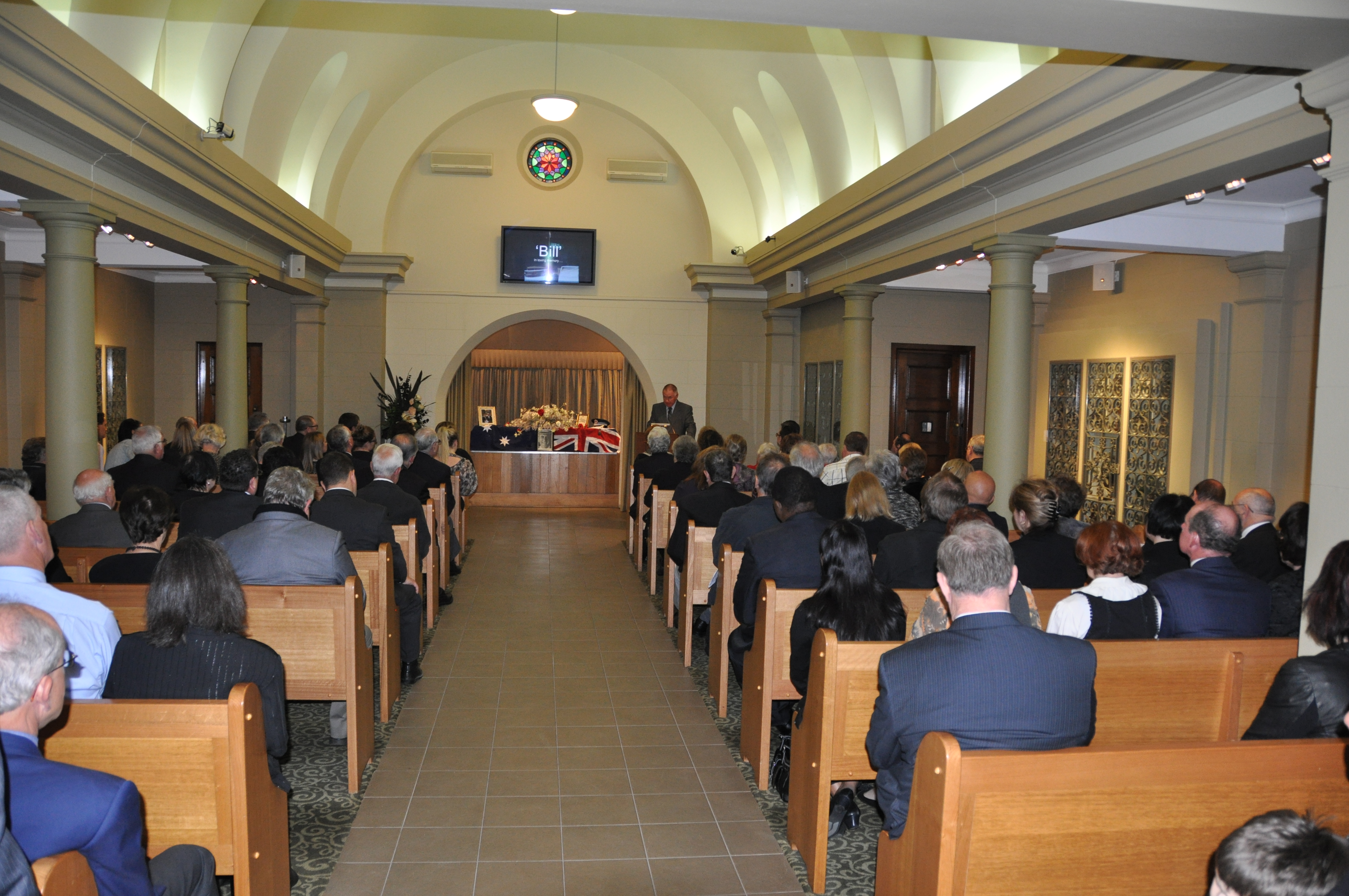
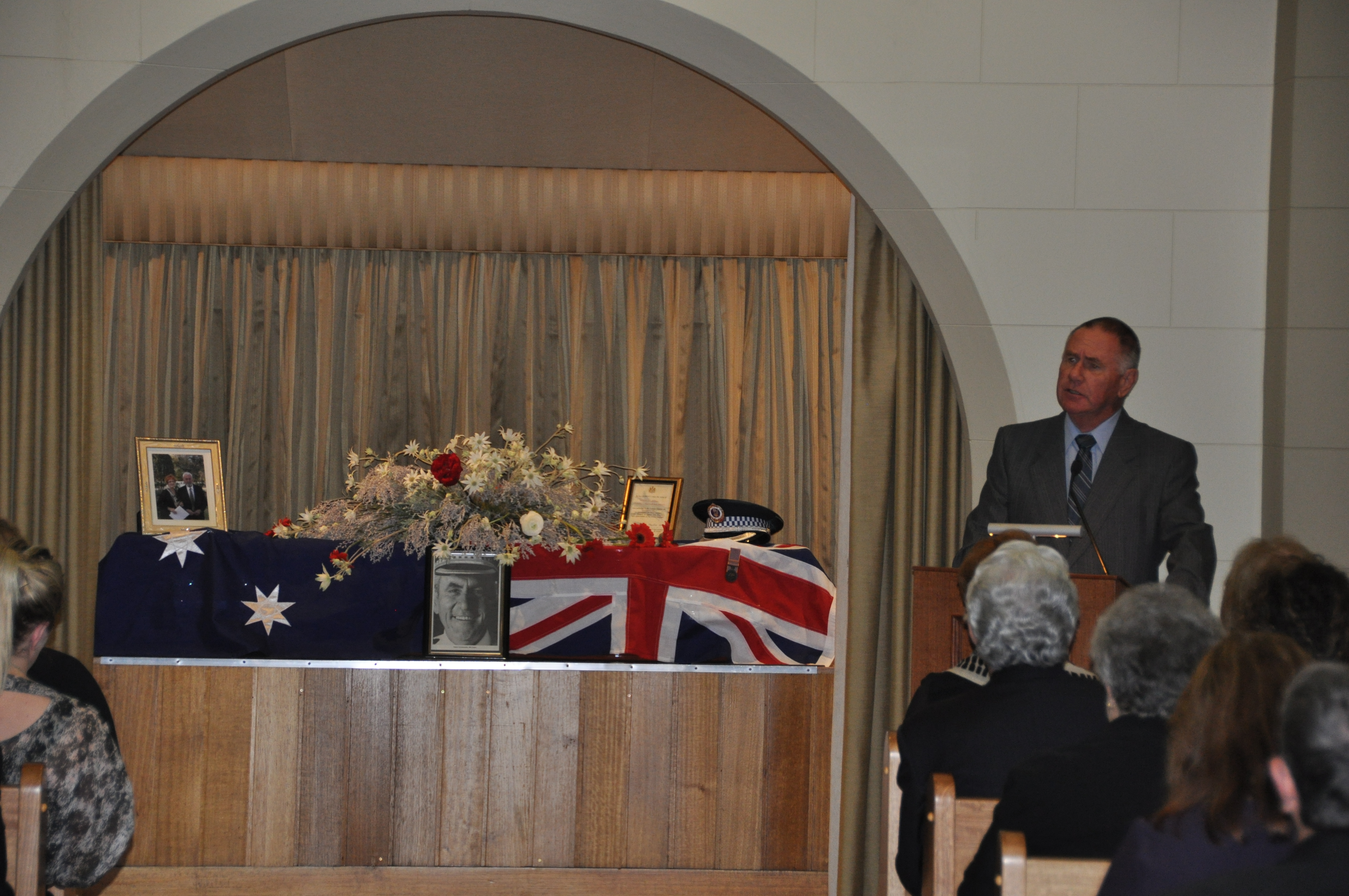
WEDNESDAY 28 SEPTEMBER 2011
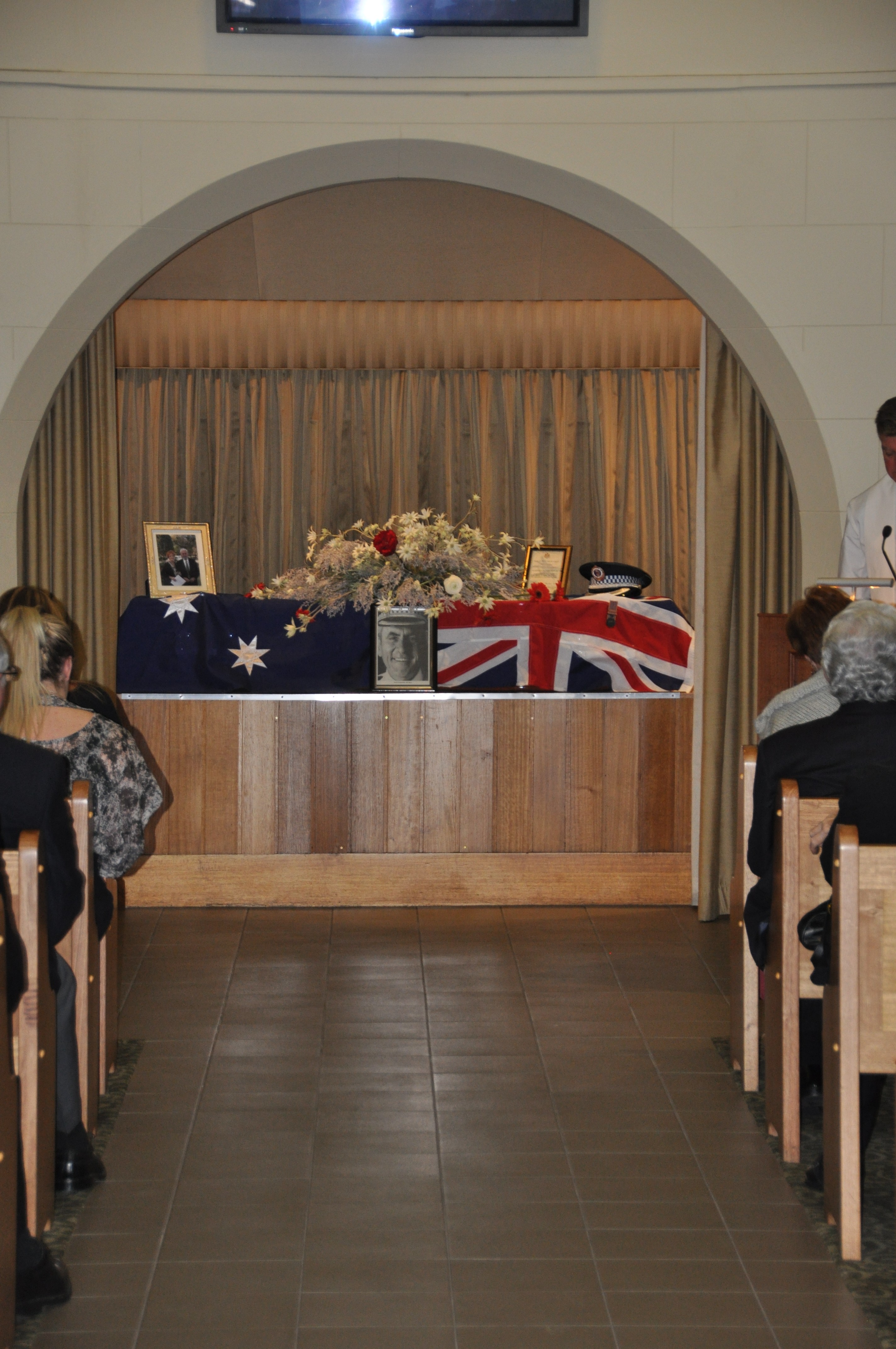
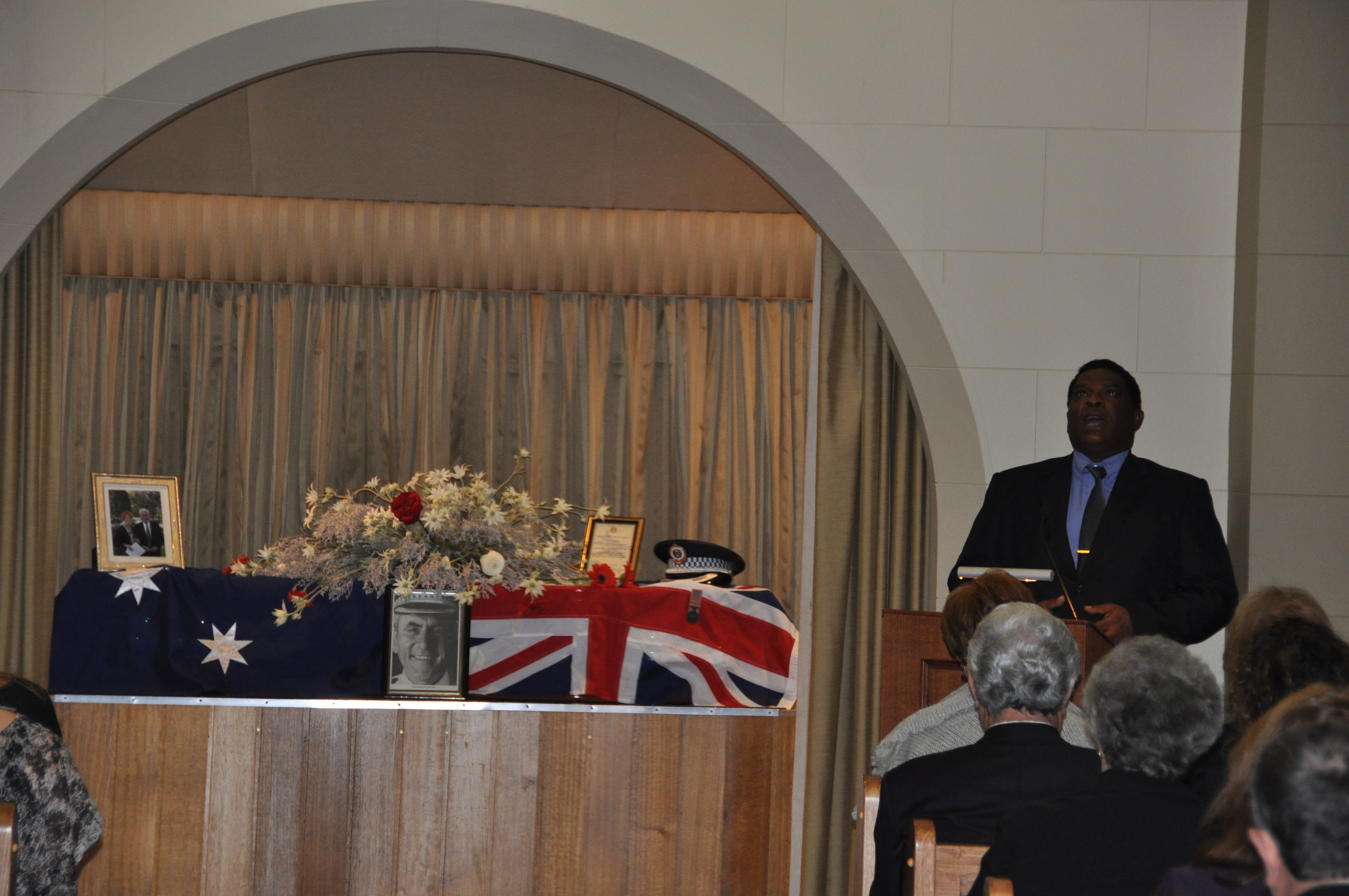
CREMATION CEREMONY FOR RETIRED CHIEF INSPECTOR WILLIAM ‘BILL’ LEONARD ESPIE. Born 250635 – 220911
SERVICE AT THE SOUTH CHAPEL, ROOKWOOD CREMATORIUM, ROOKWOOD, 10.30AM.
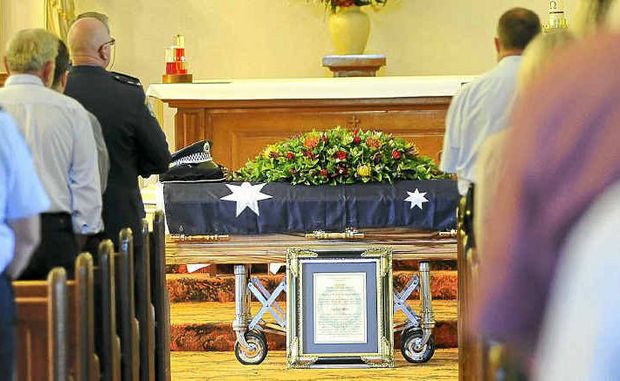
POLICE FUNERAL.
RETIRED POLICE COMMISSIONER KEN MORONEY GIVING THE EULOGY.
Bastion of culture and community October 15, 2011 .
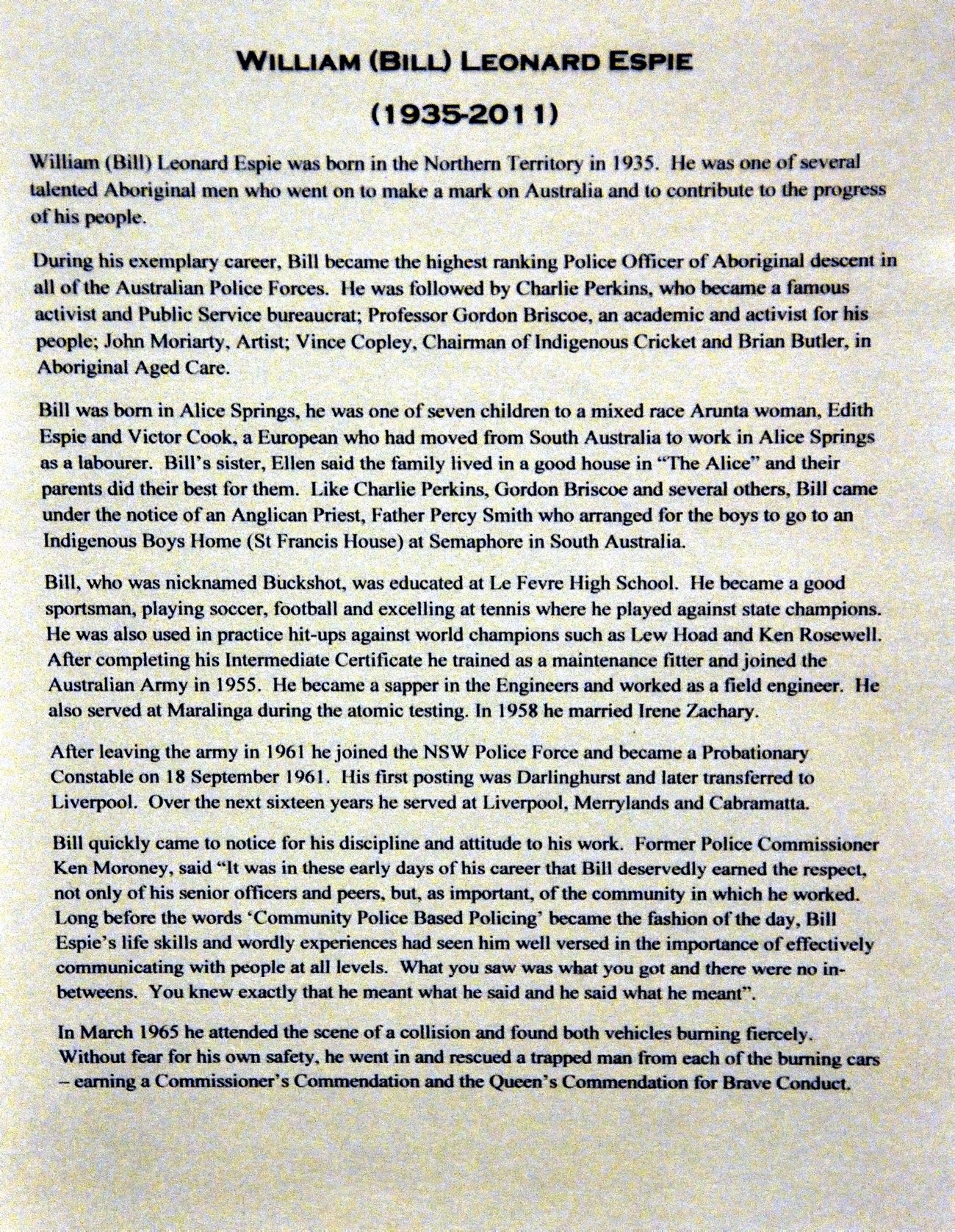
Bill Espie was one of several talented Aboriginal men born in the Northern Territory in the mid- to late 1930s who went on to make, each in his own way, his mark on Australia and to contribute to the progress of his people. Espie was the first, destined for an exemplary police career in which he became the highest-ranking police officer of Aboriginal descent in all the Australian police forces. He was followed by Charlie Perkins, who became a famous activist; Professor Gordon Briscoe, an academic and activist for his people; the artist John Moriarty; Vince Copley, chairman of Indigenous Cricket; and Brian Butler, in Aboriginal aged care.
William Leonard Espie was born in Alice Springs on June 25, 1935, one of seven children to a mixed-race Arunta woman, Edith Espie, who was part of the stolen generation, and Victor Cook, a European who had moved from South Australia to work in Alice Springs as a labourer.
Espie’s sister Ellen said the family lived in a good house in Alice Springs and their parents did their best for them. Like Perkins and Briscoe and several others, Espie came under the benign influence of an Anglican priest, Father Percy Smith, who arranged for the boys to go to St Francis House at Semaphore in Adelaide, an indigenous boys’ home.
Espie, known then as Buckshot by the boys, went to school in Port Adelaide and showed himself to be an outstanding tennis player, facing at one time Lew Hoad and Ken Rosewall. He completed his Intermediate Certificate, then trained as a maintenance fitter.
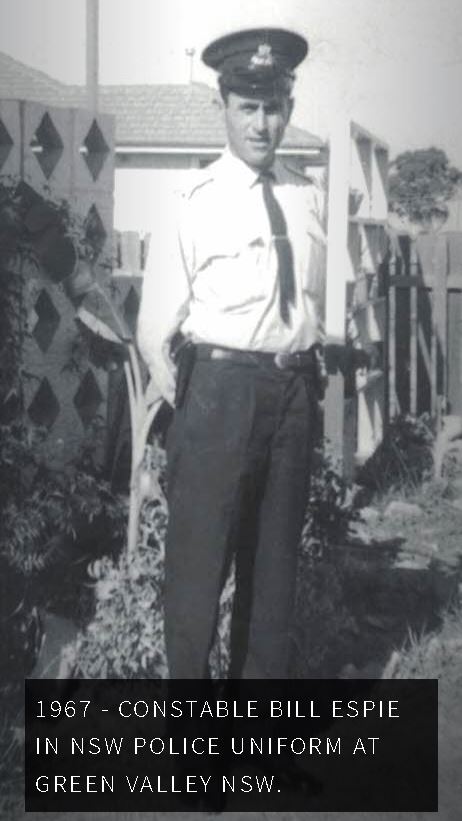
In 1955, he joined the Australian Army, became a sapper in the engineers and was appointed a field engineer. He served at Maralinga during the atomic testing. Along the way, he married Irene Zachary and served in the army until 1961. At 26, Espie decided to go to Sydney. He entered the NSW Police Force as a recruit and did his training at the Redfern academy, where he was noted as ”a good all-rounder”.
He became a probationary constable on September 18, 1961. Assigned for 12 months to Darlinghurst, he experienced a profound culture shock – the place could have not been more different from Alice Springs – but he managed the situation and was then transferred to Liverpool.
During the following 16 years, he was to serve there, at Merrylands and Cabramatta.
Espie quickly came to notice for his discipline and attitude to his work. Former police commissioner Ken Moroney said: ”It was in these early formative days of his career that Bill deservedly earned the respect not only of his senior officers and peers but, as important, of the community in which he worked. Long before the words ‘community-based policing’ became the fashion of the day, Bill Espie’s life skills and worldly experiences had seen him well versed in the importance of effectively communicating with people at all levels. What you saw was what you got and there were no in-betweens. You knew exactly that he meant what he said and he said what he meant.”
What Espie did in practical terms did not escape official notice either. In March 1965, he went to the scene of a collision and found both vehicles burning fiercely. Without hesitation, he went in and rescued a trapped man from each of the burning cars. For that, he earned a Commissioner’s Commendation and the Queen’s Commendation for Brave Conduct.
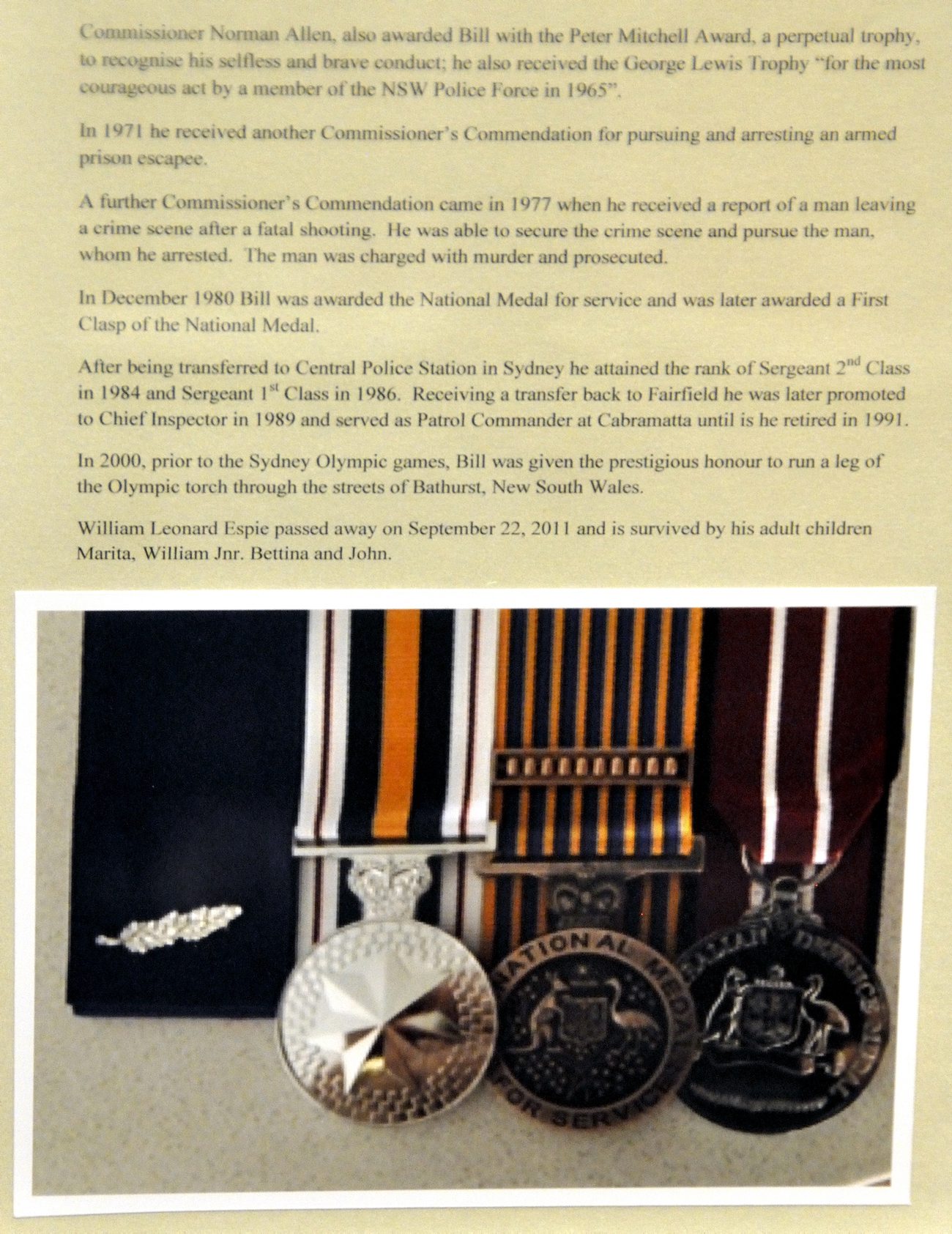
Commissioner Norman Allen also awarded him the Peter Mitchell Award, a perpetual trophy, to recognise his selfless and brave conduct. On top of that, he received the George Lewis Trophy ”for the most courageous act by a member of the NSW Police Force in 1965”.
In 1971, he received another Commissioner’s Commendation for pursuing and arresting an armed prison escapee.
A further Commissioner’s Commendation came in 1977 when he received a report of a man leaving a crime scene following a fatal shooting at Cabramatta. He was able to secure the crime scene and pursue the man, whom he arrested. The man was charged with murder and prosecuted.
In December 1980, Espie was awarded the National Medal for service and was later awarded the First Clasp of the National Medal.
Transferred to Central Police Station in the city, he became a sergeant second class in 1984 and sergeant first class in 1986. Arranging a transfer back to Fairfield, he continued performing well and, in February 1989, became a chief inspector. He served as patrol commander at Cabramatta until his retirement in April 1991.
Bill Espie is survived by his long-term partner, Maureen Ola, brothers Robert and Linton, sisters Ellen and Peg, his children Marita, William junior, Bettina and John, 11 grandchildren, great grand-daughter Sienna and nephews and nieces.
Bill Espie: Police hero from Alice Springs
By JOHN P McD SMITH
Bill Espie, born in Alice Springs in 1935, holds the unique distinction of being the highest-ranking Aboriginal police officer in any Australian police force.
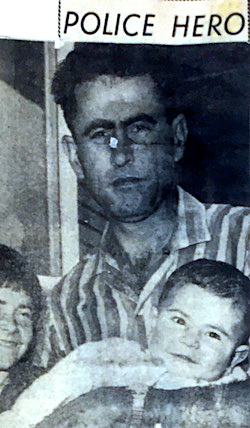
In March 1965 he attended a two vehicle collision with both vehicles on fire.
He rescued a man from each burning car, putting his own life at distinct risk.
For this act of bravery Bill was awarded the Queen’s Commendation for Brave Conduct as well as the Commissioner’s Commendation.
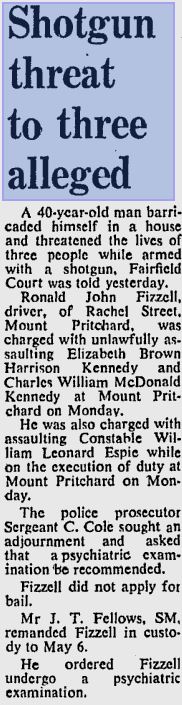
1965 Newspaper clipping reporting on Bill Espie’s heroic act to save two men for which he was awarded the Queen’s Commendation for Brave Conduct
Bill’s mother Edie Espie was one of a group of Aboriginal women in Alice Springs who wanted their children to have a better chance in life.
Others like her were Hetti Perkins, Dido Cooper, Tilly Tilmouth, Melva Palmer and Millie Woodford who accepted assistance from Father Percy Smith to help further the education of their children at St Francis’ House in Adelaide.
All these mothers had one thing in common, and that was their determination to do the best for their children. They were strong women.
Bill Espie’s nickname was “Buckshot” or “The Wasp”. All the Aboriginal boys who lived at St Francis’ House had nicknames.
Peter Tilmouth was called “Truck” because every Saturday he would go with the local greengrocer doing deliveries in his truck.
David Woodford was known as “Woody”.
This is Bill Espie’s account of his life. He passed away on September 22, 2011.
John P McD Smith
1976 Bill Espie standing next to Father Smith celebrating his 50 years of ordination – Charlie Perkins on far left next to Mrs Smith – Noel Hampton and David Woodford on far right
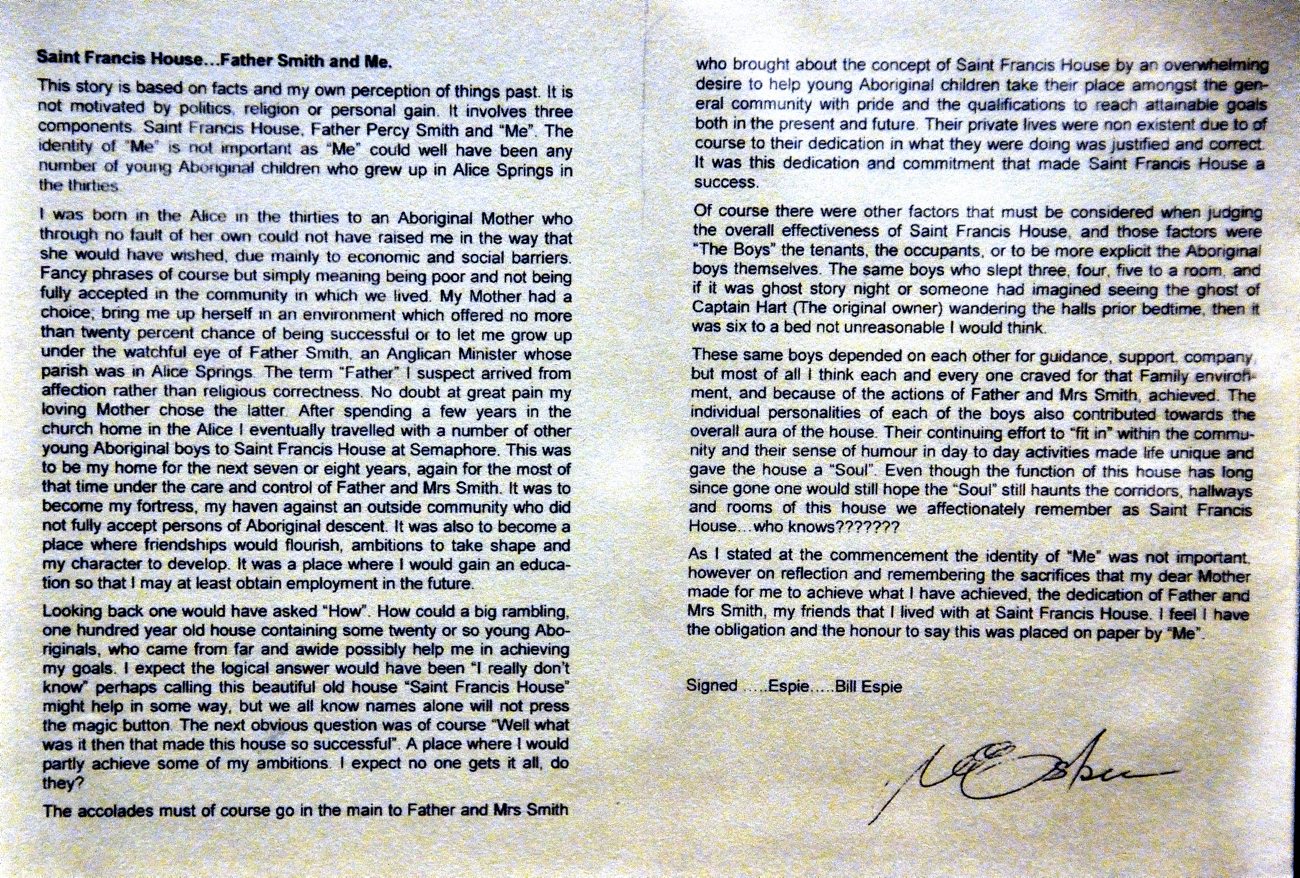
This story involves three components, St Francis House, Father Smith and Mrs Smith and me.
The identity of “me” is not important as “me” could well have been any number of young Aboriginal children who grew up in Alice Springs in the thirties.
My Aboriginal mother, through no fault of her own, could not have raised me in the way that she would have wished, due mainly to economic and social barriers.
Fancy phrases of course, but simply meaning being poor and not being fully accepted in the community.
My mother had a choice; bring me up herself in an environment which offered no more than a twenty percent chance of being successful, or to let me grow up under the watchful eye of Father Smith who was the first resident Anglican priest in Alice Springs in 1933.
No doubt at great pain my loving mother chose the latter.
After spending a few years at St John’s Hostel in Alice Springs, I travelled with five other young Aboriginal boys to St Francis’ House a Semaphore.
This was to be my home for the next seven or eight years, again for most of the time under the care of Father and Mrs Smith.
It was to become my fortress, my haven against an outside community who did not fully accept persons of Aboriginal descent.
It was also to become a place where friendships would flourish, ambitions take shape and my character develop. It was a place where I would gain an education so that I may at least obtain future employment.
Looking back one would ask, how? How could a big rambling one-hundred-year-old house containing some twenty or so young Aboriginals, who came from far and wide, possibly help me in achieving my goals?
I expect the logical answer would have been: “I really don’t know.”
Perhaps calling this beautiful old house “St Francis’ House” might help in some way, but we all know that names alone will not press the magic button. The next obvious question was of course: “Well, what was it then that made this house so successful?” A place where I would achieve some of my ambitions.
The accolades must of course go in the main to Father and Mrs Smith who brought about the concept of St Francis’ House by an overwhelming desire to help young Aboriginal children take their place amongst the general community with pride and qualifications to reach attainable goals both in the present and future.
Their private lives were non-existent due of course to their dedication in what they were doing was justified and correct. It was this dedication and commitment that made St Francis’ House a success.
Of course there were other factors that must be considered when judging the overall effectiveness of St Francis’ House.
Those factors were “the boys”, the occupants or to be more explicit the Aboriginal boys themselves.
The same boys who slept three, four, five in a room; and if it was a ghost story night or someone had imagined seeing the ghost of Captain Hart (the original owner) wandering the halls prior to bedtime, then it was six to a bed – not unreasonable I would think!
These same boys depended on each other for guidance, support, company; but most of all I think each and every one craved for that family environment, and because of the actions of Father and Mrs Smith it was achieved.
The individual personalities of each of the boys also contributed towards the overall aura of the house. Their continuing effort to “fit in” within the community and their sense of humour in day to day activities made life unique and gave the house a “soul”.
Even though the function of this house has long since gone one would still hope the “soul” still haunts the corridors, hallways and rooms we affectionately remember as St Francis House … who knows?
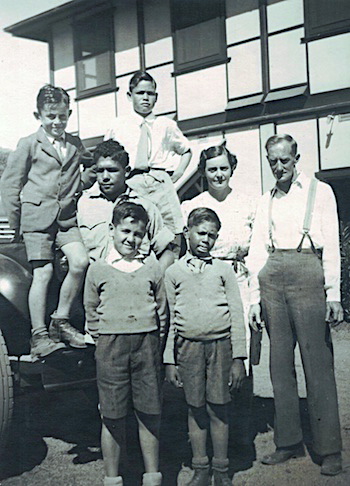
Group of boys ready in Alice Springs in 1944 – Bill Espie, John Palmer (Back), Noel Hampton, Charles Perkins, Malcolm Cooper (standing in front or Mrs Smith), Mrs Isabel Smith, Father Percy Smith
John P McD Smith picks up the story.
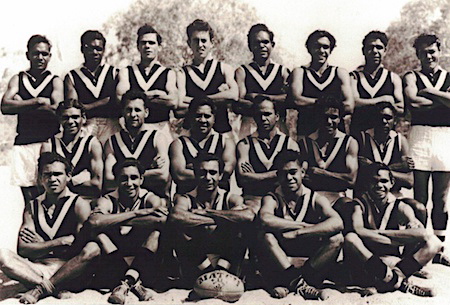
1950s Aboriginal Football Team Alice Springs: Bill Espie in back row 4th from left
After completing his Intermediate Certificate at Le Fevre Boys High School Bill Espie trained as a maintenance fitter. For a short time he returned to Alice Springs to be with his family, but he soon realised that there wasn’t much of an employment future for him there.
In 1955 he joined the Australian Army and was appointed a field engineer.
He served at Maralinga. The world was opening up to him.
After his marriage to Irene Zachary, Bill decided to go to Sydney where he was accepted into the NSW Police Force.
He trained at the Redfern academy becoming a probationary constable in 1961. During his career Bill served at Darlinghurst, Liverpool, Merrylands and Cabramatta.
He became an effective communicator as a police officer and was very good at dealing with different types of people and situations.
After rescuing the two men Bill merely said: “There wasn’t time to think, I just had to get the men out.” They were saved from a firey death.
His commendations, which also included the Peter Mitchell Award, in 1971 Bill received another Commissioner’s Commendation for pursuing and arresting an armed escapee.
Towards the end of his career Bill was awarded the National Medal for meritorious service to which later was added the First Clasp.
By 1986 Bill was a sergeant first class. Then in 1989 he became a Chief Inspector and served as patrol commander at Cabramatta until his retirement.
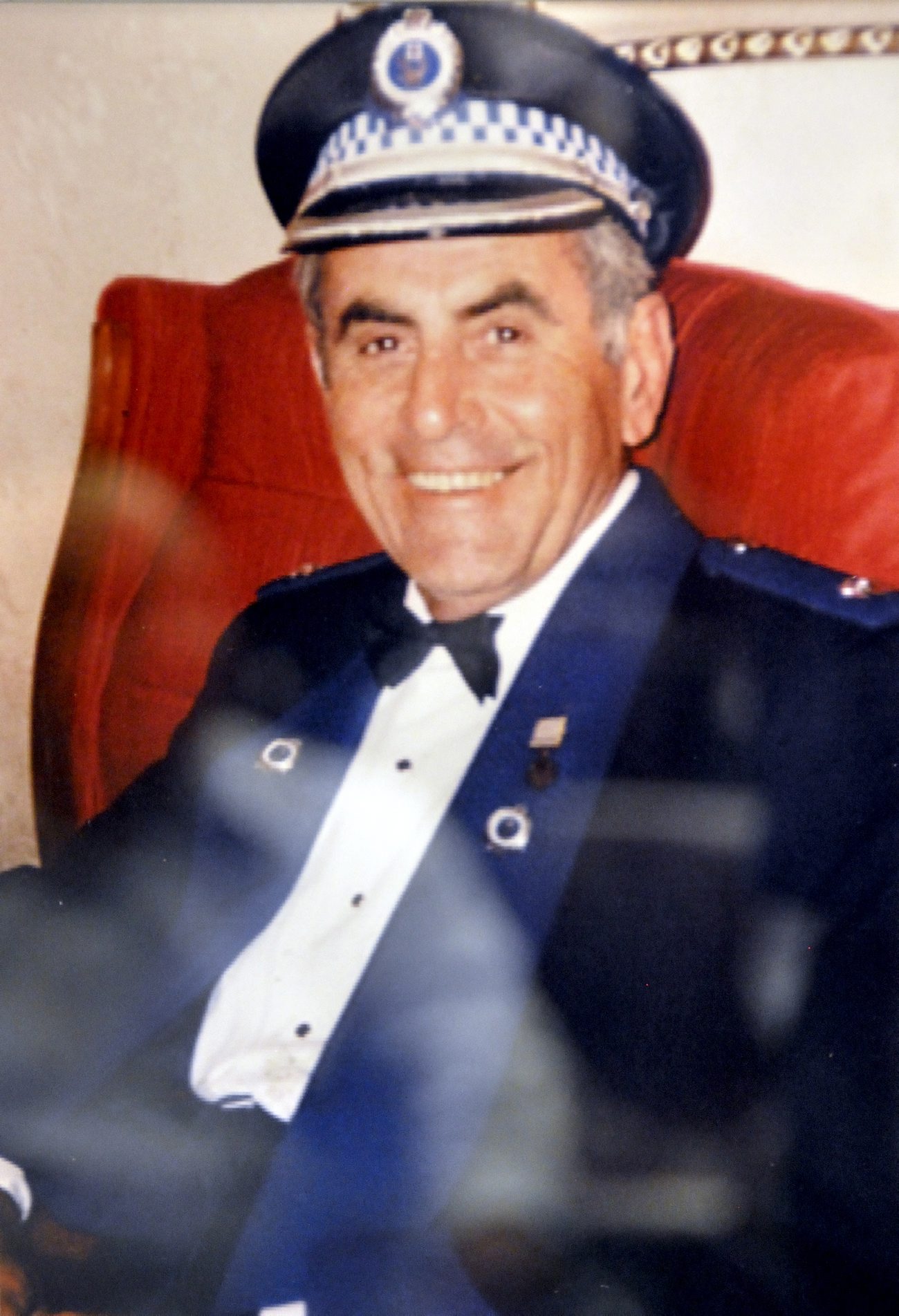
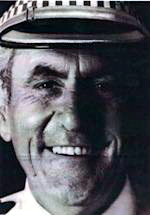
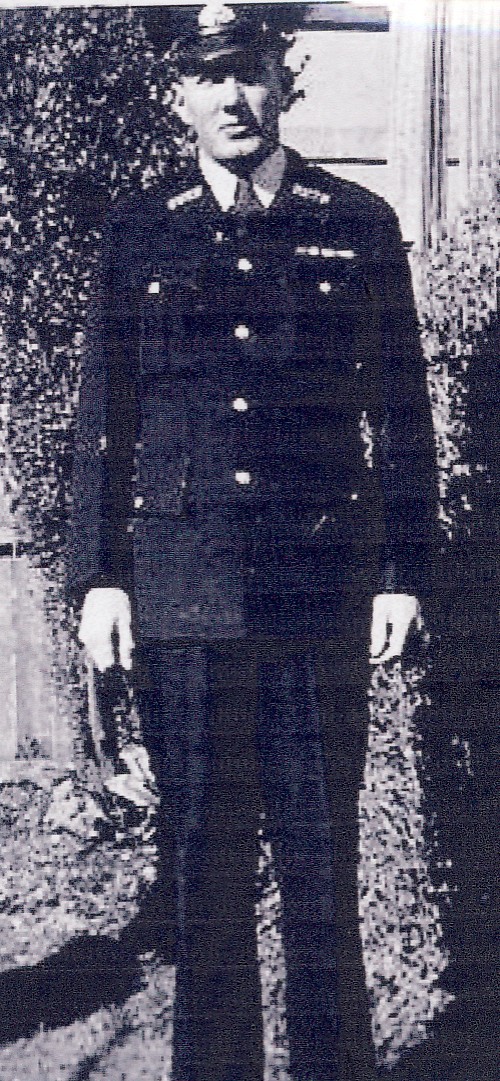
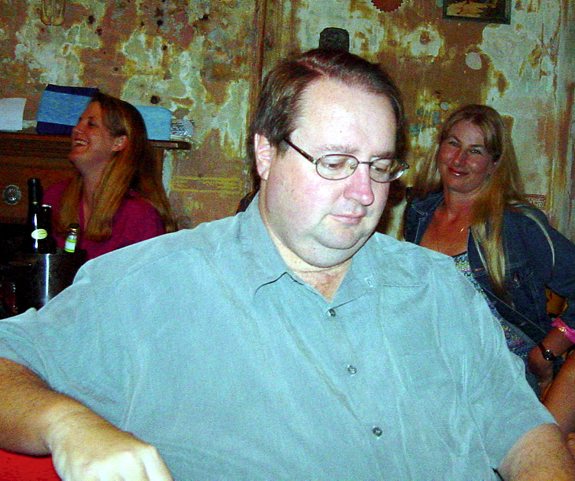
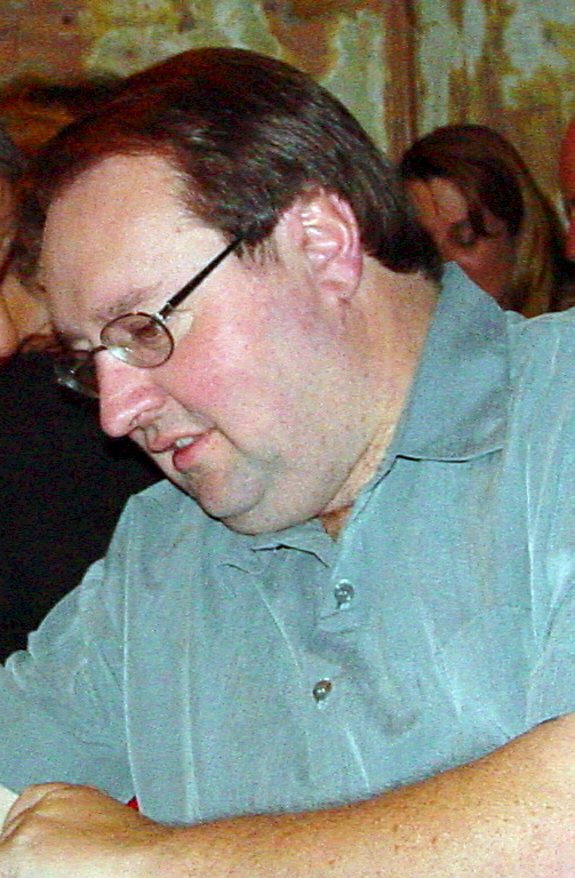
Chief Inspector Bill Espie
He deeply appreciated the chance he was given in life, which was manifested by his exemplary service. Much of his memorabilia is on perpetual display at the NSW Police Academy at Goulburn. He passed away in September 2011.
John P McD Smith is the son of Father Percy Smith (1903-82), first resident Anglican priest in Alice Springs in 1933. John has written his father’s biography, “The Flower in the Desert.”]
Posted: April 5, 2019 at 8:48 am
4 Comments (starting with the most recent)
NB: If you want to reply to a previous comment, start your comment with this notation: @n where n is the number of the comment you want to reply to.
Dwayne
Posted April 11, 2019 at 9:20 am
Enjoyed this story and the footy team photo is great. Would love to know who some of the other players are – if anyone around town knows.
James T Smerk
Posted April 5, 2019 at 4:12 pm
What a bloke. A life well lived.
Nathan
Posted April 5, 2019 at 9:51 am
Bill lived a life of service to the community. I think his own words are very strong: “My mother had a choice; bring me up herself in an environment which offered no more than a twenty percent chance of being successful, or to let me grow up under the watchful eye of Father Smith.”
Inspiration
Posted April 5, 2019 at 9:49 am
What a great story, Father Smith did a lot for the local Indigenous people here in the Alice.
My brother was one who went to Adelaide, Peter Tilmouth.
All the boys taken, all became great mates.
The Espie family was well respected here in the Alice and what an honour to have this man Bill Espie recognised, letting others know of his achievements. A story worth mentioning.
Constable William Leonard Espiewas awarded the Queen’s Commendation for Brave Conduct and Departmentally commended for initiative and courage displayed in effecting the rescue of two men from motor vehicles which had collided at Cabramatta on the 18th March, 1965. Both vehicles were burning fiercely and one was in immediate danger of exploding when the Constable, standing in burning petrol, succeeded in extricating the two men from their respective vehicles. Within seconds of the rescue one vehicle became a blazing inferno.
Bill Espie was born in Alice Springs. He was in the Army for six years and remained in Sydney upon completing his service. He joined the Police Force in 1961.
Interviewed by Shirley McLeod 5th September 2005
Shirley McLeod: Good morning Bill. Bill Espie: Good morning Shirley.
Thank you very much for giving us your valuable time.
Bill Espie: My pleasure.
Shirley McLeod: First of all I’d like to ask you, what’s your full name?
Bill Espie: My full name is William Leonard Espie, E-S-P-I-E.
Shirley McLeod: And what suburb do you live in?
Bill Espie: I live in Croydon.
Shirley McLeod: Croydon, right. I’ll just go a little bit into your early life. I see here that you were born in Alice Springs, were you?
Bill Espie: Yeah I was, yes. I was born, strange as it may seem, in a tent outside the Alice Springs hospital back in 1935.
Shirley McLeod: And what were your parents doing there?
Bill Espie: Mum was a general hand, a cook, she had many jobs. When she grew up there as a young girl, there was about a hundred people in Alice Springs and that was about it. So — my father was a grader driver in the bush.
Shirley McLeod: Right. Now, you went to Alice Springs Primary School and then you went to La Favure Tech College, that’s in Alice Springs is it?
Bill Espie: No, the Tech College is in Adelaide. The schooling in Alice Springs was very limited when I was growing up. You only had a primary school, no high school.
Shirley McLeod: And what, you would have gone to it at the age of 15 or 14?
Bill Espie: 15, 16… 15.
Shirley McLeod: And what did you do at Tech?
Bill Espie: It was a different type of Tech as they know now. It was just a high school but they called it a Technical College.
Shirley McLeod: Well we had some in Sydney, Technical College. We had North Sydney Technical, Boys Technical High School I think it was called.
Bill Espie: Usually you had to get your intermediate at those schools.
Shirley McLeod: Yes. So you did that in Adelaide?
Bill Espie: Did that in Adelaide.
Shirley McLeod: And you stayed there and you got the equivalent to your intermediate certificate?
Bill Espie: Yes.
Shirley McLeod: And what did you do after that?
Bill Espie: Well then I went back to Alice, worked as a fitter in the Department of Roads for four years prior to joining the Army.
Shirley McLeod: And where did you join up in the Army?
Bill Espie: I joined in Adelaide. So I went from — stayed in Adelaide for a couple of years and then I was fortunate enough to go to Maralinga where the atom bomb tests and came back to Sydney and stayed here for the rest of my six years.
Shirley McLeod: Right. What sort of work were you doing in the Army?
Bill Espie: I was in the engineers. So it’s like an Engineering Corp that I was in.
Shirley McLeod: All right, well we’ll get to the Police Force. Why did you decide to join Police Force?
Bill Espie: Again, it was just a change of direction. Six years in the army seemed to be long enough for me. And it wasn’t quite what I wanted so someone suggested to me why don’t you join the Police Force, well, I will. So I joined the police and never regretted it.
Shirley McLeod: Where did you join up?
Bill Espie: At Bourke Street in the City.
Shirley McLeod: Is that where the Mounted Police are now?
Bill Espie: Yes.
Shirley McLeod: I’ve been there a couple of times. And you did your training there didn’t you in those days?
Bill Espie:Yes, I done six weeks. I was lucky to get in actually because when I, when I came to the office, the sergeant that was behind said to me, ‘hop up on the scales.’ I was three pound light. And he says, ‘we can’t take you.’ And I said, ‘well I’m fit enough, I just left the Army.’ He said, ‘no you gotta have the right weight.’ but he said, ‘I’ll tell you what you do.’ He said, ‘come back and see me at 3 o’clock,’ this was obviously in the morning, it was in morning. ‘Come back and see me, but in the meantime go down to that fruit shop down in Bourke Street and eat 20 bananas.’ This is a true story. ‘Eat 20 of bananas,’ and he said, ‘then go to a tap and a drink as much water as you can until you start to be sick.’ I thought he was joking. He said, ‘do it if you want to join the Police Force.’ So I did, I ate 20 bananas, this was over about a two-hour period. Drank so much water out of this tap, I was bloated, looked like I was pregnant, went back and seen the sergeant and I tipped the scales at three and a quarter pound. He said, ‘you’re in.’
So — and the bananas (.. unclear ..) with me for a fortnight.
Shirley McLeod: Oh dear. So you did your training and Bourke Street.
Bill Espie:Bourke Street.
Shirley McLeod: And how long were you training there?
Bill Espie:Well in those days it was six weeks initial training and then one day a week for a year. So that’s the way they used to do it back in ‘61.
Shirley McLeod: And the initial training was also shooting?
Bill Espie:You’re shooting, and law…
Shirley McLeod: Hmm. And typing?
Bill Espie:And typing down at Harris Street in the Ultimo, typing. With your fingers underneath a cover that you couldn’t see and couldn’t cheat. But they didn’t want much, only wanted — can’t remember now — but it was some paltry amount of 20 words a minute or something like that.
Shirley McLeod: You’ve done your training, where was your first posting?
Bill Espie:Darlinghurst. I spent two years at Darlinghurst initially.
Shirley McLeod: Was that a culture shock to somebody from…?
Bill Espie:That was a, well I was going to say terrible culture shock, but it wasn’t, it was an interesting culture shock. Being smothered in Alice Springs in the quietness of the bush and then hitting Darlinghurst — when Darlinghurst was Darlinghurst — it was a shock but a nice one. For me it was interesting.
Shirley McLeod: Where was the Police station in Darlinghurst?
Bill Espie:Right opposite the Court of Sessions Court in Taylor Square.
Shirley McLeod: All right. Cabramatta. How did feel, the first time you came to Cabramatta, you’ve come from Fairfield anyway so you knew it fairly well. Cabramatta didn’t have such a bad name in those days did it?
Bill Espie:No, I think no. It had a, you know, it was just a normal suburb. Policing wise it was just a normal suburb. Because when I first came there were a lot of nationalities, English, Spanish you know. They had a big — in Aleck Street Cabramatta, they had a big migrant hostel where there was quite a number of nationalities living there.
Shirley McLeod: They were a mixed nationality then, were they? What year would that have been about ‘57?
Bill Espie:That was in ‘65, ‘63-‘65. There must have been 10, 12 nationalities living in the hostel. They had the old army huts for accommodation.
Shirley McLeod: Did you have problems there, did the police, were the police called in there very often?
Bill Espie:Strange as it may seem, no. No, it was well run. The people were intermingling with one another. Occasionally you’d get a fight caused by different nationalities, but very rare, very rare.
Shirley McLeod: But Cabramatta was, in later years became very much different and you were here working at the time that the south-east Asian migrants came in here.
Bill Espie:No I was here for… didn’t… in the last three years of my working with the police, that’s when they were here in Cabramatta. Say from — I didn’t take too much notice of it because I wasn’t, until I became the officer in charge, I wasn’t sort of really aware of the extent that we had. So that was in 19… say, 1987, ‘88. It was starting to become noticeable that it was gonna be an Asian suburb so to speak.
Shirley McLeod: How did that affect you?
Bill Espie:I don’t think it really affected me that much because we, we didn’t get an over problem for the first couple of years. There were minor skirmishes, minor problems that could be solved there and then on the spot. Didn’t hit the news as much as it did when the drugs were involved in Cabramatta. So we hardly ever hit the newspapers for the first two or three years that I knew. And then all of a sudden it started to change. That’s when them drugs started to come in and I was lucky enough you know, I retired prior to that occurring.
I was at Cabramatta when we only had a little call box you know, a little seven by seven (feet) box.
Shirley McLeod: Where was that?
Bill Espie:There were four of us stationed.
Shirley McLeod: There was one at Fairfield like that before the police station was built. There was one here at Cabramatta too?
Bill Espie:Yes. Cos when I first came in ‘63, you might know — one the people you’ve interviewed, Baz Lawler — he was there a (.. unclear ..)..
I haven’t interviewed him yet, I’m going to.
Bill Espie:And, it was a little call box, seven by seven (feet). And when it rained you’d get wet, it would come in underneath the floorboards, you know. We were in that for about two or three years. But there was only four of us then, that was in ‘63 to about ’70, then the police started to come and things started to improve. The more police came the more improvements we had.
Shirley McLeod: Have you had, I suppose you’ve had some very funny incidents over your many years as a policeman. Can you remember anything specifically?
Bill Espie:Oh yes.
You don’t have to mention names if you don’t want to, just incidents.
Bill Espie:I think the funniest episode was I was on my way to work when I lived in Liverpool and coming to the intersection, this car was on my right and I noticed two people sitting in the car with ski masks on. And being very astute I thought, well that’s funny, it’s hot (laughs). So, they had, they were both holding what appeared to be shot guns and I stopped to give way to ‘em, because I couldn’t believe my eyes. This was about 10 to 3 (2:50pm) in the afternoon, going to work, afternoon shift. So they turned the corner and stopped a hundred yards up the road outside the Post Office and they both bounded out and sure enough, they both had shot guns. So, I had an old car, an old the Gemini that could hardly run and it was famous around the police and they all knew it was mine. So I stopped just behind this car containing the crooks, so to speak and I said, I’ll nab thee when you come out of the Post Office. But I had another bad habit of leaving my gun at home and I realised when I stopped my car and took position behind my car, I didn’t have a gun. So I said, I’m not going to be a fool, I’ll race across the street and ring for the police to come. By this time they’d come out of the Post Office with bags. So I got… raced back to my car, they had an old car as well and they couldn’t start it.
Shirley McLeod: You hadn’t fixed it?
Bill Espie:No, but they couldn’t start their car. Their car was an old bomb too. You know, real brainy armed robbers. So I said, I’ll have thee now. Then their car roared into life, so I got back into my car, I said, I’ll follow you. My car wouldn’t start because it was a bomb.
Shirley McLeod: Sounds like comic capers.Bill Espie:Comic capers. And finally it kicked over, their car kicked over, they put it into gear and somersaulted, you know how you jack-knife down the street? And here are these two crooks getting away from me, jack-knifing down the street. I’m in my car jack-knifing after them, we must have done it at no more than 10 kilometres an hour. And in the end my car just blew — just stopped. The engine blew it was so old. They went down the street getting away from me and when they got to the corner they put the old forefinger up into the sky towards me and turned the corner. I was more insulted by the actions of the finger than the robbing.
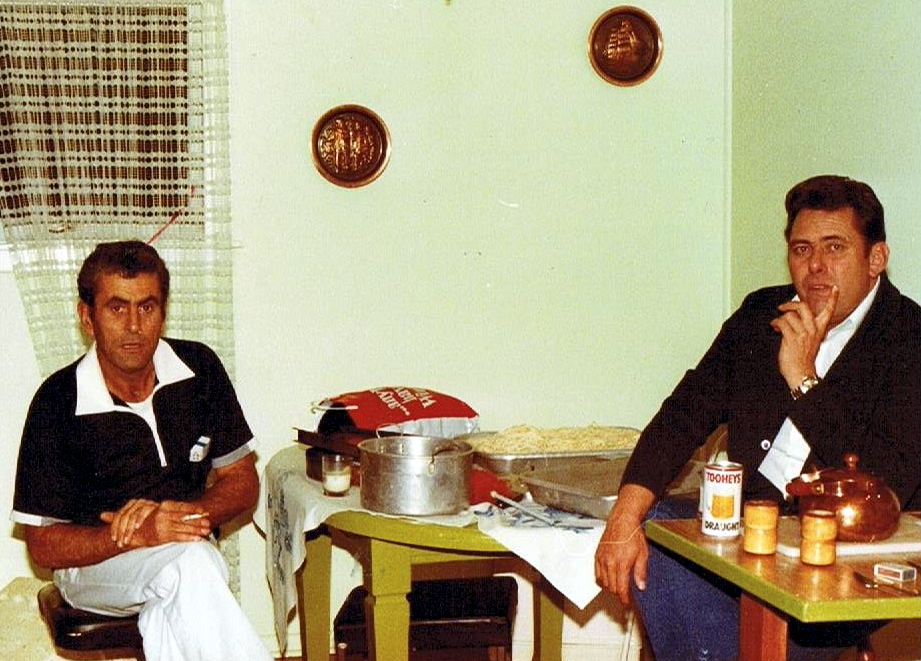
Bill Espie and Alf Gregory at Bill’s place in 1981
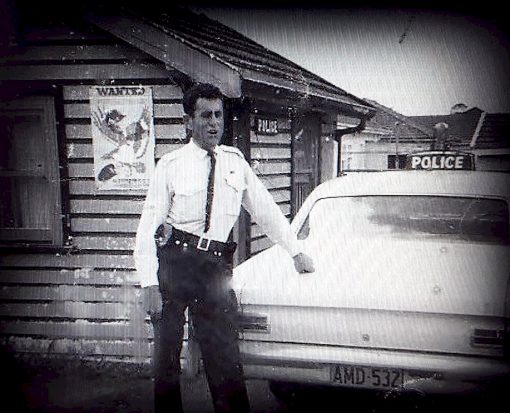
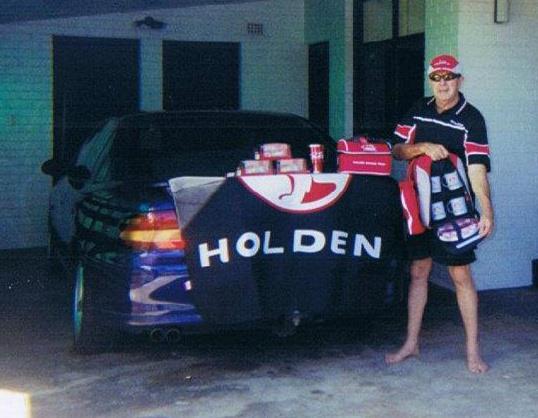
From Peter Croucher The original Cabramatta Police Station in 50s 60s early 70s. It was a call box in it’s time with barely enough room for three police. When I was stationed there in 1968, Sgt Bill Turner was the boss, Bill Espie, pictured above, had not long received the Police Medal for Bravery. If we were lucky to have an afternoon shift, the day shift would walk outside to let the others in. If it rained we’d sit on the bench desk with our feet on the chair so’s we could keep our feet dry from the rain water running across the floor. Peter C
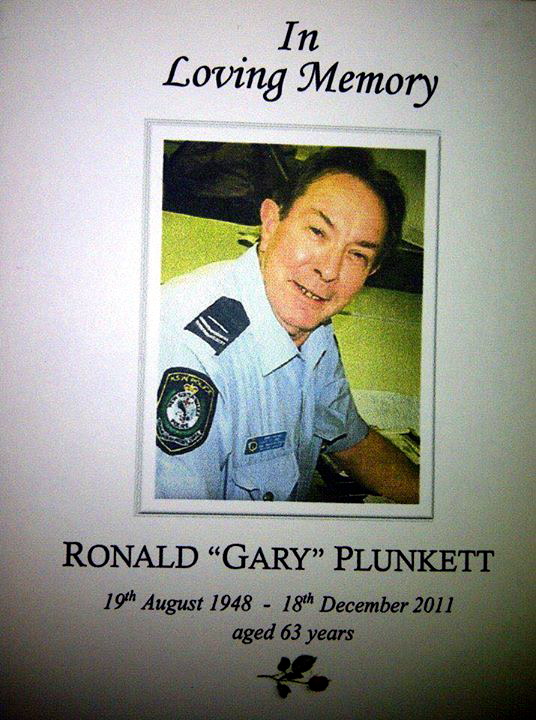
Ronald Gary PLUNKETT
| 23/10/2015
Ronald Gary PLUNKETT
aka Gary & Plunko
New South Wales Police Force
Regd. # 13877
Rank: Leading Senior Constable
Stations: ?, Campbelltown, Macquarie Field – Crime Management Unit
Service: From ? to ?
Awards: National Medal – granted 10 September 1986
1st Clasp to National Medal – granted 8 November 1995
Born: 19 August 1948
Died on: 18 December 2011
Cause: ?
Age: 63
Funeral date: ?
Funeral location: ?
Buried at: ?
Ronald Gary PLUNKETT
Gary Plunkett. It must be Bathurst time
[alert_yellow]GARY is NOT mentioned on the Police Wall of Remembrance[/alert_yellow] *NEED MORE INFO
[divider_dotted]
Funeral location: ?
[divider_dotted]
Gary, loved his car racing & used to deck his garage out at Bathurst time.
[divider_dotted]
Brian Anthony STAPLES
| 23/10/2015
Brian Anthony STAPLES
New South Wales Police Force
Regd. #8411
Rank: ?
Stations: ?
Service: From ? to ?
Awards: ?
Born: 12/04/1934
Died on: 9 September 2011
Cause: ?
Age: 77
Funeral date: Tuesday 20 September 2011
Funeral location: South Chapel, Woronora Crematorium, Linden Street, Sutherland
Buried at: Cremated
Memorial: Wall of Memories Panel 28, GG, 0083
[alert_yellow]BRIAN is NOT mentioned on the Police Wall of Remembrance[/alert_yellow] *NEED MORE INFO
[divider_dotted]
Funeral location:
[divider_dotted]
Frederick James IMBER
| 23/10/2015
Frederick James IMBER
AKA JIM
Late of?
NSW Police Training College – Penrith Class # Unknown ( prior to Class 001 of March 1947 )
New South Wales Police Force
Regd. # 4989
Rank: Probationary Constable – appointed 21 January 1946 ( aged 21 years, 2 months & 1 day )
Sergeant 3rd Class – appointed ? ? ? ( Liverpool – 22 Division )
Born on the 21st of August 1966 at Liverpool, New South Wales ( go the Blues ), my first couple of years were living at nearby Glenfield where my grandparents ran a bakery. Dad (also Les) was a Baker by trade but had joined the NSW Police in 1966, ( NSWPF # 12662 ) meeting the then arduous entry exam of standing upright, being over 6 foot tall, knowing his left from right and being a reasonably handy footballer. My brother Greg ( NSWPF # 23914 ) was born in February 1968. About two months later my birth mother left us with Dad and we never saw her again. Nowadays you’d say probably post-natal depression or something, back then, none of that was spoken about. My brother and I tried to find her about 20 years ago via the Salvos, mainly out of curiosity and got the message back from them that she didn’t want contact. After she left, Greg and I went to live with our grandparents, as Dad was working shift work. Shortly after that, they retired and we moved to St Georges Basin near Nowra.
The NSW Police being the modern organisation it was in the 1960’s, took pity on Dad, as he had asked for a compassionate transfer to Nowra to be near us, instead sent him to Narrandera, about 500 km west, so we saw him on his days off. Anyway, as luck would have it, a very kind Inspector called Jim Imber worked some magic and after 6 months Dad ended up at Nowra. Jim and Dad became lifelong friends until Jim passed about 10 years ago. Life, as I vaguely remember it back then, was everything a young lad would want, we went fishing a lot, camping, swimming and sports. I started my schooling at St Georges Basin Public School in 1971. In 1972, Dad brought home a young nurse, Irene Dawson, that he’d met at a post mortem, ever the romantic. My brother plonked onto her lap and asked her if she was our new Mummy, that sealed the deal! In 1974 Dad married Mum (she is our Mum in every sense).
Later that year we moved to Rankin Springs in western NSW where Dad was the only police officer. We stayed three years and two baby sisters later, moved to the place I call my home town, Guyra. Dad was the Lock Up Keeper and then promoted to the Sergeant, Officer in Charge. I truly loved my time in Guyra, great town, good people, nothing like those strange Glen Innes or Uralla folks we used to play football against. I left school in 1983 and started work at the Commonwealth Bank. To say banking wasn’t for me is an understatement. However, as I didn’t have my Higher School Certificate I couldn’t join the police, which is what I really wanted to do. I went to TAFE in Armidale three nights a week for two years and got my HSC. In the interim I also had a mobile disco business I did on weekends between playing basketball, cricket, union and league (odd game of soccer as well). I really enjoyed the mobile disco and as Mum used to say, I had a great face for radio. One thing Mum used to make all us kids do was our ironing, share the cooking, housekeeping etc. Really, who did she think she was, just because she worked as a nurse on a 24/7 roster, however when I left home eventually, I was housebroken. I’m quite particular and as Cindy will attest, I still do my own ironing as I’m a bit quirky in where the creases go etc.
In 1986 I applied to join the NSW Police but at the same time was transferred to Broken Hill with the bank as an Assistant Loans Officer. I decided to go as I got to live in the bank barracks, paid $2 a week rent, a cleaner was supplied and $50 a fortnight each the 12 residents which covered food and a keg always on tap. I thought I’ll save a fortune, never saved a cent. A group of us would trip off to Melbourne, Adelaide and all points in between. I did have a great time though! However, in 1987 I was accepted to the NSW Police, what I’ve always wanted to do and started in June 1987, graduating in September 1987. I actually won the public speaking award (hard to believe) for the class of 200, one of my proudest moments was marching out to collect it from the Commissioner, with a salute, in front of my parents, Nan (Pop has passed by then) and family. My Dad, who retired as an Inspector at Lismore in 2003, gave me three bits of good policing advice when I joined. They were never rush to a fight at a Hotel, never beat the Ambulance to a traffic accident and get a signature no one can read!
When at the NSW Police Academy, all Recruits were asked to list three preferences for placement, I put Armidale, Tamworth and Broken Hill. Obviously my choices were considered long and hard by the HR gurus as I was sent straight to Kings Cross! I really had a ball working there, never a dull moment for a bright eyed young Constable from Guyra who had been to Sydney about four times, all to watch my beloved Parramatta Eels play. During that time I’d also met the first Mrs Bulluss and in 1990 transferred to Dareton some 1200km south west of Sydney. Followed that with a posting to Gulargambone, back to Kings Cross and finally Warialda. Not much to say except the marriage produced four beautiful children of whom I’m extremely proud. They all moved to the Gold Coast when the marriage ended and I decided if I wanted to see my children, I’d better move to Queensland.
I joined the Queensland Police in 2000 and was stationed at Broadbeach. I then went to the Police Beat at Robina Town Centre where I worked with Peter Venz who was the Broadbeach GSE member for 2003. He introduced me to Col Makin, two months later I was jetting off to India and Nepal on my life changing GSE experience in 2004. About the same time Cindy and I became an item and in 2005 we were married. I was promoted to Sergeant at Broadbeach in 2005. In 2006, I’m sure you’d all remember the episode, I was a contestant on Temptation (the new Sale of the Century). One episode only, I knew most of the answers but the carry over champ and eventual winner of the lot knew them quicker than me! That wasn’t my first foray into games shows, in 1997 I was the carry over champ on the Channel 7 show Concentration, where I ended up winning a reverse cycle air conditioner and a year’s supply of dog food. The dog thought the food was crap, it certainly was able to turn it into great piles of crap at a great rate of knots, I ended up binning the food and sold the air conditioner via the Trading Post.
In 2008 I was promoted to Senior Sergeant Officer in Charge of Thursday Island in the Torres Strait, one of the greatest gigs in Australian Policing. From Saibai Island 5 km from PNG to the eastern Murray Island, the traditional home of Eddie Koki Mabo and all points in between, it was the most enjoyable operational policing I’ve ever done. To help police the division, the only one in Australia that has an international border, we had a plane, several boats, an MOU with Customs regarding free use of their helicopters and the best Esprit des Corps among all services that I’ve ever seen. The Torres Strait Islanders are an extremely generous, traditional and happy people. Catching a fish was not a hard skill to master either, generally a line in the water saw a fish on the end, sometimes a monster. In May 2008 I was inducted into the Thursday Island/Torres Strait Rotary Club, at our peak we had 12 members but really did some great work in supporting the villagers of the PNG Western Province with clothing and school supplies. I first met Bruce Kuhn in 2008 when he was allegedly my boss, and since then we have enjoyed many a soiree in Cairns or on TI, usually to our detriment the next morning.
In April 2011 I transferred to Gladstone as the Officer in Charge, the shortest time ever for anyone in that role, because two months after starting I went to relieve as the District Inspector and ended up promoted to that job. I had joined the Gladstone Port Curtis Rotary Club (which was men only, not now though). I joined that club (there are several in Gladstone) because Monday nights was the best for me to get to meetings, it is a great club and as with all of Rotary, members belong for the right reasons. The 2013 Queensland Police Service Restructure saw all Commissioned Officers jobs declared vacant, as 120 out of 420 positions had to go. Fortunately, the redundancy offer take up and existing vacancies across the service saw no one being forced out, because for a four-day very stressful period just prior to Christmas in 2012, there was talk that some people would be told don’t come Monday, but it didn’t come to that.
When the musical chairs music stopped, I woke up in my current job from 1 July 2013 as the Queensland Police Service Manager of Community Programs and Engagement. I’m based at Headquarters in Roma Street but really have the best Inspectors job in the QPS. I get to travel a fair bit nationally and internationally, I look after our Crime Prevention Programs, Cultural Support and other areas including the Museum. I am on the board of Neighbourhood Watch Australasia as the Queensland representative. I’m quite happy to stay in this job until I retire.
Regarding Greg’s and my birth mother, in mid 2015 I took a phone call from a guy called Ian Lacy in Victoria. He told me that my birth mother had died and he was married to my half-sister, who until her mother had died didn’t know about Greg and I. It turns out that we have two half-sisters who live in Victoria. Greg and I have both met them, they are really nice and have filled in a lot of gaps for us. It’s good to know where my sons type 1 diabetes, my children’s coeliac and other health issues probably come from, because up until then, we really didn’t know. Pretty sure it was from my maternal grandmother’s side of the family.
Anyway, between Cindy and I we have 6 adult children (3 boys, and 3 girls) and two wonderful grandchildren. As their parents work shifts, we have the grandkids most weekends under sufferance (not really). Three of the children live on the Gold Coast, my son is in Mackay, my eldest daughter is in Melbourne studying social work at RMIT and my second eldest daughter lives in the UK with her Englishman (treason I say).
Life is very good for Cindy and I. We live at Boonooroo Park (Carrara), I’m a very happy member of Broadbeach Rotary, the greatest Rotary Club in the world!
Sergeant Keith Clark, ( possibly # 3640 ) who has been stationed at Broadwater for the past three years, has left for his new station at Coraki.
During his service in Broadwater, he and his wife did good work in the February flood on the Richmond, earning the appreciation of residents of the district…………
Constable Frederick James Imber, accompanied by his wife and family of three, has taken up duty at Broadwater, in succession to Sgt Keith Clark.
Manning River Times and Advocate for the Northern Coast Districts of New South Wales (Taree, NSW : 1898 – 1954),
Wednesday 27 November 1946, page 1
WEDDINGS
PAFF — BURNETT
At the wedding reception of Miss Alma Burnett, and Mr. Oscar Paff, ( # 4790 ) on Saturday afternoon, Oct. 5th, the wedding cake was cut with a Samurai sword, which the bride’s brother, Mr. Max Burnett (ex-RAAF) had brought back with him from New Britain.
Alma is the second eldest daughter of Mr. and Mrs. G. Burnett, of Macquarie St., Cowra, and the groom is the eldest son of Mr. and Mrs. C. Paff, of Krambach.
The ceremony was performed at St. John’s Church of England, by the Ven. Archdeacon Mirrington. The bride, who was given away by her father, was attired in a white gown of self patterned heavy cloque crepe, featuring a heart shaped neckline, ruffled bodice and sleeves, with a very full skirt, ending in a train. Her tulle brocaded veil which was loaned to her for the occasion, was held in place with a halo of white camellias. She carried a shower bouquet of arum lilies and freezias. Her two sisters, Mrs. V. Cooke, of Bathurst, and Mrs. B. Rodwell, of Cowra, were matrons of honor. The former was dressed in a blue crepe gown, the skirt of which was very full. She added a shoulder length veil, held in position with a curvette of roses, and carried a bouquet of roses, ranunculus and mignonette. The latter wore a dusty pink crepe frock with cape sleeves and a full le plum and skirt. Her matching shoulder veil was held in place with a curvette of sweet peas and carnations. She chose similar flowers for her bouquet. The only jewellery worn by the bride was a string of pearls, while the attendants wore pendants with matching ear-rings. Mr. Max Burnett, brother of the bride, carried out the duties of best man, and Mr. Vic Cooke, the bride’s brother-in-law, was groomsman.
A reception was held at the Lyric Hall, where the guests were received by Mrs. Burnett, who was dressed in black, with a shoulder spray of tiger lilies. She was assisted by Mrs. Paff, who was also in black relieved with pink. Chairman at the breakfast was Mr. Hoodless, uncle of the bride. The three-decker wedding cake was made and decorated by Mr. Doug Jackson. Soloist at the wedding was Miss Beryl Thomas, who sang ‘I’ll Walk Beside You.’
An amusing feature at the wedding was that Constable Jim Imber, friend of the groom, who was in the vicinity when the bride’s bouquet was being thrown, caught the bouquet.
The honeymoon is being spent on the North Coast. Their future home will be at Cowra, where the groom is a member of the Cowra Police Force.
Among the guests at the wedding of Miss Alma Burnett and Mr. Oscar Paff were Mr. and Mrs. Hoodless, of Ginjelli; Mr. and Mrs. Con’n. of Hill End; Mrs. Paff and Miss Coral Paff, of Taree; Mrs. Kimm, of Hill End; and Mr. Kevin Rodwell, of Parkes.
Funeral location: North Chapel, Church Yard M, Forest Lawn Memorial Park, Camden Valley Way, Leppington, NSW
Buried at: Forest Lawn Memorial Park, Camden Valley Way, Leppington, NSW
[alert_blue] RONALD is NOT mentioned on the Police Wall of Remembrance[/alert_blue] * NOT JOB RELATED
[divider_dotted]
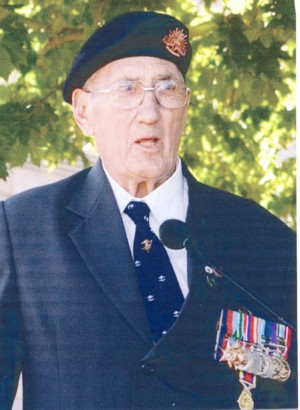
Commando – Ronald William John SCOTT 1943
Ronald William John SCOTT NSW Police – 1950
“C” Troop identity who went on to be President of the N.S.W.Association.
VALE: 16/09/2011.
SERVICE RECORD COPIED FROM WWII NOMINAL ROLL
Name
SCOTT, RONALD WILLIAM JOHN
Service
Australian Army
Service Number
24494 (NX175312)
Date of Birth
29 Jan 1925
Place of Birth
COOTAMUNDRA, NSW
Date of Enlistment
18 Sep 1943
Locality on Enlistment
Unknown
Place of Enlistment
BATHURST, NSW
Next of Kin
SCOTT, W
Date of Discharge
6 Jan 1947
Rank
Corporal
Posting at Discharge
2/10 COMMANDO SQN
August 2005 Ron was selected to join the Commemorative Mission to Hawaii marking the 60th. anniversary of victory in the Pacific. See Double Diamond December issue 2005 for full report.
2007 Ronald William John SCOTT N.S.W. Association President Reciting the “Ode”
Dedication of Plaque at Ronald William John SCOTT The Australian War Memorial Canberra 06/03/2007
Article Published in Liverpool RSL Sub-Branch Magazine.
Born at Cootamundra on the 29th. January 1925, the elder of eight children of Australian born parents of English and Irish decent.
Ron’s early childhood was on his parent’s property at Yeoval NSW, where he recalls helping trappers at night to collect rabbits.
Due to a major bushfire that ravaged the area in 1933, The family and remaining stock moved to a second property at Quandialla NSW, A wheat and sheep district where they remained for many years.
His schooling was at a one-teacher school near a Rail Siding called Berendebba, there were on average, sixteen pupils attending class 1st. to 6th.:Ron managed to gain a bursary.
At the outbreak of war in 1939, and still a youth of fourteen he witnessed almost every able bodied man in the district going off to war, For the next couple of years, Ron shore sheep, lumped wheat, fenced and became a general rouseabout.
During 1942 at the age of 17 years six months, he enlisted in the RAAF, after a medical at Parkes and interviews at Sydney, he was informed of a long waiting list before eventual call-up.
Now 18 years he managed to enlist in the AIF in l 943,Basic training was at Bathurst, then on to Canungra Jungle Training for the gruelling Infantry course, Ron volunteered for the Commando Course to follow.
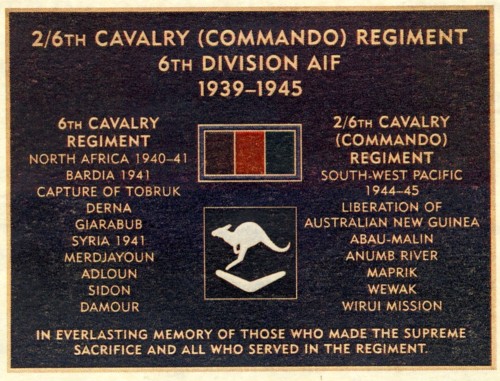
Joining the newly formed 6 Div. Cav. Commando Regiment on the Atherton Tablelands, Ron allotted to 10 Commando Sqn. Sailed with 7 and 9 Sqn on the Katoomba as vanguard for the 6″‘ Division Aitape-Wewak campaign in New Guinea.
A bitter and costly campaign fought for days behind enemy lines, Culminating in the surrender of general Adachi, being present at the surrender Ron felt very fortunate.
On returning from New Guinea and spending some weeks in Concord Hospital, His discharge finally completed, Ron applied and was accepted into the NSW Police force, He was stationed at Leichhardt, Lithgow, Regent Street and Camperdown, Fate took over when Ron on behalf of the Police service went to Victoria Barracks to borrow Walkie Talkie sets for crowd control, The then Col.F. Hassett convinced him that by returning to the regular Army with the rank,his pay would double; The Police Certificate of Service says Very Satisfactory.
Posted to 13 National Service Battalion at Ingleburn as an instructor in 1951, Ron remained there until posted to Japan and then on to 1 RAR Korea as Regimental Police Sgt. Returning with the Battalion in April 1956 to Enoggera Barracks QLD.
Still with I RAR posted to Malaya in Sep. 1959 to Nov. 1961, Returning to Holsworthy NSW, remained as R P Sgt, and Mess Secretary/Treasurer until his discharge on 17 Jan. 1963, as pre arranged Ron again elected to join. the Commonwealth and later Federal Police Service.
After some years and tiring of shift work and double shifts, He decided to call it a day_ Resigning with a Certificate of Service marked Satisfactory.
Ron joined Nock and Kirby’s warehouse at Hoxton Park, which later became Burns Philp, then BBC.
Ron and wife Pat have lived at Minto for the past 24 years, their Son and Daughter both married with children live at Minto and Ingleburn.
Service medals and badges. 39/45 Star,Pacific Star,War Medal,Australian Service Medal . General service medal and clasp Malaya. Australian service Medal 1945-75 and Clasp Korea. Australian service medal 1945-75 and Clasp Malaya. Australian Defence medal 1945-75. Pingat Jasa Malaysia Medal. Active service Badge No.462660. Infantry Combat Badge. WW2 Anniversary Medallion.
And Finally: STATEMENT FROM THE MAN HIMSELF:
MY RECOLLECTIONS OF THE END OF WW2.
As a member of the 2/6 Cav. Commando Regiment comprising 7,9, l 0,Commando Squadrons, We had taken part in the whole of the Aitape-Wewak New Guinea campaign by the 6th.Division.At this time my 2/10 Squadron was occupying a place called Cape Karawop just north of Wewak which had recently been taken after a major battle.Cape Karawop was supposed to give us a rest after a five months continued action, including an amphibious landing at Dove Bay south of Wewak, The Japanese were moving down from the Mountains to our coastal holiday home, they would attack at night with grenades and rifle fire.To us this unofficial War carried on for several nights after we had been told the Japs had surrendered, I can recall our chaps yelling out “The war is over you silly bastards”. From our Unit History “To The Green Fields Beyond” by Shawn O’Leary, I have made the following interesting extracts covering the period.8.15am 6th August 1945, 1 st Atom bomb dropped on Hiroshima.11 am 9th August 1945, 2nd Atom bomb dropped on Nagasaki12th August 1945,Sydney’s crazy celebrations could be heard on our Signals wireless.9.14am 15th August 1945,the single code word NEON was flashed around the globe to confirm the unconditional surrender of Japan, Sydney again went wild, from a platform in the Domain Jack Davey entertained an audience of 150,000.The Commandos took stock of their losses in the campaign, 48 killed 119 wounded, They had killed 778 Japanese taken 23 prisoners and found 363 dead, Our last casualty was on the 18th. “August 1945, A young 19 year old killed by one of our own booby traps while checking for Japanese infiltrators. On the 22nd August 1945 General Adachi advised that Japanese troops had been ordered to cease fire but not to lay down their Arms.On the 13th September 1945 General Adachi formally signed surrender documents on the Air strip at Cape Wom before Major General H.C.H Robertson.Having served the whole of the Campaign and being present on the surrender parade, I was most grateful and proud to have survived WW2
Funeral service will be held at North Chapel, CHURCH YARD M on Wednesday, 21st September 2011 at 10:00am.
Committal service will be held at Forest Lawn Memorial Park, North Chapel, Camden Valley Way, Leppington, NSW, Australia on Wednesday, 21st September 2011.
Joined NSW Police via the NSW Police Cadet system on 6 December 1971
Cadet # 2727
[alert_yellow]Regd. # 15783[/alert_yellow]
Rank: NSW Police Cadet – Commenced 6 December 1971
Probationary Constable – appointed 23 April 1973
Constable 1st Class – appointed 23 April 1978
Senior Constable – appointed 23 April 1982
Sergeant 3rd Class – appointed 21 May 1988
Sergeant – Retired in October 2011 due to illness
Stations: Redfern, Byron Bay
Service: From 6 December 1971to? October 2011 = 40+ years Service
Awards: National Medal – granted on 21 August 1989
1st Clasp to the National Medal – granted on 25 June 1999
Born: 23 April 1954
Died on: 28 December 2011
Cause: pancreatic cancer
Age: 57
Funeral date: 4 January 2012
Funeral location: St Kevin’s Catholic Church, Bangalow, NSW
Buried at: Eureka Cemetery, Bangalow, NSW
[alert_blue]MURRAY is NOT mentioned on the Police Wall of Remembrance[/alert_blue] * NOT JOB RELATED
[divider_dotted]
Murray POWELL
Friends and family attended the funeral of retired police sergeant Murray Powell at St Kevin’s Catholic Church in Bangalow yesterday where he received full police honours in a moving ceremony.[/caption]
Policeman devoted to family
Dominic Feain | 5th Jan 2012 4:00 AM
HUNDREDS gathered at St Kevin’s Catholic Church in Bangalow to farewell long-serving Byron Bay police officer Murray Powell yesterday.
A sergeant at Byron Bay for 25 years, Mr Powell received full police honours in a moving ceremony commemorating his life and 40 years of service to the NSW Police Force.
The widely respected officer died this week after losing his battle with pancreatic cancer. He worked for five months following his diagnosis despite being told not to, reluctantly retiring in October.
Former Richmond Local Area Commander, now New England Local Area Commander, Superintendent Bruce ‘Bluey’ Lyons remembered his mate with whom he shared his first beat with as probationary constables in the early 1970s.
He praised a man who he said served in the most difficult role, and most important rank, in the force – that of a general duties sergeant.
“We walked the streets of Chippendale and Redfern together,” he said.
“He left behind many footprints filled with camaraderie, dedication and commitment, and the most important footprints were those dedicated to his family.”
Mr Powell is survived by eight children, two from his first marriage and six from his second, to Petria.
Retired Byron Bay Inspector Owen King remembered his colleague, Muzza, as one of the proudest fathers he knew – one who was constantly regaling workmates with his children’s exploits.
“It seemed like he was always expecting a baby,” he said fondly.
“He’d come in saying Petria was expecting again, then again.
“After he moved from Bangalow to Clunes the children kept coming after that – it earned him the nick name the ‘Bangalow Bull’.”
Mr King commended Mr Powell’s composure in the most stressful of policing situations and remembered his now famous morning teas.
“Woe betide anyone who brought in a prisoner during morning tea,” he quipped.
“It was his duty to keep the place ticking over and he was so fussy people used to say ‘he thinks he owns the place’.”
Mr King remembers a man who “took it all in his stride” and embraced the advice to “not count the days, but make the days count”.
“Muzza old mate, you’ll be sorely missed but your suffering is over and you’ve gone to a better place,” he said.
The funeral procession to Eureka Cemetery was led by two highway patrol motorcycles before family, friends and colleagues gathered at Clunes Hall for “one last morning tea”.
Murray POWELL was NOT mentioned on the Retired Police Association website.
****************************
Craig Wilson PEARSE
| 23/10/2015
Craig Wilson PEARSE
Victoria Police
Regd. # ?
Rank: Sergeant
Stations: Bendigo 1988-2009 and Maryborough 2009-2011
Awards: ?
Died: 21 December 2011
Age: 47
Cause: Heart Attack
Funeral date: 30 December 2011
Funeral location: Bendigo Baptist Church
Sergeant Craig Pearse
[divider_dotted]
[alert_blue]Not mentioned on the Wall Of Remembrance [/alert_blue]
[divider_dotted]
Police mourn popular peer
By ELISE SNASHALL-WOODHAMS
Dec. 22, 2011, 11:09 a.m.
Bendigo and Maryborough police are in mourning after the passing of their admired colleague and friend Sergeant Craig Pearse. The father of two died at home in Maryborough on Wednesday after suffering a heart attack. He was 47.
Yesterday officers in Bendigo and Maryborough remembered Sergeant Pearse as a dedicated father, son, brother, police officer, musician and friend, who had time for anyone. Sergeant Pearse served in Bendigo between 1988 and 2009, building many close friendships over that time. Sergeant Tony Kekich worked with Sergeant Pearse when they were both senior constables and Sergeant Kekich said his friend had always gone above and beyond the line of duty to help people.
“He would take on quite complex investigations and would follow them methodically to the point of being pedantic just to help the victim,” he said.
“He showed a great empathy to the victims of crime.” Sergeant Kekich said he remembered one particular photo of Sergeant Pearse, published about 10 years ago in the Bendigo Advertiser, which encapsulated his friend’s generous spirit. It was an image of Sergeant Pearse helping an elderly lady across the street, taking her arm while blocking traffic in both directions.
“That’s the type of man he was,” Sergeant Kekich said. “He always had time for people who needed that extra help.”
In 2009 Sergeant Pearse left Bendigo for a promotion in Maryborough where he again drew the esteem of his colleagues. Maryborough Sergeant Ben O’Regan said he was a great friend, even a father figure, to many of his peers.
“He was pretty much a rock, a consummate professional, someone who was mentor, someone you could rely on and someone that you knew you could go to with any problem, be it work related or personal, and he would guide you through it in the best possible way,” Sergeant O’Regan said.
Sergeant O’Regan said the death had come as a huge shock to the entire Maryborough community, of which Sergeant Pearse was heavily involved.
“Personally I thought of him as unstoppable and indestructible,” he said. “He was very friendly, very warm, embracing of everyone, very professional, a real true upstanding policeman and a true friend.”
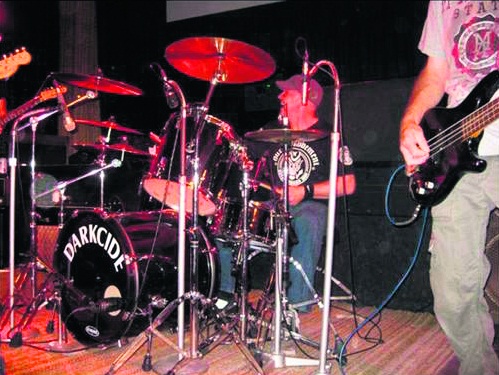
Outside of work Sergeant Pearse was passionate about his family, especially his two sons. Sergeant Kekich said his friend was artistic, too. He made and painted tin soldiers which were bought by enthusiasts worldwide, and he was also an accomplished musician.
“He could pick up virtually any instrument and play it,” Sergeant Kekich said.
“I don’t think it would be overstating it to say that the Victoria Police have lost a great asset.”
A funeral service will be held on Friday, December 30 2011 at 2pm at the Bendigo Baptist Church.
BENDIGO’S residential Strategy will be reviewed because of greater than expected growth.
The State Government has announced a grant of $50,000 to carry out the review.
The review is needed because, according to the State Government, 40 per cent of the forecast growth between 2006 and 2031 had already been realised.
Regional Development Parliamentary Secretary Damian Drum made the announcement this morning.
Mr Drum said the Bendigo Residential Strategy Review would deliver greater community and investor certainty, helping the region grow.
“The Bendigo Residential Development Strategy was adopted in 2004 and is currently being audited because of the faster than anticipated growth that has occurred in Bendigo in recent years,” he said.
“Strong residential growth has many flow-on economic benefits and having a clear framework for future development will position Greater Bendigo City Council to undertake more detailed, place-based planning in the future.”
Deputy Premier Peter Ryan said about 40 per cent of the forecast growth between 2006 and 2031 had already been realised.
The Residential Strategy impacts directly on where and how property developments use “infill” parcels of land, range of housing styles and also on housing affordability.
“This project will review the strategy, assess current and estimated land supply and demand and consider various legislative and policy changes,” Mr Ryan said,
“It will also consider the latest demographic data and establish a new strategic framework to guide the long-term residential growth of Greater Bendigo.
“The project will result in a revised residential strategy that will give developers, the community and service providers greater surety and confidence about where land can be developed for residential purposes, and that sufficient land is available to accommodate the City of Greater Bendigo’s future growth.”
Mr Ryan said a contemporary strategic planning framework was essential to the economic development of a large regional centre like Bendigo.
“Clearly identifying future growth options and supporting infrastructure needs will enable the Greater Bendigo City Council and other infrastructure providers to plan their capital works programs well in advance,” he said.
“Identifying long-term growth areas will enable the council and other service authorities to start planning for the delivery of services, thereby minimising the lag time between when residential development occurs and when the services need to be in place.”
TOP TWO: Senior constables Cary Towers and Rachel Colliver with the award. Picture: JODIE DONNELLAN
Award recognises Bendigo police officers’ dedication
By ELISE SNASHALL-WOODHAMS
Dec. 3, 2012, 1 a.m.
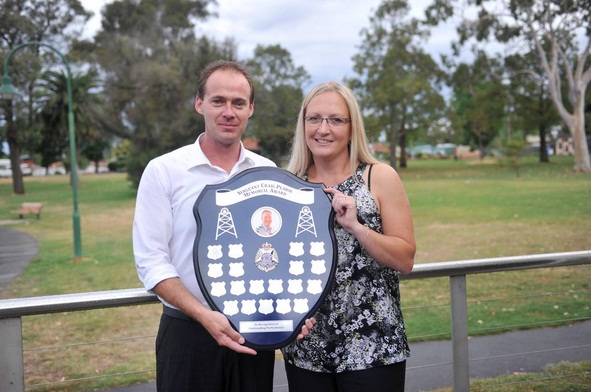
Two of Bendigo’s best police officers have been honoured with an inaugural award in memory of their late colleague Sergeant Craig Pearse.
Senior constables Rachel Colliver and Cary Towers were presented with the award at the police Christmas function on Friday night.
Inspector Mark Edwards said the award recognised the qualities of professionalism, team work and customer service that Sergeant Pearse exemplified.
Sergeant Pearse, a long-serving member in Bendigo before moving to Maryborough, passed away from a heart attack in September last year.
“We had been thinking about doing a high-achiever type award for a while, and a couple of police officers thought we should name it after Craig,” Inspector Edwards said.
“It’s great to recognise our top performers and even better to have something that has serious meaning attached to it.
“We’re keeping the memory of Craig well and truly alive.”
The Sergeant Craig Pearse Memorial Award covers the Bendigo police service area and takes in Bendigo uniform, crime investigation and highway patrol, as well as Eaglehawk, Heathcote, Goornong, Elmore and Axedale.
“We took into account a lot of things,” Inspector Edwards said.
“It isn’t just about stats, how many crooks someone catches or tickets issued.
“It’s about teamwork, leadership, supporting your mates and good customer service to the Bendigo community.”
The award was originally meant to go to just one officer but Inspector Edwards said it was too hard to split Senior Constable Colliver and Senior Constable Towers.
“In the past 12 months Rachel has been on the highway patrol her work output has been the highest in the western region,” he said, “Cary Towers rates similarly; their outputs are enormous, they work their guts out.
“They are both excellent mentors for the younger troops. The leadership they display is absolutely first-class. And their ethics have never been questioned.”
Inspector Edwards said the pair were both recognised for their “general enthusiasm” for their work. “Part of Rachel’s speech was, ‘its pretty easy to do a good job when you love your work’,” he said.
“Cary hates crooks and when there’s crimes committed he just loves to get out there and catch them.”
Senior Constable Towers said it was a “tremendous honour” to receive the award from Sergeant Pearse’s parents.
“He was held in very high regard and it’s a testament to what kind of guy he was,” he said.
Senior Constable Towers has worked in uniform for 10 years, and had a six month stint in crime investigation this year.
“I’m back in uniform now on general duties, doing all sorts of stuff, going out in the van, in the watch-house, prisoner escort.
“I enjoy the camaraderie that goes with it, and I enjoy getting out there and helping out where you can.”
Senior Constable Colliver, an officer of eight years, said she loved her role in Bendigo’s highway patrol.
“It’s not just handing out the tickets, we try to make a bit of a difference,” she said.
“I enjoy dealing with so many people. I enjoy working one-up and I enjoy being out on the road. We do a lot of kilometres.”
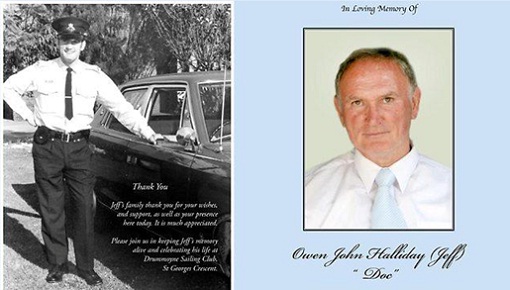
The late detective sergeant Owen John (Jeff) Halliday (aka Doc).
OWEN is NOT mentioned on the Police Wall of Remembrance * NOT JOB RELATED
Top NSW cop Detective Owen ‘Doc’ Halliday to be given full police funeral after losing battle with motor neurone disease
CRIME EDITOR MARK MORRI
THE DAILY TELEGRAPH DECEMBER 07, 20113:07PM
NSW detective Owen ‘Doc’ Halliday mixed it with some of Sydney’s roughest and dirtiest criminals – invariably coming out the winner.
Detective Halliday will be given a full police funeral tomorrow, attended by the state’s top officers after he lost his battle with motor neurone disease earlier this week.
Halliday, 60, was responsible for bringing ‘Mr Rent-a-kill‘, Christopher Dale Flannery, back to Sydney after he went into hiding in Melbourne in the 80s.
”He was one of the most tenacious detectives I have known,’’ said Deputy Police Commissioner Nick Kaldas.
”Doc had a sense of fairness you don’t often see and had an incredible disdain for bullies. He was not only a great detective but a wonderful father and a terrific bloke.’’
Halliday was a mentor to many of the state’s now-senior police and worked on some of the most high-profile cases of the 80s.
These included the Family Law Court bombings, the murder of Justice David Opas and the murders of the Turkish consul and his bodyguard in the eastern suburbs.
He also investigated the gangland murders of underworld figures Mick Sayers and Roy Thurgar .
Halliday, or ‘Doc’ as he was known, joined the force in 1968 as a police cadet and was sworn in as a constable in 1970.
Much of his career was centred in the Balmain area where he became known to locals, both good and bad.
Besides a passion for the police force Halliday was a talented footballer playing first grade rugby league for the Canterbury Bulldogs in the 80s, in the era when they were known as the “Entertainers”.
Halliday retired as a decorated detective sergeant in 2003.
A service will be held at Macquarie Park Crematorium today.
He is survived by his wife Kay and his two sons Shane and Chad, both serving NSW police officers.
Illness – Golden Staphylococcus as the result of surgery in Hospital for Type I diabettes
Funeral Thursday 8 September 2011
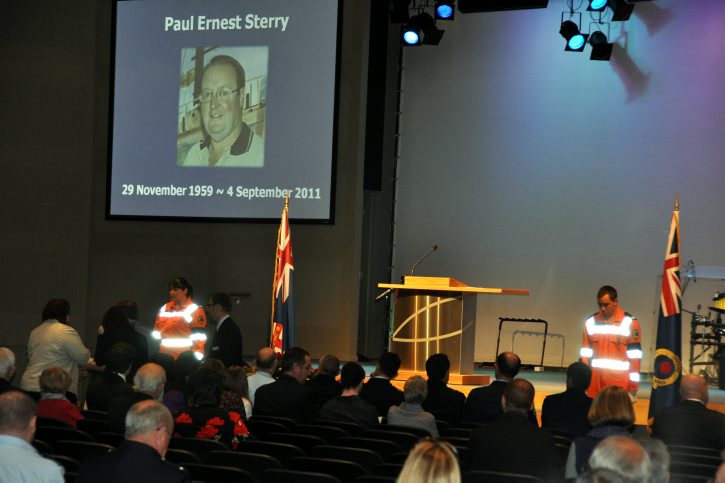
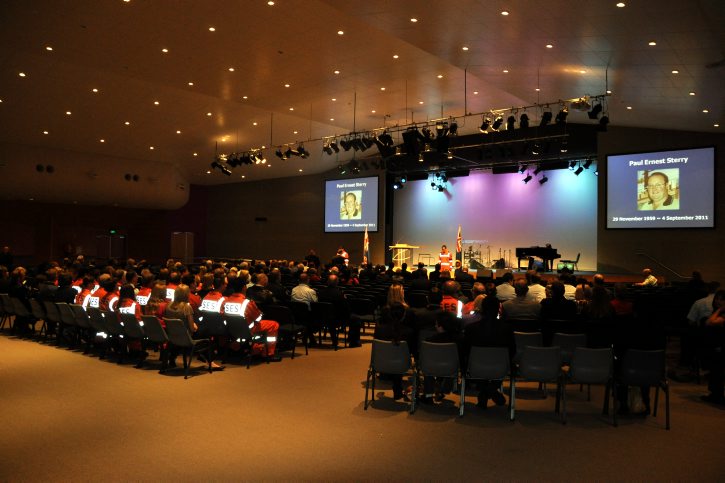
Paul STERRY
STERRY, Paul Ernest
Passed away suddenly after a courageous battle on September 4, 2011 (Fathers Day) of Blackbutt. Beloved husband of Bronwyn.Dearly loved and adored father of Mariah, Max.Son of Joan (dec) and Ernest (dec). Loved brother of Wayne. Cherished family member of Joan and Eric Dronfield and family, Margaret and Frank McNamara, the Gullicks and the Callow family. Paul will be sadly missed by his loving family and many dear friends here and in our hearts.Aged 51 Years
God has you in his keeping
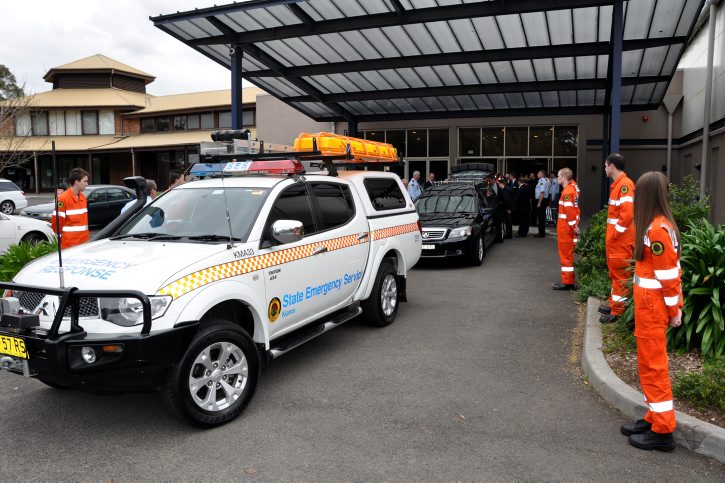
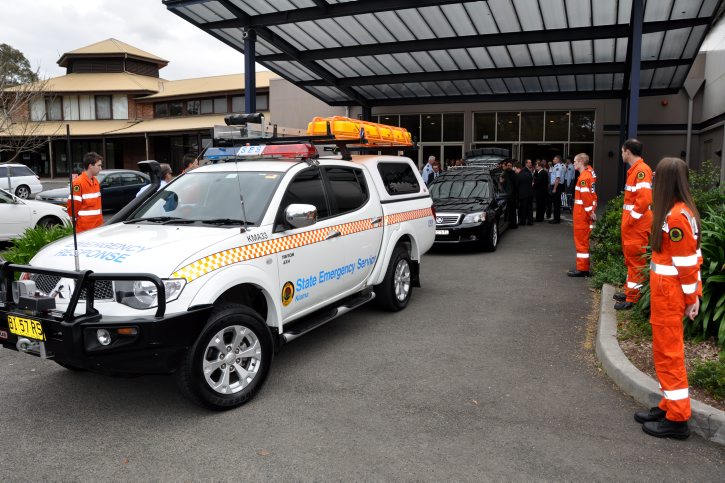
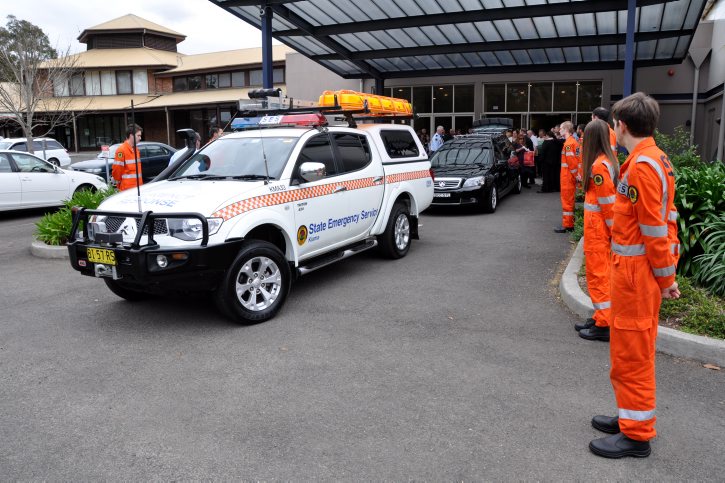
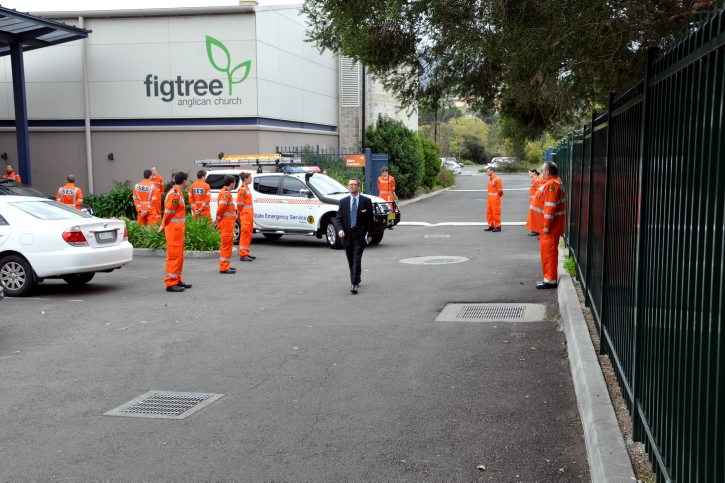
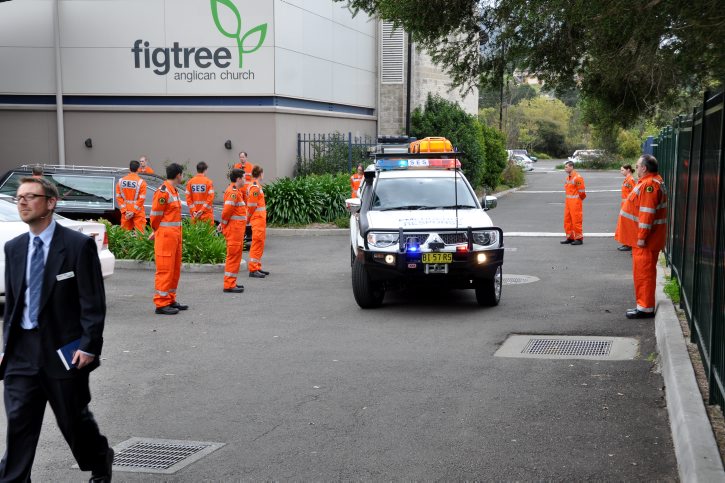
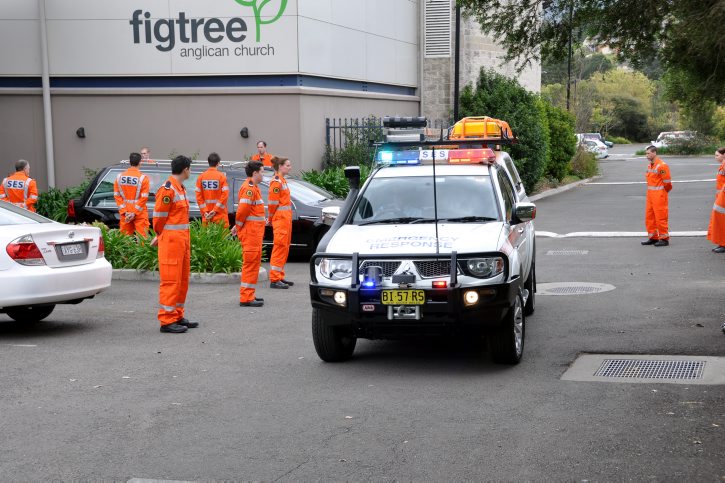
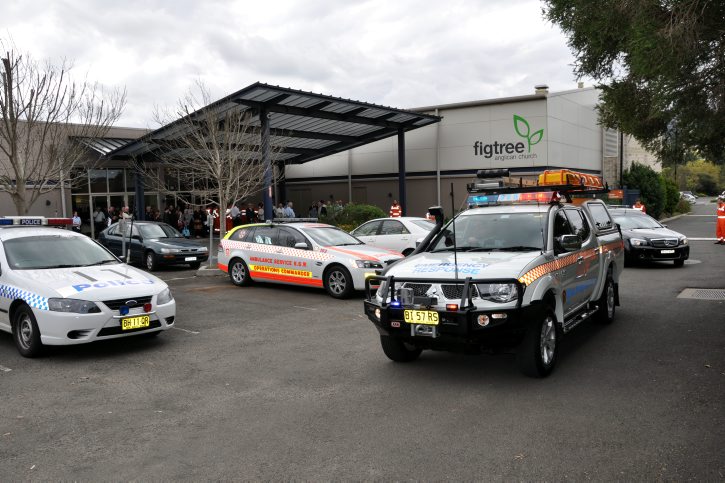
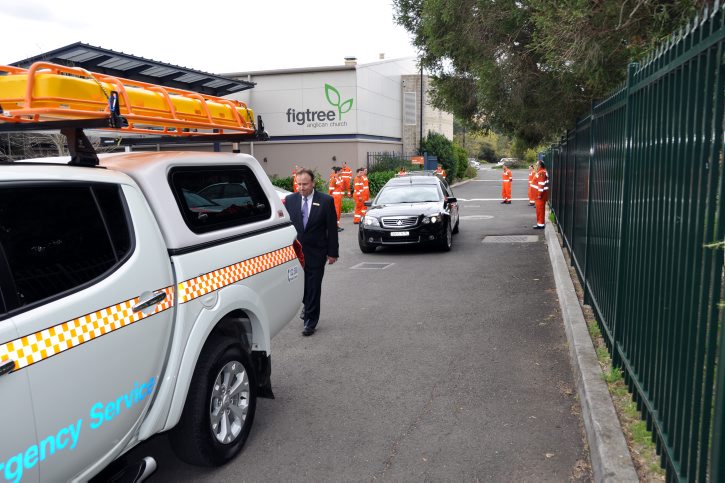
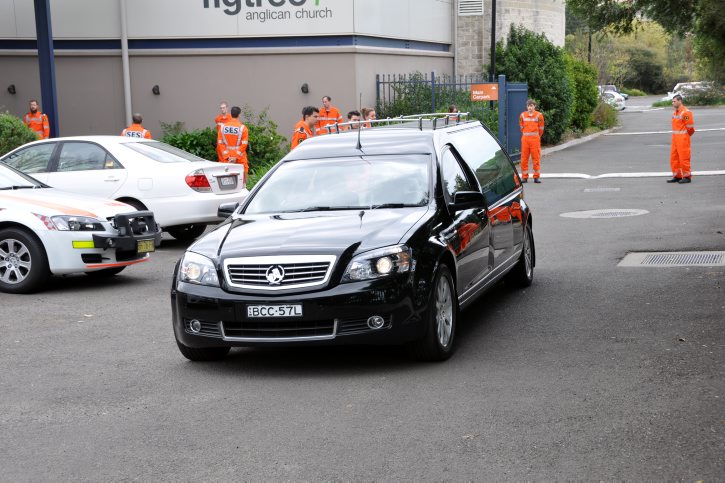
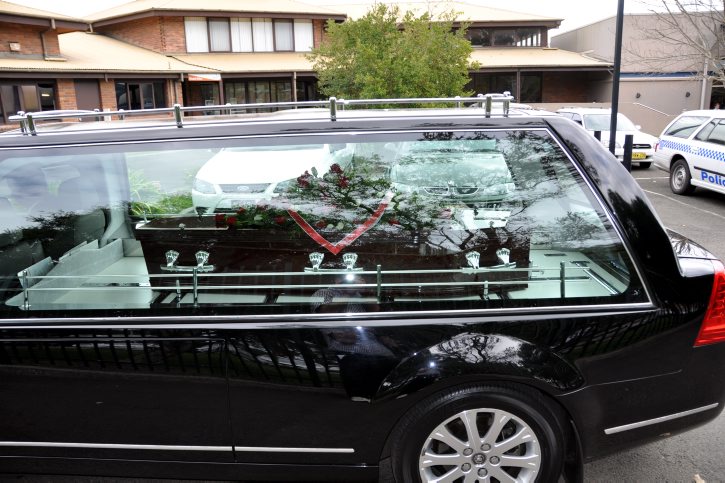
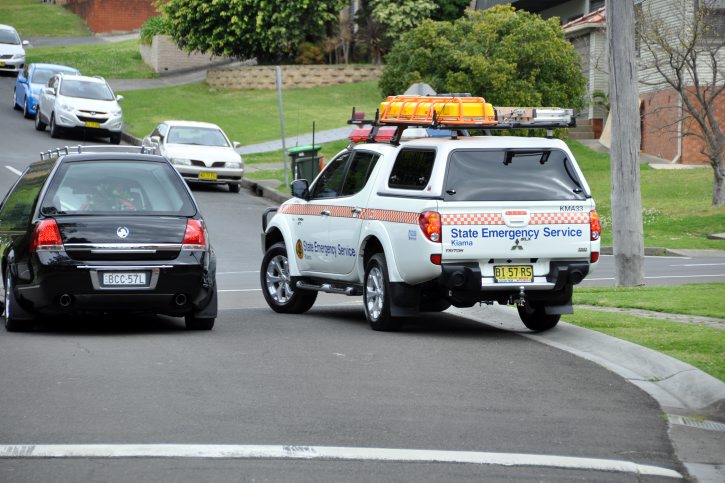
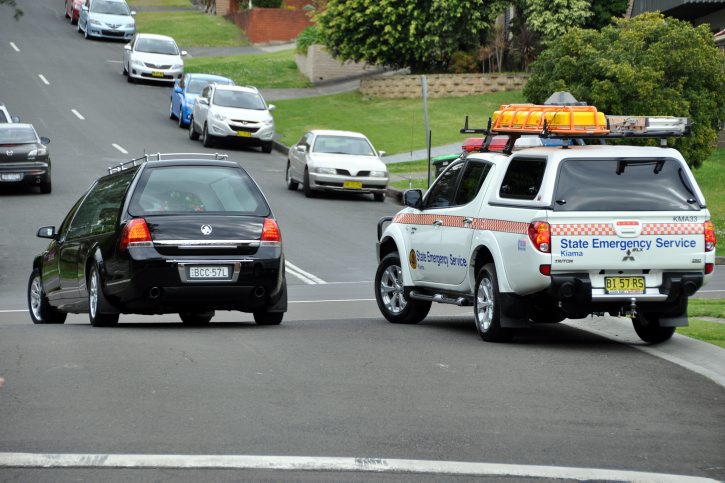
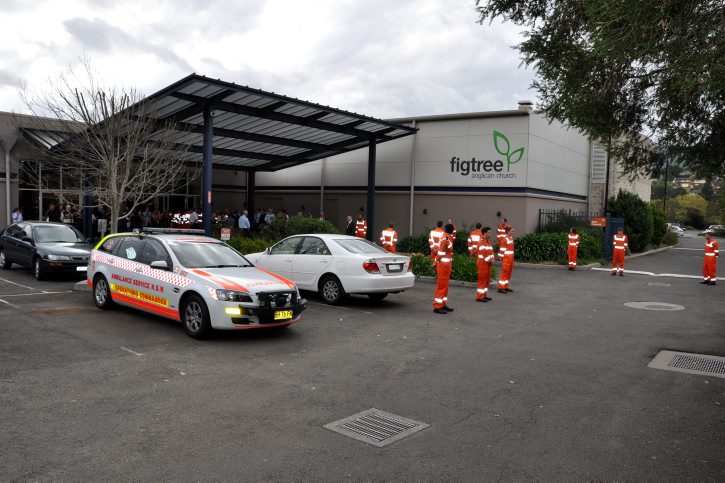
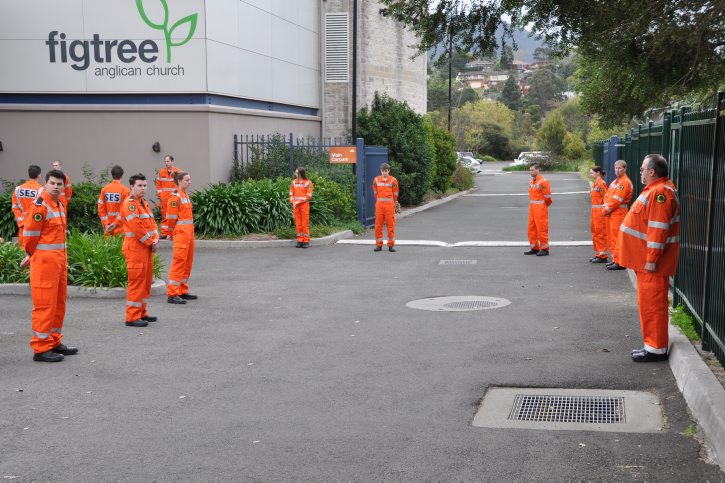
We will miss your smiling face, a special person, no one can replace.Relatives and friends are invited to attend Paul’s funeral service to be held at Figtree Anglican Church, Gibson’s Road Figtree on Thursday at 1:00pm. In lieu of flowers donations to Diabetes Australia Foundation would be appreciated.Illawarra Mercury, Wednesday September 7, 2011Paul was a Comms Officer at VKG2 (Warilla) from about 1987 and also worked with the SES and also attended the Thredbo Landslide Disaster.
He was a great bloke with a big heart, a great laugh and was always willing and happy to joke around.
We will miss you mate.
Cal
SES Commissioner’s September 2011 Newsletter page 8
Vale Paul Ernest Steery
SES Commissioner’s Newsletter September 2011 page 8
Paul Sterry joined the New South Wales State Emergency Service in 1978, he was 19 years old. Even though he held a job as a young clerk with the Public Works Department he held down at least another two part time jobs in addition to his role in the communications area of the Illawarra South Coast Division Headquarters.
Paul moved to the Kiama Unit in the mideighties and fitted in straight away, and thus was born a relationship between Paul and the Kiama Unit that lasted more than a quarter of a century. The Paul Sterry that the Kiama Unit knew and loved was generous to a fault and always willing to help anyone.
One of the Unit’s memories of Paul was at the Jamberoo Bus Crash in 2005, when a bus carrying more than 20 tourists rolled over on the Jamberoo Mountain Pass. Paul arrived in his car a few hours after the rescue began, opened his boot and started to distribute drinks, chocolates and snacks to the exhausted rescuers. Within a few minutes the boot was empty and Paul was heading back down the mountain for new supplies.
Paul was known as a joker by those who knew him well. He would often appear to talk very seriously about an issue and then, once everybody was well and truly involved, come out and say “I was only joking”. Even those who knew him well would be caught off guard by his wicked sense of humour and ability to appear completely serious until the right moment to come clean.
Louise Ashton, another member of the Kiama SES unit works at Wollongong Hospital where Paul spent long periods of time during his ongoing battle against diabetes. It was her
ritual to pop in each day before finishing work to check on him and have a quick yarn. Paul’s hospital room was like a mini office – he had bags full of paperwork, including SES receipts at times. Louise reported that the staff often commented that Paul was a delight and would often sing to them. He will be missed by all.
Paul was a recipient of the National Medal in 1999 as well as the State Medal for Hunter and Central Coast Storms in 2007. He also was awarded the SES Long Service Awards for 5, 10,
15, 20, 25 and 30 years of service with the SES.
He will be remembered by the members of the Kiama SES as one of its primary carers.
Throughout his 32 years with the Service Paul focused on caring and providing support for its volunteers, especially in times of disaster.
When Kiama SES were out helping others in our community it was Paul that would be standing behind them and supporting them with the food and equipment they needed to get the job done or offer a quiet, comforting word after a horrific crash or rescue.
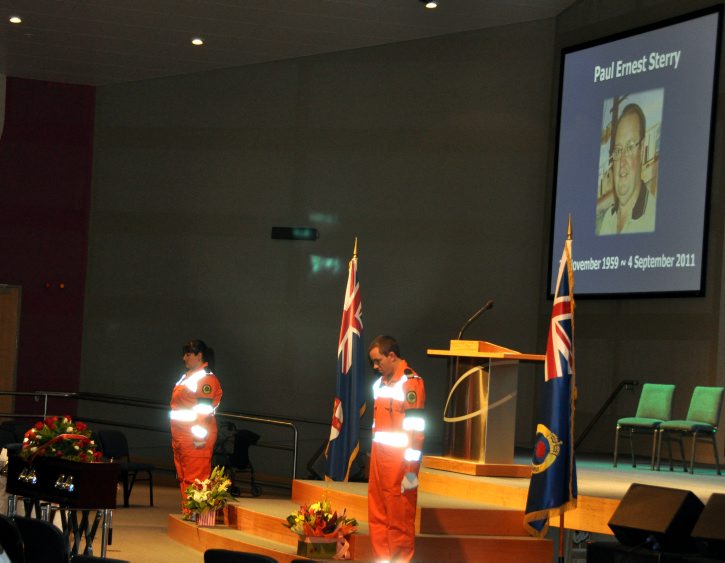
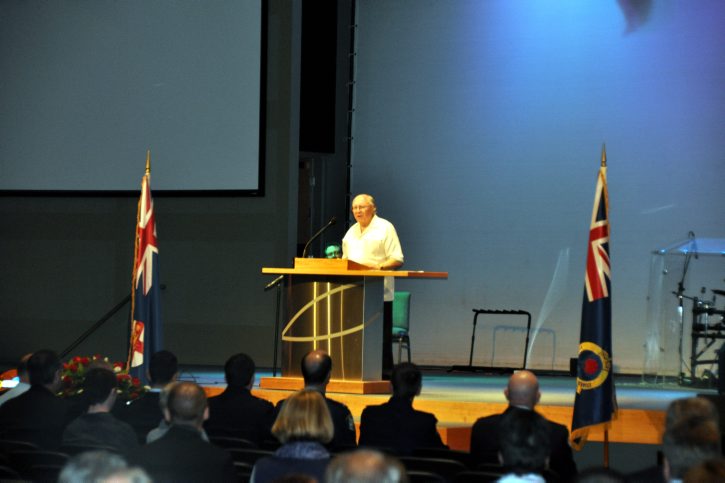
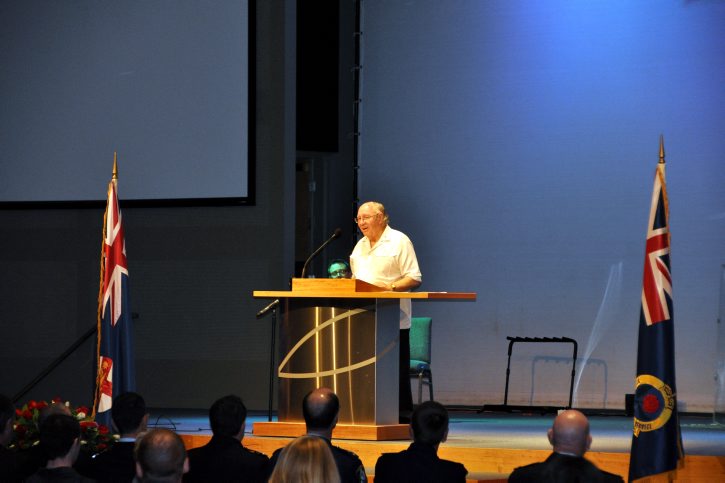
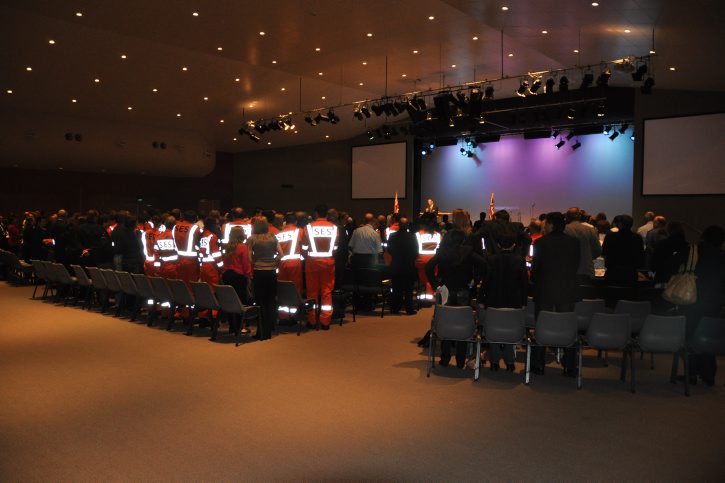
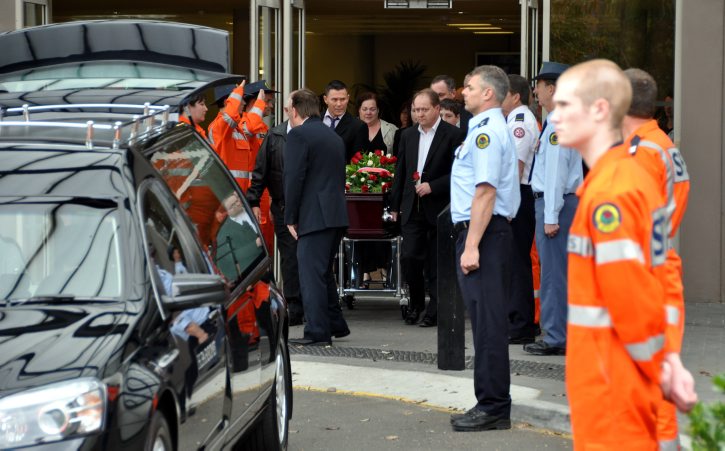
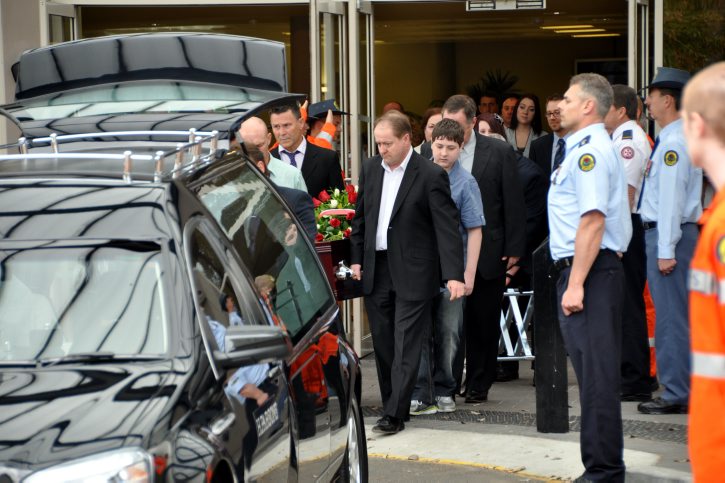
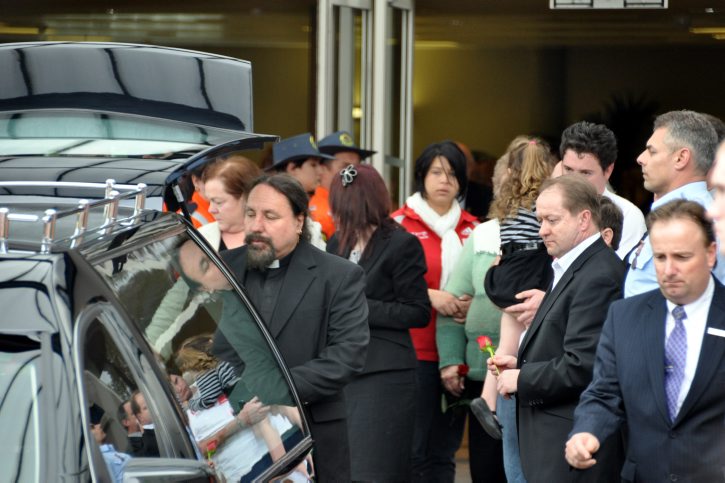
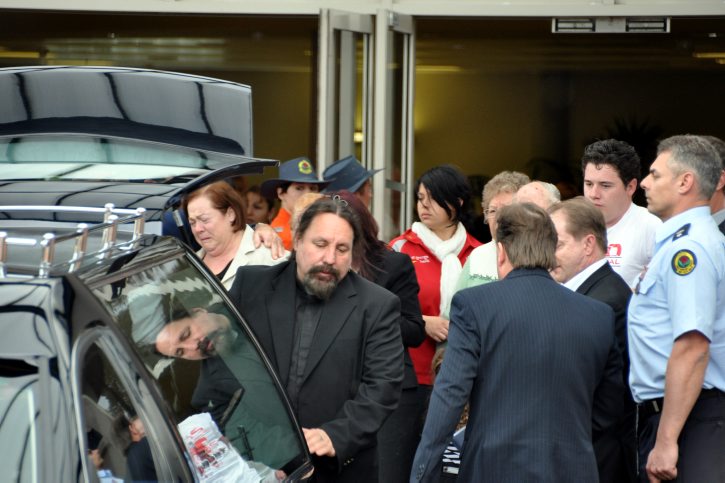
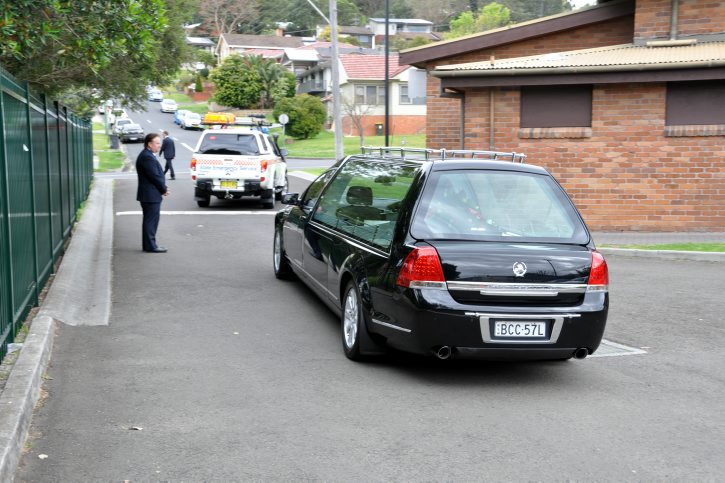
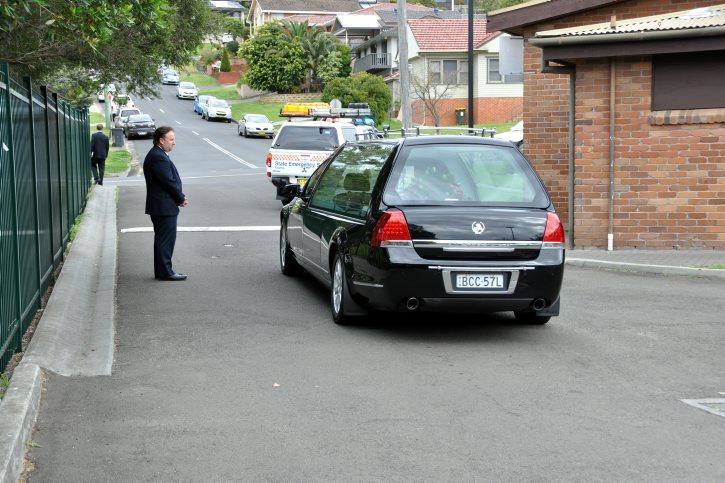
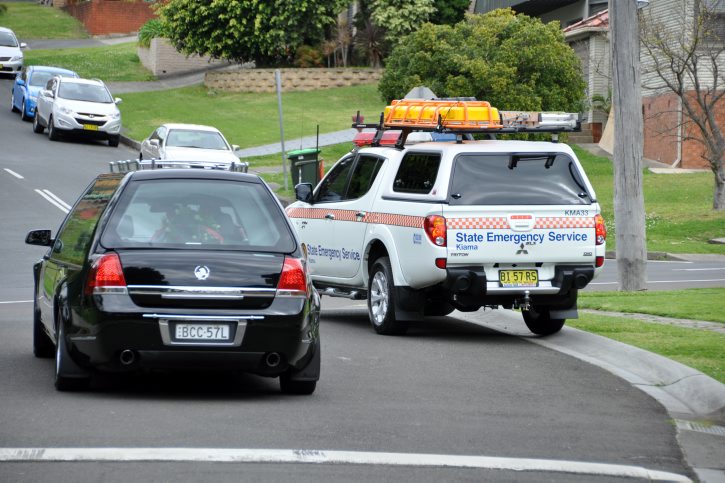
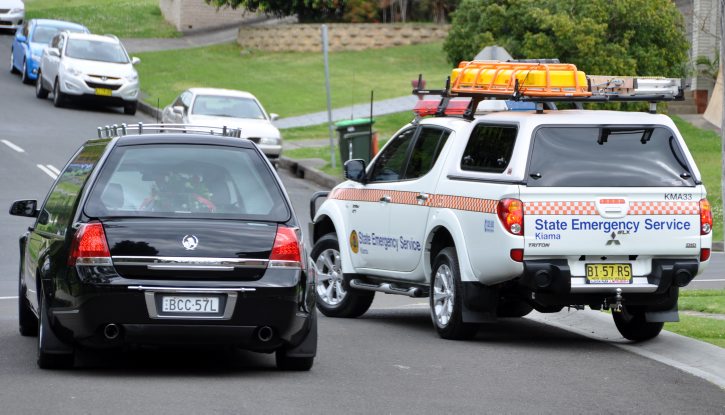
At the funeral on Thursday 8th of September the SES said farewell to a great SES member.
Paul is survived by his wife Bronwyn and children Moria and Max, who will all miss him greatly.
Extracted from the eulogy by John Wall, Deputy Local
Controller, Kiama
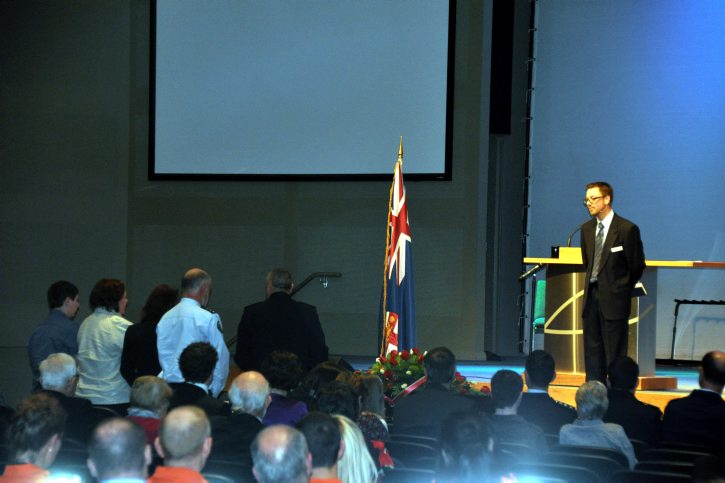
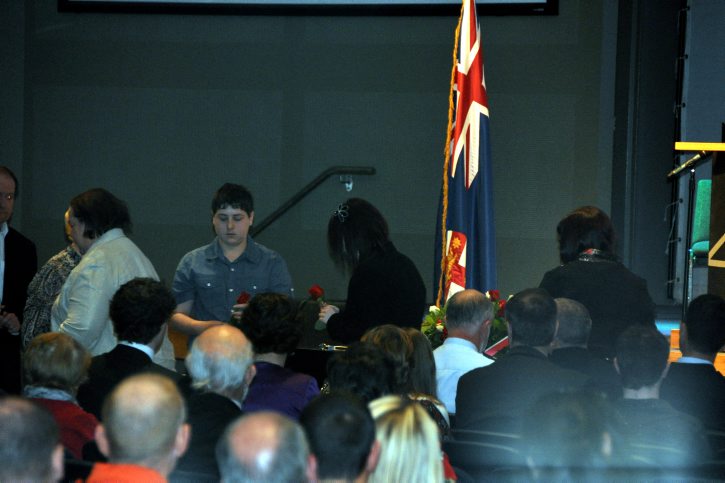
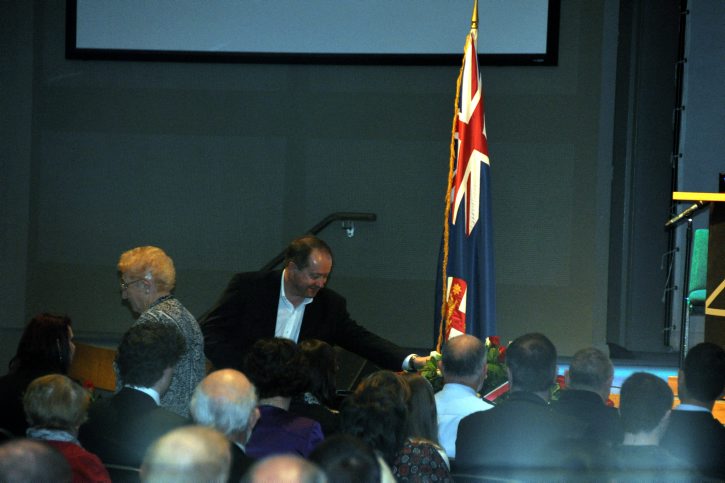
Funeral Service Location
4 Gibsons Rd, Figtree NSW 2525
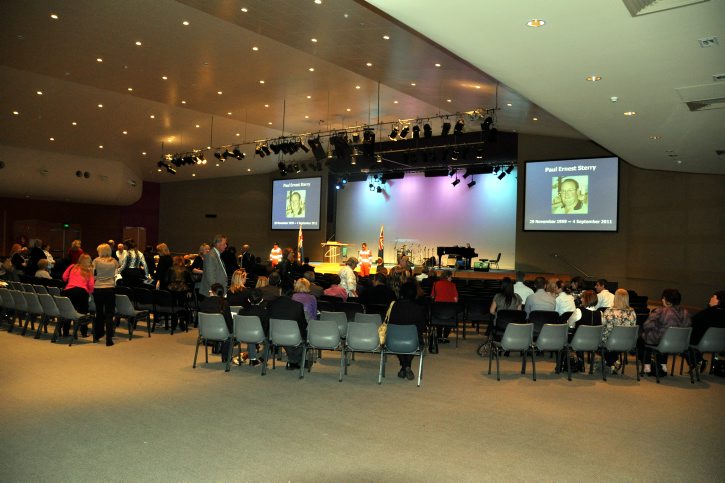
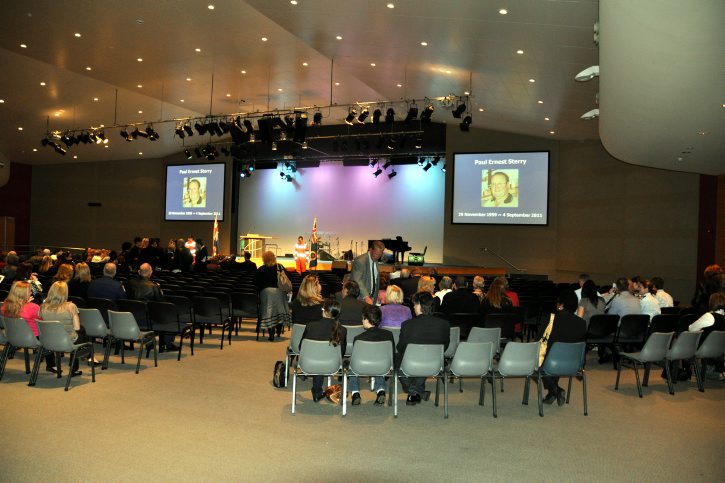
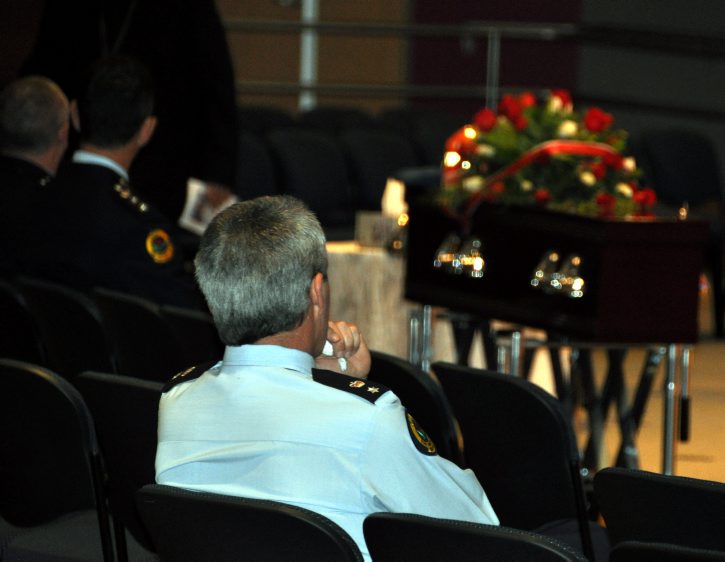
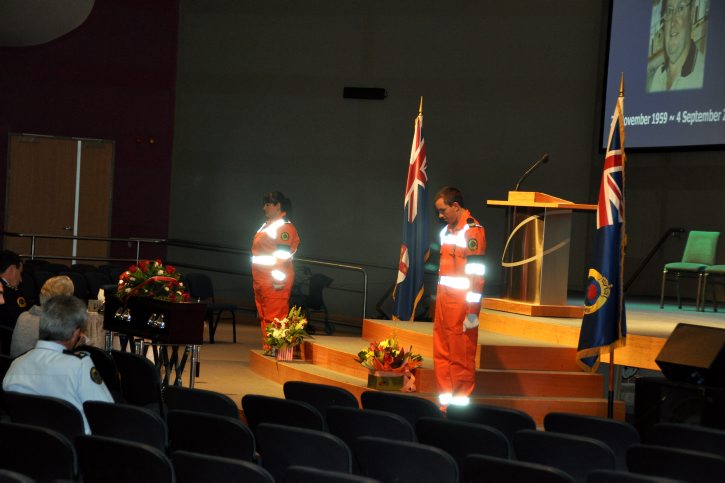
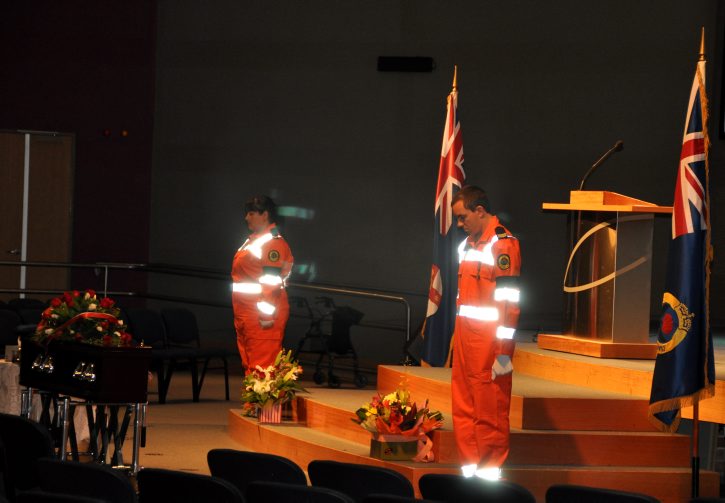
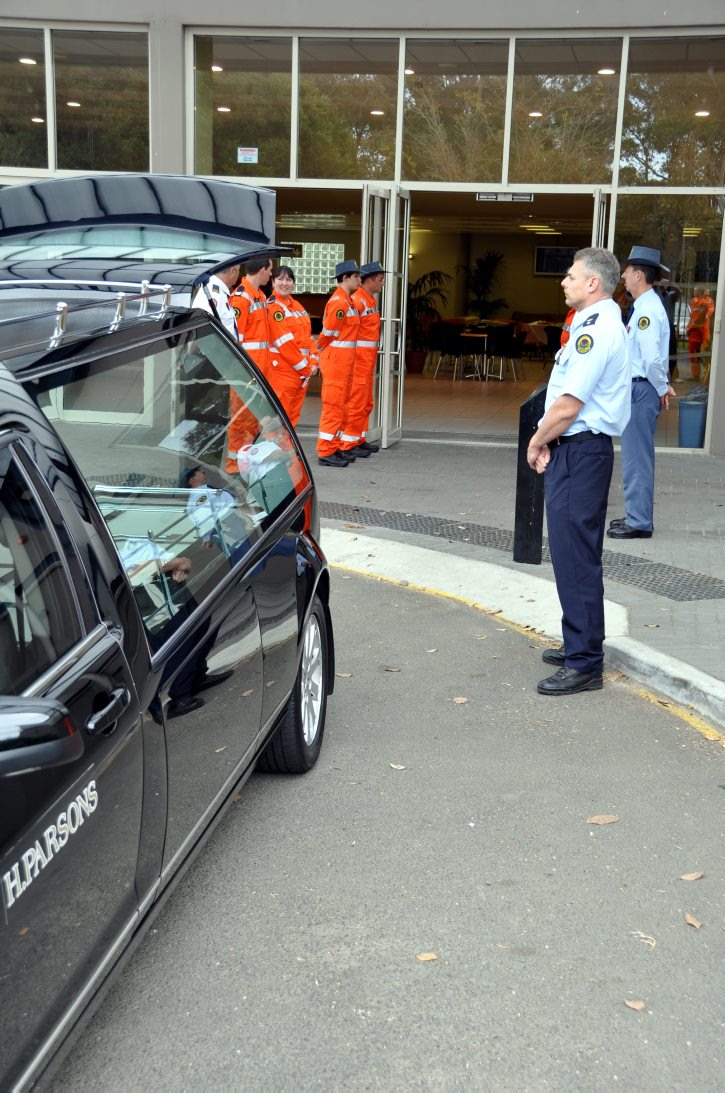
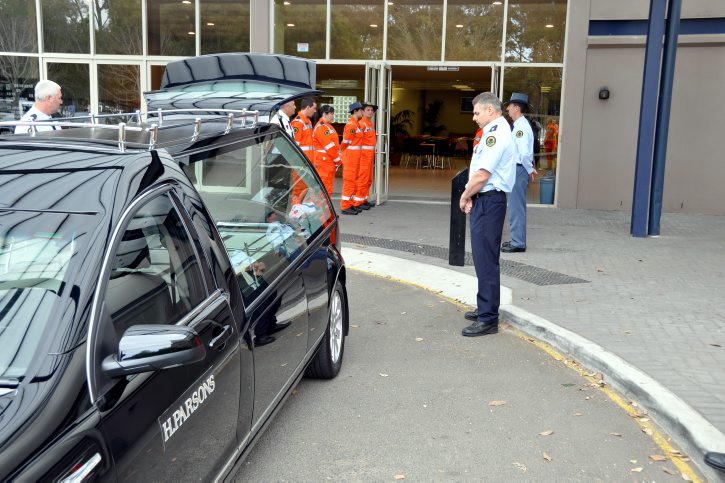
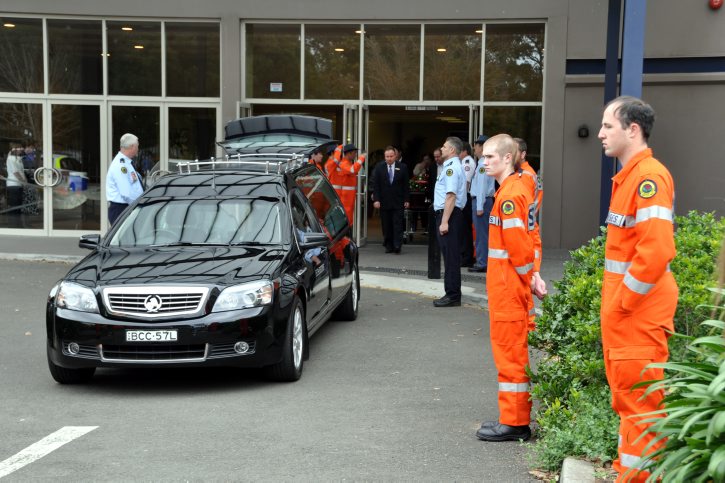
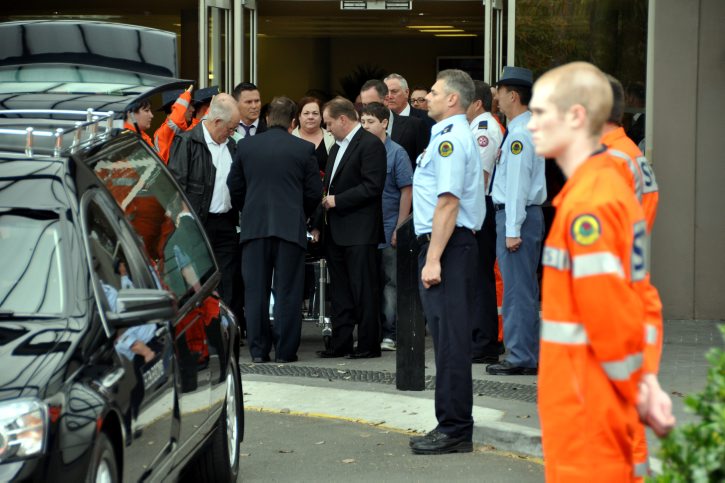
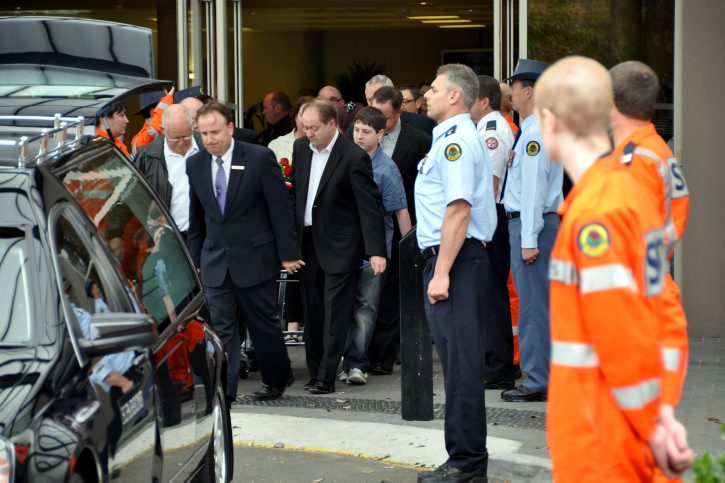
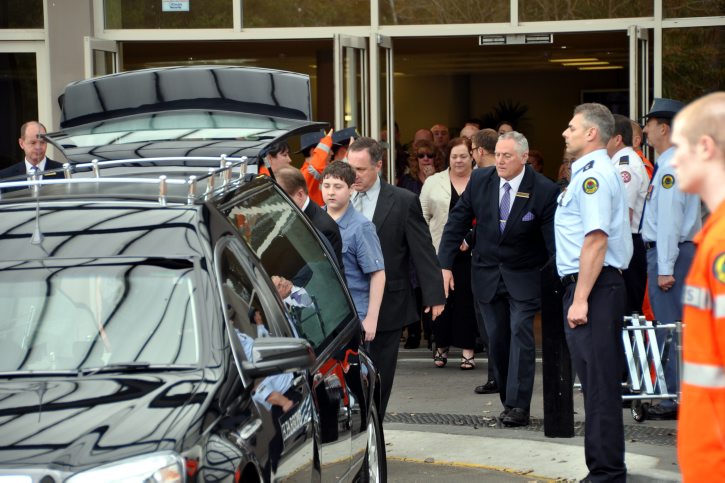
THURSDAY 8 SEPTEMBER 2011 FUNERAL SERVICE FOR PAUL STERRY, DIED FATHER DAY, SUNDAY 4 SEPTEMBER 2011 AS A RESULT OF TYPE ONE DIABETES. FIGTREE ANGLICAN CHURCH, GIBSON’S RD, FIGTREE AT 1PM.








4 Comments (starting with the most recent)
NB: If you want to reply to a previous comment, start your comment with this notation: @n where n is the number of the comment you want to reply to.
Enjoyed this story and the footy team photo is great. Would love to know who some of the other players are – if anyone around town knows.
What a bloke. A life well lived.
Bill lived a life of service to the community. I think his own words are very strong: “My mother had a choice; bring me up herself in an environment which offered no more than a twenty percent chance of being successful, or to let me grow up under the watchful eye of Father Smith.”
What a great story, Father Smith did a lot for the local Indigenous people here in the Alice.
My brother was one who went to Adelaide, Peter Tilmouth.
All the boys taken, all became great mates.
The Espie family was well respected here in the Alice and what an honour to have this man Bill Espie recognised, letting others know of his achievements. A story worth mentioning.